Injoys

A kimchi refrigerator should, as a rule, be connected to a dedicated, grounded wall outlet. Check the manual for the specific model to see whether a power strip is allowed. Monthly energy consumption in kWh alone cannot determine the capacity needed for the connection.
The connection ratings below are based on Samsung Electronics Service guidance dated November 24, 2023, and an LG Electronics manual.
What are the power connection requirements
The power connection must meet the conditions in the user manual for the specific model. General manufacturer guidance can serve as a reference when checking the manual. If the two documents give different instructions, contact the manufacturer with the model name to confirm.
| Document reviewed | Wall outlet guidance | Power strip conditions |
|---|---|---|
| LG Electronics Kimchi Refrigerator Owner's Manual MFL71401543, Rev.02_053025 | Use a dedicated, grounded 220 V wall outlet | If a wall connection is not possible, buy a new grounded power strip rated at least 16 A and connect only this appliance |
| Samsung Electronics Service, Circuit Breaker Trips While Using the Refrigerator, November 24, 2023 | Connect the appliance alone to an AC 220 V·60 Hz outlet rated at least 15 A | Prioritize a wall connection; also provides guidance on power strips rated at least 250 V·16 A |
| Samsung Electronics Service, The Product Does Not Power On at All, October 1, 2026 | Connect directly to a wall outlet whenever possible | Warns of overload and power cutoff risks depending on the connected appliances |
The LG Electronics manual specifies the following requirement for connecting the appliance alone.
Only this appliance must be connected to the power strip.
LG Electronics, Kimchi Refrigerator Owner's Manual, MFL71401543, page 5
The 15 A in Samsung Electronics Service guidance is the required outlet rating. It does not mean that the refrigerator always draws that much current. Check the manual before applying the same rating to another model. Samsung Electronics Service power and grounding guidance
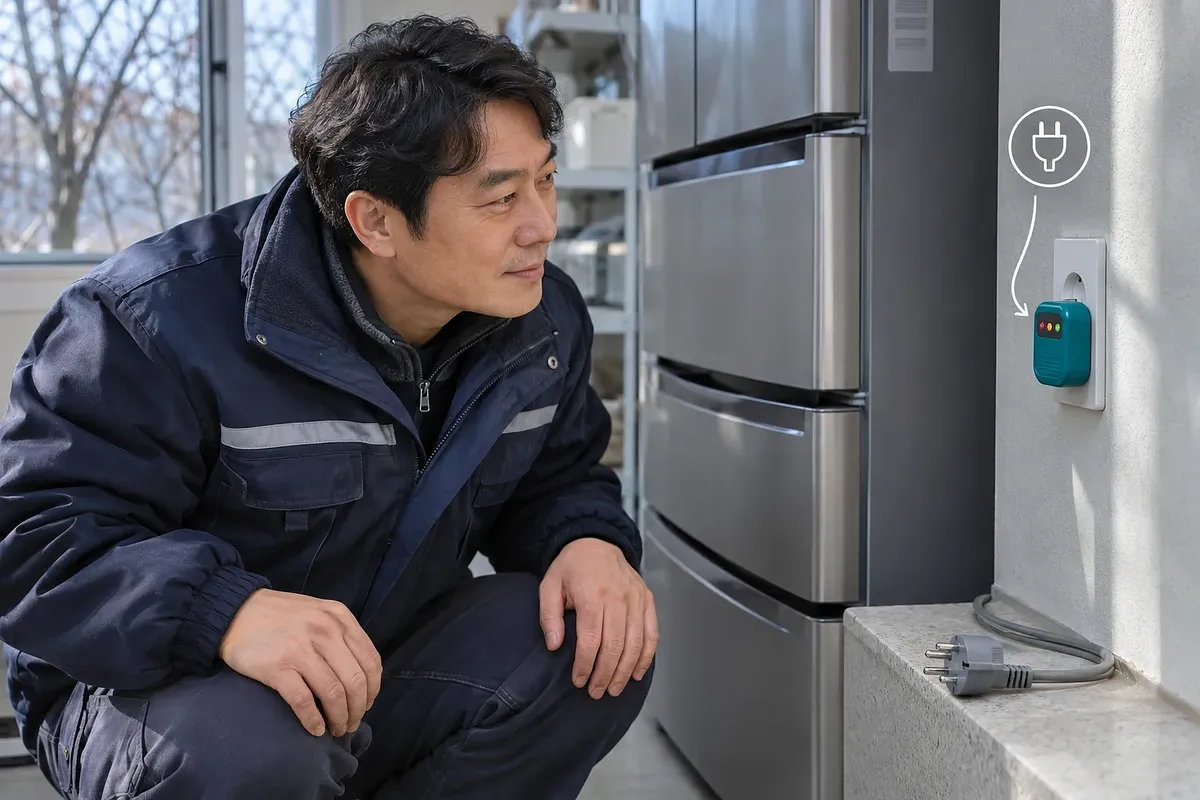
Grounding and wiring issues should be checked by an electrical professional.
Differences in appliance types and storage functions
A kimchi refrigerator has temperature controls designed for storing kimchi. Refrigeration, freezing, and storage functions for other ingredients vary by model and compartment. The exterior design or storage capacity alone cannot determine the power connection requirements.
| Category | What to check to understand the appliance | Relevance to power connection decisions |
|---|---|---|
| Upright type | Front door and drawer layout, storage functions by compartment | Check energy consumption for each function and the connection requirements for the model |
| Top-opening type | Space to open the top lid, kimchi container storage capacity | The shape alone cannot determine whether a power strip is allowed |
| Storage capacity | Distinguish the appliance's usable capacity from its kimchi container capacity | Storage capacity in L is separate from electrical capacity |
| Storage modes | Check supported modes, such as kimchi storage, refrigeration, and freezing | Energy consumption may vary by operating mode |
In the Korea Consumer Agency's 2023 comparison, the two types had similar kimchi container storage capacities. The upright type had a larger usable appliance capacity. These were the results for the products tested at that time. They illustrate why total capacity alone makes it difficult to judge how much kimchi an appliance can hold. Korea Consumer Agency product comparison
The difference between kimchi refrigerator power consumption and monthly energy consumption
Power consumption in W and monthly energy consumption in kWh/month are different quantities. W measures the rate at which power is used. kWh measures the amount of electrical energy used over a period of time. The numbers alone should not be compared. EIA explanation of power and energy
| Label | Unit | Meaning | Purpose of checking |
|---|---|---|---|
| Rated voltage | V | Voltage specified for operating the appliance | Check the power supply and appliance requirements |
| Rated frequency | Hz | AC frequency specified for operating the appliance | Check power supply specifications |
| Rated current | A | Current rating under specified conditions | Check current requirements for the appliance and connection equipment |
| Power consumption | W | Power used by the appliance | Check the electrical load |
| Monthly energy consumption | kWh/month | Monthly energy use under specified test conditions | Compare energy use |
| Power strip power limit | W | Limit on the power that can be connected to the power strip | Check the total load of all connected devices |
The appliance nameplate lists the model name and electrical ratings. Check the nameplate and manual for the values needed for the connection. The energy label is used to compare monthly consumption. Reading the units as well as the field names on a sales page is more accurate.
For example, the product support page for the Samsung Electronics RQ33DG71G1S9 lists two values. The standard listed value is 12.0 kWh/month. The value for freezer operation is 30.5 kWh/month. Neither is a W value indicating instantaneous power consumption. Samsung Electronics model specifications
Dividing monthly energy consumption by time gives average power. The average alone does not reveal the maximum load during operation. Therefore, that calculation must not be used to decide whether a power strip connection is allowed.
Steps for checking a power strip's rated capacity
Read the current, voltage, and power limit ratings together. Also check any usage restrictions printed on the product. The Korean Agency for Technology and Standards advises that the power consumption of connected devices must not exceed the rated capacity.
- Check the refrigerator manual for the conditions under which a power strip is allowed. If the appliance must be connected alone, do not connect other devices with it.
- Check the A rating on the power strip. It must meet the current rating required by the refrigerator manual.
- Check the V rating and the voltage of the power supply to be used. The voltage marked on a power strip does not change the actual supply voltage.
- Check any separately stated maximum W rating and usage restrictions. Do not use a calculated value to interpret the printed limit as being higher.
- If other connected devices are allowed, add up their total power consumption. Do not calculate as though each socket can support the full marked capacity.
The Korean Agency for Technology and Standards advises against connecting one power strip to another. Keep cords from being damaged by heavy objects pressing on them. Overloads and cord damage are associated with fire risks. Korean Agency for Technology and Standards consumer safety advisory, September 4, 2025
Example calculation using 220 V and 16 A
Multiplying 220 V by 16 A gives a simplified conversion value of 3,520 W. This applies the formula used in safety guidance, which multiplies voltage by current. It is not a calculation of the refrigerator's actual power consumption.
| Calculation or marking | Interpretation |
|---|---|
| 220 V × 16 A = 3,520 W | Simplified capacity conversion for a 220 V power supply |
| 250 V × 16 A = 4,000 W | A value calculated using 250 V; it cannot be applied as the power limit in a 220 V setting |
| Maximum W separately marked on the power strip | A value that must be checked as the limit for that product |
| Requirement in the refrigerator manual to connect the appliance alone | A connection requirement that must be followed even if calculated capacity remains available |
Therefore, do not add other appliances based only on a 250 V·16 A marking. Check the separate power limit and usage restrictions as well. This multiplication cannot verify grounding or poor electrical contact.