Skip to content
Injoys
Knowledge Base

Microwave-Safe Containers: Food-Safe and PP Labels

Food-safe labels and material names such as PP alone cannot tell you whether a product can be heated. Check whether the product is labeled as suitable for heating, then read the conditions for using the container and lid, along with the permitted temperatures and times.

Listen or read this article

13:30

Listen, or read the text only.

Microwave-Safe Containers: Food-Safe and PP Labels

Kokoro 82M AI-generated voice 14 min read

0:00 13:30

Advertisement

Download audio

File name
microwave-container-material-and-safe-use-labels-en.mp3
Format
MP3 (audio/mpeg)
Duration
13:30
File size
9.27 MB
Engine
Kokoro 82M

This audio was generated by AI.

You may download and use it freely for personal use.

Microwave-Safe Containers: Food-Safe and PP Labels

10 min read

Microwave-Safe Containers: Food-Safe and PP Labels
Food-safe labels and material names such as PP alone cannot tell you whether a product can be heated. Check whether the product is labeled as suitable for heating, then read the conditions for using the container and lid, along with the permitted temperatures and times.
A food-safe label indicates that an item is intended to hold food, not that it is approved for heating.
PP and material identification code 5 describe the material; they do not replace the heating conditions specified for each product.
Check the container and lid separately for microwave suitability and instructions on venting steam.
If the labeling is missing or illegible, check with the manufacturer or transfer the food to a container with clear conditions for use.
Approval to heat single-use packaging does not mean it can be washed and reused repeatedly.
Whether a product can go in a microwave depends on its labeling for permitted heating uses. A food-use marking or the material designation PP alone is not enough. The conditions for using the container body and lid must also be checked separately.
These criteria are based on the Ministry of Food and Drug Safety's guidance dated December 23, 2025, and manufacturers' instructions.
Differences Between Food-Use, Material, and Heating Labels
Different types of markings on containers provide different information. A food-use marking indicates that the product is intended for contact with food. A material marking explains what it is made of. Whether heating is permitted must be checked in separate usage instructions.
Type of marking | Information provided | What to check separately Food-use wording or food-utensil symbol | Intended for holding or handling food | Whether heating is permitted Material designation such as PP | Material used in the product or component | Permitted appliances and conditions Material identification marking containing a number | Plastic material classification | Whether heating and reuse are permitted Microwave-use wording or a symbol explained by the manufacturer | Whether that heating method is permitted | Time, temperature, power, and lid handling Temperature rating | Temperature conditions the product is designed to withstand | Permitted heating methods and duration
The MFDS distinguishes between food-use markings and markings permitting heating. The temperature rating of plastic varies with its manufacturing method and material. You must also read the precautions for the specific product before making a decision. MFDS, “Use Food Utensils Correctly!”
How to Check Microwave-Use Labels
Wording that permits heating must be read alongside the product's conditions of use. The MFDS advises checking product labels even for paper, glass, ceramic, and PP products. Online answers that merely list material names cannot replace this check.
The MFDS guidance “Know How to Use Microwave-Specific Food Containers!” states:
Check whether the product is labeled for microwave use and follow the cooking instructions.
This wording appears in the MFDS guidance dated May 19, 2020. Original MFDS guidance
· Check the container and packaging for a food-use marking. · Compare the meaning of any wording or symbol permitting heating with the product instructions. · Check the conditions of use for the container body and lid separately. · Read the permitted power, time, temperature, and intended uses. · Check whether the product is single-use and read any precautions for repeated use.
Do not interpret similar-looking symbols on your own. Dishwasher-safe or freezer-safe markings indicate different conditions of use. If a symbol is not explained, check with the manufacturer.
What Do PP and the Number 5 Mean?
PP is short for polypropylene, a type of plastic. In the material identification system, the number 5 indicates PP. This number does not indicate a heating time or permitted temperature. How2Recycle labeling guidelines
Although commonly called a recycling number, its precise function is material identification. ASTM explains that this code does not guarantee actual recyclability. You should therefore not use the number alone to determine whether a product can be recycled or heated. ASTM D7611/D7611M-21
PP products also have different temperature ratings depending on how they are manufactured. Even with the same material, you must check the permitted conditions for each product. The material name is a starting point; the final decision about use depends on the product instructions.
Deciding How to Use a Product Under Different Conditions
If only some markings can be confirmed, first obtain the missing information. The table below gives examples of decisions based on both material designations and manufacturers' conditions of use. It does not establish new criteria for permitted uses.
Confirmed information | Assessment | What to check next Only a food-use marking is present | Permission to heat has not been confirmed | Heating instructions on the packaging or in the manual Only PP or the number 5 is present | Only the material has been identified | Permitted uses for that product The body can be heated, but the lid's suitability is unclear | There is no basis for heating it with the lid | Conditions for removing the lid or using an alternative cover A microwave-use marking, time, and power are provided | Use under the stated conditions | Instructions on food quantity and lid handling The markings are worn and unreadable | The product must be identified and checked | Manufacturer, product name, and model information Single-use packaging has heating instructions | Follow the stated heating method for that food | Whether it can be washed and reused is a separate question
If the markings have worn off, purchase records and product photos can help identify the model. It is better to provide the manufacturer with photos of both the body and lid. If suitability cannot be confirmed, transfer the food to another container labeled for heating. The MFDS also advises removing packaging not intended for microwave use and transferring the food to a microwave-specific dish. MFDS guidance on using plastic containers
Comparing Conditions of Use for the Body and Lid
Even when the body can be heated, lid handling varies by product. Removing the lid and opening a steam vent are different methods. Do not apply one product's instructions to another airtight container.
Manufacturer guidance example | Confirmed conditions | Scope of application LocknLock FAQ for four-sided locking airtight containers | Open all locks and rest the lid at an angle | Products with the structure described in the FAQ LocknLock FAQ for products with steam vents | Open the steam vent before use | The relevant products with steam vents IKEA 365+ rectangular plastic 1.0 L product | Can be heated up to 100°C; open the lid during heating to release steam | Product number 392.690.78
LocknLock warns that using the product with the locks closed can deform the lid. The same FAQ also advises caution when heating plastic products for extended periods. Heating an empty container can also cause deformation. LocknLock airtight container FAQ
The 100°C in the IKEA example is the value specified for that product. It is not a universal temperature for all PP products. Because the guidance has no publication date, check the product page for the latest conditions. (Verified value: microwave heating limit 100°C · Source: ikea.com · Checked 2026-11-01) IKEA 365+ materials and care instructions
Differences Between Reheating, Cooking, and Repeated Use
A marking permitting heating does not automatically permit prolonged cooking or repeated use. The MFDS guidance on plastic containers says to use them for reheating. It also includes a warning against prolonged use for cooking. MFDS, “Is Microwave-Safe Plastic Safe to Heat?”
Intended use | Conditions to check | Common source of confusion Reheating cooked food | Stated power and heating time | Interpreting a microwave-use marking as permission for unlimited heating Cooking raw ingredients | Containers and cooking methods permitted for cooking | Using a storage container intended for reheating Defrosting frozen food | Permitted defrosting conditions for the packaging or container | Heating based only on a freezer-safe marking Reusing delivery containers | Whether they are single-use and the manufacturer's reuse instructions | Relying on a previous heating attempt that seemed fine
The distinction between reheating and cooking also matters when making steamed eggs. A container used to reheat cooked food is not necessarily suitable for cooking raw eggs. Check that the container is permitted for cooking and read the appliance's cooking instructions.
Hong Kong's Centre for Food Safety advises against reusing containers for convenience meals and takeaway food because they may have been designed for single use. The fact that a container could be heated the first time should not determine whether it can be reused. Hong Kong Centre for Food Safety, “Microwave Cooking and Food Safety”
Heat From Food and Container Damage
Containers also become hot through heat transferred from food. Microwaves are absorbed by food, generating heat. The FDA explains that this heat can melt some plastics. Whether microwaves pass through a material is therefore not enough to determine whether it can be used. FDA, “Microwave Ovens”
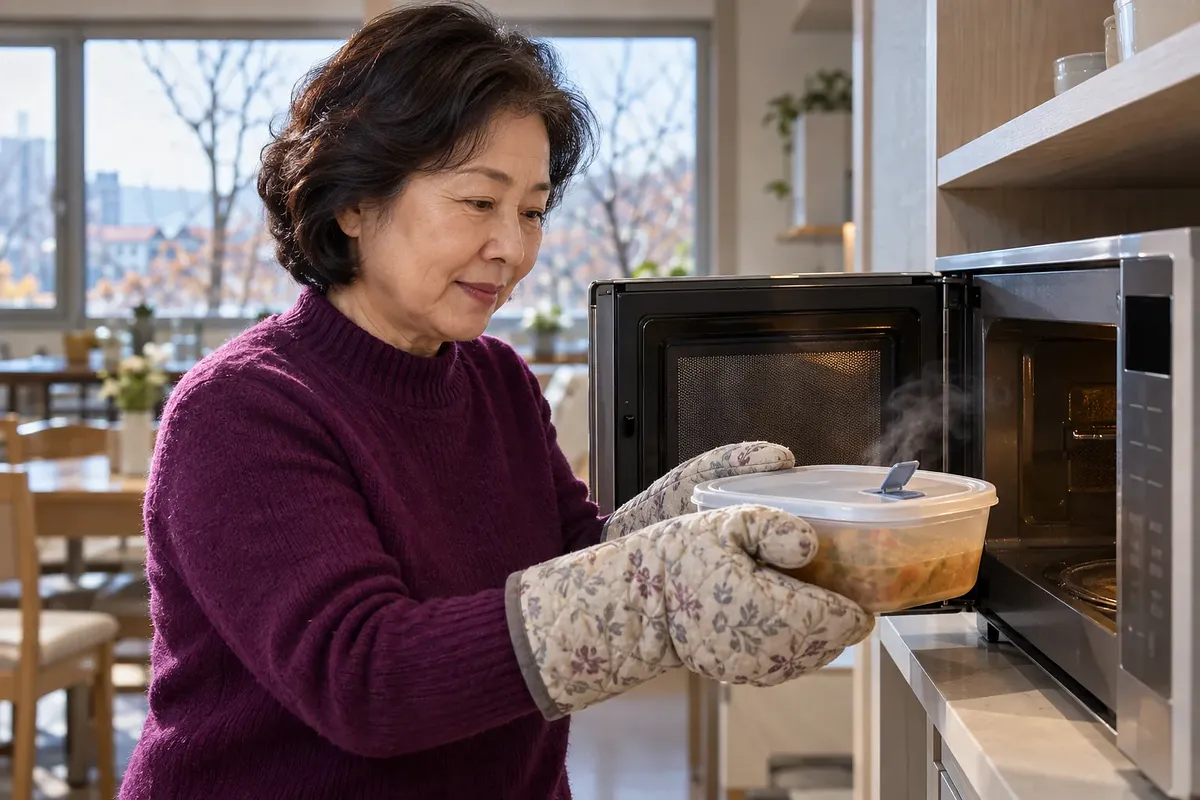
Take care to avoid burns when removing a container after heating. The MFDS warns against overheating foods high in fat or moisture. Wear gloves or similar protection when removing hot containers. Handle the lid according to the product instructions so that steam can escape.
· Aluminum foil must not be used because it poses a risk of sparks and fire. · The MFDS advises against using melamine resin tableware for heating. · It advises that PS materials must not be used because they can deform when heated.
These prohibitions follow the MFDS guidance on food containers. MFDS precautions by material
Common Mistakes
The most common error is using one type of marking to determine all conditions of use. Food use, heat resistance, permission to heat, and repeated use are different kinds of information. Any unconfirmed conditions must be checked in the product instructions or with the manufacturer.
Common interpretation | Actual information to check It is for food use, so it can be heated | Markings permitting each heating method It is PP, so all products have the same conditions | Product-specific temperature ratings and instructions The lid comes with the body, so they can be heated together | Separate conditions permitting the lid's use There is no time limit as long as the temperature rating is not exceeded | Recommended heating time and intended uses It did not deform last time, so it can keep being used | Whether it is single-use and the conditions for repeated use
Being made of glass does not mean a product can be used with every heating method. The MFDS advises following the labeled uses, such as direct-heat or oven use. Glass pots with scratches or cracks must not be used because of the risk of breakage. MFDS guidance on glass cookware
Frequently Asked Questions
Can I heat a product right away if it has a food-use marking?
A food-use marking alone does not tell you whether heating is permitted. You must also check the wording permitting heating and the product-specific conditions of use.
Is the number 5 a safety rating?
The number 5 is a material identification number indicating PP. It does not represent a safety ranking or permitted temperature.
How should I assess a delivery container with no markings?
Check the packaging instructions with the container manufacturer or food seller. If suitability cannot be confirmed, the rule is to transfer the food to another container labeled for heating.
Can any container be used if the lid is left slightly open?
First check whether the lid itself is permitted for heating. Releasing steam does not remove restrictions on the material's use.
Is there a heating time that applies to all containers?
There is no universal time that can be used to decide. Follow the power and time stated on the product.
Can I wash and reuse a single-use container after heating it once?
A marking permitting heating alone should not be used to decide whether repeated use is allowed. Single-use packaging should not be reused for repeated storage and heating.
0:00 0:00
1 / 60

Advertisement

Download text

File name
microwave-container-material-and-safe-use-labels-en.txt
Format
TXT (text/plain)
Paragraphs
60

Downloads exactly what you see as a text file.

Please cite the source when quoting.

Large text

Makes the text larger and the colors clearer. Turn it on if the text feels too small.

If heating instructions are unclear, transfer food to a container with confirmed microwave-use conditions.

Key points

  • A food-safe label indicates that an item is intended to hold food, not that it is approved for heating.
  • PP and material identification code 5 describe the material; they do not replace the heating conditions specified for each product.
  • Check the container and lid separately for microwave suitability and instructions on venting steam.
  • If the labeling is missing or illegible, check with the manufacturer or transfer the food to a container with clear conditions for use.
  • Approval to heat single-use packaging does not mean it can be washed and reused repeatedly.

Whether a product can go in a microwave depends on its labeling for permitted heating uses. A food-use marking or the material designation PP alone is not enough. The conditions for using the container body and lid must also be checked separately.

These criteria are based on the Ministry of Food and Drug Safety's guidance dated December 23, 2025, and manufacturers' instructions.

Differences Between Food-Use, Material, and Heating Labels

Different types of markings on containers provide different information. A food-use marking indicates that the product is intended for contact with food. A material marking explains what it is made of. Whether heating is permitted must be checked in separate usage instructions.

Type of marking Information provided What to check separately
Food-use wording or food-utensil symbol Intended for holding or handling food Whether heating is permitted
Material designation such as PP Material used in the product or component Permitted appliances and conditions
Material identification marking containing a number Plastic material classification Whether heating and reuse are permitted
Microwave-use wording or a symbol explained by the manufacturer Whether that heating method is permitted Time, temperature, power, and lid handling
Temperature rating Temperature conditions the product is designed to withstand Permitted heating methods and duration

The MFDS distinguishes between food-use markings and markings permitting heating. The temperature rating of plastic varies with its manufacturing method and material. You must also read the precautions for the specific product before making a decision. MFDS, “Use Food Utensils Correctly!”

Check microwave suitability for the container and lid separately, and follow the steam-venting instructions.

How to Check Microwave-Use Labels

Wording that permits heating must be read alongside the product's conditions of use. The MFDS advises checking product labels even for paper, glass, ceramic, and PP products. Online answers that merely list material names cannot replace this check.

The MFDS guidance “Know How to Use Microwave-Specific Food Containers!” states:

Check whether the product is labeled for microwave use and follow the cooking instructions.

This wording appears in the MFDS guidance dated May 19, 2020. Original MFDS guidance

  1. Check the container and packaging for a food-use marking.
  2. Compare the meaning of any wording or symbol permitting heating with the product instructions.
  3. Check the conditions of use for the container body and lid separately.
  4. Read the permitted power, time, temperature, and intended uses.
  5. Check whether the product is single-use and read any precautions for repeated use.

Do not interpret similar-looking symbols on your own. Dishwasher-safe or freezer-safe markings indicate different conditions of use. If a symbol is not explained, check with the manufacturer.

What Do PP and the Number 5 Mean?

PP is short for polypropylene, a type of plastic. In the material identification system, the number 5 indicates PP. This number does not indicate a heating time or permitted temperature. How2Recycle labeling guidelines

Although commonly called a recycling number, its precise function is material identification. ASTM explains that this code does not guarantee actual recyclability. You should therefore not use the number alone to determine whether a product can be recycled or heated. ASTM D7611/D7611M-21

PP products also have different temperature ratings depending on how they are manufactured. Even with the same material, you must check the permitted conditions for each product. The material name is a starting point; the final decision about use depends on the product instructions.

Deciding How to Use a Product Under Different Conditions

If only some markings can be confirmed, first obtain the missing information. The table below gives examples of decisions based on both material designations and manufacturers' conditions of use. It does not establish new criteria for permitted uses.

Confirmed information Assessment What to check next
Only a food-use marking is present Permission to heat has not been confirmed Heating instructions on the packaging or in the manual
Only PP or the number 5 is present Only the material has been identified Permitted uses for that product
The body can be heated, but the lid's suitability is unclear There is no basis for heating it with the lid Conditions for removing the lid or using an alternative cover
A microwave-use marking, time, and power are provided Use under the stated conditions Instructions on food quantity and lid handling
The markings are worn and unreadable The product must be identified and checked Manufacturer, product name, and model information
Single-use packaging has heating instructions Follow the stated heating method for that food Whether it can be washed and reused is a separate question

If the markings have worn off, purchase records and product photos can help identify the model. It is better to provide the manufacturer with photos of both the body and lid. If suitability cannot be confirmed, transfer the food to another container labeled for heating. The MFDS also advises removing packaging not intended for microwave use and transferring the food to a microwave-specific dish. MFDS guidance on using plastic containers

Comparing Conditions of Use for the Body and Lid

Even when the body can be heated, lid handling varies by product. Removing the lid and opening a steam vent are different methods. Do not apply one product's instructions to another airtight container.

Manufacturer guidance example Confirmed conditions Scope of application
LocknLock FAQ for four-sided locking airtight containers Open all locks and rest the lid at an angle Products with the structure described in the FAQ
LocknLock FAQ for products with steam vents Open the steam vent before use The relevant products with steam vents
IKEA 365+ rectangular plastic 1.0 L product Can be heated up to 100°C; open the lid during heating to release steam Product number 392.690.78

LocknLock warns that using the product with the locks closed can deform the lid. The same FAQ also advises caution when heating plastic products for extended periods. Heating an empty container can also cause deformation. LocknLock airtight container FAQ

The 100°C in the IKEA example is the value specified for that product. It is not a universal temperature for all PP products. Because the guidance has no publication date, check the product page for the latest conditions. (Verified value: microwave heating limit 100°C · Source: ikea.com · Checked 2026-11-01) IKEA 365+ materials and care instructions

Differences Between Reheating, Cooking, and Repeated Use

A marking permitting heating does not automatically permit prolonged cooking or repeated use. The MFDS guidance on plastic containers says to use them for reheating. It also includes a warning against prolonged use for cooking. MFDS, “Is Microwave-Safe Plastic Safe to Heat?”

Intended use Conditions to check Common source of confusion
Reheating cooked food Stated power and heating time Interpreting a microwave-use marking as permission for unlimited heating
Cooking raw ingredients Containers and cooking methods permitted for cooking Using a storage container intended for reheating
Defrosting frozen food Permitted defrosting conditions for the packaging or container Heating based only on a freezer-safe marking
Reusing delivery containers Whether they are single-use and the manufacturer's reuse instructions Relying on a previous heating attempt that seemed fine

The distinction between reheating and cooking also matters when making steamed eggs. A container used to reheat cooked food is not necessarily suitable for cooking raw eggs. Check that the container is permitted for cooking and read the appliance's cooking instructions.

Hong Kong's Centre for Food Safety advises against reusing containers for convenience meals and takeaway food because they may have been designed for single use. The fact that a container could be heated the first time should not determine whether it can be reused. Hong Kong Centre for Food Safety, “Microwave Cooking and Food Safety”

Heat From Food and Container Damage

Containers also become hot through heat transferred from food. Microwaves are absorbed by food, generating heat. The FDA explains that this heat can melt some plastics. Whether microwaves pass through a material is therefore not enough to determine whether it can be used. FDA, “Microwave Ovens”

Take care to avoid burns when removing a container after heating. The MFDS warns against overheating foods high in fat or moisture. Wear gloves or similar protection when removing hot containers. Handle the lid according to the product instructions so that steam can escape.

  • Aluminum foil must not be used because it poses a risk of sparks and fire.
  • The MFDS advises against using melamine resin tableware for heating.
  • It advises that PS materials must not be used because they can deform when heated.

These prohibitions follow the MFDS guidance on food containers. MFDS precautions by material

Common Mistakes

The most common error is using one type of marking to determine all conditions of use. Food use, heat resistance, permission to heat, and repeated use are different kinds of information. Any unconfirmed conditions must be checked in the product instructions or with the manufacturer.

Common interpretation Actual information to check
It is for food use, so it can be heated Markings permitting each heating method
It is PP, so all products have the same conditions Product-specific temperature ratings and instructions
The lid comes with the body, so they can be heated together Separate conditions permitting the lid's use
There is no time limit as long as the temperature rating is not exceeded Recommended heating time and intended uses
It did not deform last time, so it can keep being used Whether it is single-use and the conditions for repeated use

Being made of glass does not mean a product can be used with every heating method. The MFDS advises following the labeled uses, such as direct-heat or oven use. Glass pots with scratches or cracks must not be used because of the risk of breakage. MFDS guidance on glass cookware

Key questions in this article

Can I heat a product right away if it has a food-use marking?

A food-use marking alone does not tell you whether heating is permitted. You must also check the wording permitting heating and the product-specific conditions of use.

Is the number 5 a safety rating?

The number 5 is a material identification number indicating PP. It does not represent a safety ranking or permitted temperature.

How should I assess a delivery container with no markings?

Check the packaging instructions with the container manufacturer or food seller. If suitability cannot be confirmed, the rule is to transfer the food to another container labeled for heating.

Can any container be used if the lid is left slightly open?

First check whether the lid itself is permitted for heating. Releasing steam does not remove restrictions on the material's use.

Is there a heating time that applies to all containers?

There is no universal time that can be used to decide. Follow the power and time stated on the product.

Can I wash and reuse a single-use container after heating it once?

A marking permitting heating alone should not be used to decide whether repeated use is allowed. Single-use packaging should not be reused for repeated storage and heating.

Open the link

Opens in a new window.

Advertisement

Sign-in required

Sign in with your Google account to like, comment, and save highlights.

FAQ

What is the difference between a food-use label and a label indicating suitability for heating?

A food-use label indicates that a product is intended for holding or handling food. A label indicating suitability for heating means it can be used with a specific heating method. You also need to check product-specific conditions, such as usage time and temperature.

Can a product made of PP be used for heating?

You cannot judge by the material name PP alone. Even products made of the same material can have different permitted conditions depending on how they are manufactured and their intended use. You need to check the product's label indicating suitability for heating.

What does the number 5 on the bottom of a container mean?

In the material identification system, the number 5 stands for PP, or polypropylene. It does not indicate a permitted heating temperature or a safety rating.

If the container body is suitable for heating, can I put the lid in with it?

You need to check the conditions for the container body and lid separately. Follow the product-specific instructions, such as removing the lid, releasing the locking mechanism, or opening the steam vent.

How can I check a container if its label has worn off?

You can identify the model from purchase records or product photos. Ask the manufacturer about the conditions of use for both the container body and the lid. If you cannot confirm them, use another container labeled as suitable for heating.

Can I determine the heating time from the temperature rating alone?

The temperature rating alone does not determine the permitted heating time. You also need to check the power, time, intended use, and food quantity conditions specified on the product.

Can I make steamed eggs in a plastic container intended for reheating?

A label stating that a container is intended for reheating does not mean that it is also suitable for cooking raw eggs. You need to check that the container is approved for cooking and check the appliance's cooking instructions.

Can single-use packaging that is suitable for heating be reused?

Permission to heat single-use packaging is different from permission to reuse it. The Hong Kong Centre for Food Safety advises against reusing containers for convenience meals and takeaway food.

Can all glass containers be used?

You also need to check the heating uses indicated on glass products. The Ministry of Food and Drug Safety advises against using glass pots with scratches or cracks because of the risk of breakage.

Sources

Data formats

This content is available in several machine-friendly formats.

Data-only languages (machine translated, files only)

Indonesian JSON MD Portuguese JSON MD Chinese (Traditional) JSON MD Deutsch JSON MD

Verification

This article was drafted with AI and then reviewed and edited by a person.

Reviewed by 신익희 · 편집장 · 2026-11-01

Figures in this article were checked against the source material during generation. · 2026-11-01

This translation has been cross-checked by AI. · 2026-11-01

Reuse & AI usage

Search indexing and AI citation with attribution are welcome. See the license policy for details.

CC BY · License

Loading…

Loading…

Loading…

Where this content lives

Related content

From Injoys

Request the content you want and take 70% of what it earns

Just leave the subject. We handle production, review, translation and distribution.

See how revenue sharing works

Comments