Skip to content
Injoys
Comparison

Kimchi Fridge Rated Capacity vs. Container Storage

A kimchi refrigerator's rated capacity in liters differs from the amount you can store in its kimchi containers. The criteria for comparing the standard container set, compartment uses, and installation space are based on a 2023 comparative test.

Listen or read this article

13:14

Listen, or read the text only.

Kimchi Fridge Rated Capacity vs. Container Storage

Kokoro 82M AI-generated voice 14 min read

0:00 13:14

Advertisement

Download audio

File name
kimchi-refrigerator-rated-capacity-vs-container-storage-en.mp3
Format
MP3 (audio/mpeg)
Duration
13:14
File size
9.08 MB
Engine
Kokoro 82M

This audio was generated by AI.

You may download and use it freely for personal use.

Kimchi Fridge Rated Capacity vs. Container Storage

10 min read

Kimchi Fridge Rated Capacity vs. Container Storage
A kimchi refrigerator's rated capacity in liters differs from the amount you can store in its kimchi containers. The criteria for comparing the standard container set, compartment uses, and installation space are based on a 2023 comparative test.
To compare kimchi storage amounts, distinguish between total usable capacity and kimchi container storage capacity.
Compare the total capacity of the included kimchi containers separately from the maximum capacity that includes containers purchased separately.
Exclude compartments you plan to use for other foods from your kimchi storage plan.
Check the dimensions of the installation space and the clearance needed to open doors and drawers separately.
Compare prices including the cost of the kimchi containers you need, delivery, and installation.
Compare kimchi refrigerators by the combined capacity of the kimchi containers you will actually put inside, rather than the stated capacity in liters. Distinguish between included containers and those purchased separately. Base your choice on the kimchi storage capacity remaining after excluding compartments you will use for other foods.
The capacity comparisons are based on the Korea Consumer Agency’s 2023 test results.
How does the stated capacity in liters differ from kimchi container storage capacity?
Total usable capacity measures the space inside the refrigerator. Kimchi container storage capacity is the combined capacity of the kimchi containers it holds. Check the second figure if you plan to store kimchi in dedicated containers.
Category | Meaning | What to check when choosing Total usable capacity | Usable space inside the appliance | The overall amount of space Kimchi container storage capacity | Combined capacity of the kimchi containers | Whether it is based on the standard or maximum configuration Included kimchi containers | Containers supplied with the appliance | The number of each size and the compartments they fit in Maximum kimchi container storage capacity | Maximum configuration, including additional containers | Separate purchase requirements and additional costs
You cannot fill the gaps between containers with kimchi. The shelf and drawer layout also affects how the containers fit. A difference in the stated capacity in liters therefore does not equal the difference in kimchi storage capacity.
How large was the difference in the 2023 test?
The difference in total capacity among the tested products was greater than the difference in kimchi container capacity. The Korea Consumer Agency compared 3 upright models and 3 top-opening models. The averages below apply only to the 6 products tested at the time.
Averages for products tested in 2023 | Upright | Top-opening Total usable capacity | 482.7L | 220.3L Kimchi container storage capacity | 159.1L | 140.7L
The upright models had about 2.2 times the total usable capacity. The difference in kimchi container storage capacity was 18.4L. Their larger overall space did not produce a proportional increase in kimchi container capacity.
An LG Electronics Best Shop article dated October 22, 2026, also cited these results. The cited document is Bigyo Gonggam No. 2023-17. Details of the test are available in the December 2023 issue of the Korea Consumer Agency’s Consumer Era. Do not apply those averages to all products currently sold.
When should you choose an upright or top-opening model?
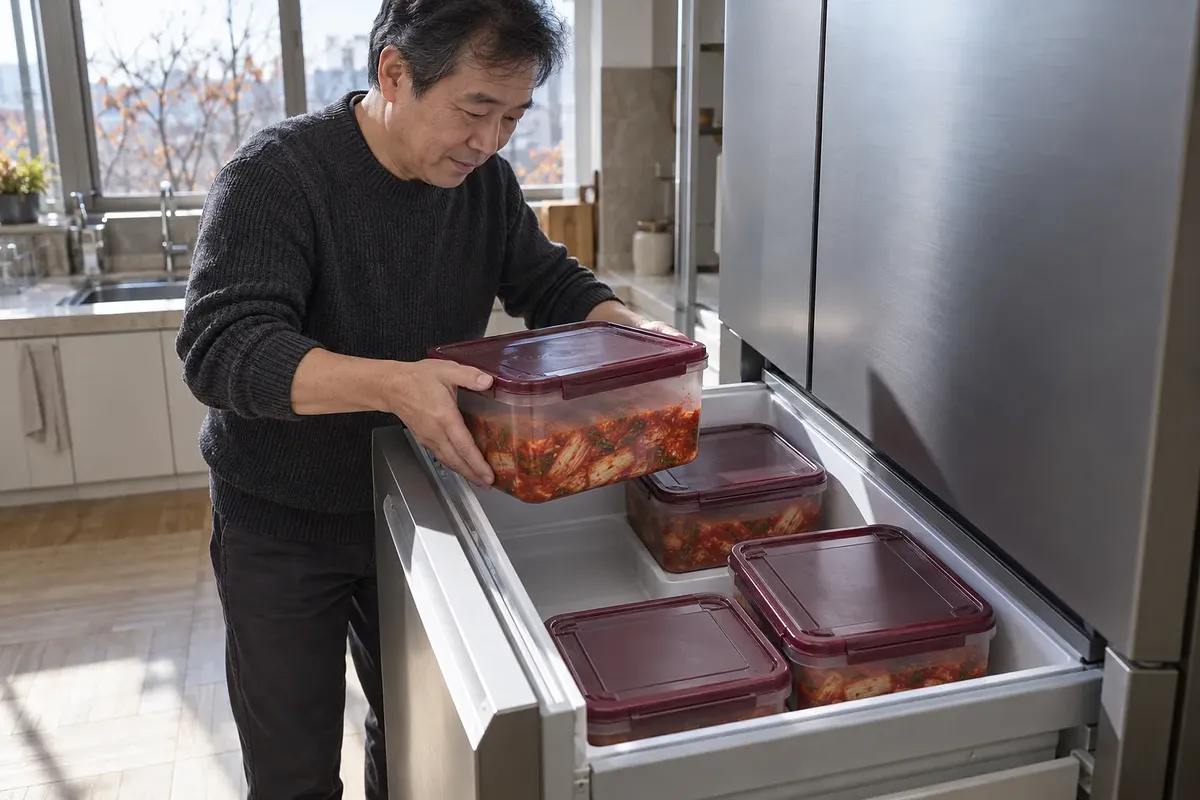
If you also want to store foods other than kimchi, compare the compartment layouts of upright models first. If storing kimjang kimchi is your main purpose, top-opening models are also an option. Use the advantages and drawbacks below to assess the storage arrangement you need.
Selection criterion | Upright | Top-opening Best suited for | Separating foods by compartment | Storage focused on kimchi containers How to access contents | Use front doors and drawers | Open the top lid and lift out containers Potential inconvenience to check | Access to lower drawers and clearance in front for opening | Lifting containers from deep inside Space requirements | Appliance height and front clearance | Appliance width and clearance above the lid Capacity limitations | Kimchi containers do not fill the entire stated capacity | Check the layout if you need shelf storage Cost comparison | A quote including the containers and features you need | A quote that meets the same kimchi storage requirement
Purchase prices for the products tested by the Korea Consumer Agency also differed by type. The amounts below are purchase prices at directly operated stores in March 2023. Do not use them as a guide to current prices or discounts.
Products tested at the time | Purchase price range in March 2023 3 upright models | KRW 3,230,000~3,300,000 3 top-opening models | KRW 1,240,000~1,440,000
Check current costs through quotes for each model you are considering. Also check whether delivery and installation are charged separately. Compare rentals or subscriptions by the total payments over the contract period rather than the monthly payment.
Calculation example: comparing the standard configuration with maximum capacity
You may need to buy additional kimchi containers to use the maximum capacity. The RQ48A94W1AP in the 2023 test was one such example. This model’s standard kimchi container storage capacity was 147.6L.
Configuration of the model tested in 2023 | Capacity calculation Combined capacity of included kimchi containers | 147.6L Additional kimchi containers that can be fitted | 10.9L × 3 = 32.7L Maximum combined capacity with additional containers | 147.6L + 32.7L = 180.3L
When comparing this product, record 147.6L for the standard configuration. If you plan to buy additional containers, record 180.3L along with the additional cost. The other product must be assessed under the same configuration conditions for the comparison to be valid.
How to account for compartments reserved for other foods
Calculate the capacity available for kimchi based on the compartments you will actually use. The combined capacity of all kimchi containers the product can hold may differ from the total you normally use. This is especially important to check if the appliance will also serve as a secondary refrigerator.
· List the kimchi containers you will store at the same time just after kimjang, grouped by size. · Check which compartment each container will fit in for each candidate product. · Exclude compartments you will use for vegetables or other foods from your kimchi storage plan. · Add up only the capacity of the kimchi containers that fit in the remaining compartments. · Check the positions of containers you will access frequently, then decide on the final configuration.
It is difficult to determine the capacity you need from household size alone. Households with the same number of people may store different amounts of kimchi at once. Compare capacity based on when your stored quantity is highest, rather than how often you buy kimchi.
Usage situation | Basis for assessing capacity Storing all your kimjang kimchi at once | The number and size of containers needed just after kimjang Buying kimchi in small amounts | The number of packages or containers stored at the same time Storing kimchi alongside other foods | Combined container capacity in the compartments assigned to kimchi Continuing to use existing kimchi containers | External container dimensions and whether they fit in each compartment
A table for comparing candidate products using the same criteria
Recording each model’s specifications under the same criteria reveals missing conditions. Mark unconfirmed values as unconfirmed rather than estimating them. Match information by the exact model name, not just the brand name.
Comparison item | Candidate A entry | Candidate B entry Exact model name | Enter manually | Enter manually Total usable capacity | L | L Standard kimchi container configuration | L for each size × quantity | L for each size × quantity Combined capacity of standard kimchi containers | L | L Maximum combined capacity with additional containers | L and additional cost | L and additional cost Compartments to use for kimchi | Compartment names and number of containers | Compartment names and number of containers Compartments to use for other foods | Compartment names and supported modes | Compartment names and supported modes External appliance dimensions | Width, depth, height, mm | Width, depth, height, mm Opening and ventilation clearance | As specified in the manual, mm | As specified in the manual, mm Monthly electricity consumption | kWh/month and conditions for the stated figure | kWh/month and conditions for the stated figure Total purchase cost | Including required containers, delivery, and installation | Including required containers, delivery, and installation
Capacity does not indicate storage performance itself. The ability to maintain a stable temperature also matters for kimchi storage. Check the candidate model’s manual for supported storage modes and operating instructions.
Steps for checking the installation space and opening clearance
Do not decide whether an appliance will fit based only on its dimensions with the doors closed. You need to open the doors or drawers to remove kimchi containers. Follow the installation instructions for each model’s required ventilation clearances.
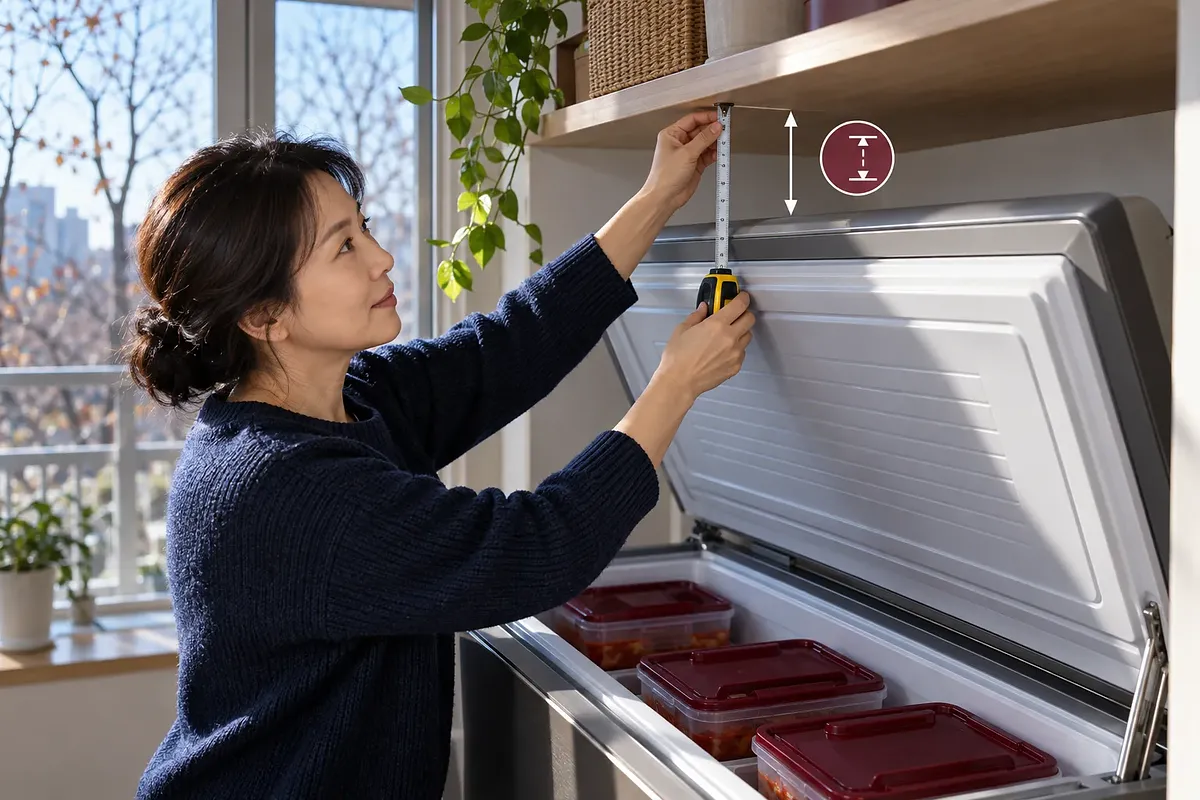
· Measure the width, depth, and height of the installation space using the same unit. · Check whether the appliance dimensions include protruding parts such as handles. · For upright models, check the space in front needed to open doors and drawers. · For top-opening models, check whether an overhead shelf will obstruct the lid. · Account for the ventilation clearances in the manual when deciding whether installation is possible. · Also check the route the appliance must take through the entrance and into the kitchen.
Considering the movement needed to remove kimchi containers allows for a more specific comparison. Check whether the design requires you to tilt a container to remove it, even when the door is open. It is best to record installation dimensions and space needed for everyday access separately.
Common mistakes when reading capacity figures
Converting the combined capacity of kimchi containers into the actual weight of kimchi introduces errors. L is a unit of volume. Do not convert it to kg without accounting for the type of kimchi and how it is packed.
Common interpretation | What to check Twice the stated capacity means twice as much kimchi | Compare kimchi container storage capacity separately More containers mean more storage | Check both the capacity and number of containers Maximum capacity is included as standard | Check additional purchase requirements Containers can be filled to their full capacity | Check the filling guidelines in the manual All remaining space can be used for kimchi | Check the actual container layout and the purpose of each compartment Existing containers with the same capacity in L will also fit | Check external dimensions and whether handles interfere
The storage guidance in the December 2023 issue of the Korea Consumer Agency’s Consumer Era includes the following wording.
About 80% of the kimchi container’s capacity Korea Consumer Agency, Consumer Era, December 2023 issue, Precautions for Kimchi Storage, Maintenance, and Care
This guidance accounts for the increase in volume as kimchi ferments. Distinguish between a container’s nominal capacity and the amount you actually put in it. Also check the manuals for the appliance and kimchi containers you purchase.
0:00 0:00
1 / 47

Advertisement

Download text

File name
kimchi-refrigerator-rated-capacity-vs-container-storage-en.txt
Format
TXT (text/plain)
Paragraphs
47

Downloads exactly what you see as a text file.

Please cite the source when quoting.

Large text

Makes the text larger and the colors clearer. Turn it on if the text feels too small.

Compare kimchi storage capacity separately from the refrigerator’s stated total capacity.

Key points

  • To compare kimchi storage amounts, distinguish between total usable capacity and kimchi container storage capacity.
  • Compare the total capacity of the included kimchi containers separately from the maximum capacity that includes containers purchased separately.
  • Exclude compartments you plan to use for other foods from your kimchi storage plan.
  • Check the dimensions of the installation space and the clearance needed to open doors and drawers separately.
  • Compare prices including the cost of the kimchi containers you need, delivery, and installation.

Compare kimchi refrigerators by the combined capacity of the kimchi containers you will actually put inside, rather than the stated capacity in liters. Distinguish between included containers and those purchased separately. Base your choice on the kimchi storage capacity remaining after excluding compartments you will use for other foods.

The capacity comparisons are based on the Korea Consumer Agency’s 2023 test results.

How does the stated capacity in liters differ from kimchi container storage capacity?

Total usable capacity measures the space inside the refrigerator. Kimchi container storage capacity is the combined capacity of the kimchi containers it holds. Check the second figure if you plan to store kimchi in dedicated containers.

Category Meaning What to check when choosing
Total usable capacity Usable space inside the appliance The overall amount of space
Kimchi container storage capacity Combined capacity of the kimchi containers Whether it is based on the standard or maximum configuration
Included kimchi containers Containers supplied with the appliance The number of each size and the compartments they fit in
Maximum kimchi container storage capacity Maximum configuration, including additional containers Separate purchase requirements and additional costs

You cannot fill the gaps between containers with kimchi. The shelf and drawer layout also affects how the containers fit. A difference in the stated capacity in liters therefore does not equal the difference in kimchi storage capacity.

Check installation dimensions separately from the clearance needed to open the lid.

How large was the difference in the 2023 test?

The difference in total capacity among the tested products was greater than the difference in kimchi container capacity. The Korea Consumer Agency compared 3 upright models and 3 top-opening models. The averages below apply only to the 6 products tested at the time.

Averages for products tested in 2023 Upright Top-opening
Total usable capacity 482.7L 220.3L
Kimchi container storage capacity 159.1L 140.7L

The upright models had about 2.2 times the total usable capacity. The difference in kimchi container storage capacity was 18.4L. Their larger overall space did not produce a proportional increase in kimchi container capacity.

An LG Electronics Best Shop article dated October 22, 2026, also cited these results. The cited document is Bigyo Gonggam No. 2023-17. Details of the test are available in the December 2023 issue of the Korea Consumer Agency’s Consumer Era. Do not apply those averages to all products currently sold.

When should you choose an upright or top-opening model?

If you also want to store foods other than kimchi, compare the compartment layouts of upright models first. If storing kimjang kimchi is your main purpose, top-opening models are also an option. Use the advantages and drawbacks below to assess the storage arrangement you need.

Selection criterion Upright Top-opening
Best suited for Separating foods by compartment Storage focused on kimchi containers
How to access contents Use front doors and drawers Open the top lid and lift out containers
Potential inconvenience to check Access to lower drawers and clearance in front for opening Lifting containers from deep inside
Space requirements Appliance height and front clearance Appliance width and clearance above the lid
Capacity limitations Kimchi containers do not fill the entire stated capacity Check the layout if you need shelf storage
Cost comparison A quote including the containers and features you need A quote that meets the same kimchi storage requirement

Purchase prices for the products tested by the Korea Consumer Agency also differed by type. The amounts below are purchase prices at directly operated stores in March 2023. Do not use them as a guide to current prices or discounts.

Products tested at the time Purchase price range in March 2023
3 upright models KRW 3,230,000~3,300,000
3 top-opening models KRW 1,240,000~1,440,000

Check current costs through quotes for each model you are considering. Also check whether delivery and installation are charged separately. Compare rentals or subscriptions by the total payments over the contract period rather than the monthly payment.

Calculation example: comparing the standard configuration with maximum capacity

You may need to buy additional kimchi containers to use the maximum capacity. The RQ48A94W1AP in the 2023 test was one such example. This model’s standard kimchi container storage capacity was 147.6L.

Configuration of the model tested in 2023 Capacity calculation
Combined capacity of included kimchi containers 147.6L
Additional kimchi containers that can be fitted 10.9L × 3 = 32.7L
Maximum combined capacity with additional containers 147.6L + 32.7L = 180.3L

When comparing this product, record 147.6L for the standard configuration. If you plan to buy additional containers, record 180.3L along with the additional cost. The other product must be assessed under the same configuration conditions for the comparison to be valid.

How to account for compartments reserved for other foods

Calculate the capacity available for kimchi based on the compartments you will actually use. The combined capacity of all kimchi containers the product can hold may differ from the total you normally use. This is especially important to check if the appliance will also serve as a secondary refrigerator.

  1. List the kimchi containers you will store at the same time just after kimjang, grouped by size.
  2. Check which compartment each container will fit in for each candidate product.
  3. Exclude compartments you will use for vegetables or other foods from your kimchi storage plan.
  4. Add up only the capacity of the kimchi containers that fit in the remaining compartments.
  5. Check the positions of containers you will access frequently, then decide on the final configuration.

It is difficult to determine the capacity you need from household size alone. Households with the same number of people may store different amounts of kimchi at once. Compare capacity based on when your stored quantity is highest, rather than how often you buy kimchi.

Usage situation Basis for assessing capacity
Storing all your kimjang kimchi at once The number and size of containers needed just after kimjang
Buying kimchi in small amounts The number of packages or containers stored at the same time
Storing kimchi alongside other foods Combined container capacity in the compartments assigned to kimchi
Continuing to use existing kimchi containers External container dimensions and whether they fit in each compartment

A table for comparing candidate products using the same criteria

Recording each model’s specifications under the same criteria reveals missing conditions. Mark unconfirmed values as unconfirmed rather than estimating them. Match information by the exact model name, not just the brand name.

Comparison item Candidate A entry Candidate B entry
Exact model name Enter manually Enter manually
Total usable capacity L L
Standard kimchi container configuration L for each size × quantity L for each size × quantity
Combined capacity of standard kimchi containers L L
Maximum combined capacity with additional containers L and additional cost L and additional cost
Compartments to use for kimchi Compartment names and number of containers Compartment names and number of containers
Compartments to use for other foods Compartment names and supported modes Compartment names and supported modes
External appliance dimensions Width, depth, height, mm Width, depth, height, mm
Opening and ventilation clearance As specified in the manual, mm As specified in the manual, mm
Monthly electricity consumption kWh/month and conditions for the stated figure kWh/month and conditions for the stated figure
Total purchase cost Including required containers, delivery, and installation Including required containers, delivery, and installation

Capacity does not indicate storage performance itself. The ability to maintain a stable temperature also matters for kimchi storage. Check the candidate model’s manual for supported storage modes and operating instructions.

Steps for checking the installation space and opening clearance

Do not decide whether an appliance will fit based only on its dimensions with the doors closed. You need to open the doors or drawers to remove kimchi containers. Follow the installation instructions for each model’s required ventilation clearances.

  1. Measure the width, depth, and height of the installation space using the same unit.
  2. Check whether the appliance dimensions include protruding parts such as handles.
  3. For upright models, check the space in front needed to open doors and drawers.
  4. For top-opening models, check whether an overhead shelf will obstruct the lid.
  5. Account for the ventilation clearances in the manual when deciding whether installation is possible.
  6. Also check the route the appliance must take through the entrance and into the kitchen.

Considering the movement needed to remove kimchi containers allows for a more specific comparison. Check whether the design requires you to tilt a container to remove it, even when the door is open. It is best to record installation dimensions and space needed for everyday access separately.

Common mistakes when reading capacity figures

Converting the combined capacity of kimchi containers into the actual weight of kimchi introduces errors. L is a unit of volume. Do not convert it to kg without accounting for the type of kimchi and how it is packed.

Common interpretation What to check
Twice the stated capacity means twice as much kimchi Compare kimchi container storage capacity separately
More containers mean more storage Check both the capacity and number of containers
Maximum capacity is included as standard Check additional purchase requirements
Containers can be filled to their full capacity Check the filling guidelines in the manual
All remaining space can be used for kimchi Check the actual container layout and the purpose of each compartment
Existing containers with the same capacity in L will also fit Check external dimensions and whether handles interfere

The storage guidance in the December 2023 issue of the Korea Consumer Agency’s Consumer Era includes the following wording.

About 80% of the kimchi container’s capacity

Korea Consumer Agency, Consumer Era, December 2023 issue, Precautions for Kimchi Storage, Maintenance, and Care

This guidance accounts for the increase in volume as kimchi ferments. Distinguish between a container’s nominal capacity and the amount you actually put in it. Also check the manuals for the appliance and kimchi containers you purchase.

Open the link

Opens in a new window.

Advertisement

Sign-in required

Sign in with your Google account to like, comment, and save highlights.

FAQ

Can I store as much kimchi as the stated capacity?

The stated total usable capacity differs from the combined capacity of the kimchi containers. To store kimchi in containers, check the kimchi container storage capacity.

Do upright models hold twice as much kimchi as top-opening models?

You cannot determine that from the type alone. In the 2023 test, the average kimchi container storage capacities were 159.1L and 140.7L. These figures apply only to the products tested at that time.

Is it enough to compare just the number of kimchi containers?

The number alone is not enough because each container may have a different capacity. Multiply the capacity of each size by the number of containers and add the results. You also need to check which compartments they fit in.

Does the maximum kimchi container storage capacity come as standard?

Some configurations may require you to buy additional containers separately. Check the total capacity included as standard separately from the total after buying additional containers.

How do I determine the right capacity in liters for my family size?

It is difficult to determine the right capacity based on family size alone. First, count the containers you need when you have the most kimchi to store. You also need to consider which compartments you will use for other foods.

Can I use my existing kimchi containers in a new model?

Even containers with the same capacity in liters may have different external dimensions. Check whether the container's height or handles prevent it from fitting in the compartment or drawer. It is best to follow the guidance for that model to determine whether you can use it.

Can I convert kimchi container capacity to kimchi weight?

Do not convert L to the same number of kg. The weight of the same volume varies depending on the type of kimchi and how it is packed.

Is it enough if the product's dimensions fit the installation space?

You need additional space to open the doors and drawers. For top-opening models, also check for overhead obstructions. Check the installation manual for each model for ventilation clearances.

Can I use the 2023 test prices as a basis for buying now?

Do not use the purchase prices from that time as current prices. Check the total cost of the models you are currently considering, including the required containers and delivery and installation costs.

Sources

Data formats

This content is available in several machine-friendly formats.

Data-only languages (machine translated, files only)

Indonesian JSON MD Portuguese JSON MD Chinese (Traditional) JSON MD Deutsch JSON MD

Verification

This article was drafted with AI and then reviewed and edited by a person.

Reviewed by 신익희 · 편집장 · 2026-10-28

Figures in this article were checked against the source material during generation. · 2026-10-28

This translation has been cross-checked by AI. · 2026-10-28

Reuse & AI usage

Search indexing and AI citation with attribution are welcome. See the license policy for details.

CC BY · License

Loading…

Loading…

Where this content lives

Related content

From Injoys

Request the content you want and take 70% of what it earns

Just leave the subject. We handle production, review, translation and distribution.

See how revenue sharing works

Comments