Injoys
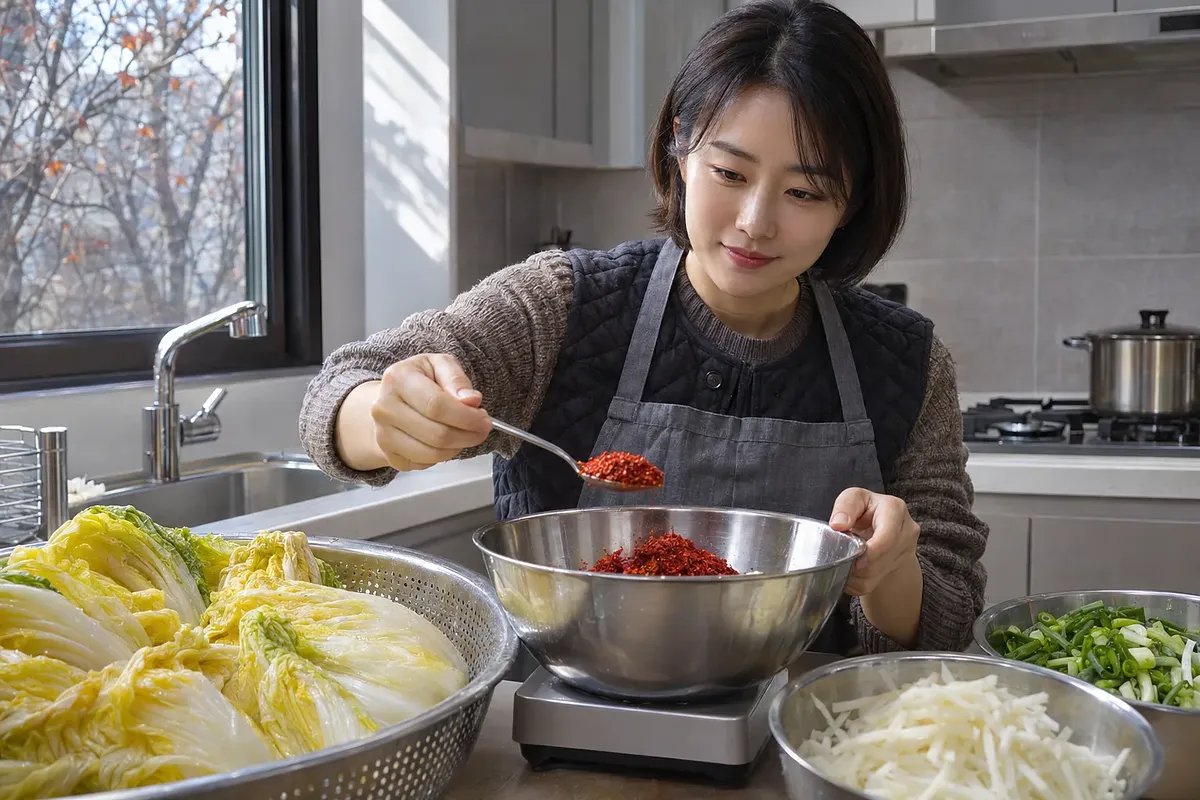
For 20kg of salted napa cabbage, calculate the seasoning based on its weight after salting, not the number of heads. One recipe published by a public agency calls for 900g of red pepper powder. The seasoning ingredients, including radish and vegetables, total 7.4kg. Check the product label for the number of heads.
The seasoning quantities are based on the Nongsikpum Ollbaro recipe table and the Rural Development Administration's announcement dated November 15, 2013.
Steps for Calculating Kimchi-Making Quantities
The first step is to match the condition of the cabbage described on the product label to the condition specified in the recipe. Have the product details page and your chosen recipe table ready. You will also need a scale to weigh the ingredients.
- Check whether the product weight refers to salted cabbage. Record the number of heads separately.
- Check whether the recipe uses raw cabbage or salted cabbage.
- Divide the weight you plan to prepare by the recipe's reference weight. The scaling factor for reducing a 50kg recipe to 20kg is 0.4.
- Multiply every ingredient by the same factor. Do not mix in quantities of salted fermented seafood or red pepper powder from other recipes.
- Distinguish between the amount of ingredients for homemade seasoning and the amount of ready-made seasoning to buy. For commercial products, follow the manufacturer's usage instructions.

When calculating seasoning amounts, distinguish salted cabbage weight from the total weight with seasoning.
Raw Cabbage Weight and the Number of Salted Cabbage Heads
Raw cabbage weight and weight after salting are not the same basis for calculation. The weight changes during salting, washing, and draining. Heads are a unit of count, so their weight varies with cabbage size.
| Label basis | Meaning | What to check when calculating |
|---|---|---|
| Raw cabbage kg | Cabbage weight before salting | Do not substitute this directly into a recipe for salted cabbage |
| Salted cabbage kg | Cabbage weight after salting, washing, and draining | Check that it is in the same condition as the cabbage in the recipe |
| Number of heads | Count of cabbage heads | Check the size per head and the product's expected range |
Nongsikpum Ollbaro's “Easy Kimchi-Making Method” uses cabbage of a specific size as an example. 20 heads of raw cabbage weighing 3.5kg each total 70kg. In this example, they weigh about 50kg after salting, washing, and draining. This ratio cannot be applied to all cabbage.
The information from Goesan and Haenam also gives the number of heads as a range. The figures below are those stated in each source. Do not treat them as guaranteed counts for the product you plan to buy.
| Source checked | Weight | Listed number of heads |
|---|---|---|
| Goesan County's “Country-Style Salted Cabbage” | 20kg per box | 7 to 9 heads |
| Haenamgol Farm product information | 20kg | Approximately 7 to 9 heads |
Neither page specifies the year to which these figures apply. Check the current product options again when ordering. You must also distinguish between the number of cabbage halves and the number of whole heads.
Salted Cabbage Seasoning Ratios and Weight Conversion Table
The table below scales Nongsikpum Ollbaro's recipe for 50kg of salted cabbage. It is not based on 50kg of raw cabbage. Nor is it a universal formula for every kimchi-making recipe.
| Ingredient | Original recipe for 50kg | Calculated amount for 10kg | Calculated amount for 20kg | Calculated amount for 40kg |
|---|---|---|---|---|
| Red pepper powder | 2,250g | 450g | 900g | 1,800g |
| Garlic | 1,000g | 200g | 400g | 800g |
| Ginger | 500g | 100g | 200g | 400g |
| Salted fermented seafood | 2,500g | 500g | 1,000g | 2,000g |
| Sesame seeds | 250g | 50g | 100g | 200g |
| Sugar | 250g | 50g | 100g | 200g |
| Glutinous rice paste | 4,250g | 850g | 1,700g | 3,400g |
| Radish | 5,000g | 1,000g | 2,000g | 4,000g |
| Total leafy greens | 2,500g | 500g | 1,000g | 2,000g |
| Total of all ingredients | 18,500g | 3,700g | 7,400g | 14,800g |
You can find the original recipe in the quantity table for “Easy Kimchi-Making Method”. The final total row is calculated by adding all the ingredients. Cabbage weight is excluded from this total.
- Leafy greens means the combined amount of ingredients such as water dropwort, scallions, garlic chives, mustard greens, and cheonggak seaweed. It does not mean adding the amount shown in the table for each ingredient.
- Salted fermented seafood is the total amount. This table does not give separate proportions for salted fermented shrimp and fish sauce.
- Glutinous rice paste is the weight of the cooked paste. Do not read it as the weight of dry glutinous rice or glutinous rice flour.
Calculation Example for One 20kg Box
Multiply each ingredient in the 50kg recipe by 0.4 to get the amount needed for one box. The red pepper powder calculation is 2,250g × 0.4 = 900g. Radish is calculated as 5,000g × 0.4 = 2,000g.
Adding the ingredients from red pepper powder through glutinous rice paste gives 4.4kg of base seasoning. Add 2kg of radish to this. Including 1kg of leafy greens brings the total preparation weight to 7.4kg.
The Rural Development Administration's announcement on developing a “Complete Kimchi Seasoning Mix” gives the following instructions.
Add 220g of seasoning mix per 1kg of salted cabbage
Rural Development Administration, “Development of a ‘Complete Kimchi Seasoning Mix’ That Saves Ingredients and Time”
This ratio also gives 20kg × 220g/kg = 4,400g. It matches the calculation for the base seasoning without vegetables. Record this separately from the total weight of the kimchi filling with vegetables mixed in.