Fine Dust Levels: When to Go Out and How to Wear a Mask
The [Our Neighborhood] air quality section on this site displays measurements and ratings exactly as received from AirKorea. Distinguish between the time frames used for concentrations and forecasts, and check the outdoor activity guidance for each rating and how to wear a protective mask.
Check PM10 and PM2.5 concentrations and ratings in [Our Neighborhood] on this site.
Check AirKorea for the latest forecasts and any advisories or warnings issued for the area you plan to visit.
Adjust the duration and intensity of outdoor activities based on whether you are in a sensitive group and your current symptoms.
Check protective mask packaging for the quasi-drug label and KF rating.
Wear the mask snugly against your face, and stop using it if you have difficulty breathing.
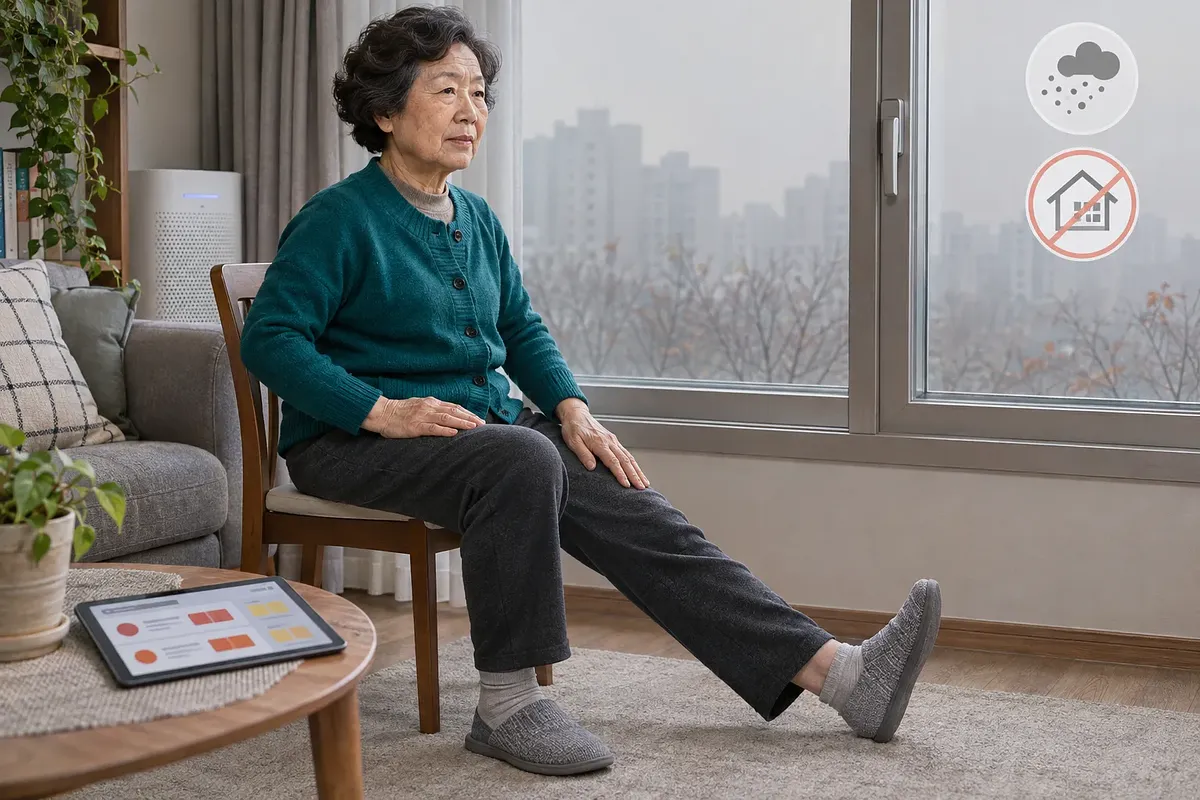
Before going out, check the fine dust rating in [My Neighborhood] on this site. If it is Bad, reduce prolonged or strenuous outdoor activities. When going out, it is best to wear a protective mask that fits snugly against your face. You can check the latest forecasts and alerts on AirKorea.
The figures and standards are based on official guidance accessed on November 11, 2026.
What to Check Before Going Out
Check both the current air quality and the forecast for the time you plan to go out. Start with [My Neighborhood] in the weather panel on the left side of this site. Air quality measurements and ratings are displayed exactly as received from AirKorea.
· Check PM10 and PM2.5 separately in [My Neighborhood].
· Check the latest forecast for your destination on AirKorea.
· Check the advisories and warnings issued for the same area.
· Adjust your outdoor activities based on whether you belong to a sensitive group and how you feel.
· When going out, check the labeling on your protective mask and make sure it fits properly.
Check today's concentrations under air quality in [My Neighborhood] on this site. Forecasts are available under “Air Quality Information for Today/Tomorrow/the Day After Tomorrow” on AirKorea. Alerts are available under “Air Pollution Alert History.”
PM10 and PM2.5 Rating Ranges
PM10 and PM2.5 are categories of dust distinguished by particle size. PM10 refers to particles at most 10㎛ in diameter. PM2.5 consists of smaller particles at most 2.5㎛ in diameter. The PM2.5 size range is included within PM10.
The concentration unit ㎍/㎥ indicates the mass of dust per volume of air. Do not confuse it with ㎛, the unit of particle size. AirKorea's real-time display and forecasts use the concentration ranges below.
Rating | PM10 concentration | PM2.5 concentration
Good | 0~30㎍/㎥ | 0~15㎍/㎥
Moderate | 31~80㎍/㎥ | 16~35㎍/㎥
Bad | 81~150㎍/㎥ | 36~75㎍/㎥
Very Bad | At least 151㎍/㎥ | At least 76㎍/㎥
The table above shows rating ranges for concentrations displayed as whole numbers. Forecast tables describe Very Bad as more than 150㎍/㎥ and more than 75㎍/㎥, respectively. Even when the ranges are the same, the averaging periods may differ. You can check these on the AirKorea real-time display and air quality forecast.
How Do Measurements and Forecasts Differ?
Measurements are observed results, while forecasts predict future air quality. The two ratings may differ even in the same area. Before comparing them, make sure the area and reference time match.
Information | Basis | When to check
Real-time measured concentration | A monitoring station's observation for the relevant hour | Checking current air quality nearby
Real-time 1-hour rating | Rating ranges applied to the 1-hour concentration | Deciding on outdoor activities now
24-hour predicted moving average | Concentration calculated from recent measurements | Assessing fine dust in the Comprehensive Air-quality Index
Fine dust forecast | Expected daily average concentration for the relevant date | Planning outings and activities
Air quality forecasts are issued daily at 5:00, 11:00, 17:00, and 23:00. The forecasts are provided by the Ministry of Climate, Energy and Environment. The published reports are prepared by the Air Quality Forecasting Center at the National Institute of Environmental Research. Ozone forecasts are issued from April 1~October 31 each year.
A Moderate forecast does not mean concentrations will stay the same all day. Check the latest report again just before going out. Forecast model images must also be distinguished from actual observations. The AirKorea air quality forecast also explains the uncertainty in model results.
What Is the Comprehensive Air-quality Index?
The Comprehensive Air-quality Index combines several pollutants into a single score. It does not represent the PM10 or PM2.5 concentration itself. AirKorea also uses the abbreviation CAI.
Rating | Comprehensive Air-quality Index
Good | 0~50
Moderate | 51~100
Bad | 101~250
Very Bad | 251~500
The index assesses 6 pollutants, including PM10, PM2.5, and ozone. The base value is the highest individual pollutant score. Additional points are added when several pollutants are rated Bad or worse. Do not judge the overall index from the PM2.5 concentration alone.
The index uses a 24-hour predicted moving average to assess fine dust. This differs from a simple average of the previous day. The calculation method is explained in the AirKorea Comprehensive Air-quality Index guide.
Outdoor Activity Guidance by Condition
At the Bad level, both sensitive groups and the general public should reduce strenuous outdoor activities. Sensitive groups include children and older adults. They also include people with lung diseases such as asthma or with heart disease.
Situation | Sensitive groups | General public
Moderate | Stay active while paying attention to how you feel | Check how you feel
Bad | Limit prolonged or strenuous outdoor activities | Limit prolonged or strenuous outdoor activities
Very Bad | Stay indoors if possible; consult a doctor about outdoor activities | Limit prolonged or strenuous outdoor activities
Eye pain, coughing, or a sore throat at the Bad level | Consult a doctor based on your symptoms and medical conditions | Avoid outdoor activities
Coughing or a sore throat at the Very Bad level | Stay indoors if possible | Avoid outdoor activities
The table summarizes the action guidelines on the Ministry of the Interior and Safety's National Safety 24. For outdoor activities at schools or childcare centers, also check the institution's guidance. If you have asthma, consult your doctor about how to respond during outdoor activities. Details are available in the National Safety 24 fine dust action guidelines.
Fine dust can worsen respiratory diseases. Sensitive groups may experience greater health effects. On-screen concentrations alone cannot be used to diagnose an individual's health.
Fine Dust Advisory and Warning Criteria
Advisories and warnings depend on whether hourly average concentrations persist. They are separate from a Bad rating shown on the screen. Actual alerts also take local weather conditions and other factors into account.
Category | PM10 hourly average concentration | PM2.5 hourly average concentration
Advisory issued | At least 150㎍/㎥ for 2 hours | At least 75㎍/㎥ for 2 hours
Warning issued | At least 300㎍/㎥ for 2 hours | At least 150㎍/㎥ for 2 hours
Advisory lifted | Less than 100㎍/㎥ | Less than 35㎍/㎥
Warning downgraded to advisory | Less than 150㎍/㎥ | Less than 75㎍/㎥
Weather conditions and other factors are also reviewed when alerts are lifted or downgraded. Do not assume that an alert has been issued based on a single measurement. Check the official records of alerts issued and lifted for your destination. The criteria are listed under AirKorea fine dust alert criteria.
4 Crisis Alert Levels for Fine Particulate Matter Disasters
Disaster crisis alerts are divided into Attention, Caution, Alert, and Serious. The Ministry of Climate, Energy and Environment issues these crisis alerts. Cities and provinces carry out responses such as emergency reduction measures.
Level | Geographic scope | Conditions for issuance
Attention | Regional or nationwide | Emergency reduction measures are implemented or the criteria for issuing them are met
Caution | Regional or nationwide | Attention for 2 consecutive days, expected to continue for 1 more day, or the high-concentration conditions below
Alert | Regional or nationwide | Caution for 2 consecutive days, expected to continue for 1 more day, or the high-concentration conditions below
Serious | Nationwide | Alert for 2 consecutive days, expected to continue for 1 more day, or the high-concentration conditions below
The criteria for issuing emergency reduction measures at the Attention level are any one of the following. All concentrations refer to PM2.5. Distinguish between the period used to calculate the current day's average and the forecast for the next day.
· The current day's average from 0:00~16:00 is more than 50㎍/㎥, and the next day's forecast is also more than 50㎍/㎥
· An advisory or warning is issued between 0:00~16:00 on the current day, and the next day's forecast is more than 50㎍/㎥
· The next day's forecast is more than 75㎍/㎥
Higher levels also have conditions that combine high concentrations with the next day's forecast. Both conditions below must be met together. Check the official alert records to confirm the level actually in effect.
Level | PM2.5 hourly average concentration condition | Next-day PM2.5 forecast condition
Caution | At least 150㎍/㎥ for at least 2 hours | More than 75㎍/㎥
Alert | At least 200㎍/㎥ for at least 2 hours | More than 150㎍/㎥
Serious | At least 400㎍/㎥ for at least 2 hours | More than 200㎍/㎥
The Caution level of a disaster crisis alert and a fine dust advisory are separate systems. Similar names do not mean their issuance criteria are interchangeable. The full criteria are available in the AirKorea fine particulate matter disaster guide.
Emergency Reduction Measures and Preliminary Reduction Measures Compared
Emergency reduction measures are a response to reduce high concentrations of fine dust. Preliminary reduction measures are actions taken in advance by the public sector. Distinguish these from personal precautions such as wearing a mask.
Category | Basis for implementation | Targets and timing
Emergency reduction measures | Issuance criteria, including the current day's concentrations and alerts and the next day's forecast | Applicable vehicles, industrial facilities, construction sites, etc., from 06:00~21:00 on the day after issuance
Preliminary reduction measures | As of 17:00 today, concentrations are predicted to be more than 50㎍/㎥ both tomorrow and the day after tomorrow | Public sector; implemented tomorrow ahead of high concentrations the day after tomorrow
Other condition for preliminary reduction measures | As of 17:00 today, the forecast for the day after tomorrow is Very Bad | Public sector; implemented tomorrow ahead of high concentrations the day after tomorrow
Concentrations for preliminary reduction measures refer to PM2.5. Emergency reduction measures include vehicle restrictions. Check local notices for which vehicles are covered and which are exempt. Measures for each level are summarized in the AirKorea fine particulate matter disaster guide.
2026~2027 Fine Dust Seasonal Management Program
The 8th Fine Dust Seasonal Management Program is scheduled for December 2026~March 2027. This is based on the Ministry of Climate, Energy and Environment's work plan dated January 21, 2026. Check the relevant local government's notices for regional vehicle restrictions and exemptions. You can confirm the period in the Ministry of Climate, Energy and Environment's air quality work plan.
How to Choose Between KF80, KF94, and KF99
The KF number indicates a protective mask's particle filtration performance. KF stands for Korea Filter. The number does not indicate the wearer's probability of preventing disease.
Label | Average particle size in performance testing | Particle filtration performance
KF80 | 0.6㎛ | At least 80%
KF94 | 0.4㎛ | At least 94%
KF99 | 0.4㎛ | At least 99%
When buying a mask, check the packaging for the quasi-drug designation and KF label. A higher KF number may make breathing more difficult or uncomfortable. Choose based on fine dust levels and your breathing condition.
These figures appear in guidance issued by the Ministry of Food and Drug Safety on March 16, 2018. The same standards can also be found in its infographic dated November 2, 2021. Check the packaging for product-specific instructions as well. The Ministry of Food and Drug Safety mask infographic explains the ratings and how to wear a mask.
How to Wear a Protective Mask
A protective mask must cover your nose and mouth and fit snugly against your face. Gaps can reduce its particle filtration effectiveness. Wear it according to the Ministry of Food and Drug Safety's precautions for use.
· Check the packaging for the quasi-drug designation and KF rating. Follow the wearing instructions on the product.
· Wear it to cover both your nose and mouth. Do not cover only your mouth or leave it resting on your chin.
· Adjust the mask to fit snugly against your face. Do not place a towel or tissue underneath it. The Ministry of Food and Drug Safety warns that this can reduce the seal.
· Avoid touching the outside of the mask after putting it on. This is one of the Ministry of Food and Drug Safety's precautions for use.
· Stop using it if breathing becomes uncomfortable. Pregnant women, children, older or frail people, and people with respiratory or cardiovascular diseases should be especially careful. Consult a doctor or another professional if needed.
Do not wash or reuse a used protective mask. The Ministry of Food and Drug Safety states that washing cannot preserve its function. Used masks may be contaminated with dust or bacteria.
The Ministry of Food and Drug Safety's “Information on Protective Masks for Yellow Dust and Fine Dust” includes the following statement.
After putting on a mask, avoid touching its outer surface.
The quotation and wearing precautions are available in the Ministry of Food and Drug Safety press release dated March 16, 2018.
When Numbers in My Neighborhood Differ or Are Missing
If the numbers differ, first check the measurement time and averaging period. This site displays concentrations and ratings exactly as provided by AirKorea. Do not independently reassess the rating based only on the number on the screen.
AirKorea data has separate 1-hour and 24-hour ratings. The real-time concentration and 24-hour rating may appear inconsistent. Check the field names and time basis on the screens you are comparing.
What you see on the screen | What to check
The forecast is Moderate, but the current rating is Bad | Whether you are comparing a daily average forecast with the current hourly concentration
The rating differs from what the concentration table suggests | Whether it is a 1-hour rating or a 24-hour rating
The number differs from another screen | Whether the monitoring station and time are the same
A value is blank or marked as no data | The status of the measurements and whether recent data is available
No data does not mean a concentration of 0㎍/㎥ or a Good rating. Official data includes statuses such as equipment inspection, abnormal data, and communication failure. If a value is missing, check the latest data on AirKorea. The data fields are explained in the Korea Environment Corporation's AirKorea air pollution information description.
Common Mistakes and How to Read Thresholds
Rating thresholds and alert criteria must be read separately. The same number may be used in different standards. The examples below show how to interpret the official ranges.
Common interpretation | Correct interpretation
PM2.5 at 35㎍/㎥ is Bad | This concentration falls in the Moderate range
PM2.5 at 75㎍/㎥ is Very Bad | This concentration falls in the Bad range
A PM2.5 concentration of 75㎍/㎥ means an advisory is issued | Check the issuance conditions, including whether the hourly average concentration persists for 2 hours
When a warning becomes an advisory, all alerts have been lifted | The advisory remains in effect
A higher KF number means there is no need to reduce outdoor activities | Follow both mask-wearing guidance and activity limits for each rating
How Ambient Air Quality Standards Differ from Everyday Ratings
Ambient air quality standards are criteria for environmental management. They serve a different purpose from the Good and Moderate ratings used to decide whether to go out. Do not apply annual average standards to the current hourly average concentration.
Pollutant | Domestic annual average ambient air quality standard | Domestic 24-hour average ambient air quality standard
PM10 | At most 50㎍/㎥ | At most 100㎍/㎥
PM2.5 | At most 15㎍/㎥ | At most 35㎍/㎥
The values in the table follow AirKorea's guidance on domestic ambient air quality standards. When comparing standards from other countries, make sure the averaging periods and applicable years also match. Do not interpret WHO guideline values as domestic everyday ratings. You can check the standards under AirKorea domestic ambient air quality standards.