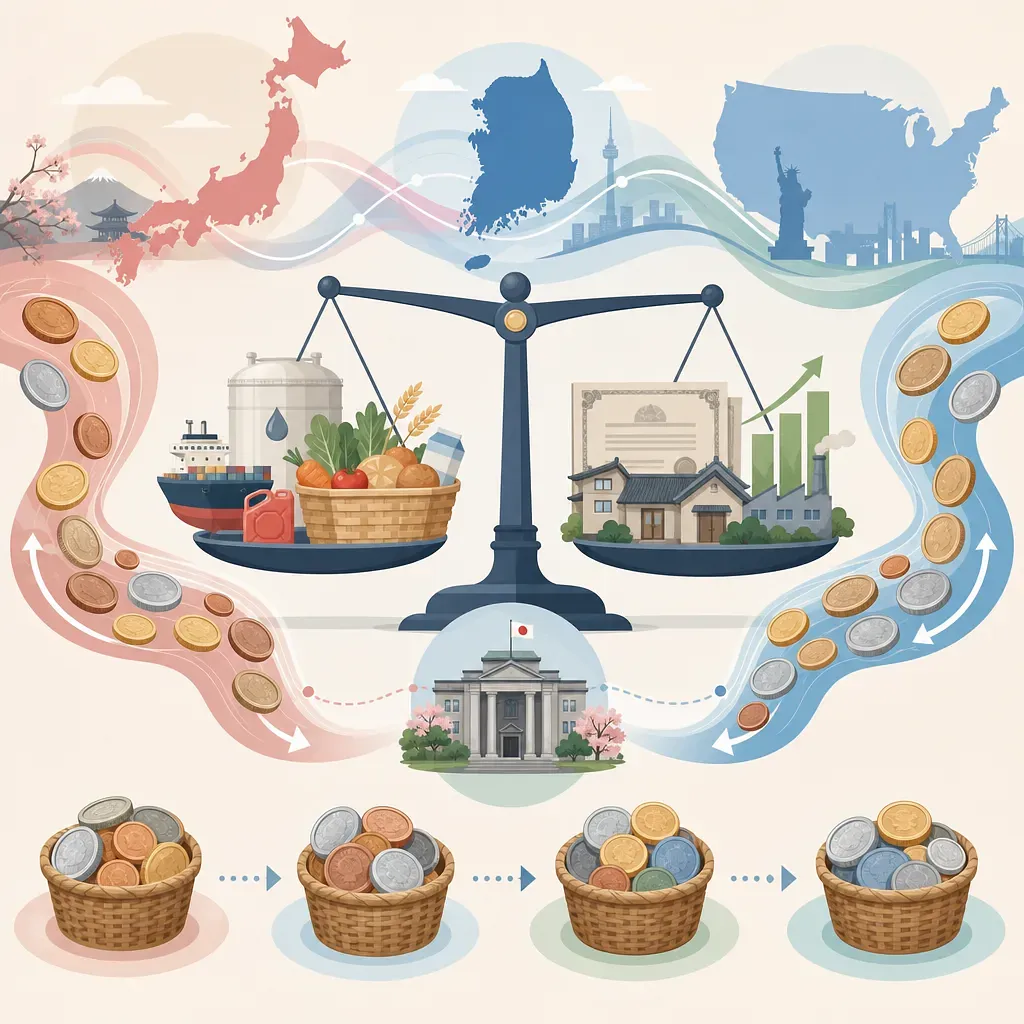
An exchange rate is the relative price of two currencies. Therefore, it is difficult to reliably predict its direction based only on one country’s interest rates or economy. This is because central bank policies, government intervention in foreign exchange markets, trade and capital flows, geopolitical shocks, and investor positioning all influence one another.
This article does not provide real-time exchange rate targets. Instead, it connects Japan’s intervention history, the Bank of Japan’s policy constraints, the yen carry trade, and the determinants of the won-dollar exchange rate to explain which claims can be trusted.
Why Exchange Rates Are Difficult to Predict
The main reason exchange rates are difficult to predict is that markets price in expectations about future policies before current economic indicators. Even when the same inflation data is released, the exchange rate may move in the opposite direction depending on whether the market had already anticipated it and whether the central bank’s response is expected to change.
Key Variables That Move Exchange Rates
| Variable | General transmission channel | Points to note when interpreting |
|---|---|---|
| Nominal interest rates and expected rates | Funds may move into a currency in pursuit of relatively higher returns | A high-interest-rate currency does not always strengthen when hedging costs and the risk of exchange rate depreciation are considered |
| Real interest rates | Returns calculated by subtracting expected inflation from nominal interest rates affect currency demand | Expected inflation is not directly observable and varies depending on the measurement method |
| Growth outlook | May raise expectations for investment and equity inflows | Expectations may simultaneously emerge that slower growth will lead to interest rate cuts |
| Trade and current account balances | Export proceeds and demand for import payments affect currency supply and demand | Overseas investment income and corporate currency hedging can be as important as the goods balance |
| Risk aversion | When a shock occurs, funds may move into highly liquid assets such as the dollar | Reactions vary depending on the cause of each country’s shock and market positioning |
| Government intervention | Trading with foreign exchange reserves or verbal warnings affects the speed and volatility of exchange rate moves | Intervention that runs counter to monetary policy and economic fundamentals may have only a short-lived effect |
| Position unwinding | Simultaneous liquidation of leveraged trades amplifies price movements | Movements can be faster and more nonlinear than changes in economic indicators |
Interest rate differentials are an important variable, but they are not a stand-alone formula. For example, even if U.S. interest rates are higher than South Korea’s, the won may strengthen if rapid U.S. rate cuts are expected or if South Korea’s exports and current account improve significantly.
History and Facts of Japan’s Foreign Exchange Market Intervention
Foreign exchange market intervention must be distinguished from policy rate adjustments. In Japan, authority over foreign exchange policy rests with the Ministry of Finance, while the Bank of Japan executes market transactions under the ministry’s direction. By contrast, the Bank of Japan determines monetary policy, including the policy rate and government bond purchases.
| Period | Market conditions | Direction and significance of intervention |
|---|---|---|
| 1995 | Rapid yen appreciation to below 80 yen per dollar | Japan, the United States, and others responded by buying dollars and selling yen. The Great Hanshin-Awaji Earthquake was part of the backdrop that heightened economic anxiety at the time, but it is difficult to regard it as the sole cause of the strong yen. |
| 1998 | Yen depreciation into the 140-yen-per-dollar range amid the Asian financial crisis | The United States and Japan intervened by buying yen. Financial instability and concerns about neighboring countries’ currencies and export competitiveness were discussed together. |
| March 2011 | The yen surged after the Great East Japan Earthquake | The G7 carried out coordinated intervention to sell yen. It was largely intended to curb expectations of repatriation after the disaster and speculative movements. |
| September–October 2022 | The yen weakened rapidly as the interest rate gap between the United States and Japan widened | Japan sold dollars and bought yen. It was the first intervention to stem yen depreciation since 1998. |
| April–May and July 2024 | The yen weakened to around 160 per dollar and volatility increased | Japanese Ministry of Finance data records large-scale intervention to buy yen. Changes in the policy rate and U.S. inflation data also affected the exchange rate during the same period. |
Therefore, the claim that intervention to stop yen depreciation occurred in 2026 for the first time in 28 years is invalid. The first yen-buying intervention since 1998 took place in 2022, and additional intervention was also confirmed in 2024. To determine whether a specific transaction in 2026 was official intervention, the monthly and quarterly intervention records published by Japan’s Ministry of Finance must be checked.
Criteria for Determining Whether Intervention Succeeded
The fact that the exchange rate fell immediately after intervention is not enough to conclude that it succeeded. At a minimum, the following items must be assessed separately.
- Did excessive volatility decline immediately after the intervention?
- Did the effect last for months rather than days?
- Did the expected interest rate gap between the United States and Japan move in the same direction?
- Did market participants believe that the government might intervene repeatedly?
- Was the scale of intervention sufficient relative to market trading volume and foreign exchange reserves?
Coordinated intervention can be more powerful than unilateral intervention because several countries send the same signal. However, if the monetary policy direction of major countries remains unchanged, there is no guarantee that it will alter the long-term trend.
Domestic and International Spillover Effects of a Super-Weak Yen
Japanese Households and Companies
A weak yen raises the yen-denominated prices of crude oil, gas, food, and raw materials. If wage growth fails to keep pace with inflation, households’ real purchasing power declines. On the other hand, companies with a high share of overseas sales may report higher earnings when foreign-currency profits are converted into yen, while spending by foreign visitors to Japan gains price competitiveness.
A weak yen therefore does not produce the same gains and losses across Japan. The beneficiaries and those bearing the burden differ depending on import dependence, the share of overseas production, currency hedging, and household income structures.
Relationship With U.S. Treasury Yields
Caution is needed regarding the simple causal claim that a weak yen automatically raises long-term U.S. interest rates. If Japanese interest rates rise, Japanese investors may have less incentive to hold U.S. Treasuries while bearing currency-hedging costs, and the return of funds to Japan could put upward pressure on U.S. Treasury yields.
In practice, however, U.S. Treasury yields are jointly determined by the Federal Reserve’s policy outlook, U.S. inflation and growth, the fiscal deficit, Treasury issuance, and global demand for safe assets. The movement of Japanese funds is one of several factors, not the sole cause.
Emerging Markets
A strong dollar can increase principal and interest burdens for countries with large dollar-denominated debts and insufficient foreign exchange reserves. If the yen is also weak, exporters competing with Japanese companies may face price pressure.
However, not all emerging-market countries necessarily sell U.S. Treasuries to defend their exchange rates. Various tools are used, including policy rate adjustments, foreign exchange swaps, bank liquidity regulations, capital flow management, and verbal intervention. Whether U.S. Treasuries were actually sold must be verified through country-specific data on foreign exchange reserves and asset holdings.
The Bank of Japan’s Dilemma and the Yen Carry Trade
Explaining the Bank of Japan’s difficulty in raising rates quickly solely in terms of fear rooted in the past is incomplete. Policy decisions take into account the persistence of inflation, wage growth, consumption and investment, government bond market functioning, and the interest burden on the government and private sector.
Trade-Offs Created by Raising Interest Rates
| Expected effects of interest rate increases | Costs that may arise simultaneously |
|---|---|
| Expectations of a narrower U.S.-Japan interest rate gap and reduced yen depreciation | Higher borrowing costs for households and companies |
| Reduced import-price pressure | Potential slowdown in consumption and capital investment |
| Potential improvement in financial institutions’ net interest margins | Valuation losses on bond holdings and greater government bond market volatility |
| Monetary policy normalization | Risk of a gradual increase in interest costs on enormous government debt |
It is true that past cases in which Japan’s economy deteriorated after rate increases have influenced policy caution. However, Japan’s prolonged deflation cannot be explained by a single rate increase. The collapse of asset prices, financial institution distress, demographic structure, low expected inflation, and shocks to the global economy all played a role.
What the 2024 Yen Carry Unwind Revealed
The yen carry trade is a strategy of borrowing yen at low interest rates and then investing in dollar bonds, stocks, or other higher-yielding assets. Losses on this trade can increase when Japanese interest rates rise, U.S. rate cuts are expected, or the yen suddenly strengthens.
On July 31, 2024, the Bank of Japan raised its short-term policy rate target to approximately 0.25%. As concerns about a U.S. economic slowdown, a correction in technology stocks, and the unwinding of crowded positions converged, the Nikkei 225 fell by more than 12% on August 5. It is inaccurate to conclude that this was caused solely by Japan’s rate increase or to say that the Bank of Japan reversed its policy within two days. A Bank of Japan official signaled that the bank would not rush additional increases in an unstable market, but it did not cancel the July rate increase itself.
The Structure Determining the Won-Dollar Exchange Rate
A rise in the won-dollar exchange rate means that more won is needed to buy one dollar, indicating won weakness. An inverted South Korea-U.S. policy rate differential can increase the relative attractiveness of dollar assets, but actual capital flows reflect currency-hedging costs, the equity market outlook, and credit risk.
Indicators to Check Beyond the Interest Rate Differential
- The dollar index and real U.S. Treasury yields
- South Korea’s goods balance and current account balance
- Semiconductor exports and terms of trade
- Net purchases of domestic stocks and bonds by foreign investors
- Overseas securities investment by domestic institutions and individuals
- Energy import prices and international oil prices
- China’s economy and movements in the yuan
- Geopolitical risks and global volatility indices
- Expectations for the future rate paths of the South Korean and U.S. central banks
The Bank of Korea does not have to match U.S. interest rates exactly solely for the sake of the exchange rate. Monetary policy comprehensively considers price stability, financial stability, and growth conditions. Raising rates may support the won, but it can increase the interest burden on household debt and deepen the slowdown in domestic demand. Conversely, lowering rates may help the economy and financing costs, but all else being equal, it can increase pressure for won depreciation.
A Strong Won Is Not Always Beneficial
A stronger won reduces the cost of imported raw materials and overseas travel, as well as the won-converted burden of foreign-currency debt. On the other hand, it may reduce the won value of exporters’ foreign-currency revenue. Actual export competitiveness is more closely reflected by the real effective exchange rate, which compares the won with competitor currencies such as the yen, yuan, and euro, than by the won-dollar exchange rate alone.