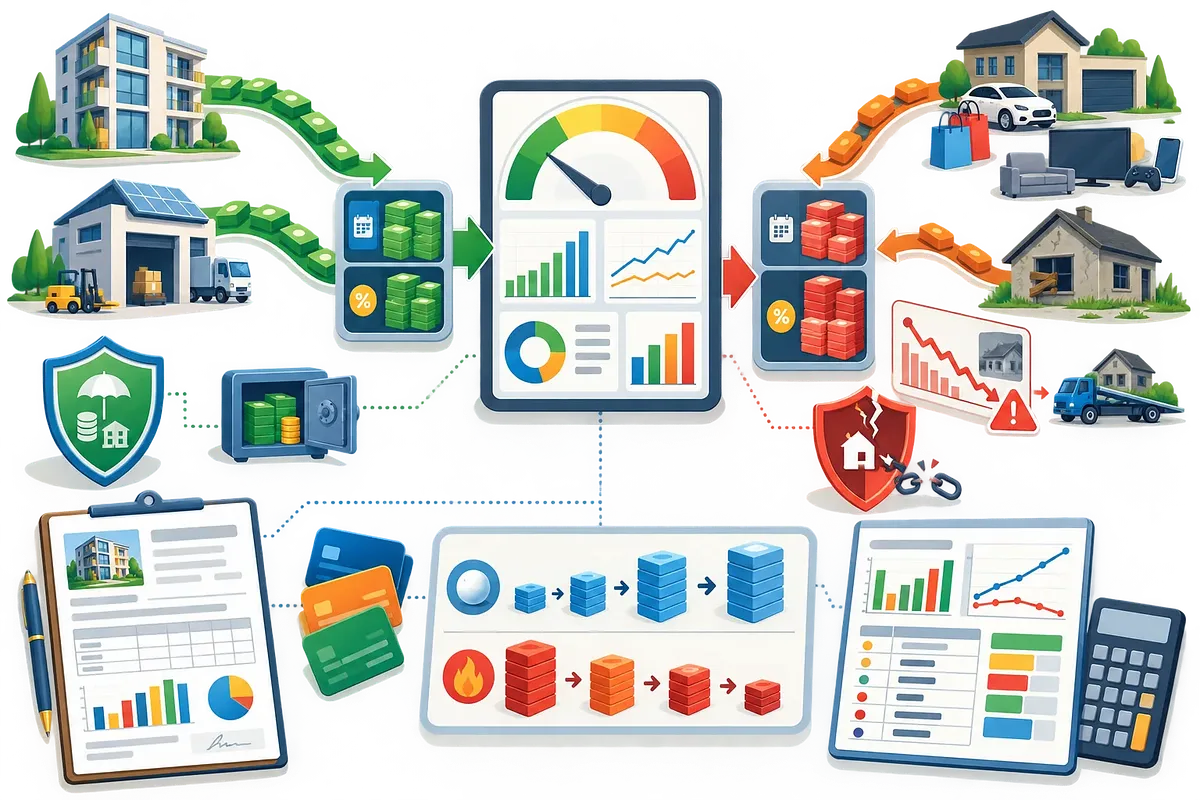
Good debt is debt whose principal and interest can be covered by the net cash flow from income-producing assets. Bad debt is debt repaid from wages after consumption, or debt for which the income from a purchased asset falls short of the repayment amount. You must consider not only how the money is used but also the interest rate, collateral, personal guarantees, and liquidity.
Numerical criteria: Check actual interest rates and costs in the loan agreement, cardholder agreement, and with the relevant tax authority
Criteria for Distinguishing Good Debt from Bad Debt
The nature of debt is determined by what the money is spent on and the source of repayment. Consumer debt is structured to bring future earned income forward for present use. Asset-backed debt aims to be repaid with income from the new asset.
However, debt is not good simply because it was used to purchase an asset. Rent or business profits may be lower than the costs. Variable interest rates and failure to extend the maturity can also alter cash flow.
| Evaluation Item | Closer to Good Debt | Closer to Bad Debt |
|---|---|---|
| Use of funds | An asset that generates cash flow | An item that rapidly loses value after consumption |
| Source of repayment | Income from the asset after expenses | Wages or additional borrowing |
| Interest-rate structure | Returns cover interest and principal | Interest erodes returns |
| Collateral risk | Enough capacity to avoid a forced sale even if value declines | Additional collateral is required after even a small decline |
| Liquidity | Emergency funds remain separately available | Cash is tied up in both the asset and repayments |
| Scope of liability | The extent of potential losses is understood | Personal guarantees expose even personal living assets |
Therefore, looking only at the size of the debt is also insufficient. A large loan can produce substantial losses even from a small shock. You should first check the repayment structure and the extent of losses if the plan fails.
Breakdown by Condition
The same loan can have a different character depending on its terms. If many of the answers to the following questions are unfavorable, the leverage risk is high.
- Can income after operating expenses cover principal and interest?
- Can repayments still be made if interest rates rise or sales decline?
- Can additional collateral be provided if the collateral value falls?
- Does the loan maturity align with when the asset can be converted into cash?
- Are personal guarantees or additional collateral included?
- Will emergency funds remain after repayment?
It is not enough merely to compare whether the asset’s return is higher than the loan interest rate. Asset returns fluctuate, but loan interest accrues according to the contract. Taxes and transaction costs also reduce the difference in returns.
Returns and Margin Call Risk of Securities-Backed Loans
A securities-backed loan provides liquidity without selling shares. If share prices rise, you can retain the gains on your holdings. Conversely, if the collateral value falls, you may be required to provide additional collateral or make a repayment.
If you cannot meet the demand, the financial institution may sell the securities. The timing of the sale may be unfavorable to the investor. This is generally called a margin call or the risk of a forced sale due to insufficient collateral.
It is misleading to view Elon Musk’s acquisition of X simply as an example of a securities-backed loan. Large acquisitions may use equity together with multiple financing structures. A particular individual’s transaction should not be used as evidence that a personal loan is safe.
Not selling an asset may delay the point at which tax is imposed. However, a loan does not eliminate taxes. Capital gains taxation and interest deductions vary by country and purpose.
Example Calculation for a Business Acquisition Loan
The key to a business acquisition is net cash flow, not sales. Using the figures provided, calculating only the structure can show the amount of borrowing. Because the business’s actual profit is not available, its repayment capacity must be reviewed separately.
- The annual return from investing 280 million won at 8% per year must be verified from the basis of calculation.
- The ratio between 280 million won in equity and the 2.8 billion won acquisition price, as well as the remaining amount to be financed, must be verified in the original text.
- The required financing amount and financing method must be verified in the original text.
- If net cash flow after the acquisition is lower than principal and interest, personal funds will have to be contributed.
- If there is a personal guarantee, business failure may lead to the loss of personal assets.
Seller financing is a structure in which the seller receives part of the acquisition price at a later date. A 10% upfront payment and 90% deferred payment is only one example. The actual proportions and interest rate vary depending on contract negotiations.
The U.S. SBA 7(a) loan may be used for certain changes in business ownership. It is not a program under which every buyer is approved. Eligibility, guarantees, and contract terms must be confirmed with the SBA and the participating financial institution.
Comparing a Mortgage with Renting
A mortgage builds home equity as the principal is repaid. However, acquisition costs, taxes, insurance, and repair expenses may arise. Renting purchases housing and flexibility to move instead of an ownership stake.
| Comparison Item | Mortgage | Renting |
|---|---|---|
| Monthly spending | Principal, interest, and management and ownership costs | Rent and expenses required under the lease |
| Asset accumulation | Equity increases by the amount of principal repaid | No home equity is created |
| Responsibility for repairs | Often borne by the owner | May be borne by the landlord depending on the lease and the law |
| Mobility | Requires a sale or conversion to a rental property | Relatively easy to move after the lease ends |
| Liquidity | Repayments are tied up in home equity | Available cash can be retained for other purposes |
| Price risk | Exposed to fluctuations in home prices | No direct risk from purchase and sale prices |
It is inaccurate to view all rent as wasted money. Rent includes the use of space and the transfer of some management responsibilities. Conversely, not all mortgage principal and interest payments are investments.