Injoys
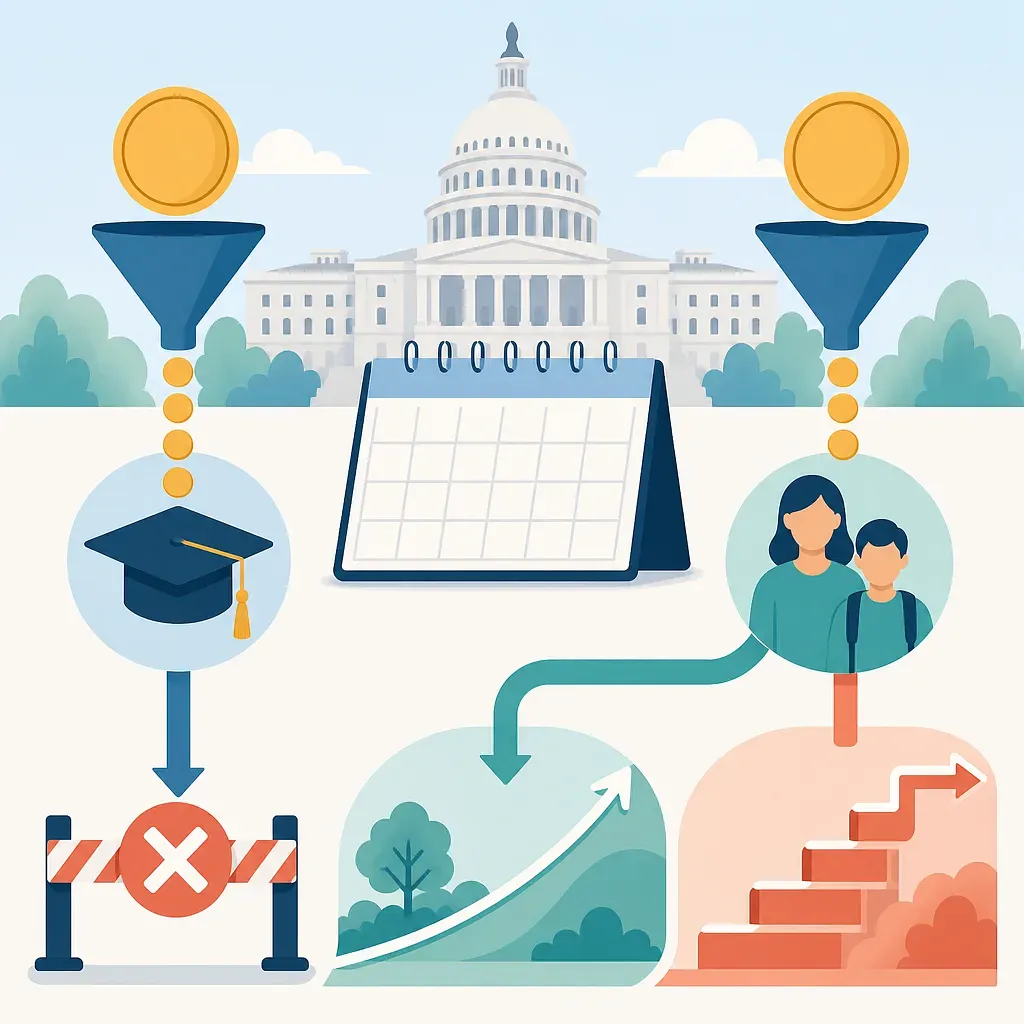
On July 1, 2026, federal student loan limits and repayment systems in the United States changed significantly. In particular, graduate and professional students taking out new loans beginning with the fall 2026 semester, as well as families using Parent PLUS, may find it difficult to continue using their existing student financing plans.
The information below describes the common standards under federal rules. Actual loan amounts vary depending on program classification, existing loan balances, enrollment status, cost of attendance, and other financial aid, so students should review both their school’s official financial aid notice and their StudentAid.gov account.
Who Is Directly Affected by the 2026 Changes
The key criterion is not simply the loan application or disbursement date, but whether the loan applies to an academic period beginning on or after July 1, 2026.
The groups most directly affected include:
- Students entering graduate or professional degree programs beginning in the fall 2026 semester
- Graduate students who planned to cover tuition and living expenses with Grad PLUS
- Parents using Parent PLUS for the first time on or after July 1, 2026
- Students with existing loans who also need to take out new federal loans
- Borrowers who want to select an income-driven repayment plan or change an existing repayment plan
- Undergraduate students receiving both Pell Grants and outside scholarships for the 2026–27 academic year
The standard Direct Subsidized Loan and Direct Unsubsidized Loan system for undergraduate students has not been eliminated altogether. The biggest changes in this overhaul concern graduate and professional degree loans, Parent PLUS, and the simplification of repayment plans.
Elimination of Grad PLUS and Graduate Loan Limits
Under the new loan system applying on or after July 1, 2026, new Grad PLUS loans are generally eliminated for graduate and professional degree students. As a result, students generally can no longer use Grad PLUS to cover the full cost of attendance established by their school.
Instead, the following limits apply to Direct Unsubsidized Loans.
| Category | Annual Limit | Aggregate Limit for the Program |
|---|---|---|
| General graduate programs | $20,500 | $100,000 |
| Professional degree programs recognized under statutes and federal regulations | $50,000 | $200,000 |
A $257,500 lifetime aggregate limit also applies to all federal student loans, excluding Parent PLUS. If a student has previously received federal loans, the remaining borrowing capacity under the new limit may be reduced.
Professional Degree Status Must Be Confirmed with the School
Not every program described as medicine, dentistry, law, or a similar field automatically qualifies for the $50,000 annual limit. The applicable standard is the professional degree program classification established under federal regulations and the information reported by the school. Rather than relying solely on the program’s name, students should confirm the following with the financial aid office:
- Whether the program is classified as a professional degree program under federal loan regulations
- The remaining aggregate limit after accounting for existing undergraduate and graduate loans
- The actual Direct Unsubsidized Loan amount available for the 2026–27 academic year
- The school’s calculated cost of attendance, including tuition, insurance, practicum fees, and living expenses
New Parent PLUS Limits and Transition Rules
Parent PLUS loans subject to the new rules on or after July 1, 2026, are limited to $20,000 annually and $65,000 in aggregate per dependent undergraduate student.
These are per-student limits. The total limit for the same student does not increase even if two parents apply separately or submit multiple applications. A school may further reduce the actual amount available after considering the student’s other financial aid and cost of attendance.
Transition Rules for Existing Borrowers
Limited transition rules may apply to students and families if the student was enrolled in the applicable program through June 30, 2026, and had already received an eligible federal loan for that program before July 1, 2026. In general, the protected period is based on the shorter of the following:
- The remaining normal period of study needed to complete the program
- Up to 3 academic years
The transition rules do not provide indefinite protection. Eligibility may vary based on a program change, an extended leave of absence, the timing of reenrollment, or a change in the student’s enrollment status. Existing Grad PLUS or Parent PLUS borrowers should ask their school to confirm in writing whether they are classified as eligible for the transition rules.
Comparison of RAP and Balance-Based Standard Repayment
The 2026 changes simplify repayment options for new loans around the Repayment Assistance Plan·RAP and standard repayment. Existing borrowers may continue using previous plans for a certain period depending on when their loans were originated and the loan type, but some existing income-driven repayment plans may be phased out or subject to conversion.
| Item | RAP | Balance-Based Standard Repayment |
|---|---|---|
| Basis for monthly payment | Adjusted gross income and number of dependents | Loan balance, interest rate, and repayment term |
| Basic structure | Applicable percentage rises as income increases | Principal and interest repaid over a fixed period |
| Minimum monthly payment | Generally $10 | Calculated based on balance and interest rate |
| Interest protection | Protection for some interest not covered by the calculated payment | Borrower generally pays accrued interest |
| Principal reduction assistance | Structure providing up to $50 per month in principal reduction assistance under certain conditions | No separate income-driven principal assistance |
| Treatment of long-term balance | Remaining balance may be forgiven after 360 qualifying monthly payments | Designed for full repayment within the specified term |
| Parent PLUS | Generally not eligible | Available |
RAP monthly payments are structured so that when adjusted gross income exceeds $10,000, the applicable percentage rises by income bracket from approximately 1% to as much as 10%, and an adjustment of $50 per month for each dependent may apply. However, because minimum payment rules apply, the calculated payment will not always be $0.
Standard repayment differs from what is commonly called graduated repayment with interest-only payments. Its repayment term varies by loan balance as follows.
| Loan Balance at Start of Repayment | Standard Repayment Term |
|---|---|
| $25,000 or less | 10 years |
| More than $25,000 and at most $50,000 | 15 years |
| More than $50,000 and at most $100,000 | 20 years |
| More than $100,000 | 25 years |
RAP may reduce the initial monthly burden, but it may result in a longer repayment period. Standard repayment does not automatically adjust to a decline in income, but it may reduce principal more quickly and lower total interest. When choosing a plan, borrowers should compare not only the first monthly payment but also the estimated total payments, repayment term, and potential income growth.
Points of Particular Concern for Parent PLUS Borrowers
Parent PLUS loans and some consolidation loans created to repay them are not eligible for RAP. Whether existing Parent PLUS borrowers can use prior income-driven repayment options or consolidation procedures depends on the loan origination date and consolidation history.
Using private refinancing to repay federal loans may cause borrowers to lose federal rights such as federal repayment plans, deferment and forbearance, death and disability discharge, and Public Service Loan Forgiveness. Borrowers should compare the value of these federal rights before switching solely because a private loan offers a lower interest rate.