Injoys

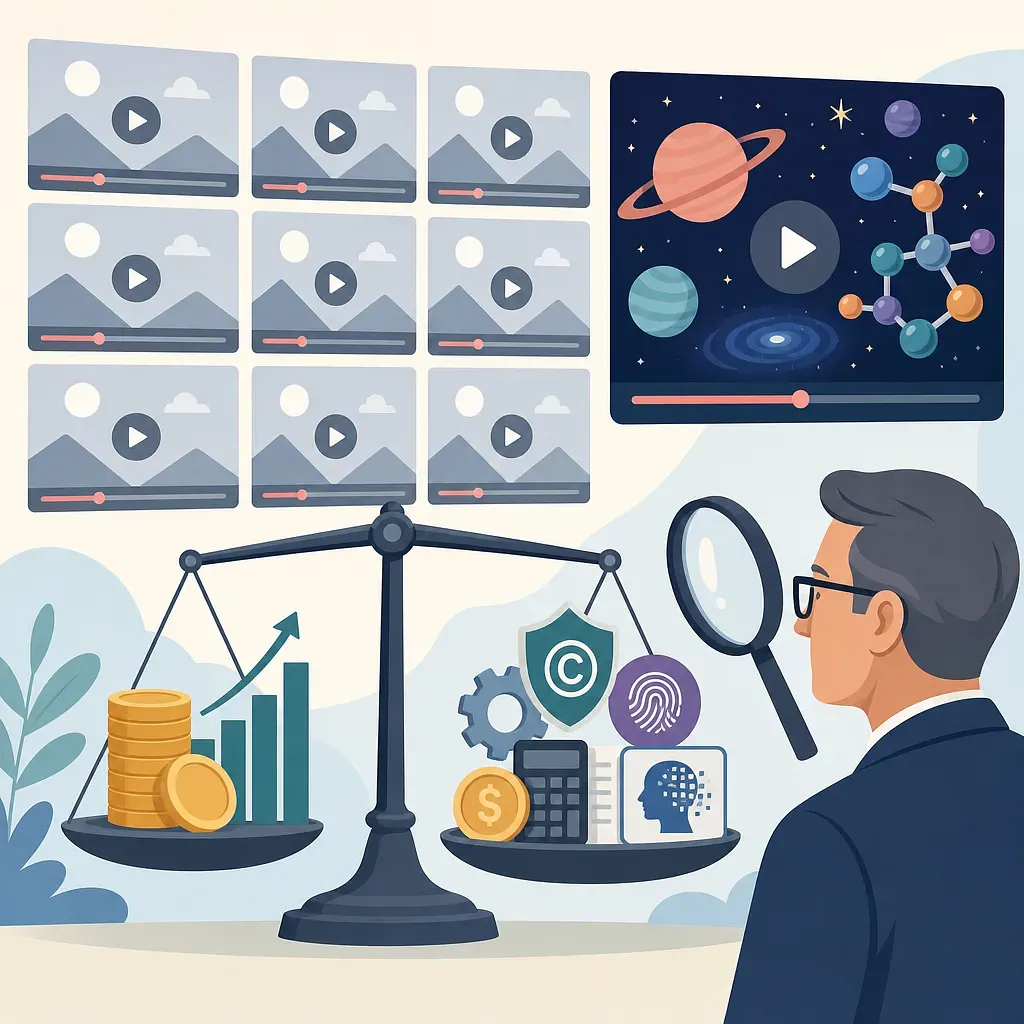
AI can be used to quickly create scripts, narration, images, and rough edits. However, “producing a video in 2 hours” and “earning 5 million won per month” are separate issues. The former concerns production efficiency, while the latter is a business outcome determined by views, advertising rates, viewer countries, video length, costs, taxes, and other factors.
This article reconstructs the production process using interview material from an IT employee in his 50s as a case study. The earnings figures are self-reported by the interviewee and are neither externally verified averages nor reproducible income guarantees.
Case Overview
The interviewee said that while considering his income and lifestyle after retirement, he came across a free YouTube-related course and started a side business. He initially considered economics and science as potential topics, then focused on the long-form science channel that achieved monetization results first.
| Item | Information provided in the interview | Points to consider when interpreting |
|---|---|---|
| Primary job | IT-related role | Familiarity with technology may have reduced the initial setup time |
| Content | Long-form videos on science topics | Fact-checking and the accuracy of visual materials are especially important |
| Production frequency | Uploading almost every day | Differentiation and quality for each video take priority over frequency |
| Production time | Approximately 1–2 hours per video | Time spent on topic research, error correction, and tool setup may have been excluded |
| Cumulative earnings | 17 million won over approximately 3 months after uploads began | Self-reported by the interviewee; no analytics screens or payment records were provided |
| Monthly earnings | Explained as approximately $3,000 per month, or approximately 4.5–5 million won after taxes | Exchange rates, platform withholding, domestic taxes, and tool costs must be distinguished |
| Highest daily earnings | Approximately 610,000 won | A peak does not represent average daily earnings or a sustainable level |
The material states that video uploads began in April, but the year is not specified. Therefore, the results should not be assumed to belong to a particular year.
How to Interpret the “5 Million Won per Month” Figure
Revenue, Payouts, and Net Profit Are Different
Estimated revenue displayed in YouTube Studio may not be the same as the final payout or net business profit. To compare actual performance, the following items must be separated.
- Estimated advertising revenue: The amount provisionally displayed in YouTube Analytics
- Finalized earnings: The amount confirmed as payable after adjustments are applied
- Platform payout: The amount actually deposited after withholding or payment adjustments
- Net business profit: The payout minus AI subscription fees, voice and video generation API costs, music and source material costs, equipment expenses, and taxes
Based on the material alone, it is impossible to determine whether the “4.5–5 million won per month after taxes” mentioned in the interview refers to the amount after platform withholding or net profit after domestic comprehensive income tax. The statements about cumulative earnings of 17 million won and approximately $3,000 each month are also difficult to reconcile precisely without view counts and exchange-rate data for each period.
Data Needed to Verify Performance
At a minimum, the following metrics are needed to evaluate an earnings case.
- The exact period during which the earnings were generated
- Monthly views and valid playbacks
- RPM and playback-based CPM
- Viewers’ primary countries and languages
- The share of revenue by source, including long-form advertising revenue, YouTube Premium, and affiliate revenue
- Estimated revenue before cancellations and adjustments, and the actual payout
- Costs for AI tools, APIs, music, and outsourced work
- A distinction between pre-tax and after-tax profit
A channel experiencing a rapid short-term surge in views may record high peak daily earnings, but there is no guarantee that the same level will continue afterward.
Reconstructing the AI Video Production Process
The process described by the interviewee is closer to a semi-automated workflow that connects multiple generation tools to automate rough production while leaving final decisions to a person, rather than an approach in which AI operates the entire channel without human involvement.
Step 1: Finding Potential Topics
The interviewee explained that he subscribes to multiple science channels and looks for videos whose recent views are increasing rapidly relative to their subscriber counts. This can be used as a signal of viewers’ current interests, but it does not mean that the structure and expression of the original video may be copied.
Safer research methods include the following.
- Find questions or phenomena that have recently gained attention.
- Review papers, public agency materials, and multiple explanatory sources rather than relying on a single video.
- Design a core question, an original explanatory sequence, and a visual approach that differ from the original.
- Confirm that the title and thumbnail match the actual content of the video.
- Record the source and verification date for each referenced claim in the working document.
A “video with relatively few subscribers but many views” is only a clue for discovering topic demand. Imitating the title, script progression, and thumbnail composition of a particular video may create copyright and reused-content issues.
Step 2: Compiling Source Materials and Writing the Script
The interviewee said that he provides a reference video URL to Claude and requests a script approximately 10 minutes long to create the basic structure. However, it should not be assumed that AI can always accurately read the full video, subtitles, or latest information from a URL. The scope of processing may vary depending on access permissions, subtitle availability, and service functionality.
A more reliable method is to organize and provide verified materials first.
- The core question to explain and the target audience
- Facts confirmed through authoritative sources
- Speculation and unverified figures that must not be used
- The video’s original perspective or analogy
- The desired length, writing style, and scene structure
- Instructions that each fact must be rechecked
Once the AI draft is complete, a person must recheck proper nouns, dates, figures, causal relationships, and the level of scientific consensus. Any quotations or research findings not found in the sources must be removed.
Step 3: Generating Voice and Visual Materials
In this case, voice, image, and video generation services were connected to an integrated production solution. The process involved creating narration with a voice API such as ElevenLabs and generating photorealistic images and short intro videos.
The following risks must be reviewed at this stage.
- Whether a real person’s voice or face has been imitated without permission
- Whether generated images distort scientific facts
- Whether actual observational images could be confused with conceptual illustrations
- Whether the rights to logos, characters, photos, or video sources are being infringed
- Whether realistic-looking synthetic scenes require disclosure
- Whether the conditions for commercial use of music and sound effects are met
In science videos, generated images may serve as explanatory visualizations. If they are presented as though they were actual microscope images, astronomical observation data, or historical records, it is safer to clearly explain within the video that they are synthetic images.
Step 4: Reviewing the Rough Edit in CapCut
Once the integrated tool creates a project file with the script, narration, images, and video placed on the timeline, subtitles, background music, scene lengths, and other elements are adjusted in CapCut. Even after automatic placement is complete, a person must review the following from beginning to end.
- Whether the narration and visuals explain the same facts
- Whether numbers, units, and proper nouns in subtitles are accurate
- Whether scene transitions are excessively repetitive
- Whether voice pronunciation and sentence pacing sound natural
- Whether the background music conflicts with the narration
- Whether materials requiring attribution are presented in a misleading way
- Whether each video offers substantive commentary and new value
Step 5: Final Human Approval Before Uploading
The interviewee said that even when an automatic upload feature is available, he reviews the video himself before publishing it. This is an important control procedure for reducing errors, rights violations, and incorrect publication settings.
Before uploading, confirm the following.
- Whether the title and thumbnail exaggerate or misrepresent the video’s content
- Whether the necessary source and rights information has been included in the description
- Whether the made-for-kids setting has been configured correctly
- Whether realistic altered or synthetic content must be disclosed
- Whether there are any issues with copyright check results or music licenses
- Whether someone is responsible for reviewing comments and viewer reports after publication
Conditions That Make 1–2 Hour Production Possible
Producing one video in 1–2 hours is not a standard time that every creator can achieve immediately. It is more appropriate to view this as a compressed editing time made possible when the following prerequisites are in place.
- A reusable project template is available.
- Voice, image, and editing APIs have already been integrated.
- The channel’s writing style and visual style have been established.
- The creator understands the tools’ error patterns and how to correct them.
- Time for topic research and collecting reference materials is handled separately.
- Complex animation or original filming is not required.
Accurate science content may require more time for research and verification than for production itself. Omitting fact-checking to save time can undermine trust and monetization potential in the long run.