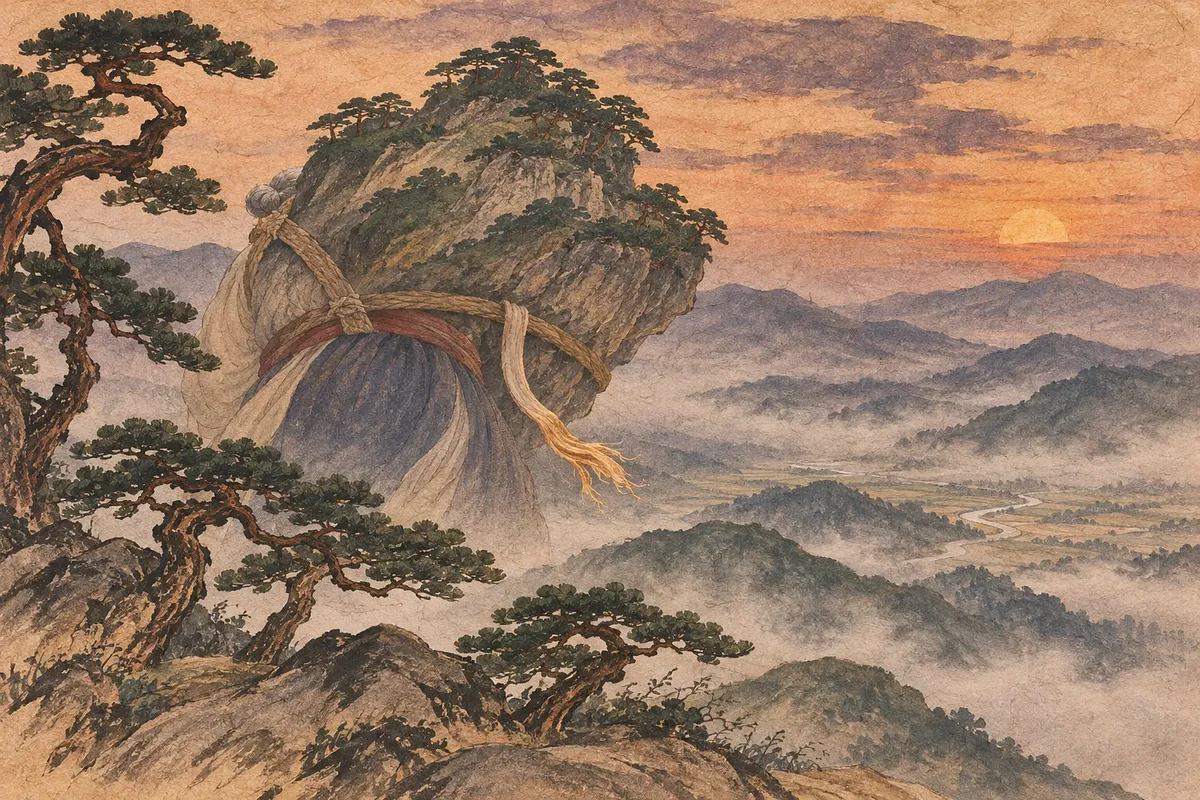
Gyeongjusan in Danjang-myeon, Miryang, is said to be a mountain that Grandmother Mago carried on her back from Gyeongju. Even after the mountain was set down in Miryang, the people of Gyeongju still considered it their own. This is a retelling of a place-name legend recorded in Sannae-myeon, Miryang, in 1981.
This piece was prepared in November 2026, following the oral account of Gyeongjusan in Danjang-myeon in the Compendium of Korean Oral Literature.
How Grandmother Mago Crossed Seoknamjae Pass
Grandmother Mago took a whole mountain from Gyeongju onto her back. She fastened a carrying harness to the mountain and slipped the straps over both shoulders. Even a mountain was just another load. She carried it over Seoknamjae Pass and down toward Miryang.
As she was crossing the pass, the strap pulling against her shoulder suddenly snapped. Grandmother Mago set the mountain down right there and went on her way. That was how a mountain came to be left in Danjang-myeon, Miryang.
As far as the people of Gyeongju were concerned, there was no reason for the mountain to change owners just because it had crossed a pass. It might stand on Miryang land, but it had originally been in Gyeongju, so they said it was still theirs. That, it is said, is why the people of Miryang also called it Gyeongjusan.
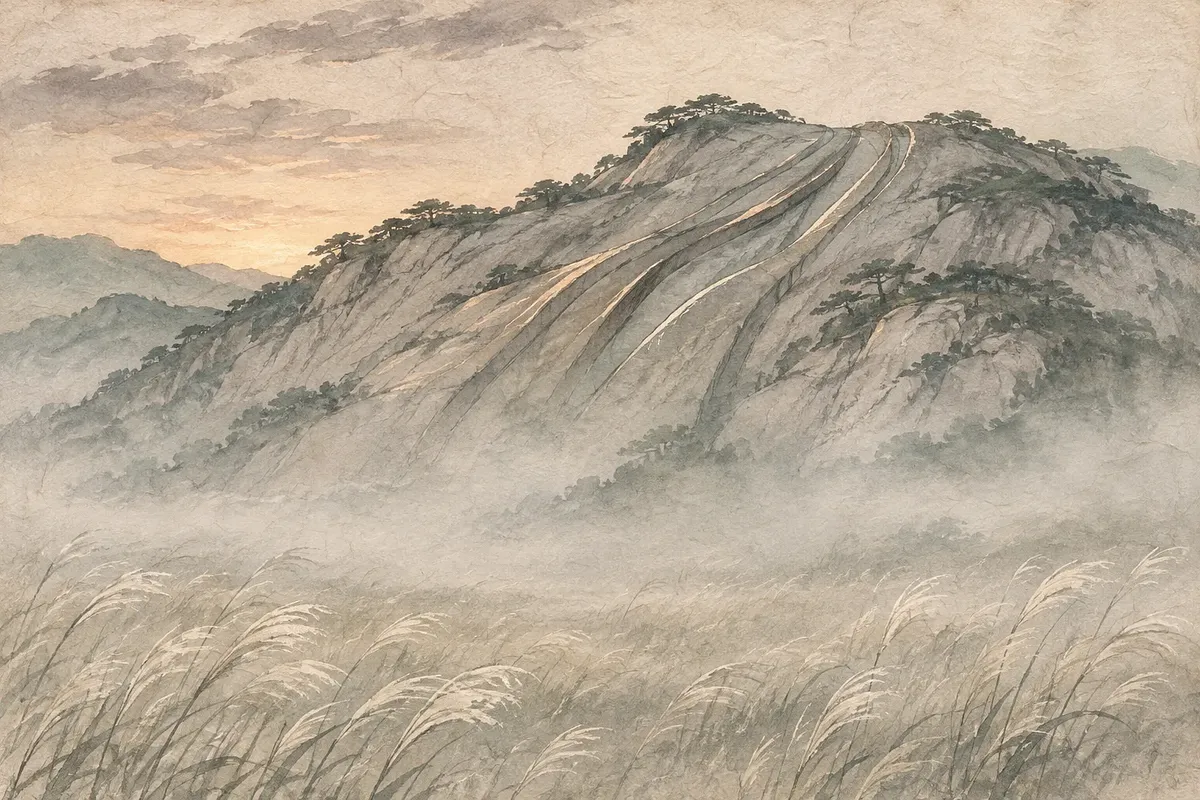
Legend says Gyeongjusan got its nickname, Jimppasan, from the marks left by Grandmother Mago’s carrying ropes.AI-generated image
The Original Source of the Gyeongjusan Legend and Where It Was Recorded
The full oral account can be read in the Academy of Korean Studies’ Compendium of Korean Oral Literature. It appears under the title “The Origin of Gyeongjusan (慶州山) in Danjang-myeon (丹場面).” Danjang-myeon is where the mountain stands.
The story was recorded in Yangsongjeong, Songbaek 2-ri, in neighboring Sannae-myeon. July 26, 1981 was the day Son Chul-heon told the story to researchers there. The record does not tell us when the mountain was first called Gyeongjusan.
The Stories Behind the Names Gyeongjusan and Jimppasan
The same carrying straps appear in both versions, but the clues to the names are different. The name Gyeongjusan points to the place the mountain came from. The nickname Jimppasan reflects how the mountain was carried there.
| Account | Clue to the Name |
|---|---|
| The oral account of Gyeongjusan in the Compendium of Korean Oral Literature | The people of Gyeongju claim the mountain as their own. Gyeongju is said to have even collected a tax on it. |
| The Jimppasan story in Local N Culture | The straps used to tie the load are said to have left marks on the mountain. Those marks explain the nickname Jimppasan. |
In the recorded account, sanse refers to a tax levied on the mountain, not to the mountain’s shape. In the story, the tax supports the Gyeongju people’s claim to the mountain. The oral account alone cannot confirm whether the tax was actually collected.
The Meaning of the Giant Woman Who Carried a Mountain
The National Folk Museum of Korea’s Encyclopedia of Korean Folk Culture describes Grandmother Mago as a giant woman who shapes the land. In the Miryang story, her strength is shown through the straps used to carry a load. She carries the mountain over the pass the way a person might carry a bundle on their back.
The tale of Obaegol told in Miryang also features marks left on a mountain. Local N Culture tells how Grandmother Mago scratched the mountain in front, leaving five fingernail marks. In the Obaegol story, her hand explains the shape of the mountain. In the Jimppasan story, it is the straps she used.