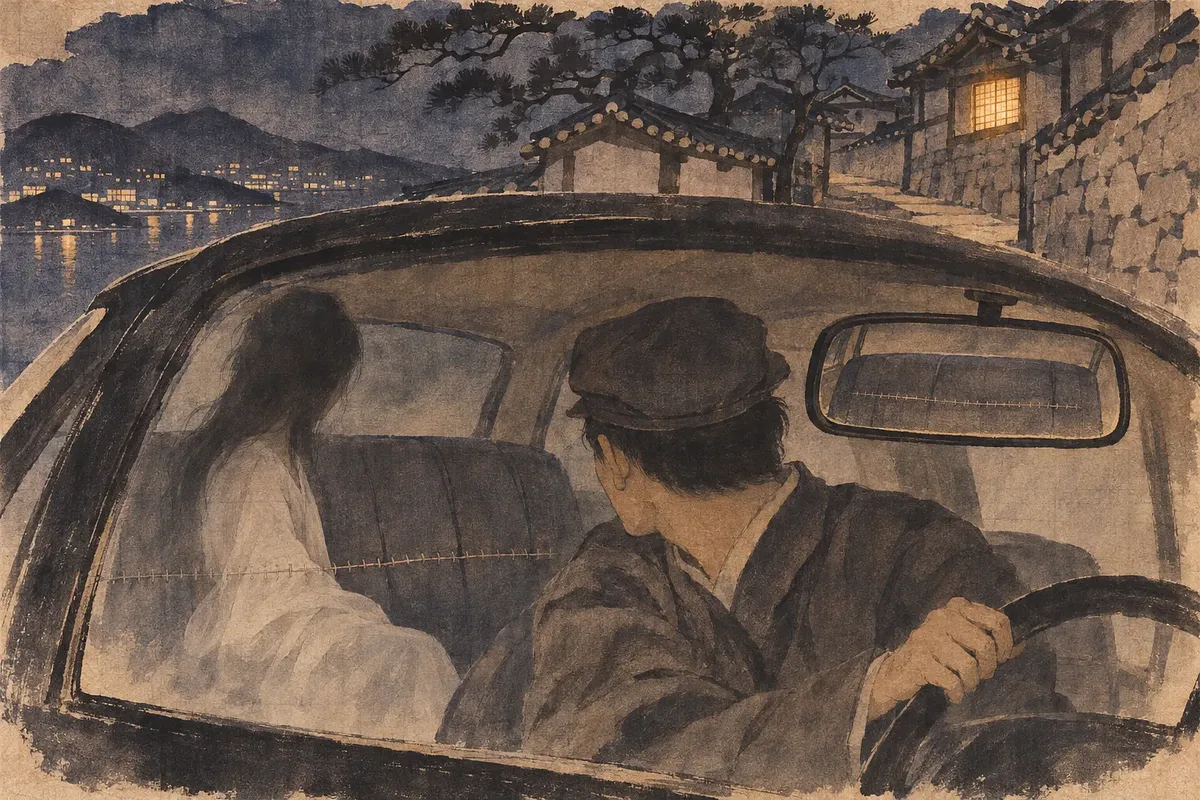
“The Taxi Driver Who Picked Up a Ghost” is an urban legend passed down by word of mouth about a driver who picked up a passenger on her way home on the day of a memorial rite. This is a retelling of a story recorded in Yeonje-gu, Busan, in 2018. The driver in the Busan story collects the fare and leaves, but the driver in the Taebaek story spends the night at the house.
This article was prepared in November 2026, based on the oral account from Yeonje-gu in volume 10 of the Busan Oral Culture Series.
The Story Told in Yeonje-gu, Busan
A woman dressed in white raised her hand by the roadside, and a taxi driver pulled over. After she got in, he glanced up at the mirror without thinking. The seat the passenger had just taken was empty. When he turned around, the woman was still sitting there, watching him.
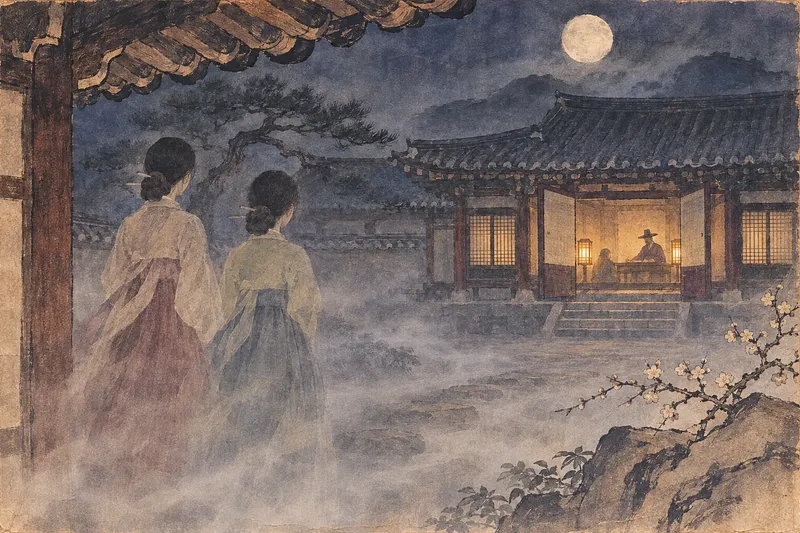
The driver pulled up in front of the house the woman had directed him to. It was nighttime, but the house was brightly lit inside. The woman asked him to wait a moment and stepped inside, into the light. The driver waited a long time, but no one opened the door and came back out.
Finally, the driver got out and knocked on the door. He said he was waiting for the passenger he had just brought there. After hearing what had happened, someone in the family said it was the day of their mother’s memorial rite, so she must have come home. The driver took the fare the family member paid on her behalf and went on his way.
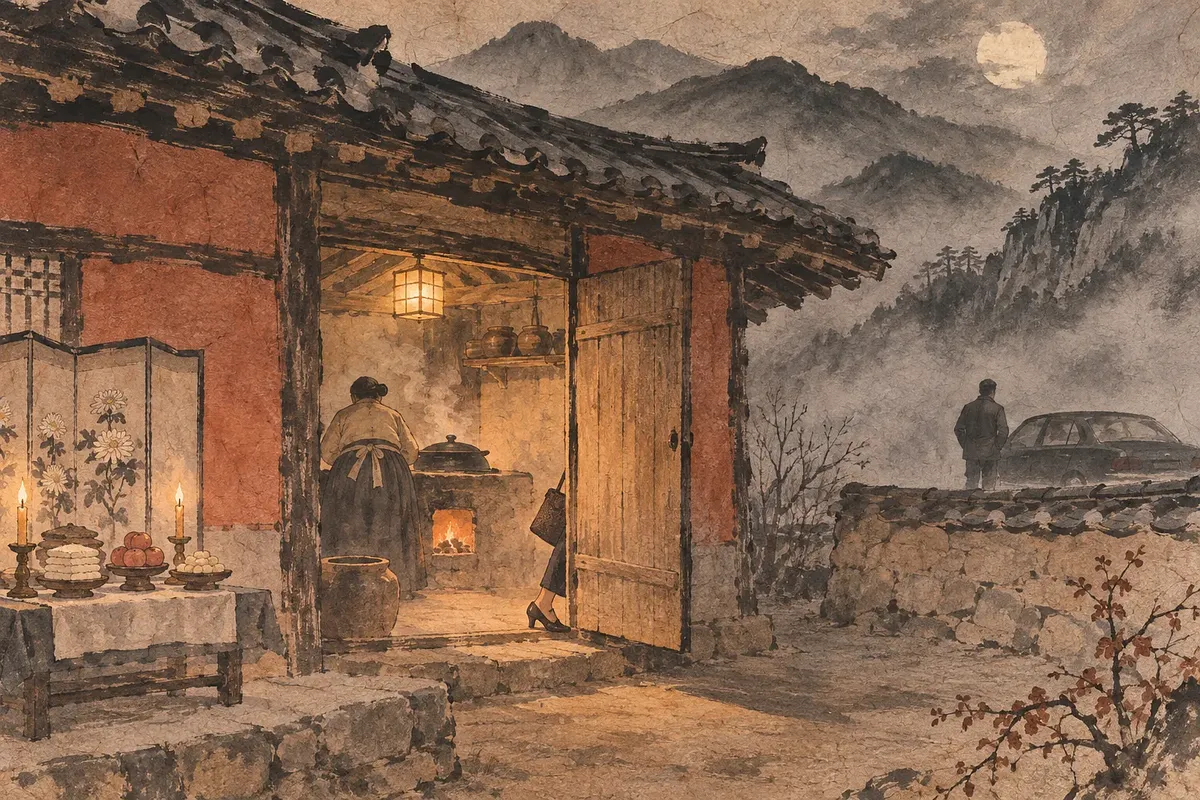
In the Taebaek telling, the driver’s account makes the father-in-law realize the passenger was his late daughter-in-law.AI-generated image
Original Sources and Recording Locations
The original source for the Busan story is an oral account on pages 322 to 323 of volume 10 of the Busan Oral Culture Series. It is titled “The Taxi Driver Who Picked Up a Ghost on Her Way to Her Memorial Rite.” Kim Ok-seon told the story on February 1, 2018, in Yeonsan 8-dong, Yeonje-gu, Busan. It appears in the book as “Yeonje-gu Folktale 168.”
The Taebaek story appears as “The Taxi Driver Who Picked Up a Ghost” in the Academy of Korean Studies’ Compendium of Korean Oral Literature. Byeon Chun-ok told it on June 2, 2012, in Samsu-dong, Taebaek. The names in the two records are those of the people who told the stories. No one knows who first made up the stories or when they first began to circulate.
Different Endings in the Busan and Taebaek Oral Accounts
The two stories end differently depending on whom the driver meets after the passenger goes inside. In Busan, a family member hears the driver out and pays the mother’s fare. In Taebaek, the person in the kitchen says no one came in, and an argument follows.
| Scene | Oral Account from Yeonje-gu, Busan | Oral Account from Samsu-dong, Taebaek |
|---|---|---|
| The moment the driver notices something strange | The driver can see the passenger when he turns around, but she does not appear in the mirror. | The passenger goes in through the kitchen door, but the person inside says they did not see her. |
| The passenger the family recognizes | A family member thinks their mother must have come home on the day of her memorial rite. | The father-in-law recognizes his late daughter-in-law from the description of her clothes and bag. |
| The fare and the driver’s final scene | The driver collects the fare from the family and leaves. | The father-in-law says he will pay the fare if the driver stays the night. The driver stays overnight, goes home the next day, and falls ill. |
In the Taebaek account, the father-in-law asks the driver to sleep beside him that night. He brings up the fare as part of the invitation. The Busan story ends when the fare is handed over, while the Taebaek story continues until the driver goes home and falls ill.
The Meaning of the Memorial Rite and the Taxi Fare
The day of the memorial rite offers a clue to why the dead passenger chose that house as her destination. To the driver, she is a passenger he has never seen before, but to the people in the house, she is a family member for whom they hold a memorial rite. Only at the end of the Busan story do the lights left on late into the night take on their meaning as lights for the mother’s memorial rite.
The fare gives the driver and the bereaved family, who do not know each other, a reason to talk. If the woman had paid when she got out, the driver would have had no reason to wait outside the house. In the Busan account, the family’s payment on her behalf can be read as a sign that they treat their dead mother like any other family member who has come home by taxi.
In a 2020 study, Yeom Won-hui compared oral accounts like these with the “vanishing hitchhiker” story told in many countries. In both, a stranger picked up in a car disappears, leaving people wondering who the stranger was. In the version in the Compendium of Korean Oral Literature, Yeom focused on the day the passenger returned. Because it was the day of the passenger’s own memorial rite, Yeom saw the story as closely related to Korean folktales about memorial rites.