The tale of Queen Hyeondeok's appearance in a dream is recorded in 『Yongcheondamjeokgi』, written by Kim An-ro during the reign of King Jungjong of Joseon. It tells of an official relocating a royal tomb who finds the coffin after receiving words of comfort in a dream. This article retells that traditional tale.
This article follows the story in 『Yongcheondamjeokgi』 and was compiled as of November 2026.
The Story
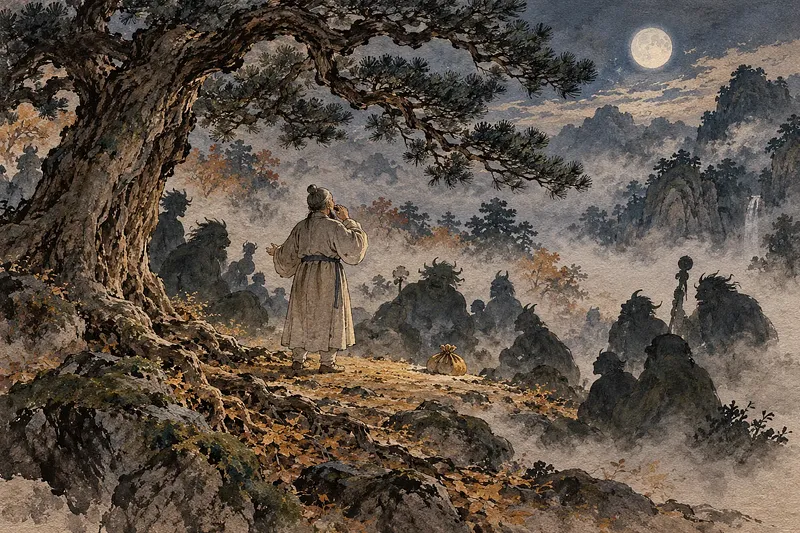
The officials relocating the tomb were in a difficult position because they could not find the coffin. People believed that a small hill was where the queen lay buried. Yet rumors also circulated that cast doubt on whether this was the right place. Even after they dug deep into the ground, the coffin did not appear.
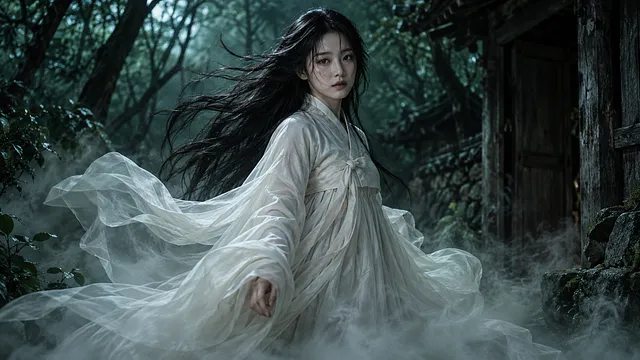
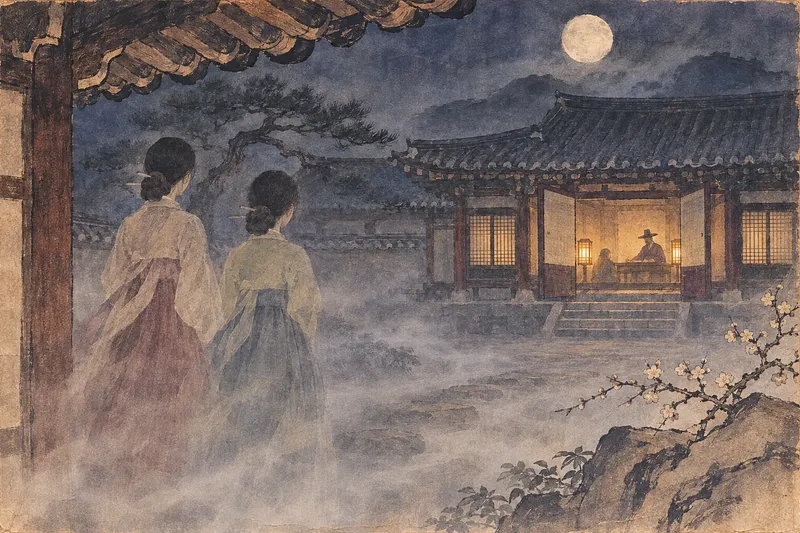
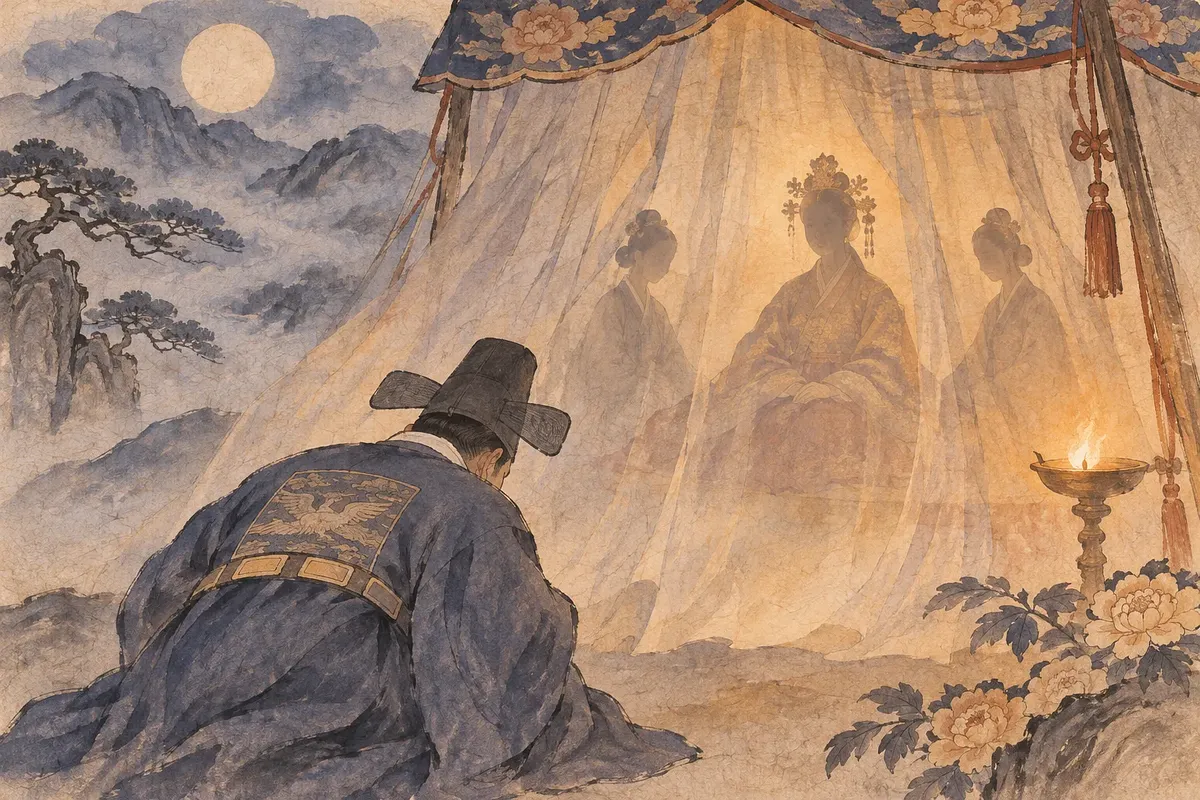
That night, the official supervising the work briefly fell asleep. In his dream, a figure dressed as a queen sat inside a tent. Two maids attended her. The figure called the official over and offered words of comfort in recognition of the workers' efforts.
The official prostrated himself in a bow, sweating in astonishment. Even after waking, he found the dream strange. The next day, the workers dug deeper in the same place. A palm-sized piece of lacquer then came up, stuck to a shovel blade.
The fragment had flaked off the thick layer of lacquer coating the queen's coffin. At last, a trace of the coffin they had been unable to find had appeared. They were able to locate the coffin and complete the tomb's relocation.
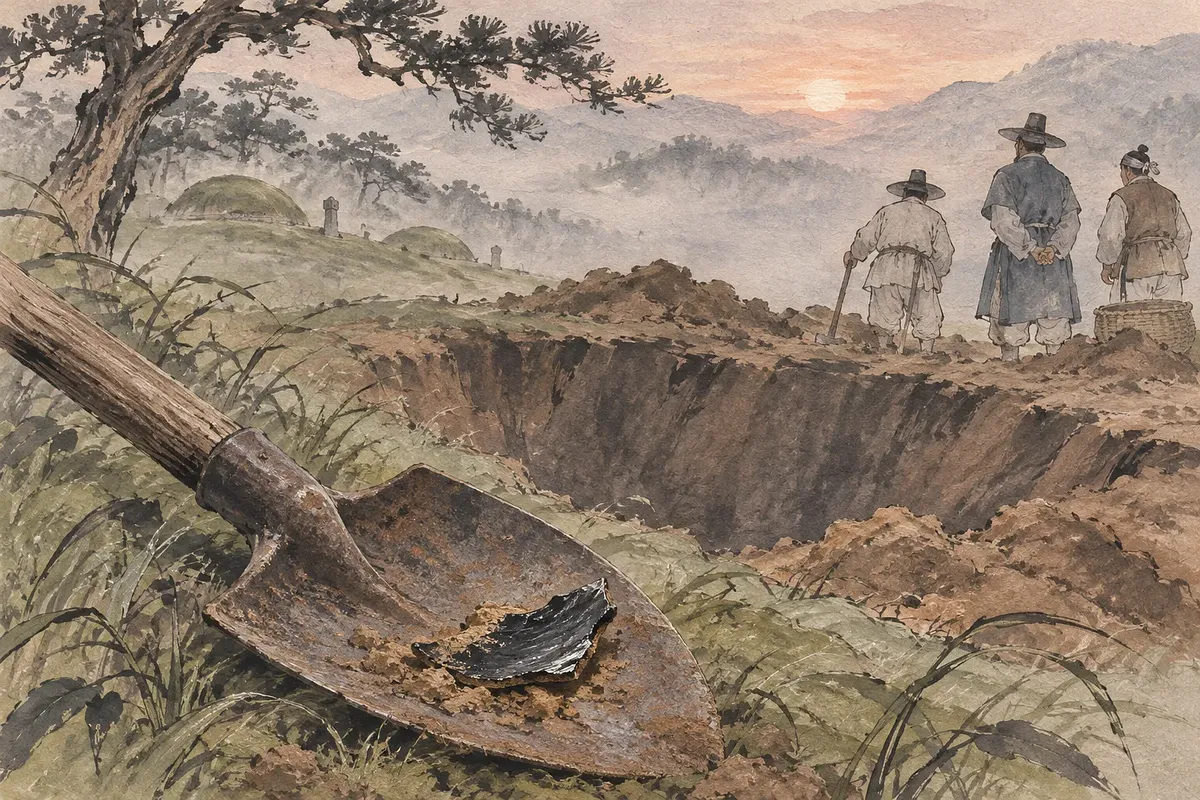
Chungwanji omits a detail of the discovery recorded in Yongcheondamjeokgi.AI-generated image
Original Source and Origins
The original source of this story is 『Yongcheondamjeokgi』 in volume 8 of 『Huirakdangmungo』. It is a collection of yadam recorded by Kim An-ro in the early Joseon period. Yadam refers to stories about people and events that circulated among the public. In this case, the story is also a folk tale preserved in writing.
The Encyclopedia of Korean Culture explains that the book contains 35 stories. It also states that the individual stories were not given separate titles. Thus, “the tale of Queen Hyeondeok's appearance in a dream” is a name used to distinguish its subject matter. It is not an original title given to the work. Encyclopedia of Korean Culture, “Yongcheondamjeokgi”
The original Classical Chinese text can be read in volume 8 of 『Huirakdangmungo』 on Wikisource. Passages concerning Soreung appear within 『Yongcheondamjeokgi』, which is classified as miscellaneous writings. The retelling above follows the scenes of the official's dream and the discovery of the coffin in those passages. The wording of modern translations or ghost story collections was not used as the basis for the retelling. Wikisource, 『Huirakdangmungo』, volume 8
Queen Hyeondeok and the Restoration of Soreung
Soreung is the name of the tomb of Queen Hyeondeok, the consort of King Munjong. Queen Hyeondeok was also the mother of King Danjong. The restoration of Soreung concerned restoring the deposed queen's status and the honors due to her. The tomb relocation in this story is connected to that restoration process.
Jeong Yong-geon's study explains that the restoration of Soreung took place in 1513. The study analyzes it as a movement to restore Confucian legitimacy. Related records also include supernatural tales recounting unusual events. However, the history of the restoration must be distinguished from whether the dream visitation actually occurred. Jeong Yong-geon, “Patterns and Significance of Records on the Restoration of Soreung by Writers during Jungjong's Reign”
Other Sources and Similar Stories
A dream visitation tale following the same sequence also appears in “Restoration of Soreung” in volume 1 of 『Chungwanji』. The sequence is the same: an official cannot find the coffin and then has a dream. The appearance of a figure dressed as a queen and two maids also matches. The difference lies in the details of the discovery of the coffin the next day.
| Point of comparison | 『Yongcheondamjeokgi』 | “Restoration of Soreung” in 『Chungwanji』 |
|---|---|---|
| Initial difficulty | They are perplexed when the coffin does not appear even after deep digging | The supervising official is bewildered because the coffin cannot be seen |
| Figures in the dream | A figure dressed as a queen and two maids | A figure dressed as a queen and two maids |
| Action in the dream | Calls the official over and offers words of comfort in recognition of his efforts | Calls the official over and offers words of comfort in recognition of his efforts |
| Directions to the burial site | No words specifying the location | No words specifying the location |
| Discovery the next day | After deeper digging, a piece of lacquer comes up stuck to a shovel blade | States that they dug deeper and found the coffin |
| Explanation of the lacquer fragment | Explains that it had flaked off the thick lacquer coating on the coffin | Does not include this description |
The omission of the lacquer fragment in 『Chungwanji』 does not change the ending. Both records retain the sequence in which the coffin is found the day after the dream. 『Yongcheondamjeokgi』 describes the clue to the discovery as a visible object. 『Chungwanji』 describes that scene briefly. Korean History Database, 『Chungwanji』, volume 1, “Restoration of Soreung”
Are the Two Records Independent Eyewitness Accounts?
The two sources cannot be treated as independent eyewitness evidence. The fact that similar sentences have been passed down does not by itself establish separate testimony. The textual collation notes in the Korean History Database also show a connection between the two texts. Textual collation is the process of comparing editions to correct or supplement characters.
Some characters in “Restoration of Soreung” were corrected with reference to the version included in 『Daedongyaseung』. The text consulted was 『Yongcheondamjeokgi』 itself. This is editorial information to consider when reading the text currently available to the public. However, this fact alone cannot establish the entire path by which the story was transmitted.
Relationship to the Tale of Jeong Mong-ju's Dream Visitation
『Yongcheondamjeokgi』 also contains a story in which Jeong Mong-ju appears in a dream. This passage connects a dead person's dream visitation with a place for memorial rites. Comparing it with the Queen Hyeondeok story reveals differences in what is said in the dreams.
| Point of comparison | Tale of Queen Hyeondeok's dream visitation | Tale of Jeong Mong-ju's dream visitation |
|---|---|---|
| Related location | The site of the tomb relocation | Jeong Mong-ju's shrine |
| Words spoken in the dream | Offers words of comfort in recognition of the workers' efforts | Says that the shrine has collapsed and he cannot shelter from the wind and rain |
| What follows | The coffin is found and the tomb relocation is completed | The shrine is repaired |
In the Jeong Mong-ju story, the words spoken in the dream refer directly to the condition of the shrine. The Queen Hyeondeok story contains no statement revealing the burial location. Mixing the details of similar dream visitation tales erases the differences between the original sources.
Folklore in the Story
This story illustrates the belief that people can communicate with the dead through dreams. A dream visitation means the appearance of a dead person or a spiritual being in a dream. Here, a figure appearing in the form of the queen speaks to the official. This is what happens in the story, not a statement that actual communication has been verified.
Memorial rites and the care of royal tombs also form the background to this tradition. Memorial rites are ceremonies honoring the dead. Tomb care means guarding and tending a tomb. The original text states that memorial rites and tomb care ceased after the tomb was decommissioned.
Against this background, the discovery of the coffin is connected to the meaning of the restoration. It can be interpreted as the scene in which the work of honoring the queen once again is completed. The words of comfort in the dream can also be read as recognition of those carrying out that work. This is a narrative interpretation, not an explanation proving a supernatural cause.
Jeong Yong-geon's 2020 study analyzes the political significance of the restoration records. It also examines supernatural tales within records that express the justification for the restoration. This dream visitation tale can therefore be read in the context of the Confucian order of the time. It should not be used as the basis for a guide to present-day haunted locations.
Key questions in this article
Did Queen Hyeondeok's Dream Visitation Really Happen?
The dream visitation itself has not been verified as a historical fact. This is a traditional tale recorded in a Joseon-period source. The historical event of Soreung's restoration must be distinguished from whether the dream actually occurred.
Did the Queen Reveal the Coffin's Location in the Dream?
The relevant passages in the two sources contain no specific directions to the location. The figure in the dream offers words of comfort in recognition of the official's efforts. The coffin is discovered during deeper digging the next day.
Why Is the Lacquer Fragment Worth Noting?
The lacquer fragment is the clue to the discovery described in 『Yongcheondamjeokgi』. The original text explains that it had flaked off the thick lacquer coating on the coffin. 『Chungwanji』 omits this detail.
Where Can the Original Text Be Read?
The original text of 『Yongcheondamjeokgi』 is in volume 8 of 『Huirakdangmungo』 on Wikisource. The passage for comparison is “Restoration of Soreung” in volume 1 of 『Chungwanji』. That text can be read in the National Institute of Korean History's Korean History Database.
What Does This Story Mean?
The story connects the deceased queen's appearance in a dream with the completion of the tomb relocation. It can be read as a narrative recognizing the efforts of those who worked for her restoration. This interpretation is distinct from a claim that the dream visitation was real.