Injoys
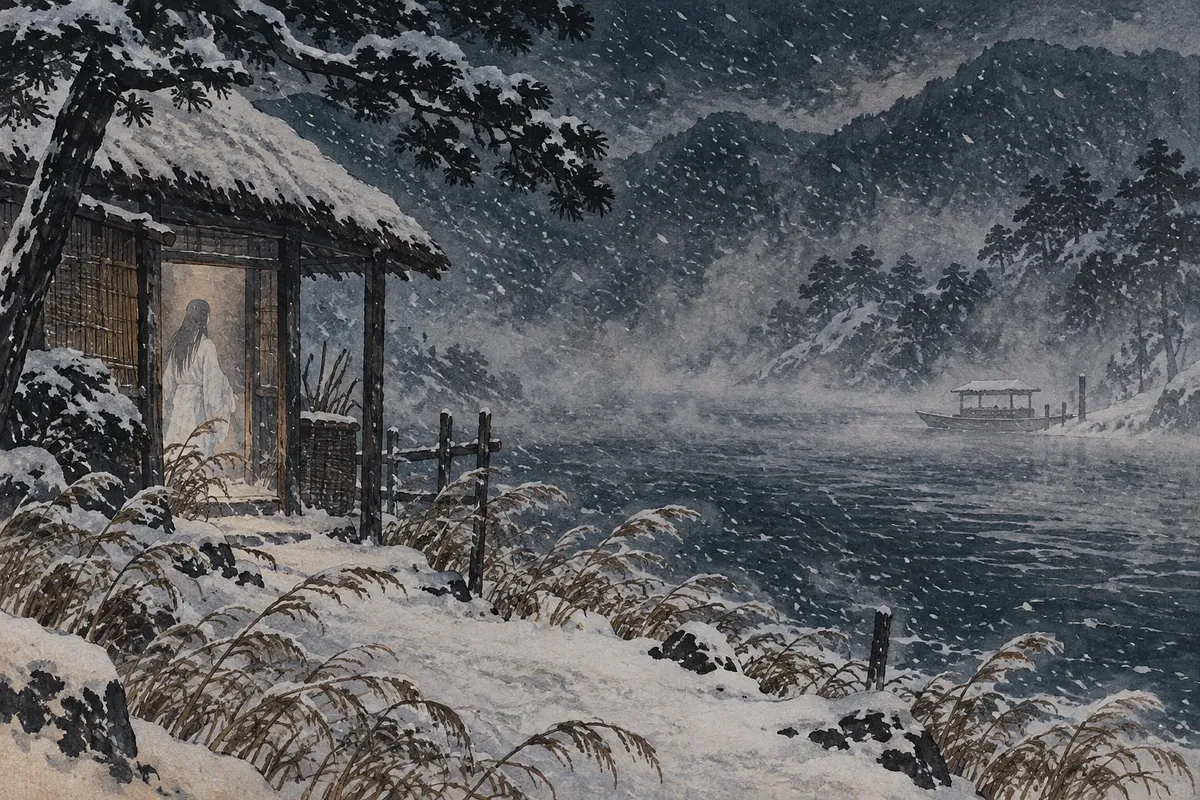
Yuki-onna (雪女) is a Japanese tale about a woman of the snow. This article is a retelling based on Lafcadio Hearn's 1904 book, Kwaidan. It retells the traditional tale of a man who survives by keeping a secret, marries the snow woman, and later parts from her.
This article follows “Yuki-Onna” in Kwaidan and was prepared as of October 2026.
The Story
Minokichi was a woodcutter who met the snow woman in a hut where he had taken shelter from a blizzard. He cut wood with an old man named Mosaku in a village in Musashi Province. One winter evening, a fierce blizzard struck on their way home. By the time they reached the river, the ferry was already on the opposite bank.
The two men went into the ferryman's small hut. There was nowhere to light a fire, so they lay down under their straw raincoats. The hut shook whenever the wind battered the door. After enduring the cold for a while, Minokichi also fell asleep.
He woke to snowflakes touching his face and found the door open. A woman dressed in white was bending over Mosaku. Her breath settled over him like white mist. Soon, she approached Minokichi.
The woman said she would spare Minokichi because he was young and she pitied him. But she set one condition: he must never tell anyone what he had seen that night. She also warned that she would take his life if he broke his promise. After the woman disappeared, Minokichi realized that Mosaku was dead.
The ferryman found Minokichi when he returned the next day. Minokichi was ill for some time, but once he recovered, he went back to cutting wood. He did not tell even his mother about the woman in white. That night remained a memory he kept to himself.
Marriage to O-Yuki
The following winter, Minokichi met a woman named O-Yuki on the road. O-Yuki said that her parents had died and that she was on her way to find relatives. The two walked side by side and talked. When they reached the village, Minokichi invited her to rest at his home.
His mother welcomed O-Yuki warmly. O-Yuki stayed at the house and later married Minokichi. They had ten children together. Even as the years passed, O-Yuki's face remained as young as when they first met.
The Night He Told the Secret
It was his wife whom Minokichi told about the events of long ago. One night, O-Yuki was sewing by lamplight. As Minokichi looked at her face, he remembered the night of the blizzard. He thought that his wife resembled the woman he had met then.
O-Yuki asked where he had seen that woman. Minokichi told her what had happened in the hut. He added that he still did not know whether it had been a dream. As she listened, O-Yuki put down her sewing.
O-Yuki revealed that she herself had been the woman that night. She then said that Minokichi had broken his promise to keep the secret. But she did not take his life because of their children. Before leaving, she told him to take good care of them.
O-Yuki's voice grew faint, like the sound of the wind. Her body turned into a thin white mist. The mist escaped through the smoke hole in the roof. No one ever saw O-Yuki again.
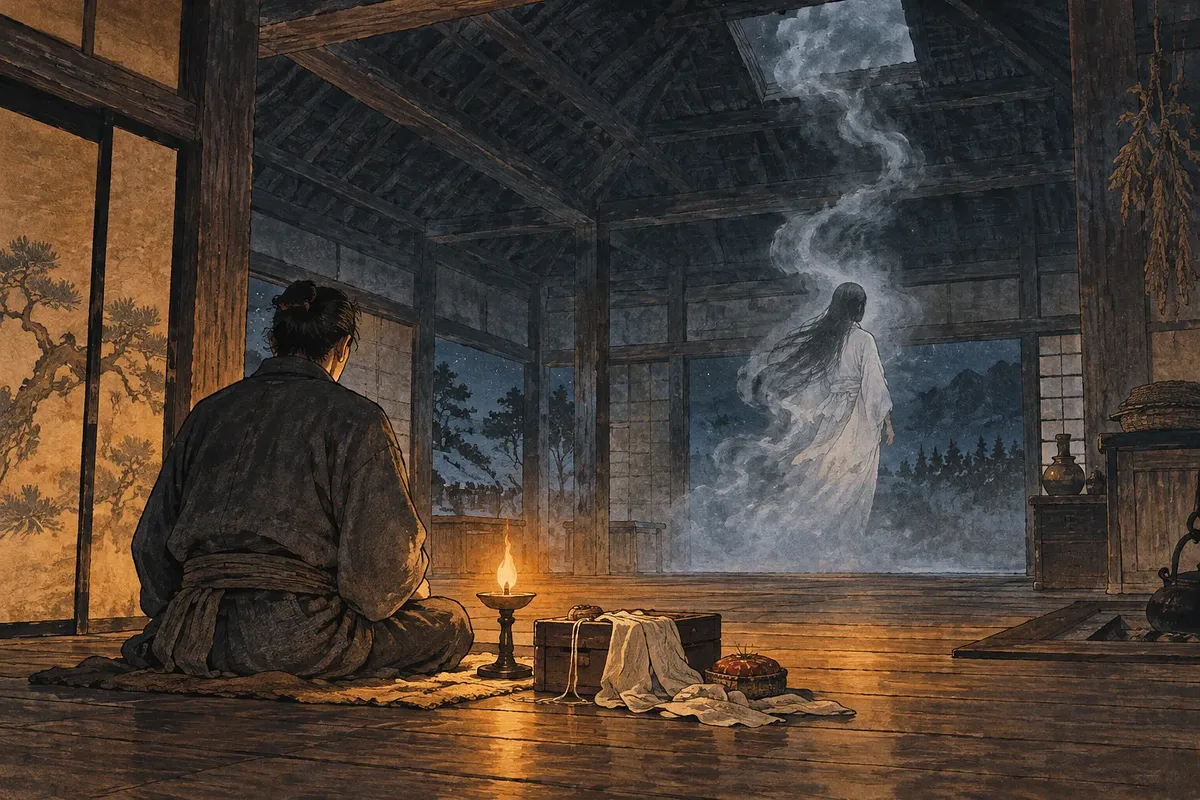
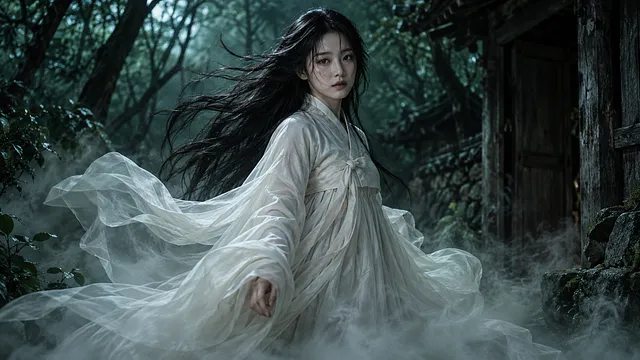
After her husband reveals the secret, Yuki-onna leaves her family and never returns.AI-generated image
The Original Text and Its Origins
The source text for this article is “Yuki-Onna” in Kwaidan, published in 1904. The book's full title appears in the bibliographic details below. This retelling did not use a modern Korean translation as an intermediary. It was based directly on the publicly available English original on Project Gutenberg.
- Author: Lafcadio Hearn
- Book title: Kwaidan: Stories and Studies of Strange Things
- Included story: Yuki-Onna
- Publication year: 1904
- Original text: English text of Kwaidan on Project Gutenberg
Where Did the Author Hear the Story?
The author wrote that he heard it from a farmer in Chofu, Nishitama District, Musashi Province. The farmer told it as a legend of his own village. This explanation appears in the author's preface dated January 20, 1904. The place names here identify the route by which the author said the story reached him.
The author stated that he did not know whether the story had ever been recorded in Japanese. It therefore cannot be assumed that the work was translated from a particular Japanese book. The account of hearing it from a farmer does not prove that the events were real, either. What can be confirmed is the oral source described by the author and the published English text.
Was 1904 the Year the Snow Woman First Appeared?
1904 is the year this book was published. It does not mark the beginning of snow woman folklore. The publication of this version must be distinguished from the origins of the snow woman motif. The records examined here alone cannot establish when snow woman folklore as a whole began.
Other Versions and Similar Stories
A record of folklore from Echigo (越後) shows a different form of the same snow woman motif. In the record held by the International Research Center for Japanese Studies, a woman in white appears and then disappears. Its summary does not mention marriage or the disclosure of a secret. The comparison below is limited to what that summary states.
| Point of comparison | Yuki-Onna in Kwaidan | Summary of the Echigo folklore record |
|---|---|---|
| Main scene | A man meets a woman in a hut during a blizzard | A woman in white is seen, then lost from view |
| Relationship with humans | She marries Minokichi and forms a family | No mention of marriage |
| Condition in the story | He must not speak of what he saw that night | No condition requiring secrecy |
| What prompts her disappearance | Her husband speaks of their past encounter | She disappears while someone is trying to get a clear look at her |
| Connection with snow | A blizzard forms the setting for the first encounter | She is said to appear rarely in years of heavy snowfall |
The source used for this comparison is the snow woman record at the International Research Center for Japanese Studies. Its record number is 1230004_001. This card summarizes material from a publication issued in 1928. That year cannot be treated as the year the tradition itself began.
Neither source has been confirmed as a direct source for the other. The shared feature of a woman in white is not enough to establish that one influenced the other. What the comparison shows is that stories can have different structures even when they share the same motif.
Folklore in the Story
The belief evident in snow woman folklore concerns a being who appears with snow. The Echigo record describes rare appearances in years of heavy snowfall. This cannot be generalized into a single belief shared throughout Japan.
The Taboo Against Telling the Secret
In “Yuki-Onna,” the taboo is the condition that Minokichi must not speak of what he saw that night. A taboo marks a boundary that must not be crossed within the story. At first, Minokichi survives because of this condition. Later, his words violate it and bring about the couple's separation.
This can be read as a boundary that sustains the relationship between a human and the snow woman. However, this is a literary interpretation based on the structure of the plot. It is not evidence that people at the time actually followed the same rule.
Marriage to a Nonhuman Being
The marriage of O-Yuki and Minokichi is a marriage between a human and a nonhuman being. This kind of narrative structure is called interspecies marriage. O-Yuki does not reveal her identity while living with her family. Her unchanging youth offers a clue that she is not an ordinary human.
In this version, the unfamiliar being does not remain outside the home. As a wife and mother, she shares in the family's daily life. For this reason, the moment her identity is revealed is also the moment the family is lost. This explanation, too, is an interpretation based on scenes in the work.
Why She Spares Her Husband at the End
O-Yuki spares her husband because of their children. The original text states this reason directly. But choosing to spare his life does not mean that she will continue living with him. Once O-Yuki leaves, she never appears again.
The ending can be read as a scene in which the violation of a taboo comes into conflict with attachment to family. The husband who broke his promise faces separation. At the same time, concern for the children prevents his death. Reading it only as a simple revenge tale diminishes the meaning of her final choice.
- The disclosure of the secret leads to the revelation of her identity.
- The children are the reason she spares her husband.
- The final event is not the couple's reunion but their permanent separation.
Key questions in this article
Is Yuki-onna, the Snow Woman, a True Story?
Yuki-onna is a traditional folktale, not an event confirmed as fact. The author stated that he heard it from a farmer as a village legend. This account records how the story was passed on. It cannot be treated as evidence that a snow woman actually appeared.
Where Can I Read the Original Text?
You can read the English original of Kwaidan on Project Gutenberg. Look for “Yuki-Onna” in the table of contents. The ebook information page also lists the available download formats.
Are O-Yuki and the Snow Woman in the Blizzard the Same Being?
In this version, they are the same being. When Minokichi speaks of the past, O-Yuki reveals her identity herself. Reading the story as though he knew her identity from the beginning when he married her changes the plot.
Why Does the Snow Woman Leave Instead of Killing Her Husband?
In the original text, O-Yuki spares her husband because of their children. She tells him to take good care of them. She then turns into mist and disappears, never to appear again.
What Does the Snow Woman Story Mean?
It is a story in which the marriage ends when the condition of keeping a secret is broken. Attachment to family becomes the reason the husband's life is spared. The ending can be interpreted as a conflict between taboo and family affection. This interpretation is grounded in the work, but it is not a single, fixed moral.
Do All Snow Woman Stories Include Marriage and Children?
Snow woman folklore cannot be reduced to a single plot. The summary of the Echigo record used in the comparison does not mention marriage or children. That record centers on a scene in which a woman in white appears and then disappears.
Does the Snow Woman Story Come from Halloween?
The snow woman story followed in this article was passed down as a Japanese village legend. The records examined contain no evidence that it originated in Halloween. It can be presented as a ghost story to read around Halloween. Since its subject is snow and blizzards, it can be read regardless of the season.