Skip to content
Injoys
Knowledge Base

Nephron Structure and Filtrate Reabsorption

The nephron is the functional unit of the kidney that filters blood and returns needed substances. A calculation example shows the difference between filtrate and final urine, but kidney function cannot be assessed from urine volume alone.

Listen or read this article

10:05

Listen, or read the text only.

Nephron Structure and Filtrate Reabsorption

Kokoro 82M AI-generated voice 11 min read

0:00 10:05

Advertisement

Download audio

File name
nephron-structure-filtration-and-reabsorption-en.mp3
Format
MP3 (audio/mpeg)
Duration
10:05
File size
6.92 MB
Engine
Kokoro 82M

This audio was generated by AI.

You may download and use it freely for personal use.

Nephron Structure and Filtrate Reabsorption

8 min read

Nephron Structure and Filtrate Reabsorption
The nephron is the functional unit of the kidney that filters blood and returns needed substances. A calculation example shows the difference between filtrate and final urine, but kidney function cannot be assessed from urine volume alone.
Each kidney has about 1 million nephrons, but the number varies from person to person.
Filtrate produced in the glomerulus contains water and needed substances as well as waste products.
The tubules reabsorb needed substances and secrete some substances into the tubules.
Assuming 150 liters of filtrate and 1.5 liters of urine per day, the reabsorption rate is about 99%.
Kidney function is evaluated using both blood and urine tests, not urine volume alone.
A nephron is the smallest functional unit in the kidney that filters blood and produces urine. The initial filtrate formed by the glomerulus undergoes reabsorption in the tubules. As necessary substances return to the blood, the final urine volume becomes much smaller than the volume of the initial filtrate.
The nephron count is described based on NIDDK guidance reviewed in June 2018.
What Is a Nephron?
A nephron is a microscopic structure responsible for filtration and the regulation of substances in the kidney. The kidneys are located on either side of the spine below the ribs. An adult kidney is generally about the size of a fist.
Each kidney has about 1 million nephrons. Together, the two kidneys can be described as having about 2 million. This number is not the same for everyone. This is based on NIDDK's explanation of kidney structure and function.
The number of nephrons varies from person to person. A study of healthy kidney donors also observed differences by age. Older groups had fewer functioning nephrons. These findings can be found in the study on nephron number and aging.
Structure of the Glomerulus and Tubules
A nephron consists of a renal corpuscle and a tubule. The renal corpuscle consists of the glomerulus and the Bowman's capsule surrounding it. The glomerulus contains a cluster of small blood vessels. The tubule is a thin tube through which filtered fluid travels.
Structure | Location or connection | Main role Glomerulus | Cluster of capillaries within the renal corpuscle | Filters water and small substances from the blood Bowman's capsule | Structure surrounding the glomerulus | Receives filtrate and passes it to the tubule Tubule | Tube extending from Bowman's capsule | Regulates fluid composition through reabsorption and secretion Collecting duct | Duct connected to several nephrons | Helps regulate water and collects urine
The tubules and ureters are different structures. The tubules regulate the composition of filtrate within the kidneys. The ureters carry urine produced by the kidneys to the bladder. The correct Korean term is ‘세뇨관,’ not ‘세노관.’
Comparing Blood Flow to the Kidneys and Initial Filtrate
The amount of blood entering the kidneys and the volume of initial filtrate are different measurements. About 25% of the blood pumped by the heart flows through the kidneys. This does not mean that 20% to 25% of the blood is discarded as urine. Blood passes through the kidneys repeatedly throughout the day.
Category | Meaning | Key distinction Renal blood flow | Amount of blood entering the kidneys over a given period | Includes both blood cells and plasma Glomerular filtration rate | Amount of fluid filtered from plasma into Bowman's capsule | Different from the total amount of blood passing through the kidneys Final urine volume | Amount of fluid excreted after reabsorption and secretion | Much smaller than the initial filtrate first produced
Initial filtrate is the fluid first filtered by the glomerulus. A normal filtration barrier keeps blood cells and most large proteins in the blood vessels. Water and small substances can pass through this barrier. The distinction between blood flow and filtration volume is based on the explanation of glomerular filtration rate physiology.
How Do Filtration, Reabsorption, and Secretion Differ?
Filtration is the process of producing initial filtrate from the blood. Reabsorption returns substances inside the tubule to the blood. Secretion moves substances from the blood into the tubule.
Process | Direction of substance movement | Typical example Filtration | From blood in the glomerulus to Bowman's capsule | Water and small solutes enter the initial filtrate Reabsorption | From inside the tubule toward the blood | Recovery of water and necessary nutrients Secretion | From the blood into the tubule | Helps eliminate hydrogen ions and some drug components
The glomerulus does not selectively filter only waste products. Initial filtrate also contains substances the body needs, such as glucose. Recovering these substances is the role of the tubules. The movement of substances in the tubules is regulated according to the body's condition.
Therefore, the substances in urine are not determined by filtration alone. The amount excreted decreases depending on how much is reabsorbed. The amount secreted acts to increase excretion. This distinction is also explained in the NIDDK workshop report on kidney function assessment.
Calculation Example Using 150 Liters of Initial Filtrate and 1.5 Liters of Urine
Assuming 150 liters of initial filtrate and 1.5 liters of urine per day, the difference is 148.5 liters. This is a simple calculation for understanding the percentage reabsorbed. The two figures are not an individual's test results or criteria for determining what is normal.
· Set the daily initial filtrate volume at 150 liters. · Set the final daily urine volume at 1.5 liters. · The difference is 150 liters - 1.5 liters = 148.5 liters. · The difference as a percentage of the initial filtrate is 148.5 ÷ 150 × 100 = 99%.
In this example, about 99% of the initial filtrate volume was reabsorbed. About 1% remained as final urine. This calculation explains the movement of water. It does not mean that 99% of all waste products are reabsorbed.
The actual daily filtration volume is not the same for everyone. Medical education materials sometimes describe it as about 180 liters per day. Urine volume is also affected by water intake and the amount lost through sweating, among other factors. This information can be found in the explanation of glomerular filtration rate and NIDDK's guide to the urinary tract.
The Kidneys' Role in Regulating Water and Electrolytes
The kidneys regulate the volume and composition of body fluids. Electrolytes are ions dissolved in body fluids, such as sodium and potassium. The kidneys regulate how much of these substances is excreted. They also help regulate blood acidity.
Kidney functions also include hormonal activity. The kidneys produce substances involved in regulating blood pressure. They also secrete a hormone that helps produce red blood cells. They help maintain bone health as well. These functions are described in NIDDK's guide to kidney function.
Common Mistakes About Initial Filtrate and Urine
Interpreting initial filtrate volume as the amount of water to drink or as a health goal leads to incorrect conclusions. Most of the water in the initial filtrate returns to the blood. The figures and concepts below should each be understood differently.
Common misconception | Correct interpretation If 150 liters of initial filtrate are produced per day, that much water must be consumed | Most of the water in the initial filtrate is reabsorbed, so it differs from water intake 1.5 liters of urine per day is the goal for everyone | This is an illustrative example, and urine volume varies among individuals The glomerulus retains all necessary substances | Small nutrients are also filtered and later reabsorbed Frequent urination means that nephrons are functioning well | Urination frequency is also affected by the bladder's storage capacity Urine is produced in the bladder | Urine is produced in the kidneys and stored in the bladder
Urine travels through the ureters and collects in the bladder. Urine stored in the bladder leaves the body through the urethra. Urine production and storage are different functions. This pathway can be found in NIDDK's explanation of urinary tract anatomy.
Can Kidney Function Be Determined from Urine Volume Alone?
Urine volume alone cannot determine whether kidney function is normal. The amount of water excreted is not the same indicator as the ability to remove waste products. Both blood and urine tests are used to assess kidney function.
Test indicator | What it measures | How it differs from urine volume eGFR, the estimated glomerular filtration rate | Filtration function estimated from blood test results | Not a measurement of daily urine volume UACR, the urine albumin-creatinine ratio | The amount of albumin passing into the urine | A clue used to assess kidney damage
Albumin is a protein found in the blood. When the kidneys are damaged, more albumin may be excreted in the urine. Test results are interpreted by considering not only a single measurement but also trends over time. The meaning of each test can be found in NIDDK's guide to chronic kidney disease testing.
0:00 0:00
1 / 42

Advertisement

Download text

File name
nephron-structure-filtration-and-reabsorption-en.txt
Format
TXT (text/plain)
Paragraphs
42

Downloads exactly what you see as a text file.

Please cite the source when quoting.

Large text

Makes the text larger and the colors clearer. Turn it on if the text feels too small.

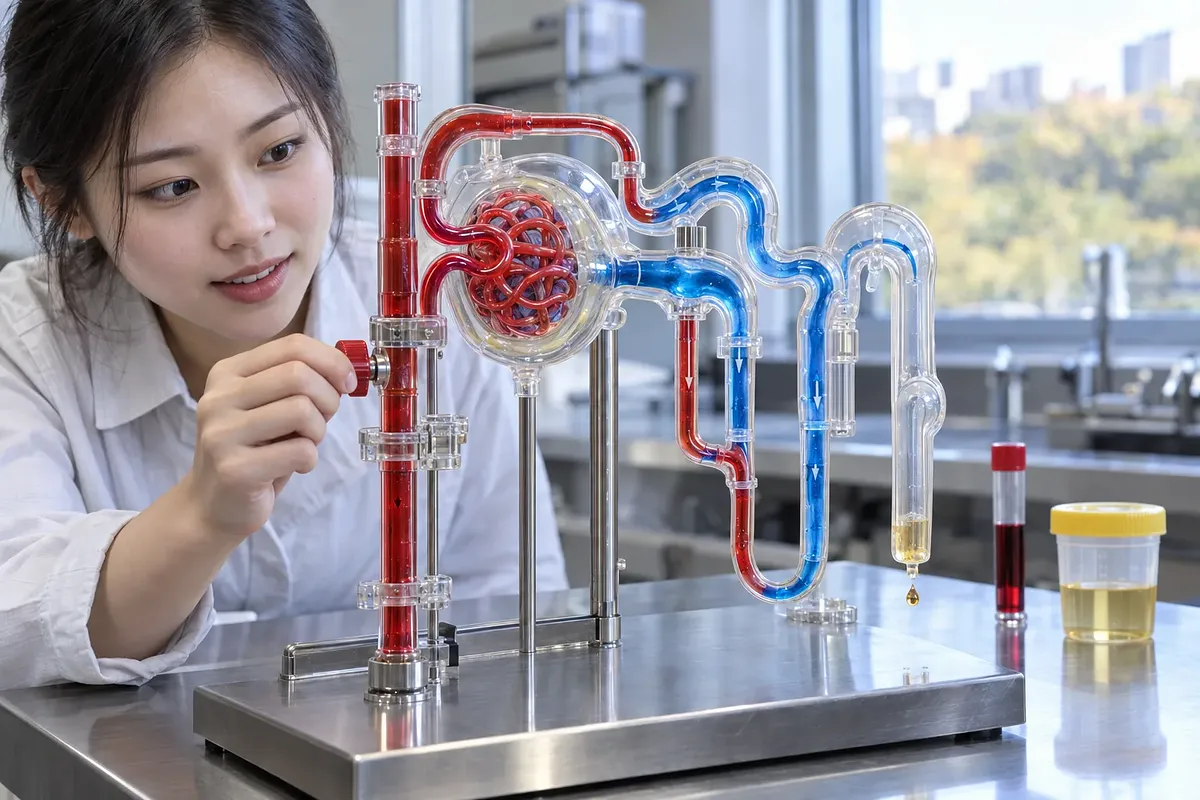
The model demonstrates glomerular filtration and reabsorption along the renal tubules.

Key points

  • Each kidney has about 1 million nephrons, but the number varies from person to person.
  • Filtrate produced in the glomerulus contains water and needed substances as well as waste products.
  • The tubules reabsorb needed substances and secrete some substances into the tubules.
  • Assuming 150 liters of filtrate and 1.5 liters of urine per day, the reabsorption rate is about 99%.
  • Kidney function is evaluated using both blood and urine tests, not urine volume alone.

A nephron is the smallest functional unit in the kidney that filters blood and produces urine. The initial filtrate formed by the glomerulus undergoes reabsorption in the tubules. As necessary substances return to the blood, the final urine volume becomes much smaller than the volume of the initial filtrate.

The nephron count is described based on NIDDK guidance reviewed in June 2018.

What Is a Nephron?

A nephron is a microscopic structure responsible for filtration and the regulation of substances in the kidney. The kidneys are located on either side of the spine below the ribs. An adult kidney is generally about the size of a fist.

Each kidney has about 1 million nephrons. Together, the two kidneys can be described as having about 2 million. This number is not the same for everyone. This is based on NIDDK's explanation of kidney structure and function.

The number of nephrons varies from person to person. A study of healthy kidney donors also observed differences by age. Older groups had fewer functioning nephrons. These findings can be found in the study on nephron number and aging.

The clinicians use a kidney model to review nephron structure and the path of filtrate.

Structure of the Glomerulus and Tubules

A nephron consists of a renal corpuscle and a tubule. The renal corpuscle consists of the glomerulus and the Bowman's capsule surrounding it. The glomerulus contains a cluster of small blood vessels. The tubule is a thin tube through which filtered fluid travels.

Structure Location or connection Main role
Glomerulus Cluster of capillaries within the renal corpuscle Filters water and small substances from the blood
Bowman's capsule Structure surrounding the glomerulus Receives filtrate and passes it to the tubule
Tubule Tube extending from Bowman's capsule Regulates fluid composition through reabsorption and secretion
Collecting duct Duct connected to several nephrons Helps regulate water and collects urine

The tubules and ureters are different structures. The tubules regulate the composition of filtrate within the kidneys. The ureters carry urine produced by the kidneys to the bladder. The correct Korean term is ‘세뇨관,’ not ‘세노관.’

Comparing Blood Flow to the Kidneys and Initial Filtrate

The amount of blood entering the kidneys and the volume of initial filtrate are different measurements. About 25% of the blood pumped by the heart flows through the kidneys. This does not mean that 20% to 25% of the blood is discarded as urine. Blood passes through the kidneys repeatedly throughout the day.

Category Meaning Key distinction
Renal blood flow Amount of blood entering the kidneys over a given period Includes both blood cells and plasma
Glomerular filtration rate Amount of fluid filtered from plasma into Bowman's capsule Different from the total amount of blood passing through the kidneys
Final urine volume Amount of fluid excreted after reabsorption and secretion Much smaller than the initial filtrate first produced

Initial filtrate is the fluid first filtered by the glomerulus. A normal filtration barrier keeps blood cells and most large proteins in the blood vessels. Water and small substances can pass through this barrier. The distinction between blood flow and filtration volume is based on the explanation of glomerular filtration rate physiology.

How Do Filtration, Reabsorption, and Secretion Differ?

Filtration is the process of producing initial filtrate from the blood. Reabsorption returns substances inside the tubule to the blood. Secretion moves substances from the blood into the tubule.

Process Direction of substance movement Typical example
Filtration From blood in the glomerulus to Bowman's capsule Water and small solutes enter the initial filtrate
Reabsorption From inside the tubule toward the blood Recovery of water and necessary nutrients
Secretion From the blood into the tubule Helps eliminate hydrogen ions and some drug components

The glomerulus does not selectively filter only waste products. Initial filtrate also contains substances the body needs, such as glucose. Recovering these substances is the role of the tubules. The movement of substances in the tubules is regulated according to the body's condition.

Therefore, the substances in urine are not determined by filtration alone. The amount excreted decreases depending on how much is reabsorbed. The amount secreted acts to increase excretion. This distinction is also explained in the NIDDK workshop report on kidney function assessment.

Calculation Example Using 150 Liters of Initial Filtrate and 1.5 Liters of Urine

Assuming 150 liters of initial filtrate and 1.5 liters of urine per day, the difference is 148.5 liters. This is a simple calculation for understanding the percentage reabsorbed. The two figures are not an individual's test results or criteria for determining what is normal.

  1. Set the daily initial filtrate volume at 150 liters.
  2. Set the final daily urine volume at 1.5 liters.
  3. The difference is 150 liters - 1.5 liters = 148.5 liters.
  4. The difference as a percentage of the initial filtrate is 148.5 ÷ 150 × 100 = 99%.

In this example, about 99% of the initial filtrate volume was reabsorbed. About 1% remained as final urine. This calculation explains the movement of water. It does not mean that 99% of all waste products are reabsorbed.

The actual daily filtration volume is not the same for everyone. Medical education materials sometimes describe it as about 180 liters per day. Urine volume is also affected by water intake and the amount lost through sweating, among other factors. This information can be found in the explanation of glomerular filtration rate and NIDDK's guide to the urinary tract.

The Kidneys' Role in Regulating Water and Electrolytes

The kidneys regulate the volume and composition of body fluids. Electrolytes are ions dissolved in body fluids, such as sodium and potassium. The kidneys regulate how much of these substances is excreted. They also help regulate blood acidity.

Kidney functions also include hormonal activity. The kidneys produce substances involved in regulating blood pressure. They also secrete a hormone that helps produce red blood cells. They help maintain bone health as well. These functions are described in NIDDK's guide to kidney function.

Common Mistakes About Initial Filtrate and Urine

Interpreting initial filtrate volume as the amount of water to drink or as a health goal leads to incorrect conclusions. Most of the water in the initial filtrate returns to the blood. The figures and concepts below should each be understood differently.

Common misconception Correct interpretation
If 150 liters of initial filtrate are produced per day, that much water must be consumed Most of the water in the initial filtrate is reabsorbed, so it differs from water intake
1.5 liters of urine per day is the goal for everyone This is an illustrative example, and urine volume varies among individuals
The glomerulus retains all necessary substances Small nutrients are also filtered and later reabsorbed
Frequent urination means that nephrons are functioning well Urination frequency is also affected by the bladder's storage capacity
Urine is produced in the bladder Urine is produced in the kidneys and stored in the bladder

Urine travels through the ureters and collects in the bladder. Urine stored in the bladder leaves the body through the urethra. Urine production and storage are different functions. This pathway can be found in NIDDK's explanation of urinary tract anatomy.

Can Kidney Function Be Determined from Urine Volume Alone?

Urine volume alone cannot determine whether kidney function is normal. The amount of water excreted is not the same indicator as the ability to remove waste products. Both blood and urine tests are used to assess kidney function.

Test indicator What it measures How it differs from urine volume
eGFR, the estimated glomerular filtration rate Filtration function estimated from blood test results Not a measurement of daily urine volume
UACR, the urine albumin-creatinine ratio The amount of albumin passing into the urine A clue used to assess kidney damage

Albumin is a protein found in the blood. When the kidneys are damaged, more albumin may be excreted in the urine. Test results are interpreted by considering not only a single measurement but also trends over time. The meaning of each test can be found in NIDDK's guide to chronic kidney disease testing.

Open the link

Opens in a new window.

Advertisement

Sign-in required

Sign in with your Google account to like, comment, and save highlights.

FAQ

What is a nephron?

A nephron is the smallest functional unit of the kidney that performs filtration and regulates substances. The filtrate produced in the glomerulus passes through the renal tubule, where its composition is regulated.

How many nephrons are in the kidneys?

Each kidney is described as having about 1 million nephrons. Together, both kidneys have about 2 million, but the number varies from person to person.

Are the renal tubule and the ureter the same structure?

They are different structures. The renal tubule handles reabsorption and secretion within the kidney. The ureter carries urine from the kidney to the bladder.

Does glomerular filtrate contain only waste products?

Glomerular filtrate contains necessary nutrients in addition to water and waste products. The necessary substances are reabsorbed into the blood from the renal tubule.

Why is the final urine volume low even though there is a large amount of glomerular filtrate?

This is because most of the filtered water returns to the blood. The liquid that remains after this reabsorption process becomes the final urine.

How are reabsorption and secretion different?

Reabsorption is the process of returning substances inside the tubule to the blood. Secretion is the movement of substances from the blood into the tubule.

Must daily urine output be 1.5 liters?

1.5 liters is not a target amount that applies to everyone. Urine output varies depending on water intake and water lost through sweating, among other factors.

If 150 liters of glomerular filtrate are produced each day, is that much water also needed?

The amount of glomerular filtrate should not be interpreted as the amount of water that must be consumed. Most of the water in the glomerular filtrate is reabsorbed and returns to the blood.

Does the number of nephrons change with age?

Studies of healthy kidney donors found that older groups had fewer nephrons. However, findings from group studies cannot determine the number of nephrons in an individual.

If urine passes normally, is kidney function also normal?

Urine output alone cannot determine whether kidney function is normal. Blood tests that estimate filtration function and urine tests that check for albumin are evaluated together.

Sources

Data formats

This content is available in several machine-friendly formats.

Data-only languages (machine translated, files only)

Indonesian JSON MD Portuguese JSON MD Chinese (Traditional) JSON MD Deutsch JSON MD

Verification

This article was drafted with AI and then reviewed and edited by a person.

Reviewed by 신익희 · 편집장 · 2026-09-19

Figures in this article were checked against the source material during generation. 1 correction(s) applied. · 2026-09-19

This translation has been cross-checked by AI. · 2026-09-19

Reuse & AI usage

Search indexing and AI citation with attribution are welcome. See the license policy for details.

CC BY · License

Loading…

Loading…

Related content

From Injoys

Request the content you want and take 70% of what it earns

Just leave the subject. We handle production, review, translation and distribution.

See how revenue sharing works

Comments