
Skip to content
Injoys
Knowledge Base 🇰🇷 South Korea

This content applies specifically to South Korea.

Fact-Checking the ‘Abolition of the Property Grading System’ for Self-Employed Health Insurance and the Current Calculation Structure

The claim that the property premium grading system for self-employed subscribers was abolished and replaced with a flat-rate system differs from current law. In 2024, the basic property deduction was increased to KRW 100 million and vehicle premiums were abolished, but property premiums are still calculated using a points table based on property value.

Views 47 11 min read KO EN JA ES

Listen or read this article

Listen, or read the text only.

Fact-Checking the ‘Abolition of the Property Grading System’ for Self-Employed Health Insurance and the Current Calculation Structure

Kokoro 82M AI-generated voice

0:00 15:26

Download audio

File name
regional-health-insurance-property-grade-system-fact-check-en.mp3
Format
MP3 (audio/mpeg)
Duration
15:26
File size
10.6 MB
Engine
Kokoro 82M

This audio was generated by AI.

You may download and use it freely for personal use.

Fact-Checking the ‘Abolition of the Property Grading System’ for Self-Employed Health Insurance and the Current Calculation Structure

11 min read

Fact-Checking the ‘Abolition of the Property Grading System’ for Self-Employed Health Insurance and the Current Calculation Structure
The claim that the property premium grading system for self-employed subscribers was abolished and replaced with a flat-rate system differs from current law. In 2024, the basic property deduction was increased to KRW 100 million and vehicle premiums were abolished, but property premiums are still calculated using a points table based on property value.
Starting with the February 2024 premium, the basic property deduction for self-employed subscribers was increased from KRW 50 million to KRW 100 million.
Health insurance premiums based on vehicle ownership by self-employed subscribers were abolished starting with the February 2024 premium.
A flat-rate system that applies a single percentage to the exact property value has not been fully implemented for property premiums.
Income decreases are not immediately reflected in regular assessment data, but those who meet the requirements may apply for premium adjustment and reconciliation.
To determine whether premiums will increase or decrease, income, the property tax base, deductions, household composition, and whether adjustments were applied must all be reviewed.
An explanation has been circulating that health insurance premiums for self-employed insured persons are “shifting to a flat-rate system after abolishing the property grade system for the first time in 50 years.” However, under current laws and regulations, this wording confuses the 2024 reform with the structure used to calculate property-based premiums.
The key changes actually implemented were the expansion of the basic property deduction and the abolition of automobile premiums. Property-based premiums are still calculated by converting the property amount remaining after the deduction into points based on brackets.
Fact Check at a Glance
Claim | Verdict | What to Check The property grade system for self-employed insured persons has been abolished | False | The current Enforcement Decree contains a property premium assessment point table based on the property amount after deductions. A flat-rate system that multiplies property value by a fixed percentage has been introduced | False | A flat-rate method applies to income, but property is assessed using a point table. Automobile premiums for self-employed insured persons have been abolished | True | Automobile assessments were abolished beginning with premiums for February 2024. The basic property deduction was increased to KRW 100 million | True | It was increased from the previous KRW 50 million to KRW 100 million beginning in February 2024. Reduced income is reflected automatically in nearly real time | Inaccurate | Regular updates involve a time lag, and a separate income adjustment and reconciliation system is available. Premiums will decrease for all households with little property | Cannot be concluded | Other factors, including income, property, minimum premiums, and household composition, also apply.
Was the Property Grade System Actually Abolished?
No. At least under the current calculation structure of the Enforcement Decree of the National Health Insurance Act, it is difficult to describe the change as a “complete abolition of the property grade system.”
The monthly premiums for self-employed insured persons broadly consist of the following elements:
· Premiums assessed on income · Premiums assessed on property · Provisions concerning minimum premiums that may apply to households with very low income · Separate long-term care insurance premiums calculated based on health insurance premiums
Property-based premiums are based on factors such as the property tax assessment base for land, buildings, and housing, as well as the assessed value of rental housing deposits and monthly rent. After applying the statutory basic deduction, the remaining amount is matched to a bracket in the property premium assessment point table, and the premium is calculated by multiplying the applicable points by the amount per point.
Therefore, the structure does not directly apply a single premium rate to the entire property value. The explanation that the system “shifted to a flat-rate system after abolishing the grade system” may confuse the 2022 shift to a flat-rate income assessment system with the property assessment system.
Why the Example That KRW 200 Million and KRW 2 Billion Fall into the Same Grade Is Inaccurate
Property is not divided into only a few broad grades. The table attached to the Enforcement Decree divides the property amount after deductions into multiple brackets and assigns points to each. An example suggesting that two people whose property differs tenfold will always receive the same property points is an exaggerated explanation that does not reflect the current point table.
However, under a bracket-based point system, different property amounts within the same bracket may receive the same points. It is therefore true that discussions continue regarding discontinuities at bracket thresholds and the fairness of property assessments.
What Actually Changed in 2024
KRW 100 Million Basic Property Deduction
Beginning with premiums for February 2024, the basic deduction for property-based premiums for self-employed insured persons was increased from KRW 50 million to KRW 100 million. Here, “KRW 100 million” is not an amount automatically deducted from the sale price of a home. It is deducted from the statutory property amount, such as the property tax assessment base, used to calculate health insurance premiums.
For example, even for homes with the same market value, the health insurance premium calculation may differ depending on the property tax assessment base, ownership share, and whether other property is owned. If no property amount remains after the deduction, no property-based premium may be assessed, but this does not automatically eliminate income-based premiums or minimum premiums.
Abolition of Automobile Premiums
Beginning with premiums for February 2024, health insurance premiums assessed on self-employed insured persons for owning an automobile were abolished. This reform did not merely ease some automobile-related assessment criteria; it eliminated the automobile premium category itself.
Even after automobile premiums were eliminated, premiums based on income from business, employment, pensions, interest, dividends, and other sources, as well as property, are calculated separately.
What Changed and What Did Not
Category | Through January 2024 | Beginning February 2024 Basic property deduction | KRW 50 million | KRW 100 million Automobile assessment | Assessed on automobiles meeting certain criteria | Abolished Property calculation method | Point table by property amount | Point table retained Flat-rate property system | Not applied | Not fully introduced
How Property-Based Premiums for Self-Employed Insured Persons Are Calculated
Conceptually, property-based premiums are calculated in the following order:
· Identify the property subject to premium assessment. · Calculate statutory base amounts, including the property tax assessment base and the assessed value of rental deposits and monthly rent. · Apply the KRW 100 million basic deduction to the household’s property amount. · Find the property premium assessment points corresponding to the amount after the deduction. · Multiply the property points by the amount per point for the applicable year. · Add the income-based premium and apply relevant provisions, including upper and lower limits. · Add the separate long-term care insurance premium to calculate the actual billed amount.
Because premium rates and the amount per point may change by year, standards from the same year must be used when comparing past billed amounts.
Market Value and the Tax Assessment Base Are Different
A home with a market value of KRW 300 million is not entered as KRW 300 million directly into the health insurance premium calculation. Property-based premiums are based on the property tax assessment base and other amounts prescribed by law, so the following figures must be distinguished:
· Actual sale price or market value · Officially assessed value · Property tax assessment base under the Local Tax Act · Property amount reflected in the health insurance premium calculation · Property amount after applying the basic deduction
When reviewing a billed amount, judging that the premium is incorrect based only on market value may lead to errors.
Income Reporting Lag and the Adjustment and Reconciliation System
Income data confirmed by the National Tax Service and other agencies is used to calculate income-based premiums for self-employed insured persons. Because income goes through reporting and confirmation procedures, current monthly income is not automatically reflected in premiums in real time.
If retirement, business suspension, business closure, or an income reduction occurs, an insured person may apply to the National Health Insurance Service for a premium adjustment by meeting certain requirements and submitting supporting documentation. Once finalized income is subsequently confirmed, the premiums for the adjusted period may be recalculated, resulting in either an additional payment or a refund of the difference.
What to Know Before Applying for an Adjustment
· Submitting an application alone does not guarantee a premium reduction. · The income covered and application requirements may differ depending on the cause and timing. · If finalized income is higher than the income estimated at the time of adjustment, additional premiums may be assessed later. · If finalized income is lower, a refund may be issued during reconciliation. · Documentation proving the reason, such as a certificate of retirement, certificate of business closure, or certificate of income amount, may be required.
Therefore, rather than saying that “the income reporting lag has disappeared,” it is more accurate to understand that a mechanism is available to adjust for changes in income before it is finalized and later reconcile premiums based on the actual finalized income.
Will My Health Insurance Premium Decrease?
With the expansion of the basic property deduction and the abolition of automobile premiums, households that previously paid these components may see their premiums decrease if all other conditions remain the same. However, the total billed amount will not necessarily decrease in the following situations:
Situation | Expected Effect Households with a property amount of KRW 100 million or less before the deduction | The property-based premium may be eliminated. Households previously assessed automobile premiums | Their burden may decrease by the automobile-based amount. Households with increased income | The increase in income-based premiums may exceed the reduction in the property burden. People who switch from dependent status to self-employed insured status | New self-employed insured premiums may arise. Low-property households with almost no income | They may be affected by minimum premium provisions. When long-term care insurance premiums are also compared | Additional amounts charged separately from health insurance premiums must also be checked.
If the billed amount changes, compare not only the total but also the income and property components on the bill, as well as the long-term care insurance premium, to identify the cause.
Check Estimated Premiums With the Official Calculator
The National Health Insurance Service’s official premium calculator is a reference tool that estimates premiums for self-employed insured persons based on the income and property entered. The actual assessed amount may differ depending on the taxation data held by the Service, household composition, adjustment history, and applicable year.
It is advisable to prepare the following information before using the calculator:
· Annual income from business, employment, pensions, interest, dividends, and other sources · Property tax assessment bases for land, buildings, housing, and other property · Rental housing deposits and monthly rent · Income and property assessment details shown on the current bill
What to Check When the Bill Differs From Expectations
· Check whether the insured status and household composition are correct. · Check which year’s income data was used as the basis for the premium. · Verify that the tax assessment base, rather than the property’s market value, was accurately reflected. · Check whether the KRW 100 million basic property deduction was applied. · Check that no automobile premium category remains. · If there is a reason for reduced income, such as business closure, business suspension, or retirement, ask whether an adjustment application is available. · If an error is suspected, contact the National Health Insurance Service with the bill and supporting documentation and request verification.
Key Takeaways
Reforms to reduce the property-based premium burden on self-employed insured persons have indeed been implemented, but it is inaccurate to describe them as the “complete abolition of the property grade system and the introduction of a flat-rate system.” The key features of the current structure are as follows:
· The basic property deduction was increased to KRW 100 million beginning with premiums for February 2024. · Automobile premiums for self-employed insured persons were abolished. · Property-based premiums continue to use a structure that converts the amount after deductions into points by bracket. · A current reduction in income does not automatically result in an immediate premium reduction. · If income has decreased, both the application requirements for the adjustment and reconciliation system and the possibility of subsequent reconciliation should be checked.
Even if further reforms to property-based premiums are announced, the government’s policy direction, advance legislative notice, amendment of laws and regulations, and actual effective date must be distinguished from one another. It is safest to determine whether a change directly affects premiums based on whether the National Health Insurance Act and its Enforcement Decree have taken effect.
0:00 0:00
1 / 57

Download text

File name
regional-health-insurance-property-grade-system-fact-check-en.txt
Format
TXT (text/plain)
Paragraphs
57

Downloads exactly what you see as a text file.

Please cite the source when quoting.

The graphic visualizes how household assets, income, and family circumstances factor into health insurance premiums.

Key points

  • Starting with the February 2024 premium, the basic property deduction for self-employed subscribers was increased from KRW 50 million to KRW 100 million.
  • Health insurance premiums based on vehicle ownership by self-employed subscribers were abolished starting with the February 2024 premium.
  • A flat-rate system that applies a single percentage to the exact property value has not been fully implemented for property premiums.
  • Income decreases are not immediately reflected in regular assessment data, but those who meet the requirements may apply for premium adjustment and reconciliation.
  • To determine whether premiums will increase or decrease, income, the property tax base, deductions, household composition, and whether adjustments were applied must all be reviewed.

An explanation has been circulating that health insurance premiums for self-employed insured persons are “shifting to a flat-rate system after abolishing the property grade system for the first time in 50 years.” However, under current laws and regulations, this wording confuses the 2024 reform with the structure used to calculate property-based premiums.

The key changes actually implemented were the expansion of the basic property deduction and the abolition of automobile premiums. Property-based premiums are still calculated by converting the property amount remaining after the deduction into points based on brackets.

Fact Check at a Glance

Claim Verdict What to Check
The property grade system for self-employed insured persons has been abolished False The current Enforcement Decree contains a property premium assessment point table based on the property amount after deductions.
A flat-rate system that multiplies property value by a fixed percentage has been introduced False A flat-rate method applies to income, but property is assessed using a point table.
Automobile premiums for self-employed insured persons have been abolished True Automobile assessments were abolished beginning with premiums for February 2024.
The basic property deduction was increased to KRW 100 million True It was increased from the previous KRW 50 million to KRW 100 million beginning in February 2024.
Reduced income is reflected automatically in nearly real time Inaccurate Regular updates involve a time lag, and a separate income adjustment and reconciliation system is available.
Premiums will decrease for all households with little property Cannot be concluded Other factors, including income, property, minimum premiums, and household composition, also apply.

Was the Property Grade System Actually Abolished?

No. At least under the current calculation structure of the Enforcement Decree of the National Health Insurance Act, it is difficult to describe the change as a “complete abolition of the property grade system.”

The monthly premiums for self-employed insured persons broadly consist of the following elements:

  1. Premiums assessed on income
  2. Premiums assessed on property
  3. Provisions concerning minimum premiums that may apply to households with very low income
  4. Separate long-term care insurance premiums calculated based on health insurance premiums

Property-based premiums are based on factors such as the property tax assessment base for land, buildings, and housing, as well as the assessed value of rental housing deposits and monthly rent. After applying the statutory basic deduction, the remaining amount is matched to a bracket in the property premium assessment point table, and the premium is calculated by multiplying the applicable points by the amount per point.

Therefore, the structure does not directly apply a single premium rate to the entire property value. The explanation that the system “shifted to a flat-rate system after abolishing the grade system” may confuse the 2022 shift to a flat-rate income assessment system with the property assessment system.

Why the Example That KRW 200 Million and KRW 2 Billion Fall into the Same Grade Is Inaccurate

Property is not divided into only a few broad grades. The table attached to the Enforcement Decree divides the property amount after deductions into multiple brackets and assigns points to each. An example suggesting that two people whose property differs tenfold will always receive the same property points is an exaggerated explanation that does not reflect the current point table.

However, under a bracket-based point system, different property amounts within the same bracket may receive the same points. It is therefore true that discussions continue regarding discontinuities at bracket thresholds and the fairness of property assessments.

What Actually Changed in 2024

KRW 100 Million Basic Property Deduction

Beginning with premiums for February 2024, the basic deduction for property-based premiums for self-employed insured persons was increased from KRW 50 million to KRW 100 million. Here, “KRW 100 million” is not an amount automatically deducted from the sale price of a home. It is deducted from the statutory property amount, such as the property tax assessment base, used to calculate health insurance premiums.

For example, even for homes with the same market value, the health insurance premium calculation may differ depending on the property tax assessment base, ownership share, and whether other property is owned. If no property amount remains after the deduction, no property-based premium may be assessed, but this does not automatically eliminate income-based premiums or minimum premiums.

Abolition of Automobile Premiums

Beginning with premiums for February 2024, health insurance premiums assessed on self-employed insured persons for owning an automobile were abolished. This reform did not merely ease some automobile-related assessment criteria; it eliminated the automobile premium category itself.

Even after automobile premiums were eliminated, premiums based on income from business, employment, pensions, interest, dividends, and other sources, as well as property, are calculated separately.

What Changed and What Did Not

Category Through January 2024 Beginning February 2024
Basic property deduction KRW 50 million KRW 100 million
Automobile assessment Assessed on automobiles meeting certain criteria Abolished
Property calculation method Point table by property amount Point table retained
Flat-rate property system Not applied Not fully introduced

How Property-Based Premiums for Self-Employed Insured Persons Are Calculated

Conceptually, property-based premiums are calculated in the following order:

  1. Identify the property subject to premium assessment.
  2. Calculate statutory base amounts, including the property tax assessment base and the assessed value of rental deposits and monthly rent.
  3. Apply the KRW 100 million basic deduction to the household’s property amount.
  4. Find the property premium assessment points corresponding to the amount after the deduction.
  5. Multiply the property points by the amount per point for the applicable year.
  6. Add the income-based premium and apply relevant provisions, including upper and lower limits.
  7. Add the separate long-term care insurance premium to calculate the actual billed amount.

Because premium rates and the amount per point may change by year, standards from the same year must be used when comparing past billed amounts.

Market Value and the Tax Assessment Base Are Different

A home with a market value of KRW 300 million is not entered as KRW 300 million directly into the health insurance premium calculation. Property-based premiums are based on the property tax assessment base and other amounts prescribed by law, so the following figures must be distinguished:

  • Actual sale price or market value
  • Officially assessed value
  • Property tax assessment base under the Local Tax Act
  • Property amount reflected in the health insurance premium calculation
  • Property amount after applying the basic deduction

When reviewing a billed amount, judging that the premium is incorrect based only on market value may lead to errors.


Income Reporting Lag and the Adjustment and Reconciliation System

Income data confirmed by the National Tax Service and other agencies is used to calculate income-based premiums for self-employed insured persons. Because income goes through reporting and confirmation procedures, current monthly income is not automatically reflected in premiums in real time.

If retirement, business suspension, business closure, or an income reduction occurs, an insured person may apply to the National Health Insurance Service for a premium adjustment by meeting certain requirements and submitting supporting documentation. Once finalized income is subsequently confirmed, the premiums for the adjusted period may be recalculated, resulting in either an additional payment or a refund of the difference.

What to Know Before Applying for an Adjustment

  • Submitting an application alone does not guarantee a premium reduction.
  • The income covered and application requirements may differ depending on the cause and timing.
  • If finalized income is higher than the income estimated at the time of adjustment, additional premiums may be assessed later.
  • If finalized income is lower, a refund may be issued during reconciliation.
  • Documentation proving the reason, such as a certificate of retirement, certificate of business closure, or certificate of income amount, may be required.

Therefore, rather than saying that “the income reporting lag has disappeared,” it is more accurate to understand that a mechanism is available to adjust for changes in income before it is finalized and later reconcile premiums based on the actual finalized income.

Will My Health Insurance Premium Decrease?

With the expansion of the basic property deduction and the abolition of automobile premiums, households that previously paid these components may see their premiums decrease if all other conditions remain the same. However, the total billed amount will not necessarily decrease in the following situations:

Situation Expected Effect
Households with a property amount of KRW 100 million or less before the deduction The property-based premium may be eliminated.
Households previously assessed automobile premiums Their burden may decrease by the automobile-based amount.
Households with increased income The increase in income-based premiums may exceed the reduction in the property burden.
People who switch from dependent status to self-employed insured status New self-employed insured premiums may arise.
Low-property households with almost no income They may be affected by minimum premium provisions.
When long-term care insurance premiums are also compared Additional amounts charged separately from health insurance premiums must also be checked.

If the billed amount changes, compare not only the total but also the income and property components on the bill, as well as the long-term care insurance premium, to identify the cause.

Check Estimated Premiums With the Official Calculator

The National Health Insurance Service’s official premium calculator is a reference tool that estimates premiums for self-employed insured persons based on the income and property entered. The actual assessed amount may differ depending on the taxation data held by the Service, household composition, adjustment history, and applicable year.

It is advisable to prepare the following information before using the calculator:

  • Annual income from business, employment, pensions, interest, dividends, and other sources
  • Property tax assessment bases for land, buildings, housing, and other property
  • Rental housing deposits and monthly rent
  • Income and property assessment details shown on the current bill

What to Check When the Bill Differs From Expectations

  1. Check whether the insured status and household composition are correct.
  2. Check which year’s income data was used as the basis for the premium.
  3. Verify that the tax assessment base, rather than the property’s market value, was accurately reflected.
  4. Check whether the KRW 100 million basic property deduction was applied.
  5. Check that no automobile premium category remains.
  6. If there is a reason for reduced income, such as business closure, business suspension, or retirement, ask whether an adjustment application is available.
  7. If an error is suspected, contact the National Health Insurance Service with the bill and supporting documentation and request verification.

Key Takeaways

Reforms to reduce the property-based premium burden on self-employed insured persons have indeed been implemented, but it is inaccurate to describe them as the “complete abolition of the property grade system and the introduction of a flat-rate system.” The key features of the current structure are as follows:

  • The basic property deduction was increased to KRW 100 million beginning with premiums for February 2024.
  • Automobile premiums for self-employed insured persons were abolished.
  • Property-based premiums continue to use a structure that converts the amount after deductions into points by bracket.
  • A current reduction in income does not automatically result in an immediate premium reduction.
  • If income has decreased, both the application requirements for the adjustment and reconciliation system and the possibility of subsequent reconciliation should be checked.

Even if further reforms to property-based premiums are announced, the government’s policy direction, advance legislative notice, amendment of laws and regulations, and actual effective date must be distinguished from one another. It is safest to determine whether a change directly affects premiums based on whether the National Health Insurance Act and its Enforcement Decree have taken effect.

Work out how much you would get

Official Regional Health Insurance Premium Estimate

Regional health insurance subscribers can enter their income and property information to check their estimated premium. Prepare your annual income, property tax assessment base, rental deposit, and monthly rent information, and note that the calculation result may differ from the actual billed amount.

You are leaving for an external site that Injoys does not operate. Please re-check eligibility, dates, and amounts on that institution's own notice.

Go to the official page

Opens in a new window.

Advertisement

Images

The graphic visualizes how household assets, income, and family circumstances factor into health insurance premiums.
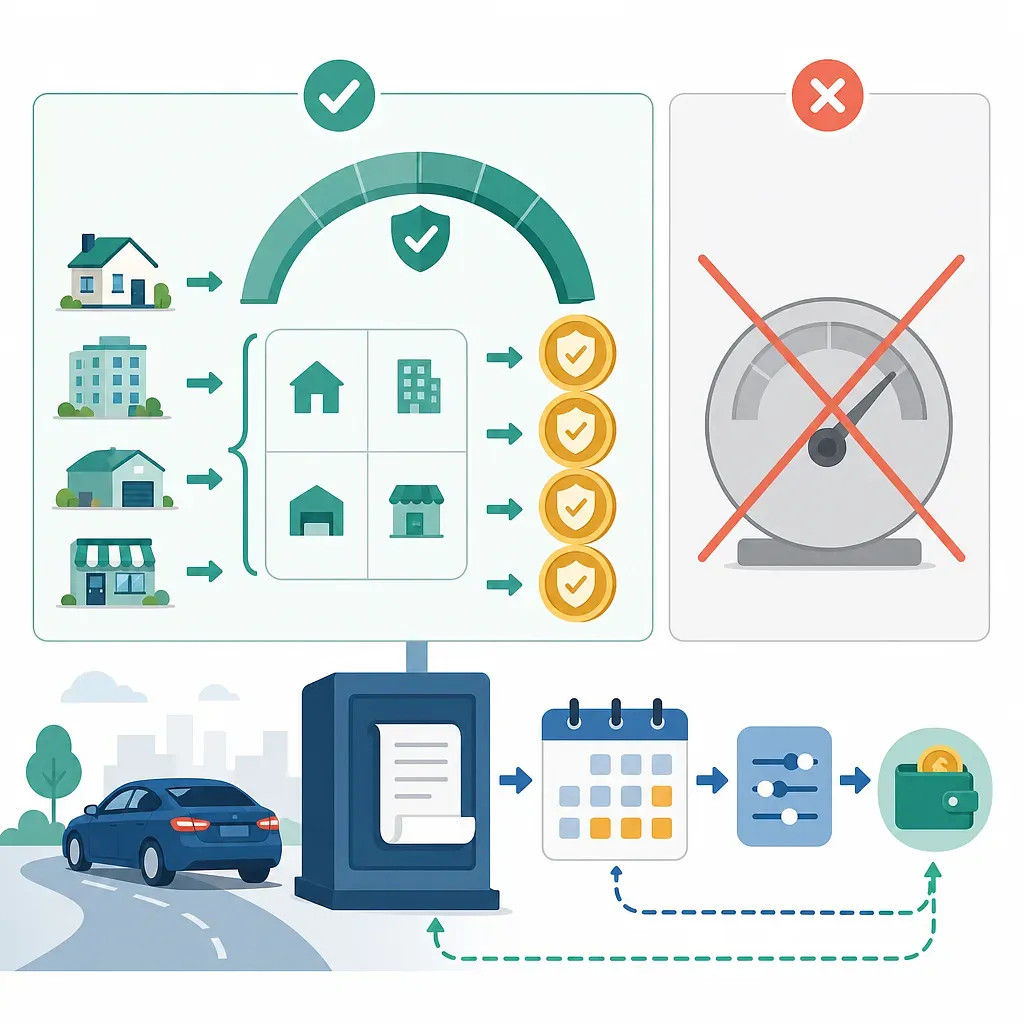
The diagram shows property and vehicle data flowing through scheduling and adjustments to determine the premium.

FAQ

Has the property grading system for self-employed health insurance subscribers been abolished?

No. The current Enforcement Decree still contains a property insurance premium assessment score table that assigns points by dividing the property amount after deductions into multiple brackets. The key changes in the 2024 reform were increasing the basic property deduction to KRW 100 million and abolishing automobile insurance premiums.

Has a flat-rate system been introduced for property, under which the property value is multiplied by a fixed rate?

A comprehensive flat-rate system that directly applies a single rate to property insurance premiums has not been introduced. Income-based insurance premiums use a flat-rate method, but property insurance premiums are calculated by finding the score corresponding to the amount after the basic deduction and multiplying it by the amount per point.

Is the KRW 100 million basic property deduction subtracted from the market value of a home?

No. KRW 100 million is not deducted directly from the sale price or market value of a home. The deduction is applied to the household's property amount calculated under health insurance laws and regulations, including the property tax base and the assessed value of rental deposits.

Are self-employed subscribers still charged additional insurance premiums for owning a car?

The health insurance premium imposed on self-employed subscribers for owning a car was abolished beginning with the premium for February 2024. However, income- and property-based insurance premiums, which are separate from automobile ownership, may still be imposed.

Do health insurance premiums decrease immediately upon retirement?

Not all insurance premiums are automatically reduced immediately solely because of retirement. After conversion to self-employed subscriber status, premiums are calculated based on the income data and property reflected in the assessment. If your income has decreased, you should check whether you are eligible to apply for an adjustment and reconciliation by submitting supporting documents.

If I apply for an income adjustment, could I later be charged additional insurance premiums?

Yes. Once the finalized income for the adjustment period is confirmed, the insurance premiums are recalculated. If the actual income is higher than it was at the time of the adjustment, an additional payment may be required; if it is lower, a refund may be issued.

If my property is worth at most KRW 100 million, do I pay no health insurance premiums at all?

No. If the property amount calculated under the law falls within the basic deduction, there may be no property-based insurance premium, but income-based insurance premiums, the minimum insurance premium, and long-term care insurance premiums may still be charged.

Why did my insurance premium remain unchanged after the basic property deduction was increased?

You may already have had no property points after deductions under the previous rules, your income-based insurance premium may have increased, or your household composition and tax assessment data may have changed. To determine the exact cause, you need to compare the income-based portion, property-based portion, and long-term care insurance premium separately on your bill.

Why does the property insurance premium not decrease immediately when the officially assessed property value decreases?

The officially assessed property value, the property tax base, and the timing of their reflection in health insurance premiums do not coincide. You need to check which year's tax assessment data was applied and whether other property was also included.

Sources

Data formats

This content is available in several machine-friendly formats.

Data-only languages (machine translated, files only)

Indonesian JSON MD Portuguese JSON MD Chinese (Traditional) JSON MD Deutsch JSON MD

Reuse & AI usage

Search indexing and AI citation with attribution are welcome. See the license policy for details.

CC BY · License

Corrections · Improvements · Feedback Let us know what's wrong or could be better and we'll review it. No login required.

Comments (0)

Sign-in required

Sign in with your Google account to like and comment.

Be the first to comment.

Related content