A Key Checklist for Minimizing Losses in Settlements and Insurance Claims Following a Traffic Accident
This is a practical, step-by-step guide covering everything from ensuring safety and documenting evidence to seeking medical treatment, reviewing insurance documents, and determining the right time to settle a claim following a traffic accident. It also explains why you should avoid settling early in cases involving serious injury, permanent disability, or death, and outlines key points to check regarding your auto insurance coverage.
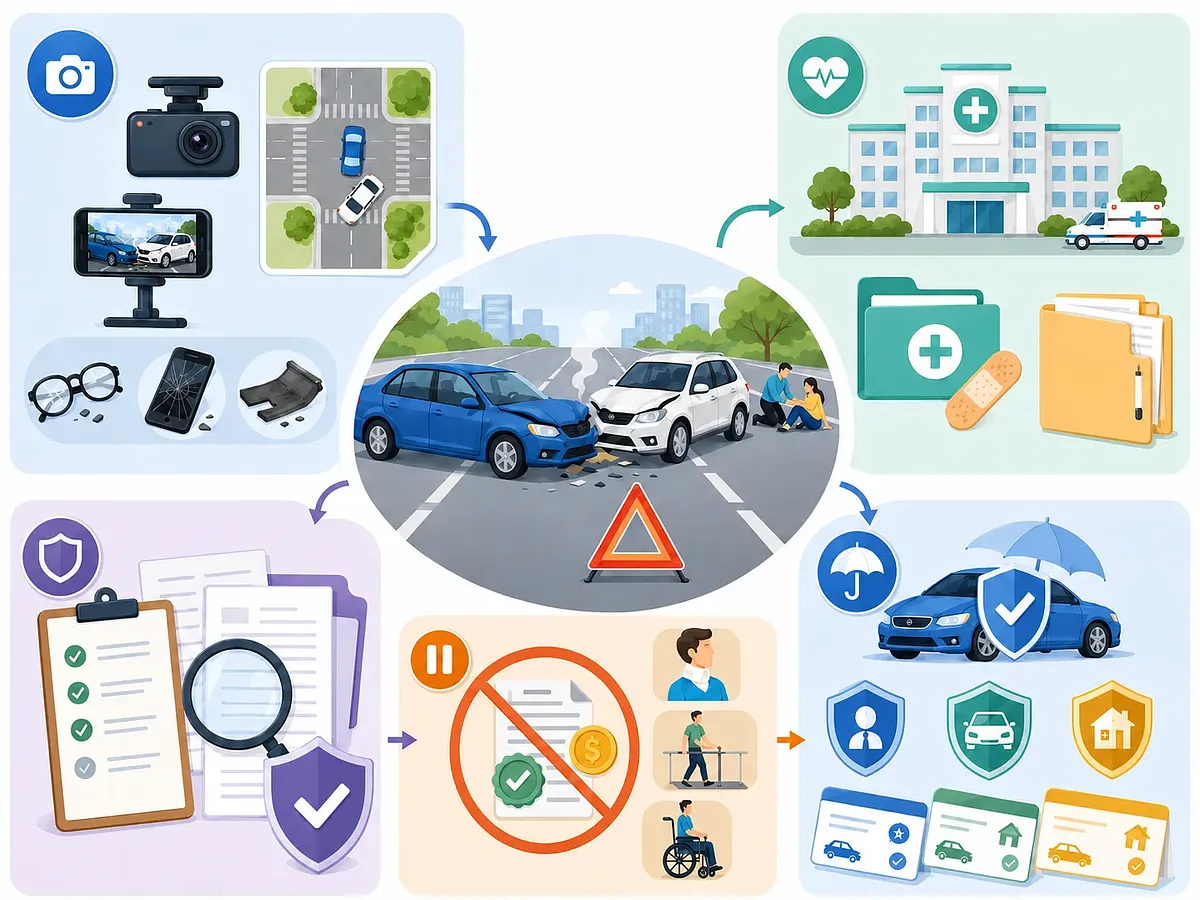
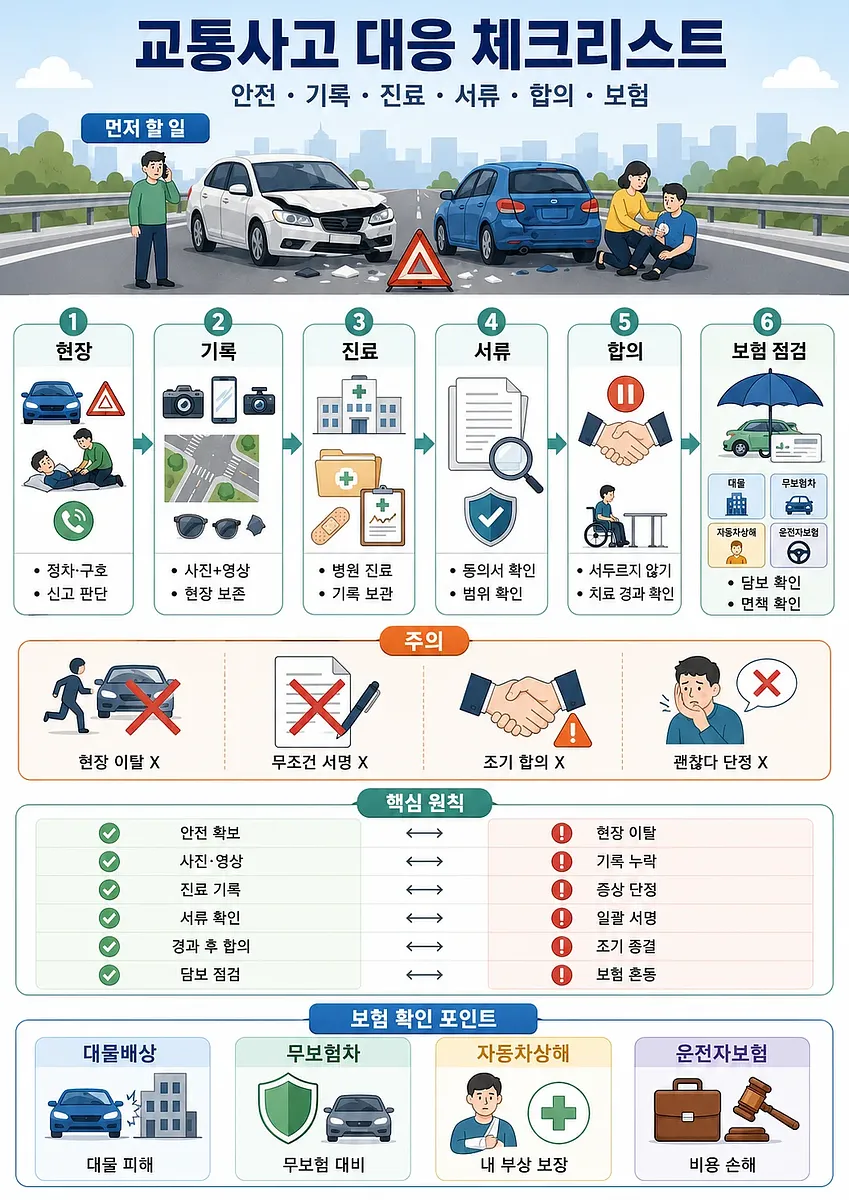
Immediately after a traffic accident, stopping, providing assistance, assessing the need to report the incident, and documenting the scene take priority over reaching a settlement.
By taking both photos and videos, you can more accurately preserve the context immediately following the accident, including the vehicle's location, road layout, areas of damage, and damage to your personal belongings.
The medical consultation consent form is not a document to be signed automatically; after verifying the reason for the consultation and the scope of the information to be provided, you must respond with a statement from your primary care physician or similar documentation.
In cases involving permanent disability, long-term care, death, or one of the 12 major forms of gross negligence, it is safer not to rush into a settlement based solely on the amount offered by the insurance company.
Since third-party property damage liability, uninsured motorist coverage, personal injury protection, and driver’s insurance differ in their coverage objectives and exclusions, you should review them separately before renewal.
If you’re involved in a traffic accident, the first things you should do are not to “calculate the settlement amount,” but to ensure safety, provide first aid, document the incident, seek medical treatment, and review the paperwork. A single word spoken or a single signature immediately after the accident can affect disputes over fault, medical expenses, lost wages, and compensation for permanent disability; therefore, it is advisable to address each step in the proper sequence.
This article provides general information to help you understand the practical aspects of traffic accidents and auto insurance in South Korea. Since the outcome may vary depending on the degree of fault, insurance policy terms, medical diagnosis, presence of disability, and whether a criminal case is involved, it is safest to have a lawyer or an independent claims adjuster review cases involving serious injury, death, permanent disability, or the need for long-term care on a case-by-case basis.
Key Principles at a Glance
Step | What to Do | What to Avoid
At the Scene | Stop, prevent secondary accidents, assist injured persons, and determine whether to call 112 or 119 | Leaving the scene when someone is injured
Documentation | Document vehicle positions, damage locations, traffic signals and lanes, dashcam footage, nearby CCTV footage, and damage to personal belongings using photos and videos | Taking photos only of the vehicle and omitting the road layout, the other vehicle, and interior damage
Medical Treatment | Verify the personal injury claim number and payment guarantee, and keep medical records | Assuming you’re “fine” on the day of the accident because the pain is mild
Documents | Carefully review personal information, medical records, and medical consultation consent forms separately | Sign all documents without reading them, based only on the titles
Settlement | Review the settlement proposal only after confirming the course of treatment, potential disability, future medical expenses, and lost wages | Settle the case prematurely even if pain persists or a diagnosis has not been finalized
Insurance Review | Distinguish and verify property damage liability, uninsured motorist coverage, personal injury protection, and driver’s insurance | Mistaking auto insurance and driver’s insurance for the same product
1. Immediately after an accident, “Stop, Assist, Report, and Document” are the top priorities
The Road Traffic Act stipulates that in the event of a traffic accident, drivers and others must immediately stop to assist any injured or deceased persons and provide the victim with their personal information, such as name, phone number, and address. Additionally, if there are casualties or if it is necessary to prevent road hazards, you must report the accident location, the number of casualties and the extent of their injuries, as well as any damaged property and the extent of the damage, to the police. However, an exception to the reporting obligation may be granted if it is clear that only the vehicle was damaged and necessary measures have been taken to prevent road hazards and ensure smooth traffic flow. (Legal Information Center)
What to Do Immediately at the Scene
· Turn on your hazard lights and move to a safe location. The risk of secondary accidents is higher on highways and arterial roads.
· If anyone is injured, call 119 immediately. Avoid moving the injured person on your own if they are unconscious, bleeding, experiencing neck or back pain, or having difficulty walking.
· Verify the other party’s personal information and whether they have filed an insurance claim. Record their driver’s license number, license plate number, insurance company, and contact information.
· Document the scene before moving your vehicle. If the accident is significantly obstructing traffic, or if the police or insurance company instruct you to move the vehicle, take photos first and then move it to a safe area, such as the shoulder of the road.
· Preserve the original dashcam footage. Since memory cards can be overwritten, save the footage to a separate storage device as soon as possible.
2. Don’t Just Take Photos—Capture Video and ‘Contextual Evidence’ as Well
Photos are useful for clearly documenting damage, while videos are useful for capturing the continuous sequence of events immediately following the accident. Rather than choosing just one, it is safest to capture both.
Filming Checklist
· Overall location of the involved vehicles: Film the front, rear, left and right sides, lane, stop line, crosswalk, and traffic lights.
· Close-up shots of the collision site: Capture the license plate, bumper, fender, wheels, windows, and whether the airbags deployed.
· Road Conditions: Record road markings, obstacles obstructing visibility, construction zones, rain, snow, or ice on the road, streetlights, and traffic signs.
· Vehicle Interior and Personal Belongings: Document the condition of your cell phone, glasses, laptop, car seat, watch, and any damaged luggage immediately after the accident.
· Surrounding Evidence: Make a note of any potential evidence from dashcams, store surveillance cameras, and dashcams in buses, taxis, or parked vehicles.
· Statements by the Other Party: Even if the other party explains the circumstances of the accident—such as saying, “I didn’t see the traffic signal”—secretly recording or disclosing such statements can become a separate legal issue; therefore, at the very least, make a note of the date, time, and content of their statements.
Documentation for Compensation for Damaged Personal Belongings
For damage to personal belongings, the causal relationship between the accident and the damage is crucial. You must gather footage taken immediately after the accident, photos of the damage, purchase receipts, repair estimates, certificates of irreparability, and documentation of the item’s period of use. High-value items may be assessed based on depreciation or second-hand market value, rather than the full price of a new product.
3. Keep Your Conversations with the Insurance Company Short and Precise
While insurance agents are there to assist with accident processing, they are also stakeholders who must consider the company’s claims payment criteria and loss ratio. Rather than giving a lengthy, emotional explanation, it’s best to state your necessary requests clearly and concisely.
Phrases to Use When Reporting Personal Injury or Property Damage Claims
· “Please text me the accident report number, the handler’s name, and their contact information.”
· “I’m experiencing pain and plan to see a doctor. Please provide the personal injury claim number and instructions for the payment guarantee procedure.”
· “Before having my vehicle repaired, I’d like to review photos of the damaged areas and the repair estimate.”
· “I’m currently undergoing treatment, so I’ll review whether to settle after seeing the diagnosis and monitoring my progress.”
Expressions to Avoid
· “I think I’m okay.”
· “Please let the insurance company handle it.”
· “We can settle this right away today.”
· “I’ve had pain in this area before, so I’m not sure if it’s due to the accident.”
Pain may become more pronounced a few days after the accident rather than immediately afterward. While you should not exaggerate your actual symptoms, you should avoid making statements early on that definitively rule out a connection to the accident. Medical certificates, imaging results, medical records, and records of outpatient and inpatient care will serve as the core evidence for subsequent compensation negotiations.
4. Documents Must Be Evaluated Based on Their Specific Purpose
Not all consent forms sent by insurance companies have the same meaning. In particular, consent for personal information processing, access to medical records, and medical consultation each have different purposes and risks.
Document | Meaning | What to Check
Consent Form for Personal Information Processing | Consent to process personal information necessary for accident reporting and insurance claim review | Purpose of use, recipients, retention period
Consent Form for Access to and Copies of Medical Records | Consent to review hospital records | Whether the scope can be limited to hospitals, time periods, and body parts related to this accident
Consent Form for Medical Consultation | Procedure for sending records to a third-party specialist (other than the attending physician) to obtain an opinion | Reason for consultation, content of questions, materials provided, specialty of the consultant, whether results will be disclosed
Settlement Agreement and Waiver of Rights | A document that limits or terminates additional civil claims in exchange for a specified amount | Future medical expenses, permanent disability, additional damages, right of subrogation, and non-litigation clause
The Korea Consumer Agency advises that when an insurance company requests consent for a medical consultation, you should first verify the reason for the request, provide a statement from your primary care physician that may supplement it, and then carefully decide whether to give your consent. The Agency also advises that when requesting a medical consultation, insurance companies must explain to the consumer the reason for the request, its details, and the materials provided to the consulting specialist. (Korea Consumer Agency)
Therefore, rather than categorically stating that “a medical consultation consent form is always illegal and must never be signed,” it is more accurate to understand that you should not sign it automatically; instead, verify the reason for the consultation and the scope of the materials provided, and if necessary, respond by submitting a statement from your primary care physician, requesting additional tests, or seeking an evaluation from a third-party medical institution.
5. Consider a settlement only when “treatment is nearing completion” and “damages have been determined”
In the case of a minor fender-bender, a quick settlement can reduce the emotional and time-related costs. However, an early settlement may be disadvantageous in the following situations.
Situations where you should be particularly cautious about early settlements
· Cases where there is a possibility of disability, such as surgery, fractures, herniated discs, ligament tears, or nerve damage
· Cases requiring long-term care, such as brain injury, spinal cord injury, paralysis, or cognitive impairment
· Fatal accidents or accidents resulting in serious injury
· Cases involving serious traffic violations, such as driving under the influence, driving without a license, hit-and-run, running a red light, or crossing the center line
· Cases involving a long treatment period and significant losses due to time off work or lost income
· Cases where the insurance company attempts to minimize the accident’s contributory factor on the grounds of a pre-existing condition
Although the Special Act on the Handling of Traffic Accidents generally prohibits the filing of criminal charges against the victim’s explicit wishes in cases of general work-related negligence resulting in injury, exceptions apply to hit-and-run, refusal or obstruction of breathalyzer tests, running a red light, crossing the center line, exceeding the speed limit by 20 km/h, improper passing, violations of railroad crossing procedures, failure to protect pedestrians at crosswalks, driving without a license, driving under the influence of alcohol or drugs, driving on the sidewalk, failure to prevent passengers from falling out of the vehicle, violations of child safety zone regulations, and failure to take measures to prevent cargo from falling—are designated as exceptions. (Legal Information Center)
Items of Damages to Verify Before Reaching a Settlement
Item | Supporting Documents
Medical Expenses | Medical receipts, itemized statements, future treatment plan
Loss of Earnings | Income records, proof of employment, business income tax return documents, duration of hospitalization and outpatient treatment
Compensatory Damages | Severity of injury, duration of treatment, presence of disability, circumstances of the accident
Future Medical Expenses | Attending physician’s opinion, possibility of surgery, rehabilitation, manual therapy, and physical therapy plans
Permanent Disability | Date of disability diagnosis, percentage of loss of earning capacity, use of the McBride scale for evaluation
Nursing Care Expenses | Time required for nursing care, medical necessity, life expectancy, whether care is provided by family members
Lost Earnings | Occupation, age, retirement age, potential for income growth, disability rate
If the settlement agreement contains a clause stating that “no further civil or criminal claims will be raised,” additional claims may be restricted. If there is even the slightest possibility of residual disability, you must carefully review whether an exception clause can be included in the settlement agreement and whether the settlement amount sufficiently covers future medical expenses.
6. Do Not Base Your Decision on the “Insurer’s Offer” Alone in Cases Involving Serious Injury, Death, or Long-Term Care
Accidents resulting in death, long-term hospitalization, permanent disability, or the need for long-term care are far more complex than cases involving simple medical expenses. Key issues include compensation for pain and suffering, lost income, disability rating, loss of earning capacity, nursing care hours, life expectancy, degree of fault, the contribution of pre-existing conditions, and future medical expenses.
In such cases, the standards set by insurance policy terms, court rulings, and damage assessment methods may differ. The amount initially offered by the insurance company is merely a starting point for negotiation and should not be considered the final settlement amount. In particular, since it is difficult to determine the degree of disability immediately after an accident, it is often necessary to monitor the patient’s progress until their medical condition has stabilized before making a final assessment.
7. Review Your Auto Insurance Coverage in Advance
Auto insurance is broadly divided into liability coverage, which compensates for damages caused to others, and coverage that compensates the insured for their own losses. The Ministry of Government Legislation’s “Everyday Legal Information” explains the basic functions of each coverage type, including Personal Injury Liability I and II, Property Damage Liability, Personal Injury Coverage, Injuries Caused by Uninsured Vehicles, and Vehicle Damage Coverage. (Easy Law) The General Insurance Association of Korea also explains that comprehensive auto insurance consists of coverage that goes beyond mandatory liability insurance, including Personal Injury Liability II, Property Damage Liability, Personal Injury Coverage, Vehicle Damage Coverage, and Injuries Caused by Uninsured Vehicles. (General Insurance Association of Korea Consumer Portal)
4 Types of Coverage to Check
Coverage | Why It’s Important | Points to Check
Property Damage Liability | Losses can be significant if high-value vehicles, facilities, business interruption, or rental car fees are involved | Do not settle for the statutory minimum; compare coverage limits as much as possible
Personal Injury Caused by Uninsured Vehicles | Prepares for accidents involving uninsured, hit-and-run, or financially insolvent at-fault drivers | Verify coverage limits not only for yourself but also for family members as defined in the policy
Personal Injury or Automobile Injury Coverage | Covers your injuries in the event of an accident caused by your own fault or a single-vehicle accident | Personal Injury coverage typically focuses on limits based on injury severity levels, while Automobile Injury coverage often has a broader scope of coverage, though premiums are higher
Driver’s Insurance | Coverage for financial losses such as criminal settlement fees, fines, and attorney’s fees | This is a different product from auto insurance; verify actual out-of-pocket costs, coverage conditions, and exclusions
Driver’s insurance is a product that covers financial losses resulting from injuries caused by car accidents or criminal and administrative liabilities; it differs from auto insurance, which primarily covers civil liabilities arising from car accidents, such as bodily injury and property damage liability. According to guidance from the Financial Supervisory Service, driver’s insurance is not mandatory. It is important to note that coverage for financial losses is based on actual expenses incurred rather than the full coverage limit, and that accidents involving unlicensed driving, drunk driving, or hit-and-run are not covered. (KDI Economic Education and Information Center)
8. Checklist for Handling Traffic Accidents
On the Day of the Accident
· Determine whether to call 112 or 119
· Verify the other party’s license plate number, driver’s name, insurance company, and contact information
· Take photos and videos of the accident scene
· Back up the original dashcam footage
· Seek medical treatment and keep medical records, including diagnosis certificates and medical expense receipts
· Obtain the insurance claim number and the claims adjuster’s contact information
During Treatment
· Record the location and changes in pain by date
· Keep records of outpatient and inpatient schedules, as well as medical expense receipts
· Keep test results, doctors’ opinions, and prescription details
· Record the content of calls with the insurance company via text messages or notes
· If a settlement offer is made, first confirm whether treatment has concluded and whether future treatment is possible
Before Settlement
· Review medical expenses, lost wages, future medical costs, compensation for pain and suffering, and potential disability
· Check the settlement agreement for phrases such as “waiver of all claims,” “no civil or criminal objections,” and “including future medical costs”
· If there is a possibility of residual disability or additional treatment, consider whether an exception clause is necessary
· For cases involving serious injury, death, or the need for long-term care, compare the amount calculated by an expert with the amount offered by the insurance company
Conclusion
There are four key points to handling a traffic accident. First, at the scene, prioritize first aid and safety, and meticulously document evidence. Second, communicate only necessary requests to the insurance company accurately and avoid making hasty assumptions about your physical condition. Third, for documents that affect your rights—such as medical consultations, medical records, and settlement agreements—verify the title and scope before signing. Fourth, for accidents involving disability, death, long-term care, or serious traffic violations, do not settle based solely on the insurer’s offer; instead, seek an independent review.
The best way to prepare is to review your auto insurance policy before an accident occurs to confirm the coverage limits for property damage liability, uninsured motorist coverage, personal injury protection, and driver’s insurance, as well as any exclusions.
 Injoys