
Skip to content
Injoys
Report 🇬🇧 United Kingdom

This content applies specifically to United Kingdom.

Effectiveness and Privacy Issues of UK Online Age Verification

Online age verification in the UK can create meaningful barriers to harmful content, but adopting a particular technology does not by itself prove its effectiveness. Assessments must measure not only accuracy and resistance to circumvention, but also movement between services, data minimization, and error rates across different groups.

Views 110 13 min read KO EN JA ES

Listen or read this article

Listen, or read the text only.

Effectiveness and Privacy Issues of UK Online Age Verification

Kokoro 82M AI-generated voice

0:00 20:16

Download audio

File name
uk-online-age-assurance-effectiveness-privacy-en.mp3
Format
MP3 (audio/mpeg)
Duration
20:16
File size
13.9 MB
Engine
Kokoro 82M

This audio was generated by AI.

You may download and use it freely for personal use.

Effectiveness and Privacy Issues of UK Online Age Verification

13 min read

Effectiveness and Privacy Issues of UK Online Age Verification
Online age verification in the UK can create meaningful barriers to harmful content, but adopting a particular technology does not by itself prove its effectiveness. Assessments must measure not only accuracy and resistance to circumvention, but also movement between services, data minimization, and error rates across different groups.
The UK's Online Safety Act does not require every site to conduct the same identity checks; the strength of age-assurance obligations varies according to a service's features and the risks it poses to children.
Ofcom's “highly effective age assurance” must demonstrate technical accuracy, robustness, reliability, and fairness.
Identity document checks, facial age estimation, financial and telecommunications data, and device-based signals each have different advantages and disadvantages in terms of accuracy and privacy.
Effectiveness must be judged by measuring not only check pass rates, but also reduced exposure to harmful content, circumvention rates, movement to other services, misjudgments, and privacy incidents.
For social media restrictions on children under 16, app stores and operating systems could share roles with platforms, but the scope of responsibility must be established through final legislation and implementation guidance.
The UK’s online age-checking policy is intended to reduce children’s access to pornography and other harmful content. The key question is not whether an age-check screen exists, but whether it reduces actual exposure without requiring users to disclose excessive amounts of identity information.
In its initial assessment published on July 15, 2026, Ofcom said that age checks are helping to make UK children’s online experiences safer, while also noting that the protection system is not yet complete. In particular, it believes that age-estimation methods used by some social media services require further performance testing.
What Is the UK’s Online Age-Checking System?
The Online Safety Act 2023, the UK’s online safety law, imposes child-protection duties on online businesses according to the type of service and level of risk. Ofcom enforces the rules and oversees whether the protective measures adopted by businesses meet legal standards.
Terms that are often used interchangeably under this system can be distinguished as follows.
Term | Meaning | Representative examples Age assurance | An umbrella term covering all processes used to determine a user’s age or age range | ID checks, facial age estimation, device signals Age verification | Checking a date of birth or whether someone is over a threshold age against reliable information | Passport or driver’s license checks, digital identity checks Age estimation | Probabilistically estimating an age range from characteristics or behavioral data without directly checking a date of birth | Facial age estimation, account activity-based analysis Self-declaration of age | Users directly enter their date of birth or whether they are adults | Entering a date of birth, an “18 or over” button
Because children can easily enter a different date, simple self-declaration alone is difficult to regard as highly effective age assurance.
Which Services Does It Apply To?
Age assurance is not relevant only to pornography sites. Social media services that host user posts, gaming communities, dating services, and search services may also need to assess whether children are likely to access them and the risk of harmful content. However, the following distinctions are important.
· Services that directly provide pornography or allow it to be posted may be required to use strong age assurance to prevent access to adult content. · Social media, gaming, and dating services likely to be used by children must establish measures such as age-based access restrictions, controls on content recommendations, and safety settings, depending on their risk assessments. · The same checking process does not apply to every business solely on the basis of its industry category. Service features, content, and connections to UK users affect the determination. · A site is not automatically exempt merely because it is small or based overseas, although detection and enforcement may become more difficult.
It is therefore inaccurate to say that “every internet user in the UK must provide ID.” The law imposes outcome-based duties and does not mandate a single technology for every service.
Ofcom’s “Highly Effective” Standard
Rather than approving specific providers or products across the board, Ofcom focuses on the performance that age assurance must achieve. The four key factors for determining whether age assurance is highly effective are as follows.
· Technical accuracy: Error rates in which actual minors are incorrectly classified as adults or adults are incorrectly classified as minors must be sufficiently low. · Robustness: The system must not be easily defeated by circumvention attempts such as using someone else’s documents, recapturing a screen, using synthetic images, or sharing accounts. · Reliability: It must produce consistent results repeatedly, rather than functioning only at certain times or on certain devices. · Fairness: Error rates must not become excessively high for particular groups based on skin color, gender, disability, age range, or other characteristics.
Whether these four conditions are met cannot be determined from the name of the technology alone. For example, even when the same facial age-estimation method is used, results vary according to the model, capture conditions, decision thresholds, and retesting procedures.
Problems at the Age Threshold
Age estimates generally come with probabilities and margins of error. This is why it is difficult to distinguish perfectly between an actual 17-year-old and a 19-year-old when applying an age threshold of 18.
Businesses may consider the following safeguards for borderline ranges.
· Apply a conservative buffer to the estimated age. · Provide another means of proof if one method fails. · Allow adults to appeal if they are incorrectly blocked. · Separately disclose the rate at which children are incorrectly allowed through and the rate at which adults are incorrectly blocked. · Independently test error rates by group and performance in real-world usage environments.
Widening the buffer can reduce the number of children incorrectly allowed through, but it may increase the blocking of adults who look young. Effectiveness must be assessed with these trade-offs in mind.
Comparison of Major Age-Checking Methods
Method | Advantages | Main limitations | Privacy risks Government-issued ID check | Can be highly reliable because it directly checks a date of birth | Accessibility for people without documents, forgery and identity theft, mismatch between the account user and document owner | Leakage or excessive retention of names, dates of birth, photographs, and document numbers Facial age estimation | Can be designed to estimate only an age range without necessarily revealing identity | Errors occur around the age threshold and under different capture conditions, and performance must be tested across groups | Collection of facial images, potential reuse, and lack of transparency about retention and model training Financial, credit card, or open banking check | Can confirm a threshold age using a financial relationship held in an adult’s name | Exclusion of adults without financial instruments, mismatch between the cardholder and actual user | Unnecessary exposure of financial institution or transaction-related information Mobile network operator check | Can reduce the need to submit separate documents by using existing subscriber information | Family plans, prepaid lines, and differences between the account holder and actual user | Possibility of linking a phone number to the service being used Digital identity service | Can provide multiple sites with only an “over the threshold age” signal instead of original documents | Dependence on identity providers and the possibility of extensive tracking | Risk of linking usage records across different services App store, operating system, or device-based check | Can reduce repeated checks by transmitting a previously configured age signal to multiple apps | Shared devices, accounts in a parent’s name, incorrect initial settings, and dependence on ecosystem providers | Possibility that usage history will be concentrated in a central account
No method is the most accurate and privacy-friendly in every situation. High-risk content may require strong proof, but requiring users to repeatedly submit original identity documents to each service increases the risk of large-scale data leaks.
Design Principles That Are Less Intrusive to Privacy
Age checks do not necessarily conflict with privacy protection. A service can be structured so that it does not directly receive a date of birth or a copy of an identity document, but instead receives only a result such as “18 or over” from an independent provider.
A privacy-preserving system should follow these principles.
· Data minimization: If an exact date of birth is not needed, process only whether the user is over the threshold age. · Purpose limitation: Do not repurpose age-check data for advertising, user profiling, or model training. · Short retention periods: Do not unnecessarily retain identity document images or facial videos after the check is complete. · Separation and unlinkability: Design the system so that age-check providers cannot easily track the sites users visit or combine records from multiple services. · Security: Apply encryption during transmission and storage, access controls, and breach-response procedures. · Transparency: Explain to users what data is collected, who processes it, how long it is retained, how automated decisions are made, and how to appeal. · Alternative methods: Provide another verification route for people who cannot use a particular document or facial capture.
Facial images do not always constitute special-category biometric data under UK data protection law. The specific manner of use matters, including whether the images are technically processed for the purpose of uniquely identifying an individual. However, facial data is sensitive information that is difficult to change after a leak, so it requires a high level of protection.
How Should the Initial 2026 Results Be Interpreted?
Ofcom’s July 2026 announcement assessed that age checks are helping to create protective barriers, but that the technology industry needs to strengthen safeguards further. It also emphasized that age estimation used by some social media services requires additional testing in real-world usage environments.
These initial results support neither the claim that the system does not work at all nor the claim that every problem has been solved. The regulator’s observations are an important signal of policy effectiveness, but comparable long-term data is needed to establish the causal effect of the system as a whole.
Key Metrics for Assessing Effectiveness
Evaluation area | Required metrics | Question answered by the metrics Coverage | Adoption rate among covered services, proportion of users actually subject to checks | How many risky access routes are covered? Accuracy | Rate at which minors are incorrectly allowed through, rate at which adults are incorrectly blocked | Are age determinations actually correct? Reduction in exposure | Frequency and duration of harmful-content exposure for children’s accounts | Has harm decreased after the checks? Resistance to circumvention | Rates of circumvention through VPNs, account sharing, other people’s documents, and unregulated sites | How easily can users avoid the barrier? Displacement effects | Proportion moving from large platforms to small or overseas services | Has the harm disappeared, or merely moved elsewhere? Fairness | Differences in error rates by age range, gender, skin color, disability, and other groups | Is the burden concentrated on particular users? Privacy protection | Data collected, retention periods, third-party sharing, and breach incidents | Is excessive personal information being required for safety? Redress procedures | Number of retests and appeals, and processing times | Can incorrectly blocked users resolve the problem?
It is difficult to judge success based only on the “number of checks conducted” disclosed by platforms. It is also necessary to determine whether users who abandoned a check were children or adults, whether they moved to other sites, and whether actual exposure to harmful content decreased.
Circumvention and Regulatory Gaps
Age checks can raise the cost of access, but they are not a perfect means of blocking it. Common circumvention routes include the following.
· Using a VPN or proxy to appear to be accessing the service from outside the UK · Borrowing an adult’s account, ID, payment method, or device · Moving to small or overseas sites with weak age checks · Viewing some content through search-result previews, images, or caches · Using encrypted messaging, file sharing, or unofficial app distribution channels
Search services may also be subject to online safety duties, so it should not be assumed that search engines as a whole fall into a legal gap. However, search previews, external links, and the direct provision of content have different structures, requiring precise enforcement to determine where actual risks should be blocked.
Small sites are not automatically exempt based solely on their size, but identifying overseas operators and enforcing corrective measures may take time. If only the compliance rate of large services increases while users move to more dangerous and less regulated spaces, the overall protective effect will be limited.
Division of Responsibilities Under Social Media Restrictions for Under-16s
The UK government’s proposed social media restrictions for children under 16 may require a broader age boundary than existing duties to protect against specific types of harmful content. However, policy announcements must be distinguished from legally enforceable duties. Covered services, exemptions, implementation dates, and each business’s responsibilities must be established through final legislation and guidance.
Platforms
Because platforms operate actual accounts and content-recommendation systems, they are likely to assume the following roles.
· Verify or estimate age at sign-up and for existing accounts. · Restrict the visibility, messaging, recommendations, advertising, and location features of children’s accounts. · Detect suspicious age changes and account transfers. · Provide retesting and appeal procedures for incorrect decisions. · Audit the accuracy and personal-data processing of age-check providers.
App Stores
App stores can link age ratings to account age at the download stage. However, because of accounts held in a parent’s name and family sharing, app-store information does not always match the actual user’s age. Services accessed directly through websites also cannot be controlled solely through app stores.
Operating Systems and Devices
Operating systems can provide child accounts, parental controls, screen-time settings, and age-eligibility signals. This has the advantage of avoiding repeated submission of identity documents to each service, but shared devices and incorrectly configured accounts remain problematic. Technical separation is needed to prevent operating system providers from concentrating users’ complete service-usage histories.
Why There Is No Single Responsible Party
Making platforms solely responsible may increase repeated identity checks and differences between services. Conversely, making app stores or operating systems solely responsible may overlook web access, shared devices, and account transfers. An effective system must allow each layer to share only the minimum necessary age signal while clearly establishing which business is responsible for errors and privacy violations.
Overall Assessment
The UK’s age-checking system is a practical means of making it more difficult for children to access harmful content, but it is not a mechanism that can solve online safety through one technology alone. ID checks can provide strong evidence but create risks from the concentration of information, while facial age estimation can be designed to reveal less identity information but requires accuracy testing around age thresholds and across groups. Device-based checks reduce repetitive procedures but must address mismatches between accounts and actual users.
Policy success should be judged not by “how many people were checked,” but by “how much actual harm to children was reduced.” The key data that Ofcom and the government should disclose in the future includes not only whether each platform has implemented checks, but also error rates, circumvention and movement between services, performance across groups, data-retention practices, and breaches. When this data is independently verified, it will be possible to assess whether both child protection and privacy protection have been achieved.
0:00 0:00
1 / 60

Download text

File name
uk-online-age-assurance-effectiveness-privacy-en.txt
Format
TXT (text/plain)
Paragraphs
60

Downloads exactly what you see as a text file.

Please cite the source when quoting.

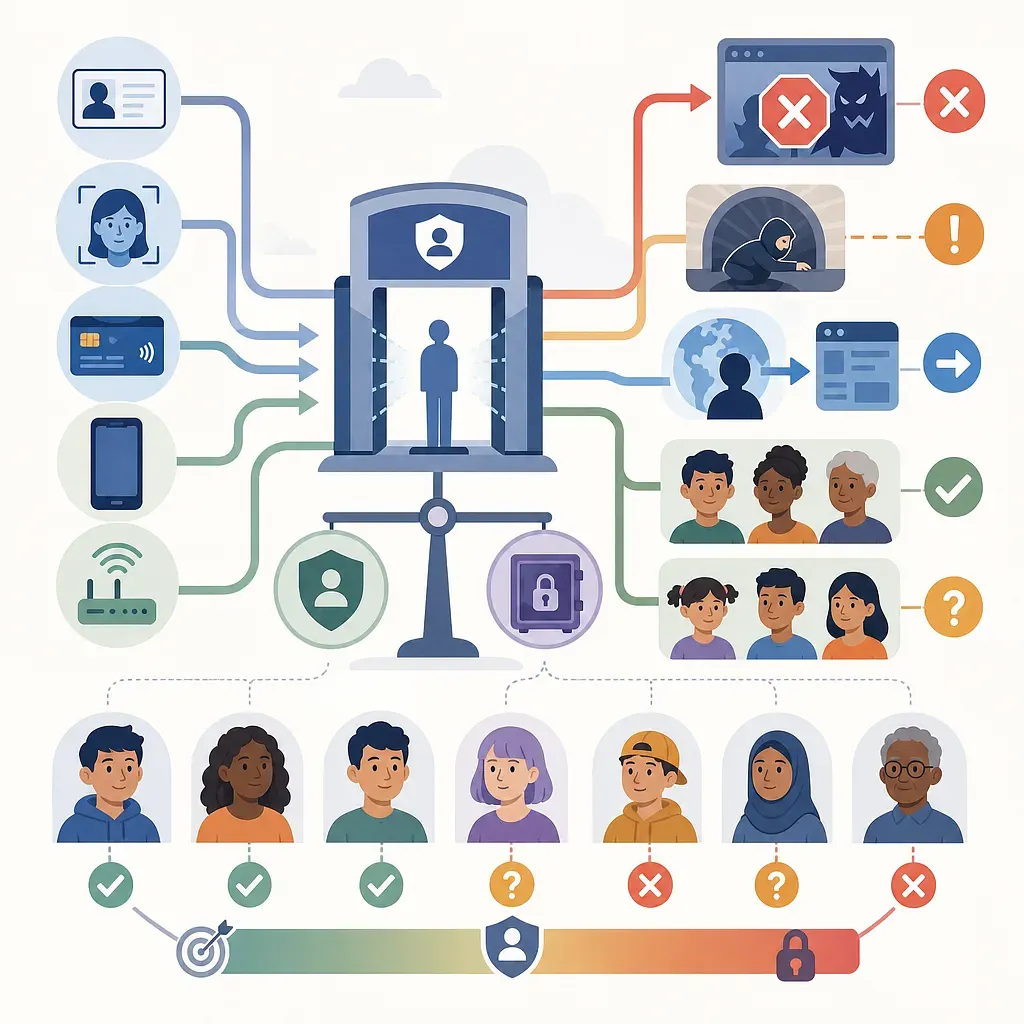
The illustration depicts how UK online age checks affect content access and privacy.

Key points

  • The UK's Online Safety Act does not require every site to conduct the same identity checks; the strength of age-assurance obligations varies according to a service's features and the risks it poses to children.
  • Ofcom's “highly effective age assurance” must demonstrate technical accuracy, robustness, reliability, and fairness.
  • Identity document checks, facial age estimation, financial and telecommunications data, and device-based signals each have different advantages and disadvantages in terms of accuracy and privacy.
  • Effectiveness must be judged by measuring not only check pass rates, but also reduced exposure to harmful content, circumvention rates, movement to other services, misjudgments, and privacy incidents.
  • For social media restrictions on children under 16, app stores and operating systems could share roles with platforms, but the scope of responsibility must be established through final legislation and implementation guidance.

The UK’s online age-checking policy is intended to reduce children’s access to pornography and other harmful content. The key question is not whether an age-check screen exists, but whether it reduces actual exposure without requiring users to disclose excessive amounts of identity information.

In its initial assessment published on July 15, 2026, Ofcom said that age checks are helping to make UK children’s online experiences safer, while also noting that the protection system is not yet complete. In particular, it believes that age-estimation methods used by some social media services require further performance testing.

What Is the UK’s Online Age-Checking System?

The Online Safety Act 2023, the UK’s online safety law, imposes child-protection duties on online businesses according to the type of service and level of risk. Ofcom enforces the rules and oversees whether the protective measures adopted by businesses meet legal standards.

Terms that are often used interchangeably under this system can be distinguished as follows.

Term Meaning Representative examples
Age assurance An umbrella term covering all processes used to determine a user’s age or age range ID checks, facial age estimation, device signals
Age verification Checking a date of birth or whether someone is over a threshold age against reliable information Passport or driver’s license checks, digital identity checks
Age estimation Probabilistically estimating an age range from characteristics or behavioral data without directly checking a date of birth Facial age estimation, account activity-based analysis
Self-declaration of age Users directly enter their date of birth or whether they are adults Entering a date of birth, an “18 or over” button

Because children can easily enter a different date, simple self-declaration alone is difficult to regard as highly effective age assurance.

Which Services Does It Apply To?

Age assurance is not relevant only to pornography sites. Social media services that host user posts, gaming communities, dating services, and search services may also need to assess whether children are likely to access them and the risk of harmful content. However, the following distinctions are important.

  • Services that directly provide pornography or allow it to be posted may be required to use strong age assurance to prevent access to adult content.
  • Social media, gaming, and dating services likely to be used by children must establish measures such as age-based access restrictions, controls on content recommendations, and safety settings, depending on their risk assessments.
  • The same checking process does not apply to every business solely on the basis of its industry category. Service features, content, and connections to UK users affect the determination.
  • A site is not automatically exempt merely because it is small or based overseas, although detection and enforcement may become more difficult.

It is therefore inaccurate to say that “every internet user in the UK must provide ID.” The law imposes outcome-based duties and does not mandate a single technology for every service.

Ofcom’s “Highly Effective” Standard

Rather than approving specific providers or products across the board, Ofcom focuses on the performance that age assurance must achieve. The four key factors for determining whether age assurance is highly effective are as follows.

  1. Technical accuracy: Error rates in which actual minors are incorrectly classified as adults or adults are incorrectly classified as minors must be sufficiently low.
  2. Robustness: The system must not be easily defeated by circumvention attempts such as using someone else’s documents, recapturing a screen, using synthetic images, or sharing accounts.
  3. Reliability: It must produce consistent results repeatedly, rather than functioning only at certain times or on certain devices.
  4. Fairness: Error rates must not become excessively high for particular groups based on skin color, gender, disability, age range, or other characteristics.

Whether these four conditions are met cannot be determined from the name of the technology alone. For example, even when the same facial age-estimation method is used, results vary according to the model, capture conditions, decision thresholds, and retesting procedures.

Problems at the Age Threshold

Age estimates generally come with probabilities and margins of error. This is why it is difficult to distinguish perfectly between an actual 17-year-old and a 19-year-old when applying an age threshold of 18.

Businesses may consider the following safeguards for borderline ranges.

  • Apply a conservative buffer to the estimated age.
  • Provide another means of proof if one method fails.
  • Allow adults to appeal if they are incorrectly blocked.
  • Separately disclose the rate at which children are incorrectly allowed through and the rate at which adults are incorrectly blocked.
  • Independently test error rates by group and performance in real-world usage environments.

Widening the buffer can reduce the number of children incorrectly allowed through, but it may increase the blocking of adults who look young. Effectiveness must be assessed with these trade-offs in mind.

Comparison of Major Age-Checking Methods

Method Advantages Main limitations Privacy risks
Government-issued ID check Can be highly reliable because it directly checks a date of birth Accessibility for people without documents, forgery and identity theft, mismatch between the account user and document owner Leakage or excessive retention of names, dates of birth, photographs, and document numbers
Facial age estimation Can be designed to estimate only an age range without necessarily revealing identity Errors occur around the age threshold and under different capture conditions, and performance must be tested across groups Collection of facial images, potential reuse, and lack of transparency about retention and model training
Financial, credit card, or open banking check Can confirm a threshold age using a financial relationship held in an adult’s name Exclusion of adults without financial instruments, mismatch between the cardholder and actual user Unnecessary exposure of financial institution or transaction-related information
Mobile network operator check Can reduce the need to submit separate documents by using existing subscriber information Family plans, prepaid lines, and differences between the account holder and actual user Possibility of linking a phone number to the service being used
Digital identity service Can provide multiple sites with only an “over the threshold age” signal instead of original documents Dependence on identity providers and the possibility of extensive tracking Risk of linking usage records across different services
App store, operating system, or device-based check Can reduce repeated checks by transmitting a previously configured age signal to multiple apps Shared devices, accounts in a parent’s name, incorrect initial settings, and dependence on ecosystem providers Possibility that usage history will be concentrated in a central account

No method is the most accurate and privacy-friendly in every situation. High-risk content may require strong proof, but requiring users to repeatedly submit original identity documents to each service increases the risk of large-scale data leaks.

Design Principles That Are Less Intrusive to Privacy

Age checks do not necessarily conflict with privacy protection. A service can be structured so that it does not directly receive a date of birth or a copy of an identity document, but instead receives only a result such as “18 or over” from an independent provider.

A privacy-preserving system should follow these principles.

  • Data minimization: If an exact date of birth is not needed, process only whether the user is over the threshold age.
  • Purpose limitation: Do not repurpose age-check data for advertising, user profiling, or model training.
  • Short retention periods: Do not unnecessarily retain identity document images or facial videos after the check is complete.
  • Separation and unlinkability: Design the system so that age-check providers cannot easily track the sites users visit or combine records from multiple services.
  • Security: Apply encryption during transmission and storage, access controls, and breach-response procedures.
  • Transparency: Explain to users what data is collected, who processes it, how long it is retained, how automated decisions are made, and how to appeal.
  • Alternative methods: Provide another verification route for people who cannot use a particular document or facial capture.

Facial images do not always constitute special-category biometric data under UK data protection law. The specific manner of use matters, including whether the images are technically processed for the purpose of uniquely identifying an individual. However, facial data is sensitive information that is difficult to change after a leak, so it requires a high level of protection.

How Should the Initial 2026 Results Be Interpreted?

Ofcom’s July 2026 announcement assessed that age checks are helping to create protective barriers, but that the technology industry needs to strengthen safeguards further. It also emphasized that age estimation used by some social media services requires additional testing in real-world usage environments.

These initial results support neither the claim that the system does not work at all nor the claim that every problem has been solved. The regulator’s observations are an important signal of policy effectiveness, but comparable long-term data is needed to establish the causal effect of the system as a whole.

Key Metrics for Assessing Effectiveness

Evaluation area Required metrics Question answered by the metrics
Coverage Adoption rate among covered services, proportion of users actually subject to checks How many risky access routes are covered?
Accuracy Rate at which minors are incorrectly allowed through, rate at which adults are incorrectly blocked Are age determinations actually correct?
Reduction in exposure Frequency and duration of harmful-content exposure for children’s accounts Has harm decreased after the checks?
Resistance to circumvention Rates of circumvention through VPNs, account sharing, other people’s documents, and unregulated sites How easily can users avoid the barrier?
Displacement effects Proportion moving from large platforms to small or overseas services Has the harm disappeared, or merely moved elsewhere?
Fairness Differences in error rates by age range, gender, skin color, disability, and other groups Is the burden concentrated on particular users?
Privacy protection Data collected, retention periods, third-party sharing, and breach incidents Is excessive personal information being required for safety?
Redress procedures Number of retests and appeals, and processing times Can incorrectly blocked users resolve the problem?

It is difficult to judge success based only on the “number of checks conducted” disclosed by platforms. It is also necessary to determine whether users who abandoned a check were children or adults, whether they moved to other sites, and whether actual exposure to harmful content decreased.

Circumvention and Regulatory Gaps

Age checks can raise the cost of access, but they are not a perfect means of blocking it. Common circumvention routes include the following.

  • Using a VPN or proxy to appear to be accessing the service from outside the UK
  • Borrowing an adult’s account, ID, payment method, or device
  • Moving to small or overseas sites with weak age checks
  • Viewing some content through search-result previews, images, or caches
  • Using encrypted messaging, file sharing, or unofficial app distribution channels

Search services may also be subject to online safety duties, so it should not be assumed that search engines as a whole fall into a legal gap. However, search previews, external links, and the direct provision of content have different structures, requiring precise enforcement to determine where actual risks should be blocked.

Small sites are not automatically exempt based solely on their size, but identifying overseas operators and enforcing corrective measures may take time. If only the compliance rate of large services increases while users move to more dangerous and less regulated spaces, the overall protective effect will be limited.

Division of Responsibilities Under Social Media Restrictions for Under-16s

The UK government’s proposed social media restrictions for children under 16 may require a broader age boundary than existing duties to protect against specific types of harmful content. However, policy announcements must be distinguished from legally enforceable duties. Covered services, exemptions, implementation dates, and each business’s responsibilities must be established through final legislation and guidance.

Platforms

Because platforms operate actual accounts and content-recommendation systems, they are likely to assume the following roles.

  • Verify or estimate age at sign-up and for existing accounts.
  • Restrict the visibility, messaging, recommendations, advertising, and location features of children’s accounts.
  • Detect suspicious age changes and account transfers.
  • Provide retesting and appeal procedures for incorrect decisions.
  • Audit the accuracy and personal-data processing of age-check providers.

App Stores

App stores can link age ratings to account age at the download stage. However, because of accounts held in a parent’s name and family sharing, app-store information does not always match the actual user’s age. Services accessed directly through websites also cannot be controlled solely through app stores.

Operating Systems and Devices

Operating systems can provide child accounts, parental controls, screen-time settings, and age-eligibility signals. This has the advantage of avoiding repeated submission of identity documents to each service, but shared devices and incorrectly configured accounts remain problematic. Technical separation is needed to prevent operating system providers from concentrating users’ complete service-usage histories.

Why There Is No Single Responsible Party

Making platforms solely responsible may increase repeated identity checks and differences between services. Conversely, making app stores or operating systems solely responsible may overlook web access, shared devices, and account transfers. An effective system must allow each layer to share only the minimum necessary age signal while clearly establishing which business is responsible for errors and privacy violations.

Overall Assessment

The UK’s age-checking system is a practical means of making it more difficult for children to access harmful content, but it is not a mechanism that can solve online safety through one technology alone. ID checks can provide strong evidence but create risks from the concentration of information, while facial age estimation can be designed to reveal less identity information but requires accuracy testing around age thresholds and across groups. Device-based checks reduce repetitive procedures but must address mismatches between accounts and actual users.

Policy success should be judged not by “how many people were checked,” but by “how much actual harm to children was reduced.” The key data that Ofcom and the government should disclose in the future includes not only whether each platform has implemented checks, but also error rates, circumvention and movement between services, performance across groups, data-retention practices, and breaches. When this data is independently verified, it will be possible to assess whether both child protection and privacy protection have been achieved.

Images

The illustration depicts how UK online age checks affect content access and privacy.
The diagram shows how online age checks balance access control with privacy protection.

FAQ

In the UK, do all website users have to submit identification?

No. The Online Safety Act does not require the same identification checks for every site. Obligations vary depending on the service's content and features, whether it can be accessed by children, and the risks involved, and operators may use other age assurance methods that meet the standards instead of identification.

How do age verification and age estimation differ?

Age checking or age assurance refers to the entire process of determining a user's age range. Age verification involves checking against reliable evidence such as identification, while age estimation uses facial or account signals to make a probabilistic assessment of the user's age range.

Is facial age estimation the same technology as facial recognition?

Not necessarily. Facial age estimation can be designed to determine only the age range without identifying the person in the photo. However, because it processes facial images, it requires rigorous evaluation of security, storage, reuse, and accuracy across different groups.

What are Ofcom's criteria for highly effective age assurance?

The key criteria are technical accuracy, robustness against circumvention, reliability over repeated use, and fairness across user groups. A specific technology does not meet the criteria by name alone; its performance in the actual deployment environment and its redress procedures must also be evaluated.

Can a VPN be used to bypass age checks in the UK?

On some services, users may be able to attempt to evade checks by making their location appear different. However, whether this succeeds depends on the service's detection methods, and because other forms of circumvention include account sharing and moving to overseas sites, the overall effectiveness of the system must be measured separately.

Can age checks be compatible with privacy protection?

Yes. Instead of receiving the original identification or exact date of birth, a service can receive only a signal from an independent provider indicating that the user is 'at least the threshold age.' However, this requires data minimization, short retention periods, purpose limitation, prevention of cross-service tracking, and alternative verification methods.

Has social media use by children under 16 already been completely banned in the UK?

The government's plans to pursue restrictions must be distinguished from the child protection obligations under the Online Safety Act that are currently in force. The final legislation and implementation guidance must be consulted to determine the specific services covered, exemptions, the effective date, and the responsibilities of platforms, app stores, and operating systems.

Are small or overseas sites exempt from UK regulation?

They cannot be considered automatically exempt simply because they are small or operated overseas. Their connection to UK users and their service features are important, but there are practical limits to identifying and enforcing against overseas operators, so the effect of users moving to less-regulated services must be monitored.

What data should be used to evaluate the effectiveness of age-checking policies?

In addition to the number of implementations, the data needed include the false acceptance rate for minors, the false rejection rate for adults, the actual reduction in exposure to harmful content, the circumvention rate, migration to other services, differences in error rates across groups, privacy violations, and the outcomes of appeals.

Sources

Data formats

This content is available in several machine-friendly formats.

Data-only languages (machine translated, files only)

Indonesian JSON MD Portuguese JSON MD Chinese (Traditional) JSON MD Deutsch JSON MD

Reuse & AI usage

Search indexing and AI citation with attribution are welcome. See the license policy for details.

CC BY · License

Corrections · Improvements · Feedback Let us know what's wrong or could be better and we'll review it. No login required.

Comments (0)

Sign-in required

Sign in with your Google account to like and comment.

Be the first to comment.

Related content