Skip to content
Injoys
Policy Guide 🇺🇸 United States

This content applies specifically to United States.

Can You Use a U.S. College Financial Aid Refund for a Laptop, Textbooks, and Living Expenses?

A U.S. college financial aid refund is the amount left from grants, scholarships, and loans after tuition and other charges are covered, and the rules for its use, repayment, and taxation vary by source. In addition to laptops and textbooks, reasonable housing, food, and transportation expenses may qualify as educational expenses, but you may have to return part of the refund if you withdraw or change the number of credits in which you are enrolled.

Listen or read this article

15:41

Listen, or read the text only.

Can You Use a U.S. College Financial Aid Refund for a Laptop, Textbooks, and Living Expenses?

Kokoro 82M AI-generated voice

0:00 15:41

Advertisement

Download audio

File name
us-college-financial-aid-refund-eligible-expenses-en.mp3
Format
MP3 (audio/mpeg)
Duration
15:41
File size
10.8 MB
Engine
Kokoro 82M

This audio was generated by AI.

You may download and use it freely for personal use.

Can You Use a U.S. College Financial Aid Refund for a Laptop, Textbooks, and Living Expenses?

12 min read

Can You Use a U.S. College Financial Aid Refund for a Laptop, Textbooks, and Living Expenses?
A U.S. college financial aid refund is the amount left from grants, scholarships, and loans after tuition and other charges are covered, and the rules for its use, repayment, and taxation vary by source. In addition to laptops and textbooks, reasonable housing, food, and transportation expenses may qualify as educational expenses, but you may have to return part of the refund if you withdraw or change the number of credits in which you are enrolled.
FAFSA is an application used to determine eligibility for federal student aid; it is not itself money paid to a student.
A financial aid refund does not consist only of free aid and may include a mix of Pell Grant funds, scholarships, and federal loans.
Laptops, textbooks, housing, food, and commuting costs may be reasonable education-related expenses, but you should check the school's cost-of-attendance calculation and the conditions for each type of aid.
Using scholarships and grants for housing, food, transportation, and similar expenses may make them taxable scholarships for federal income tax purposes, but loan proceeds are generally not income.
If you withdraw before completing the term, do not participate in classes, or reduce your enrolled credits, you may have to return part of the refund you already received to the school or the federal government.
A financial aid refund at a U.S. college is not a bonus like a tax refund. It is the balance remaining after the school applies financial aid to the student’s account and subtracts allowable institutional charges such as tuition and required fees. This balance may include not only aid that does not have to be repaid, but also loan funds that must be repaid after graduation.
Therefore, when determining whether the money can be used for a particular purpose, you should consider not only the name of the item but also the source of the refund, the relationship between the expense and education, the school’s calculated cost of attendance, enrollment status, and the expense’s classification for tax purposes.
Differences Among FAFSA, Pell Grant, Student Loans, and Refunds
Term | Meaning | Whether Repayment Is Generally Required FAFSA | An application used to determine eligibility for federal, state, and institutional student aid | It is not money, so it is not subject to repayment Pell Grant | A federal grant for eligible undergraduate students with financial need and others | Generally does not have to be repaid, but repayment obligations may arise due to withdrawal, enrollment changes, or other circumstances Scholarships and institutional grants | Aid provided under conditions established by schools, state governments, foundations, and others | Generally does not have to be repaid if the conditions are met, but the terms of each award take precedence Federal student loans | Borrowed money, such as Direct Subsidized Loan, Direct Unsubsidized Loan, and PLUS Loan | The principal and applicable interest must be repaid Financial aid refund | The balance paid to the student or parent after institutional charges are covered with financial aid | Depends on the nature of the aid making up the balance
Submitting the FAFSA does not automatically result in a refund. The aid offer and remaining balance vary depending on the school’s calculated cost of attendance, the student’s aid eligibility, enrolled credits, other aid, and the actual charges on the student’s school account.
Federal Work-Study may also be related to FAFSA results, but it is generally paid as wages for actual work rather than as a lump-sum refund at the beginning of the semester.
How Refunds Are Generated and Paid
The general process is as follows.
· The school disburses grants, scholarships, and loan funds to the student’s account. · Tuition and required fees are covered first. · Allowable institutional charges, such as school-contracted housing and meal costs, may also be covered. · If the applied financial aid exceeds the allowable charges, a Title IV credit balance arises. · The school pays the balance by check, direct deposit, or another method within the deadline established by federal regulations.
In principle, a federal Title IV credit balance must be paid within a 14-day period determined based on the date the balance arose or the first day of classes. However, the actual payment date may vary depending on the school’s schedule, the type of aid, enrollment verification, and whether any documents are missing.
A balance resulting from a Parent PLUS Loan is generally paid to the parent borrower, but it may be paid to the student if the parent has authorized the school to do so. Students should not assume that money deposited into their accounts is necessarily grant aid in their own names.
Standards for Using Refunds for Laptops, Tablets, and Textbooks
Federal student loans must be used for allowable educational expenses related to attending the school. A school’s cost of attendance may generally include not only tuition and fees but also allowances for books, course materials, supplies, equipment, transportation, food, housing, and reasonable personal expenses.
Laptops and Tablets
A laptop can readily be explained as an education-related expense if it is equipment reasonably necessary for attending classes, completing assignments, taking online courses, running major-specific software, or similar purposes. The same principle may apply to a tablet if it has an actual academic purpose, such as reading electronic textbooks or taking notes in class.
However, it is safer to verify the following:
· How much the school’s official cost of attendance includes for books, supplies, and equipment · Whether the device is necessary or reasonable for the student’s major or courses · Whether the purchase is an expensive additional device when the student already has an adequate one · Whether the scholarship provider separately restricts purchases of electronic devices · Whether the equipment is required for enrollment or attendance in order to qualify as a tax-free scholarship expense
The determination that something qualifies as an educational expense under federal student aid rules is not the same as the determination that it is a tax-free qualified education expense for federal income tax purposes. For example, even if a laptop is helpful for classes, the tax treatment of scholarship funds may differ if the school or program did not require it.
Textbooks and Course Materials
Required textbooks, practicum tools, art supplies, lab coats, major-specific software, and online assignment access codes are common education-related expenses. Even when buying used textbooks or purchasing from outside vendors, it is advisable to retain the syllabus and receipts to establish the academic connection.
Housing, Food, Transportation, and Other Living Expenses
Reasonable housing, food, and transportation expenses incurred to attend school may be part of the cost of attendance. Therefore, using a student loan balance for dormitory fees, rent, basic food costs, public transportation, or reasonable costs associated with a commuting vehicle can generally be connected to an educational purpose.
Expense | Likelihood of Being Considered Education-Related | Points to Note Tuition and required fees | High | Often deducted by the school from the student’s account first Required textbooks and practicum materials | High | Retaining the syllabus and receipts is recommended Laptop or tablet for academic use | Possible if reasonably necessary | Check high-end specifications, duplicate purchases, and any separate scholarship restrictions Rent, dormitory fees, and basic food costs | May be included in the cost of attendance | May be taxable if paid with scholarship funds Commuting transportation costs | May be included in the cost of attendance | The entire purchase price of a vehicle is not automatically allowable Medical and childcare expenses | May be included depending on the student’s circumstances and adjustments to the school’s budget | Ask the school’s financial aid office about documentation and whether an adjustment is possible Travel, entertainment, investments, and existing credit card debt | Difficult to connect to an educational purpose | It is especially prudent not to use loan funds for these purposes
Here, living expenses means reasonable basic costs needed while enrolled. It does not mean that vacations, luxury goods, stock or crypto-asset investments, other people’s expenses, or repayment of existing debts unrelated to education are allowable.
If the school’s standard housing or transportation allowance differs significantly from the student’s actual circumstances, the student may ask the financial aid office whether the cost of attendance can be adjusted. Special circumstances and documentation are required, and an adjustment is not approved automatically.

Differences Between Grants, Scholarships, and Loan Funds
Before spending a refund, students should check the school’s student account or aid offer to determine what makes up the balance.
Pell Grant and Scholarships
Pell Grant and many scholarships generally do not have to be repaid as long as eligibility and conditions are maintained. However, repayment or an aid adjustment may occur in the following situations:
· The student withdraws from all classes during the semester · The student enrolls but never begins participating in classes · Enrolled credits decrease, changing aid eligibility or the payment amount · The student fails to meet scholarship renewal conditions concerning grades, major, enrollment status, or other requirements · An overpayment occurs due to incorrect information or overlapping aid
Outside scholarships may restrict funds to tuition and textbooks, so the terms of the relevant scholarship foundation should be reviewed separately.
Federal Student Loans
A loan balance may look like cash available to spend, but it is still debt. Returning unused amounts through the school’s cancellation process or the loan servicer reduces the total cost.
If all or part of a Direct Loan disbursement is returned within 120 days of the disbursement date, it can generally be processed so that no interest or loan fee is charged on the returned amount. The return method and applicable date should be confirmed with the school or loan servicer.
Different Standards for Tax Treatment
For U.S. federal income tax purposes, scholarships and grants are not always tax-free. Generally, scholarships used by a degree candidate for tuition, required fees, and books, supplies, and equipment required for courses may be tax-free under certain conditions.
By contrast, scholarship funds allocated to the following expenses may generally be taxable:
· Dormitory fees or rent · Food · Commuting and travel expenses · Optional equipment · Amounts received as payment for research, teaching, or services, although exceptions provided by law may apply
Student loan proceeds are generally not taxable income when received because they must be repaid. However, regardless of how the loan funds are spent, the obligation to repay principal and interest remains.
When claiming a tax credit, the same qualified education expenses cannot be used for both a tax-free scholarship and an education tax credit. How Pell Grant funds are allocated among expenses can affect the tax outcome, so IRS Publication 970 should be reviewed together with the individual’s actual records.
Repayment Risk When Withdrawing or Changing Enrolled Credits
If a student withdraws from all classes during a semester, the school may perform a Return of Title IV Funds calculation. Through the 60% point of the semester or payment period, earned federal student aid is generally calculated according to the percentage of the period completed. After exceeding the 60% point, the student is generally considered to have earned 100% of the federal aid for that period.
If the calculation identifies unearned aid, the school and student may have to return amounts in a prescribed order. In some cases, the school first returns federal funds and then charges that amount to the student’s account as an unpaid balance. Spending the entire refund does not eliminate the obligation.
Even canceling only some courses may have the following effects:
· Pell Grant may be recalculated to reflect the student’s actual enrollment intensity · It may affect the minimum half-time enrollment requirement for a Direct Loan · Future scheduled loan disbursements may be canceled · It may violate the school’s or scholarship’s minimum-credit requirements · It may affect satisfactory academic progress standards
If a student plans to stop attending classes, it is safer to first confirm the official withdrawal date, return calculation, account balance, and future aid eligibility with the registrar and financial aid office.
Checklist Before Spending a Refund
· Check the student portal to determine whether the refund consists of Pell Grant, scholarships, Direct Loan, or PLUS Loan funds. · Review the school’s cost-of-attendance table for allowances for books, equipment, housing, food, transportation, and personal expenses. · Read each scholarship’s restrictions on use and its enrollment and academic-performance requirements. · If the funds are from a loan, keep only the amount needed and consider canceling or returning the unnecessary portion. · For laptops or equipment, choose a product for which the academic need and reasonableness of the price can be explained. · Retain receipts, syllabi, lease agreements, transportation expense records, and bank statements. · Before reducing enrolled credits or withdrawing, ask the financial aid office for an estimate of the amount that may have to be returned. · If scholarship funds were used for living expenses, review whether they constitute a taxable scholarship when filing taxes.
Records Worth Keeping
· The school’s financial aid offer or award letter · Student account ledger and refund payment statement · The school’s published cost of attendance for the relevant year · Loan disbursement notices and amounts by loan type · Scholarship terms and restrictions on use · Receipts for textbooks, computers, and software · Syllabi and major-specific equipment requirements · Lease agreements, dormitory statements, and commuting expense records · Confirmation of loan funds that were returned or canceled
The key is not to treat a refund as a single pool of money. Distinguishing among free aid, conditional scholarships, and loans that must be repaid—and separately applying the standards for educational purpose, taxes, and maintaining enrollment—can reduce unexpected taxes or debts owed to the school.
0:00 0:00
1 / 58

Advertisement

Download text

File name
us-college-financial-aid-refund-eligible-expenses-en.txt
Format
TXT (text/plain)
Paragraphs
58

Downloads exactly what you see as a text file.

Please cite the source when quoting.

Large text

Makes the text larger and the colors clearer. Turn it on if the text feels too small.

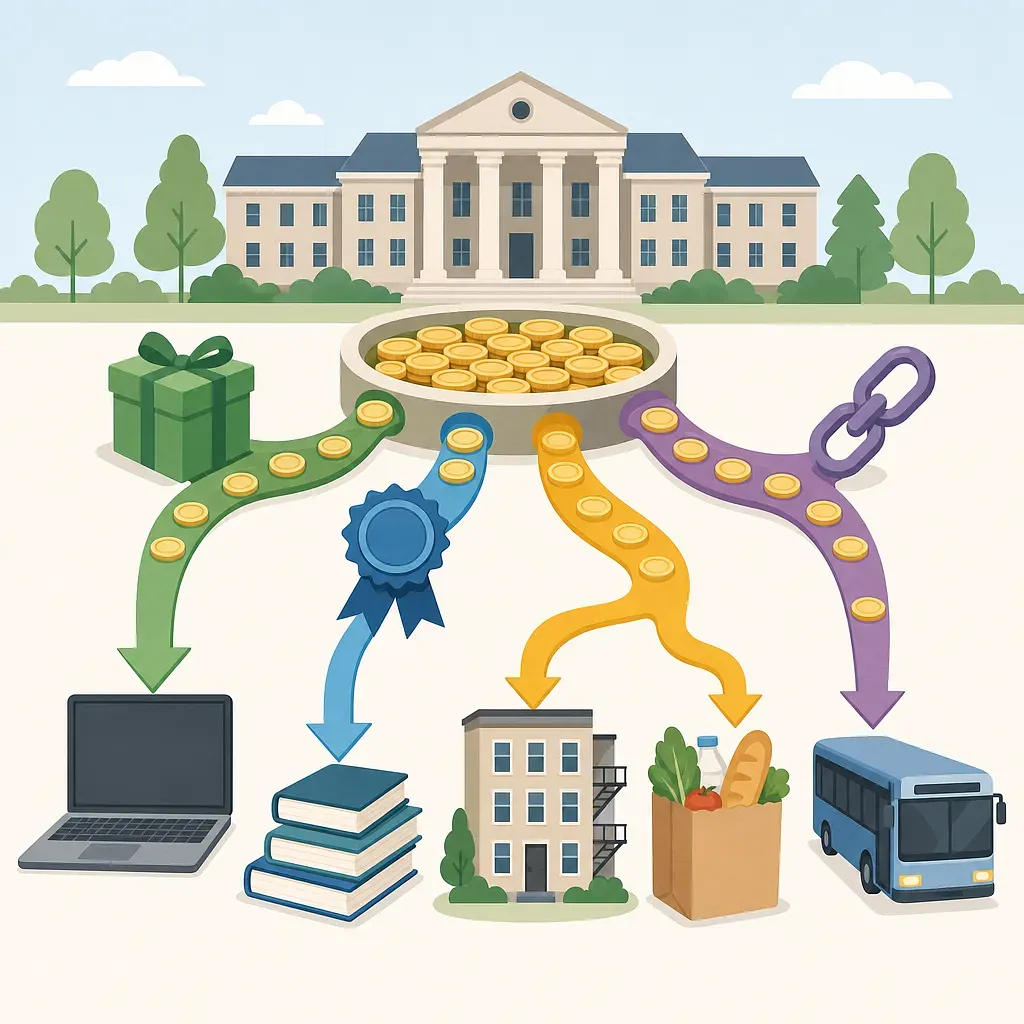
The illustration shows a college refund being allocated to education and living expenses.

Key points

  • FAFSA is an application used to determine eligibility for federal student aid; it is not itself money paid to a student.
  • A financial aid refund does not consist only of free aid and may include a mix of Pell Grant funds, scholarships, and federal loans.
  • Laptops, textbooks, housing, food, and commuting costs may be reasonable education-related expenses, but you should check the school's cost-of-attendance calculation and the conditions for each type of aid.
  • Using scholarships and grants for housing, food, transportation, and similar expenses may make them taxable scholarships for federal income tax purposes, but loan proceeds are generally not income.
  • If you withdraw before completing the term, do not participate in classes, or reduce your enrolled credits, you may have to return part of the refund you already received to the school or the federal government.

A financial aid refund at a U.S. college is not a bonus like a tax refund. It is the balance remaining after the school applies financial aid to the student’s account and subtracts allowable institutional charges such as tuition and required fees. This balance may include not only aid that does not have to be repaid, but also loan funds that must be repaid after graduation.

Therefore, when determining whether the money can be used for a particular purpose, you should consider not only the name of the item but also the source of the refund, the relationship between the expense and education, the school’s calculated cost of attendance, enrollment status, and the expense’s classification for tax purposes.

Differences Among FAFSA, Pell Grant, Student Loans, and Refunds

Term Meaning Whether Repayment Is Generally Required
FAFSA An application used to determine eligibility for federal, state, and institutional student aid It is not money, so it is not subject to repayment
Pell Grant A federal grant for eligible undergraduate students with financial need and others Generally does not have to be repaid, but repayment obligations may arise due to withdrawal, enrollment changes, or other circumstances
Scholarships and institutional grants Aid provided under conditions established by schools, state governments, foundations, and others Generally does not have to be repaid if the conditions are met, but the terms of each award take precedence
Federal student loans Borrowed money, such as Direct Subsidized Loan, Direct Unsubsidized Loan, and PLUS Loan The principal and applicable interest must be repaid
Financial aid refund The balance paid to the student or parent after institutional charges are covered with financial aid Depends on the nature of the aid making up the balance

Submitting the FAFSA does not automatically result in a refund. The aid offer and remaining balance vary depending on the school’s calculated cost of attendance, the student’s aid eligibility, enrolled credits, other aid, and the actual charges on the student’s school account.

Federal Work-Study may also be related to FAFSA results, but it is generally paid as wages for actual work rather than as a lump-sum refund at the beginning of the semester.

How Refunds Are Generated and Paid

The general process is as follows.

  1. The school disburses grants, scholarships, and loan funds to the student’s account.
  2. Tuition and required fees are covered first.
  3. Allowable institutional charges, such as school-contracted housing and meal costs, may also be covered.
  4. If the applied financial aid exceeds the allowable charges, a Title IV credit balance arises.
  5. The school pays the balance by check, direct deposit, or another method within the deadline established by federal regulations.

In principle, a federal Title IV credit balance must be paid within a 14-day period determined based on the date the balance arose or the first day of classes. However, the actual payment date may vary depending on the school’s schedule, the type of aid, enrollment verification, and whether any documents are missing.

A balance resulting from a Parent PLUS Loan is generally paid to the parent borrower, but it may be paid to the student if the parent has authorized the school to do so. Students should not assume that money deposited into their accounts is necessarily grant aid in their own names.

Standards for Using Refunds for Laptops, Tablets, and Textbooks

Federal student loans must be used for allowable educational expenses related to attending the school. A school’s cost of attendance may generally include not only tuition and fees but also allowances for books, course materials, supplies, equipment, transportation, food, housing, and reasonable personal expenses.

Laptops and Tablets

A laptop can readily be explained as an education-related expense if it is equipment reasonably necessary for attending classes, completing assignments, taking online courses, running major-specific software, or similar purposes. The same principle may apply to a tablet if it has an actual academic purpose, such as reading electronic textbooks or taking notes in class.

However, it is safer to verify the following:

  • How much the school’s official cost of attendance includes for books, supplies, and equipment
  • Whether the device is necessary or reasonable for the student’s major or courses
  • Whether the purchase is an expensive additional device when the student already has an adequate one
  • Whether the scholarship provider separately restricts purchases of electronic devices
  • Whether the equipment is required for enrollment or attendance in order to qualify as a tax-free scholarship expense

The determination that something qualifies as an educational expense under federal student aid rules is not the same as the determination that it is a tax-free qualified education expense for federal income tax purposes. For example, even if a laptop is helpful for classes, the tax treatment of scholarship funds may differ if the school or program did not require it.

Textbooks and Course Materials

Required textbooks, practicum tools, art supplies, lab coats, major-specific software, and online assignment access codes are common education-related expenses. Even when buying used textbooks or purchasing from outside vendors, it is advisable to retain the syllabus and receipts to establish the academic connection.

Housing, Food, Transportation, and Other Living Expenses

Reasonable housing, food, and transportation expenses incurred to attend school may be part of the cost of attendance. Therefore, using a student loan balance for dormitory fees, rent, basic food costs, public transportation, or reasonable costs associated with a commuting vehicle can generally be connected to an educational purpose.

Expense Likelihood of Being Considered Education-Related Points to Note
Tuition and required fees High Often deducted by the school from the student’s account first
Required textbooks and practicum materials High Retaining the syllabus and receipts is recommended
Laptop or tablet for academic use Possible if reasonably necessary Check high-end specifications, duplicate purchases, and any separate scholarship restrictions
Rent, dormitory fees, and basic food costs May be included in the cost of attendance May be taxable if paid with scholarship funds
Commuting transportation costs May be included in the cost of attendance The entire purchase price of a vehicle is not automatically allowable
Medical and childcare expenses May be included depending on the student’s circumstances and adjustments to the school’s budget Ask the school’s financial aid office about documentation and whether an adjustment is possible
Travel, entertainment, investments, and existing credit card debt Difficult to connect to an educational purpose It is especially prudent not to use loan funds for these purposes

Here, living expenses means reasonable basic costs needed while enrolled. It does not mean that vacations, luxury goods, stock or crypto-asset investments, other people’s expenses, or repayment of existing debts unrelated to education are allowable.

If the school’s standard housing or transportation allowance differs significantly from the student’s actual circumstances, the student may ask the financial aid office whether the cost of attendance can be adjusted. Special circumstances and documentation are required, and an adjustment is not approved automatically.


Differences Between Grants, Scholarships, and Loan Funds

Before spending a refund, students should check the school’s student account or aid offer to determine what makes up the balance.

Pell Grant and Scholarships

Pell Grant and many scholarships generally do not have to be repaid as long as eligibility and conditions are maintained. However, repayment or an aid adjustment may occur in the following situations:

  • The student withdraws from all classes during the semester
  • The student enrolls but never begins participating in classes
  • Enrolled credits decrease, changing aid eligibility or the payment amount
  • The student fails to meet scholarship renewal conditions concerning grades, major, enrollment status, or other requirements
  • An overpayment occurs due to incorrect information or overlapping aid

Outside scholarships may restrict funds to tuition and textbooks, so the terms of the relevant scholarship foundation should be reviewed separately.

Federal Student Loans

A loan balance may look like cash available to spend, but it is still debt. Returning unused amounts through the school’s cancellation process or the loan servicer reduces the total cost.

If all or part of a Direct Loan disbursement is returned within 120 days of the disbursement date, it can generally be processed so that no interest or loan fee is charged on the returned amount. The return method and applicable date should be confirmed with the school or loan servicer.

Different Standards for Tax Treatment

For U.S. federal income tax purposes, scholarships and grants are not always tax-free. Generally, scholarships used by a degree candidate for tuition, required fees, and books, supplies, and equipment required for courses may be tax-free under certain conditions.

By contrast, scholarship funds allocated to the following expenses may generally be taxable:

  • Dormitory fees or rent
  • Food
  • Commuting and travel expenses
  • Optional equipment
  • Amounts received as payment for research, teaching, or services, although exceptions provided by law may apply

Student loan proceeds are generally not taxable income when received because they must be repaid. However, regardless of how the loan funds are spent, the obligation to repay principal and interest remains.

When claiming a tax credit, the same qualified education expenses cannot be used for both a tax-free scholarship and an education tax credit. How Pell Grant funds are allocated among expenses can affect the tax outcome, so IRS Publication 970 should be reviewed together with the individual’s actual records.

Repayment Risk When Withdrawing or Changing Enrolled Credits

If a student withdraws from all classes during a semester, the school may perform a Return of Title IV Funds calculation. Through the 60% point of the semester or payment period, earned federal student aid is generally calculated according to the percentage of the period completed. After exceeding the 60% point, the student is generally considered to have earned 100% of the federal aid for that period.

If the calculation identifies unearned aid, the school and student may have to return amounts in a prescribed order. In some cases, the school first returns federal funds and then charges that amount to the student’s account as an unpaid balance. Spending the entire refund does not eliminate the obligation.

Even canceling only some courses may have the following effects:

  • Pell Grant may be recalculated to reflect the student’s actual enrollment intensity
  • It may affect the minimum half-time enrollment requirement for a Direct Loan
  • Future scheduled loan disbursements may be canceled
  • It may violate the school’s or scholarship’s minimum-credit requirements
  • It may affect satisfactory academic progress standards

If a student plans to stop attending classes, it is safer to first confirm the official withdrawal date, return calculation, account balance, and future aid eligibility with the registrar and financial aid office.

Checklist Before Spending a Refund

  1. Check the student portal to determine whether the refund consists of Pell Grant, scholarships, Direct Loan, or PLUS Loan funds.
  2. Review the school’s cost-of-attendance table for allowances for books, equipment, housing, food, transportation, and personal expenses.
  3. Read each scholarship’s restrictions on use and its enrollment and academic-performance requirements.
  4. If the funds are from a loan, keep only the amount needed and consider canceling or returning the unnecessary portion.
  5. For laptops or equipment, choose a product for which the academic need and reasonableness of the price can be explained.
  6. Retain receipts, syllabi, lease agreements, transportation expense records, and bank statements.
  7. Before reducing enrolled credits or withdrawing, ask the financial aid office for an estimate of the amount that may have to be returned.
  8. If scholarship funds were used for living expenses, review whether they constitute a taxable scholarship when filing taxes.

Records Worth Keeping

  • The school’s financial aid offer or award letter
  • Student account ledger and refund payment statement
  • The school’s published cost of attendance for the relevant year
  • Loan disbursement notices and amounts by loan type
  • Scholarship terms and restrictions on use
  • Receipts for textbooks, computers, and software
  • Syllabi and major-specific equipment requirements
  • Lease agreements, dormitory statements, and commuting expense records
  • Confirmation of loan funds that were returned or canceled

The key is not to treat a refund as a single pool of money. Distinguishing among free aid, conditional scholarships, and loans that must be repaid—and separately applying the standards for educational purpose, taxes, and maintaining enrollment—can reduce unexpected taxes or debts owed to the school.

Images

The illustration shows a college refund being allocated to education and living expenses.
The illustration highlights common college expenses that a financial aid refund may help cover.

FAQ

Is all FAFSA refund money money that does not have to be repaid?

No. FAFSA is an application, and the actual refund may include federal student loans as well as Pell Grant funds and scholarships. You should check your student account and financial aid offer to identify the source of the balance.

Can I use a Pell Grant refund to buy a laptop?

If the laptop is equipment reasonably necessary for classes, assignments, online learning, or software required for your major, it may be considered an education-related expense. However, you should separately check any scholarship restrictions, the school's cost-of-attendance budget, and the tax requirement that the equipment be mandatory.

Can I use a student aid refund to pay rent and food expenses?

Reasonable housing and food expenses necessary while enrolled may be included in the school's cost of attendance and may therefore qualify as education-related uses of student loans and other aid. However, the portion of scholarships or Pell Grant funds used for these expenses may be subject to federal income tax.

Can I use the refund to buy a car?

Commuting expenses may be included in the cost of attendance, but the full purchase price of a car is not automatically allowed. School budgets generally reflect reasonable commuting costs, so it is safer to check with the financial aid office before purchasing an expensive vehicle.

What should I do with an unused student loan refund?

You can return it through the school's loan cancellation process or through your loan servicer. Amounts returned within 120 days after a Direct Loan is disbursed can generally be processed so that you do not have to pay interest or loan fees on that portion, so you should confirm the specific procedure and deadline.

If I withdraw during the semester, do I have to repay the refund I already spent?

You may have to. If the school performs a Return of Title IV Funds calculation and returns unearned federal aid, a new amount due may appear on your student account. The fact that you have already spent the refund does not prevent the return calculation.

Will my refund decrease even if I drop only one or two courses?

It may. Your Pell Grant may be adjusted based on enrollment intensity, and dropping below half-time enrollment may affect future Direct Loan disbursements or your repayment deferment. You should also check the school's recalculation date and the minimum credit requirements for scholarships.

Do I have to report a student aid refund on my tax return?

Loan proceeds are generally not income, but scholarships and grants may be taxable depending on how they are used. Eligible amounts used for tuition and required books may be tax-free if the requirements are met, while amounts used for housing, food, transportation, and similar expenses may be taxable.

What should I do if the school pays my refund later than expected?

You should check your student account for the date the Title IV credit balance actually arose, your enrollment confirmation status, any missing documents, and whether you consented to the school holding the balance. As a rule, federal Title IV credit balances are subject to a 14-day payment requirement, so you can ask the school's bursar or financial aid office for an itemized statement and the expected payment date.

Sources

Data formats

This content is available in several machine-friendly formats.

Data-only languages (machine translated, files only)

Indonesian JSON MD Portuguese JSON MD Chinese (Traditional) JSON MD Deutsch JSON MD

Reuse & AI usage

Search indexing and AI citation with attribution are welcome. See the license policy for details.

CC BY · License

Loading…

Loading…

Related content