Injoys

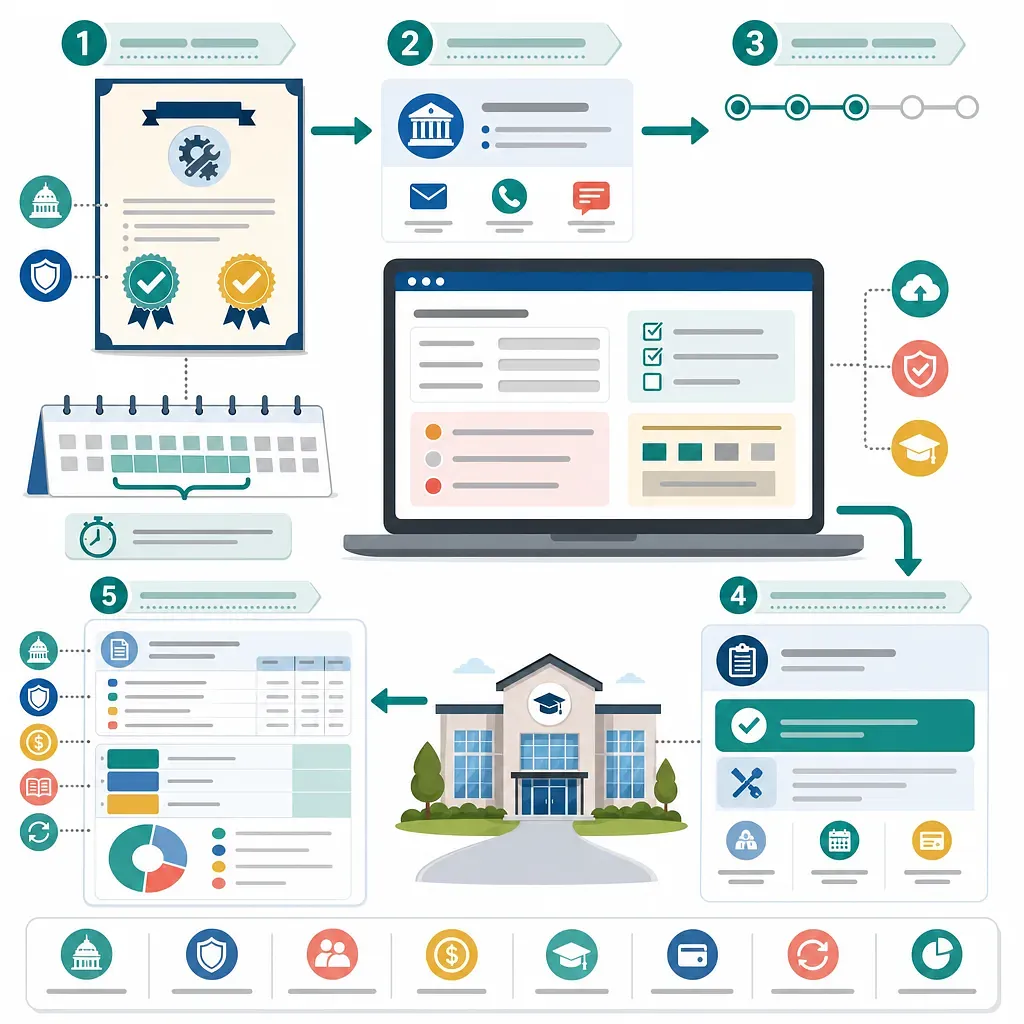
To receive a Workforce Pell Grant, the safest approach is to proceed in this order: confirm an approved program → contact the school’s financial aid office → submit the 2026-27 FAFSA → confirm enrollment → review aid details. Eligibility does not extend to all short-term courses in general, but only to vocational education programs that are at least 8 weeks and less than 15 weeks and have received both state certification and approval from the U.S. Department of Education.
The federal submission deadline for the 2026-27 FAFSA must be checked on the official Federal Student Aid website, and state, school, and program deadlines may be earlier. If you plan to enroll for the fall semester, confirm the program’s approval and begin the school and FAFSA procedures as early as possible.
Steps to Apply Now
1. Find a program that has received final federal approval
It is not enough for a school simply to have applied for Workforce Pell approval or received a state recommendation. Confirm the following with the school’s financial aid office:
- Whether the program has received final approval from the U.S. Department of Education
- The semester and start date to which the approval applies
- Whether the program is at least 8 weeks and less than 15 weeks long
- Whether the program includes at least 150 hours and less than 600 hours of instruction
- The exact program name and campus eligible for Workforce Pell
Even similar programs at the same school may have different approval statuses. You must confirm approval at the individual educational program level, not for the school as a whole.
2. Ask the school’s financial aid office about costs and enrollment requirements
It is advisable to obtain the following information in writing when making an inquiry:
- Notice of U.S. Department of Education approval and its effective date
- Estimated costs, including tuition, required fees, textbooks, and equipment
- When the estimated Workforce Pell amount will be calculated
- How it will be adjusted when received with other scholarships
- Refund policies in the event of class cancellation, withdrawal, or approval delays
- Satisfactory academic progress standards and attendance requirements
Do not make a decision based only on guidance from the admissions office. Obtain confirmation from the financial aid office that handles federal student aid.
3. Submit the 2026-27 FAFSA
Students do not complete a separate Workforce Pell application or directly indicate a short-term vocational program on the FAFSA. Once the regular FAFSA is submitted, the school verifies the student’s eligibility and enrollment in an approved program and processes the aid.
Items generally needed to submit the FAFSA include:
- The student’s StudentAid.gov account
- Identity verification information, such as a Social Security number
- Income- and tax-related information required by the official Federal Student Aid FAFSA, along with consent to provide federal tax information
- Information from contributors such as parents or a spouse, as required based on dependent student status, marital status, or other factors
- Information about the school for which aid is requested
If you have already submitted the FAFSA, do not submit a duplicate form. Confirm whether the school has received the form and whether any corrections or verification procedures are required.
4. Enroll in an approved program and confirm the school’s processing
Students do not select a Workforce Pell option on the FAFSA; the school verifies their actual enrollment status. Therefore, after being admitted to or enrolling in a program, ask the financial aid office the following:
- Whether the enrolled program matches the approved program code
- Whether the enrollment period and instructional hours comply with the approved details
- Whether the school has processed the student as eligible for Workforce Pell in the federal system
- The estimated date when the aid will be credited to the student’s account
5. Review the final aid details and out-of-pocket amount
In the school’s financial aid offer, review Workforce Pell, other scholarships, loans, and the out-of-pocket amount separately. Enrollment in a short-term program does not mean that the full annual maximum Pell Grant amount will be paid. The actual amount may vary depending on the program length and instructional hours, student eligibility, cost of attendance, other aid, and remaining Pell eligibility limit.
Official FAFSA Application
There is no separate student application exclusively for Workforce Pell. Students submit the official FAFSA from Federal Student Aid, and the school confirms enrollment in an approved program.
The federal deadline for the 2026-27 FAFSA must be checked on the official Federal Student Aid website, while school and state priority deadlines may be earlier. If the program will begin soon, allow time for FAFSA processing and the school’s review of additional documents.
Who Can Receive Aid
In addition to enrolling in an approved program, students must meet the general federal student aid eligibility requirements. The school determines final eligibility based on the FAFSA results and enrollment status.
| Item to Confirm | Key Requirement |
|---|---|
| Enrolled program | A Workforce Pell program that has received both state certification and U.S. Department of Education approval |
| Student status | Meets basic federal student aid requirements, such as being a U.S. citizen or eligible noncitizen |
| FAFSA | Submission of the FAFSA for the applicable award year and completion of any required verification procedures |
| Academic status | Meets the school’s satisfactory academic progress standards |
| Degree held | A bachelor’s degree holder may qualify for aid on an exceptional basis in an approved Workforce Pell program |
| Excluded applicants | Graduate degree holders or students enrolled in graduate programs are excluded from Workforce Pell eligibility |
| Usage limit | A prior history of receiving Pell Grants may affect the lifetime eligibility limit |
An important difference from the regular Pell Grant is that having a bachelor’s degree does not automatically disqualify a student. However, because the school will verify whether the student holds a graduate degree, is currently enrolled in a graduate program, and meets other eligibility requirements, this information should be disclosed to the financial aid office in advance.
Approval Requirements for Programs
Workforce Pell does not apply to every certificate or vocational training program simply because it is short. A program must pass both a state labor market assessment and federal review.
| Category | Main Criteria |
|---|---|
| Duration | At least 8 weeks and less than 15 weeks |
| Instructional hours | At least 150 hours and less than 600 hours |
| Educational institution | An educational institution eligible to participate in federal student aid programs |
| Approval structure | Final approval by the U.S. Department of Education after certification by the governor or through a designated state process |
| Labor market connection | Relevance to a high-skill, high-wage, or in-demand industry or occupation |
| Credential value | Leads to a credential recognized by employers and usable for employment, licensure, or qualification attainment |
| Learning pathway | A structure that can accumulate or connect to other credentials or academic credits |
| Outcomes | Under the applicable calculation rules, both completion and job placement rates meet the minimum 70% threshold |
| Operating history | Generally requires actual operating and performance data for a certain period before approval |
| Economic value | Subject to federal value standards reflecting tuition and post-completion income gains, among other factors |
State certification is the stage that confirms labor market demand, while U.S. Department of Education approval is the stage that determines whether federal Pell Grant funds may be paid. A program that has completed only one of these stages cannot be assumed to be eligible for final payment.