Skip to content
Injoys
AI Data 🇰🇷 South Korea

This content applies specifically to South Korea.

AI Data Center Special Act: 2027 Rules

The AI Data Center Special Act takes effect on March 10, 2027. The law establishes the basic framework for integrated permitting and special power provisions for areas outside the capital region, but details such as the applicable scale and procedures will be specified in subordinate legislation.

Listen or read this article

18:18

Listen, or read the text only.

AI Data Center Special Act: 2027 Rules

Kokoro 82M AI-generated voice 19 min read

0:00 18:18

Advertisement

Download audio

File name
ai-data-center-special-act-2027-rules-en.mp3
Format
MP3 (audio/mpeg)
Duration
18:18
File size
12.6 MB
Engine
Kokoro 82M

This audio was generated by AI.

You may download and use it freely for personal use.

AI Data Center Special Act: 2027 Rules

13 min read

AI Data Center Special Act: 2027 Rules
The AI Data Center Special Act takes effect on March 10, 2027. The law establishes the basic framework for integrated permitting and special power provisions for areas outside the capital region, but details such as the applicable scale and procedures will be specified in subordinate legislation.
The AI Data Center Special Act was promulgated on June 9, 2026, and takes effect on March 10, 2027.
A one-stop desk at the Ministry of Science and ICT will be introduced to process permits and approvals from relevant agencies collectively.
AI data centers outside the capital region may be eligible for special provisions on power grid impact assessments.
Facility scale, processing procedures, and support criteria will be specified in subordinate legislation.
Gathering opinions from local residents, community cooperation, and guidelines for measuring electromagnetic wave impacts are also issues in preparing for implementation.
The Special Act on AI Data Centers was promulgated on June 9, 2026, and will take effect on March 10, 2027. Detailed standards for the Ministry of Science and ICT’s integrated permitting process, processing deadlines, and special provisions for the power grid outside the Seoul metropolitan area will be prescribed by subordinate legislation. The public forum on September 9, 2026, is at the stage of discussing standards for scale, procedures, and support.
As of September 9, 2026
Implementation Schedule and Current Status
The Act has been promulgated but has not yet taken effect. The Ministry of Science and ICT is preparing subordinate legislation. A public forum will be held on September 9, 2026.
Date | Procedure | Significance June 9, 2026 | Act promulgated | The legal framework of the Special Act is finalized September 9, 2026 | Public forum on subordinate legislation | Stage of gathering opinions on detailed standards March 10, 2027 | Act takes effect | The point at which the system under the Special Act becomes operational
The matters discussed at the forum are not necessarily the final rules. The text must be reviewed after it has undergone legislative notice and finalization procedures. Until the Act takes effect, the current permitting system remains the applicable standard.
Scope of Application to AI Data Centers and Operators
The Special Act distinguishes AI data centers and related operators as legal subjects. However, facility scale and business type affect the actual boundaries of its application. Specific scale standards are among the key matters delegated to subordinate legislation.
An ordinary data center does not automatically become an AI data center. It must satisfy both the final definition and the scale requirements. The scope of operators must also be determined under the final subordinate legislation.
The following factors determine whether the Act applies:
· Whether the facility falls under the statutory definition of an AI data center · Whether it meets the scale standards prescribed by subordinate legislation · Whether the operating entity falls within the scope of operators under the Special Act · Whether it satisfies the location requirements for each special provision
The method of applying the Act to projects already underway must also be checked separately. This may vary depending on the supplementary provisions and transitional measures. Retroactive application cannot be assumed based solely on the effective date.
Integrated Permitting Process
The integrated permitting process uses the Ministry of Science and ICT as a single point of contact. This can reduce the burden on operators of separately obtaining decisions from multiple relevant authorities. It does not eliminate the relevant authorities’ substantive review powers.
The basic processing flow can be understood as follows:
· Confirm whether the project falls within the scope of the Special Act. · Submit the required permitting materials through the integrated point of contact. · The Ministry of Science and ICT requests reviews from the relevant authorities. · The result is processed after review and consultation by the relevant authorities. · If supplementation or separate conditions are required, satisfy those requirements.
Consolidated processing is a system that combines the application channel and interagency consultations. It does not exempt projects from safety and environmental requirements under individual laws. Required documents and consultation methods may be specified in subordinate legislation.
How Permitting Deadlines Work
The Special Act establishes a framework for managing permitting deadlines. The final subordinate legislation must be checked for the exact periods and calculation methods. Figures discussed at the forum stage must not be treated as finalized deadlines.
Under the deadline system, the following factors affect the actual schedule:
· The point at which the deadline begins to run · How the time required to supplement materials is treated · The scope requiring consultation with relevant authorities · The legal effect that applies when a deadline has passed
The mere existence of a processing deadline does not mean automatic approval. The legal effect must be determined from the wording of the Act and subordinate legislation. Project schedules must also account for possible supplementation and review by relevant authorities.
Special Provisions for Power Grid Impact Assessments Outside the Seoul Metropolitan Area
The special power provisions may apply to AI data centers outside the Seoul metropolitan area. The system does not grant the same special provisions to every data center. The facility and operator requirements must also be met.
A power grid impact assessment examines the effect of large-scale electricity demand on the grid. The Special Act provides a legal basis for special provisions concerning locations outside the Seoul metropolitan area. Specific application standards will depend on subordinate legislation and related guidelines.
The special provisions are not a promise guaranteeing electricity supply. Available grid capacity and connection conditions may be reviewed separately. The cost or timing of grid reinforcement is not determined automatically either.
Gathering Residents’ Opinions and Community Cooperation
Communication with local residents is one component of the facility development process. Subordinate legislation may specify who is subject to opinion-gathering procedures and how those procedures are conducted. The scope and implementation methods of community cooperation are also at issue.
The matters to be reviewed are divided as follows:
· The scope of project information to be provided to residents · When and how opinions may be submitted · Community cooperation measures to be prepared by the operator · Procedures for reviewing and recording submitted opinions
Gathering opinions is not the same as merely holding an information session. The procedures and records required by the final rules must be maintained. Any additional procedures applicable in each region must also be checked separately.
Electromagnetic Field Impact Measurement Guidelines
Guidelines for measuring electromagnetic field impacts are also included among the implementation preparations. The subjects and methods of measurement require technical standards. The method of disclosing results may also be addressed in subordinate rules.
The measurement guidelines provide objective standards for addressing residents’ concerns. However, the legal effect of the guidelines will depend on the final text. It cannot be assumed in advance that they constitute the same system as permitting requirements.
The finalized rules must be checked for the timing and location of measurements. The party responsible for measurement and the method of managing results must also be checked. Arbitrary standards must not be applied before detailed figures are announced.
Key Issues Remaining for Subordinate Legislation
Subordinate legislation serves to convert the principles of the Act into standards for actual enforcement. At the public forum stage, the final text has not been finalized. It is necessary to distinguish whether the following matters have been finalized.
Issue | Framework established by the Act | Matters to check in subordinate legislation Scope of application | Definitions of AI data centers and operators | Facility scale and detailed scope Integrated permitting | Integrated point of contact at the Ministry of Science and ICT | Application documents and interagency consultation procedures Processing deadlines | Deadline management system | Specific periods and calculation methods Special power provisions | Legal basis for special provisions outside the Seoul metropolitan area | Application requirements and processing procedures Community cooperation | Framework for residents’ opinions and cooperation | Subjects, methods, and implementation standards Electromagnetic field measurement | Preparation of measurement guidelines | Measurement methods and management of results Industry support | Legal basis for support | Eligible recipients, procedures, and support standards
The legal basis for support must be distinguished from the actual details of support. Support amounts or rates must be checked in the finalized rules. The promulgation of the Act alone does not determine support for an individual project.
Summary by Condition
The applicable systems vary depending on the facility type and location conditions. Meeting one requirement does not make all special provisions available. The separate requirements of each system must be checked.
Condition or Case | Matters to Check First | Caution Data center for AI computing | Statutory definition and scale standards | The name alone does not make it subject to the Act Operator under the Special Act | Operating model and scope of operators | May be assessed separately from facility requirements Location outside the Seoul metropolitan area | Regional requirements for special power provisions | Grid connection is not automatically guaranteed Location within the Seoul metropolitan area | General scope of application and individual permits | Must be distinguished from special power provisions outside the Seoul metropolitan area Project underway before the effective date | Supplementary provisions and transitional measures | Applicability cannot be determined solely from the effective date Project expected to affect residents | Opinion-gathering and cooperation procedures | Additional regional procedures must be checked
Projects in the Seoul metropolitan area cannot be regarded as excluded from the entire Special Act. The distinction concerning areas outside the Seoul metropolitan area relates to the special power provisions. The overall scope of application must be determined from the wording of the final legislation.
Comparison of Finalized and Undecided Matters
The framework of the promulgated Act and the detailed standards in subordinate legislation must be read separately. The effective date of the Act has already been specified. Detailed scale requirements and procedures cannot be determined until the final rules are issued.
Category | Currently Confirmable Details | Details Requiring Further Confirmation Implementation | Takes effect on March 10, 2027 | Preparatory schedule before implementation Administrative point of contact | Integrated point of contact at the Ministry of Science and ICT | Submission methods and detailed documents Permitting | Consolidated processing and deadline system | Specific deadlines and legal effects Power | Legal basis for special provisions outside the Seoul metropolitan area | Applicable scale and application procedures Resident relations | Opinion-gathering and cooperation framework | Frequency, methods, and recordkeeping standards Electromagnetic fields | Direction for preparing measurement guidelines | Measurement standards and disclosure methods Support | Legal basis for industry support | Eligible recipients, scale, and selection standards
Forum materials are useful for understanding the direction of discussions. However, they do not replace the final Enforcement Decree or Enforcement Rules. Project assessments must be updated based on promulgated subordinate legislation.
Difference Between the Effective Date and Project Approval Date
March 10, 2027, is the effective date of the system, not the approval date for individual projects. The review period for each project varies depending on the application and reviews by relevant authorities. The power connection schedule may also be managed separately.
Project schedules need to distinguish among three dates:
· The date on which the Special Act and subordinate legislation take effect · The date on which the integrated permitting application is received · The date on which individual permitting and power-related procedures are completed
This distinction may also affect existing projects. Transitional measures determine whether procedures applied for before implementation will transition to the new system. The finalized subordinate legislation and supplementary provisions must be checked together.
Common Misconceptions
The special provisions of the Special Act do not eliminate all regulations. The integrated point of contact and special power provisions each have a limited scope. Care should be taken with the following interpretations:
· The interpretation that integrated permitting exempts a project from all reviews · The interpretation that approval is automatic once the processing deadline has passed · The interpretation that electricity supply is guaranteed outside the Seoul metropolitan area · The interpretation that every data center is recognized as an AI data center · The interpretation that forum agenda items are the final Enforcement Decree · The interpretation that the special provisions took effect as soon as the Act was promulgated
The promulgation date and effective date are different. As of September 9, 2026, the Act has not yet taken effect. The final detailed standards must be checked in the promulgated subordinate legislation.
Where to Check the Original Legislation
The official provisions must be checked through the Korean Law Information Center. The title of the Act is the “Special Act on the Promotion of the Artificial Intelligence Data Center Industry.” Reviewing both the main text and the enactment and amendment text makes it possible to distinguish the effective date from the amendment history.
Posts from the Ministry of Science and ICT must be checked for discussions concerning subordinate legislation. After the forum, it is also necessary to see whether a legislative notice has been published. Final decisions must be based on the promulgated Enforcement Decree and Enforcement Rules.
Frequently Asked Questions
When does the Special Act on AI Data Centers take effect?
It takes effect on March 10, 2027. The promulgation date was June 9, 2026. Subordinate legislation will be prepared between these two dates.
Can the special provisions be used starting on September 9, 2026?
No. That is the date of the public forum on subordinate legislation. The Special Act is scheduled to take effect on March 10, 2027.
Does it apply to every data center?
No. A facility must satisfy the statutory definition of an AI data center. Detailed standards, including scale requirements, must be checked in subordinate legislation.
Does integrated permitting eliminate individual permits?
The integrated point of contact is a mechanism for consolidating administrative procedures. It does not eliminate substantive reviews by relevant authorities. Requirements under individual laws must also be met.
Is a power grid impact assessment waived outside the Seoul metropolitan area?
It must not be interpreted as a blanket exemption. The Special Act provides special provisions that may apply outside the Seoul metropolitan area. The final subordinate legislation must be checked for specific requirements and effects.
Do the special power provisions guarantee electricity supply?
They do not automatically guarantee electricity supply. Available grid capacity and connection conditions may be subject to separate review. The legal scope of the special provisions must also follow the final rules.
Has the scale of support been determined?
Support standards are among the matters to be specified in subordinate legislation. Any finalized amounts or rates must be checked in the promulgated text. The legal basis for support and individual support decisions are separate matters.
Are the matters discussed at the forum the final rules?
The forum is an opinion-gathering procedure. Discussion proposals may change during the legislative process. It is necessary to check whether the final Enforcement Decree and Enforcement Rules have been promulgated.
0:00 0:00
1 / 83

Advertisement

Download text

File name
ai-data-center-special-act-2027-rules-en.txt
Format
TXT (text/plain)
Paragraphs
83

Downloads exactly what you see as a text file.

Please cite the source when quoting.

Large text

Makes the text larger and the colors clearer. Turn it on if the text feels too small.

A man hands infrastructure project documents to an official for administrative review.

Key points

  • The AI Data Center Special Act was promulgated on June 9, 2026, and takes effect on March 10, 2027.
  • A one-stop desk at the Ministry of Science and ICT will be introduced to process permits and approvals from relevant agencies collectively.
  • AI data centers outside the capital region may be eligible for special provisions on power grid impact assessments.
  • Facility scale, processing procedures, and support criteria will be specified in subordinate legislation.
  • Gathering opinions from local residents, community cooperation, and guidelines for measuring electromagnetic wave impacts are also issues in preparing for implementation.

The Special Act on AI Data Centers was promulgated on June 9, 2026, and will take effect on March 10, 2027. Detailed standards for the Ministry of Science and ICT’s integrated permitting process, processing deadlines, and special provisions for the power grid outside the Seoul metropolitan area will be prescribed by subordinate legislation. The public forum on September 9, 2026, is at the stage of discussing standards for scale, procedures, and support.

As of September 9, 2026

Implementation Schedule and Current Status

The Act has been promulgated but has not yet taken effect. The Ministry of Science and ICT is preparing subordinate legislation. A public forum will be held on September 9, 2026.

Date Procedure Significance
June 9, 2026 Act promulgated The legal framework of the Special Act is finalized
September 9, 2026 Public forum on subordinate legislation Stage of gathering opinions on detailed standards
March 10, 2027 Act takes effect The point at which the system under the Special Act becomes operational

The matters discussed at the forum are not necessarily the final rules. The text must be reviewed after it has undergone legislative notice and finalization procedures. Until the Act takes effect, the current permitting system remains the applicable standard.

Scope of Application to AI Data Centers and Operators

The Special Act distinguishes AI data centers and related operators as legal subjects. However, facility scale and business type affect the actual boundaries of its application. Specific scale standards are among the key matters delegated to subordinate legislation.

An ordinary data center does not automatically become an AI data center. It must satisfy both the final definition and the scale requirements. The scope of operators must also be determined under the final subordinate legislation.

The following factors determine whether the Act applies:

  • Whether the facility falls under the statutory definition of an AI data center
  • Whether it meets the scale standards prescribed by subordinate legislation
  • Whether the operating entity falls within the scope of operators under the Special Act
  • Whether it satisfies the location requirements for each special provision

The method of applying the Act to projects already underway must also be checked separately. This may vary depending on the supplementary provisions and transitional measures. Retroactive application cannot be assumed based solely on the effective date.

Integrated Permitting Process

The integrated permitting process uses the Ministry of Science and ICT as a single point of contact. This can reduce the burden on operators of separately obtaining decisions from multiple relevant authorities. It does not eliminate the relevant authorities’ substantive review powers.

The basic processing flow can be understood as follows:

  1. Confirm whether the project falls within the scope of the Special Act.
  2. Submit the required permitting materials through the integrated point of contact.
  3. The Ministry of Science and ICT requests reviews from the relevant authorities.
  4. The result is processed after review and consultation by the relevant authorities.
  5. If supplementation or separate conditions are required, satisfy those requirements.

Consolidated processing is a system that combines the application channel and interagency consultations. It does not exempt projects from safety and environmental requirements under individual laws. Required documents and consultation methods may be specified in subordinate legislation.

How Permitting Deadlines Work

The Special Act establishes a framework for managing permitting deadlines. The final subordinate legislation must be checked for the exact periods and calculation methods. Figures discussed at the forum stage must not be treated as finalized deadlines.

Under the deadline system, the following factors affect the actual schedule:

  • The point at which the deadline begins to run
  • How the time required to supplement materials is treated
  • The scope requiring consultation with relevant authorities
  • The legal effect that applies when a deadline has passed

The mere existence of a processing deadline does not mean automatic approval. The legal effect must be determined from the wording of the Act and subordinate legislation. Project schedules must also account for possible supplementation and review by relevant authorities.

Special Provisions for Power Grid Impact Assessments Outside the Seoul Metropolitan Area

The special power provisions may apply to AI data centers outside the Seoul metropolitan area. The system does not grant the same special provisions to every data center. The facility and operator requirements must also be met.

A power grid impact assessment examines the effect of large-scale electricity demand on the grid. The Special Act provides a legal basis for special provisions concerning locations outside the Seoul metropolitan area. Specific application standards will depend on subordinate legislation and related guidelines.

The special provisions are not a promise guaranteeing electricity supply. Available grid capacity and connection conditions may be reviewed separately. The cost or timing of grid reinforcement is not determined automatically either.

Gathering Residents’ Opinions and Community Cooperation

Communication with local residents is one component of the facility development process. Subordinate legislation may specify who is subject to opinion-gathering procedures and how those procedures are conducted. The scope and implementation methods of community cooperation are also at issue.

The matters to be reviewed are divided as follows:

  • The scope of project information to be provided to residents
  • When and how opinions may be submitted
  • Community cooperation measures to be prepared by the operator
  • Procedures for reviewing and recording submitted opinions

Gathering opinions is not the same as merely holding an information session. The procedures and records required by the final rules must be maintained. Any additional procedures applicable in each region must also be checked separately.

Electromagnetic Field Impact Measurement Guidelines

Guidelines for measuring electromagnetic field impacts are also included among the implementation preparations. The subjects and methods of measurement require technical standards. The method of disclosing results may also be addressed in subordinate rules.

The measurement guidelines provide objective standards for addressing residents’ concerns. However, the legal effect of the guidelines will depend on the final text. It cannot be assumed in advance that they constitute the same system as permitting requirements.

The finalized rules must be checked for the timing and location of measurements. The party responsible for measurement and the method of managing results must also be checked. Arbitrary standards must not be applied before detailed figures are announced.

Key Issues Remaining for Subordinate Legislation

Subordinate legislation serves to convert the principles of the Act into standards for actual enforcement. At the public forum stage, the final text has not been finalized. It is necessary to distinguish whether the following matters have been finalized.

Issue Framework established by the Act Matters to check in subordinate legislation
Scope of application Definitions of AI data centers and operators Facility scale and detailed scope
Integrated permitting Integrated point of contact at the Ministry of Science and ICT Application documents and interagency consultation procedures
Processing deadlines Deadline management system Specific periods and calculation methods
Special power provisions Legal basis for special provisions outside the Seoul metropolitan area Application requirements and processing procedures
Community cooperation Framework for residents’ opinions and cooperation Subjects, methods, and implementation standards
Electromagnetic field measurement Preparation of measurement guidelines Measurement methods and management of results
Industry support Legal basis for support Eligible recipients, procedures, and support standards

The legal basis for support must be distinguished from the actual details of support. Support amounts or rates must be checked in the finalized rules. The promulgation of the Act alone does not determine support for an individual project.

Summary by Condition

The applicable systems vary depending on the facility type and location conditions. Meeting one requirement does not make all special provisions available. The separate requirements of each system must be checked.

Condition or Case Matters to Check First Caution
Data center for AI computing Statutory definition and scale standards The name alone does not make it subject to the Act
Operator under the Special Act Operating model and scope of operators May be assessed separately from facility requirements
Location outside the Seoul metropolitan area Regional requirements for special power provisions Grid connection is not automatically guaranteed
Location within the Seoul metropolitan area General scope of application and individual permits Must be distinguished from special power provisions outside the Seoul metropolitan area
Project underway before the effective date Supplementary provisions and transitional measures Applicability cannot be determined solely from the effective date
Project expected to affect residents Opinion-gathering and cooperation procedures Additional regional procedures must be checked

Projects in the Seoul metropolitan area cannot be regarded as excluded from the entire Special Act. The distinction concerning areas outside the Seoul metropolitan area relates to the special power provisions. The overall scope of application must be determined from the wording of the final legislation.

Comparison of Finalized and Undecided Matters

The framework of the promulgated Act and the detailed standards in subordinate legislation must be read separately. The effective date of the Act has already been specified. Detailed scale requirements and procedures cannot be determined until the final rules are issued.

Category Currently Confirmable Details Details Requiring Further Confirmation
Implementation Takes effect on March 10, 2027 Preparatory schedule before implementation
Administrative point of contact Integrated point of contact at the Ministry of Science and ICT Submission methods and detailed documents
Permitting Consolidated processing and deadline system Specific deadlines and legal effects
Power Legal basis for special provisions outside the Seoul metropolitan area Applicable scale and application procedures
Resident relations Opinion-gathering and cooperation framework Frequency, methods, and recordkeeping standards
Electromagnetic fields Direction for preparing measurement guidelines Measurement standards and disclosure methods
Support Legal basis for industry support Eligible recipients, scale, and selection standards

Forum materials are useful for understanding the direction of discussions. However, they do not replace the final Enforcement Decree or Enforcement Rules. Project assessments must be updated based on promulgated subordinate legislation.

Difference Between the Effective Date and Project Approval Date

March 10, 2027, is the effective date of the system, not the approval date for individual projects. The review period for each project varies depending on the application and reviews by relevant authorities. The power connection schedule may also be managed separately.

Project schedules need to distinguish among three dates:

  • The date on which the Special Act and subordinate legislation take effect
  • The date on which the integrated permitting application is received
  • The date on which individual permitting and power-related procedures are completed

This distinction may also affect existing projects. Transitional measures determine whether procedures applied for before implementation will transition to the new system. The finalized subordinate legislation and supplementary provisions must be checked together.

Common Misconceptions

The special provisions of the Special Act do not eliminate all regulations. The integrated point of contact and special power provisions each have a limited scope. Care should be taken with the following interpretations:

  • The interpretation that integrated permitting exempts a project from all reviews
  • The interpretation that approval is automatic once the processing deadline has passed
  • The interpretation that electricity supply is guaranteed outside the Seoul metropolitan area
  • The interpretation that every data center is recognized as an AI data center
  • The interpretation that forum agenda items are the final Enforcement Decree
  • The interpretation that the special provisions took effect as soon as the Act was promulgated

The promulgation date and effective date are different. As of September 9, 2026, the Act has not yet taken effect. The final detailed standards must be checked in the promulgated subordinate legislation.

Where to Check the Original Legislation

The official provisions must be checked through the Korean Law Information Center. The title of the Act is the “Special Act on the Promotion of the Artificial Intelligence Data Center Industry.” Reviewing both the main text and the enactment and amendment text makes it possible to distinguish the effective date from the amendment history.

Posts from the Ministry of Science and ICT must be checked for discussions concerning subordinate legislation. After the forum, it is also necessary to see whether a legislative notice has been published. Final decisions must be based on the promulgated Enforcement Decree and Enforcement Rules.

Frequently Asked Questions

When does the Special Act on AI Data Centers take effect?

It takes effect on March 10, 2027. The promulgation date was June 9, 2026. Subordinate legislation will be prepared between these two dates.

Can the special provisions be used starting on September 9, 2026?

No. That is the date of the public forum on subordinate legislation. The Special Act is scheduled to take effect on March 10, 2027.

Does it apply to every data center?

No. A facility must satisfy the statutory definition of an AI data center. Detailed standards, including scale requirements, must be checked in subordinate legislation.

Does integrated permitting eliminate individual permits?

The integrated point of contact is a mechanism for consolidating administrative procedures. It does not eliminate substantive reviews by relevant authorities. Requirements under individual laws must also be met.

Is a power grid impact assessment waived outside the Seoul metropolitan area?

It must not be interpreted as a blanket exemption. The Special Act provides special provisions that may apply outside the Seoul metropolitan area. The final subordinate legislation must be checked for specific requirements and effects.

Do the special power provisions guarantee electricity supply?

They do not automatically guarantee electricity supply. Available grid capacity and connection conditions may be subject to separate review. The legal scope of the special provisions must also follow the final rules.

Has the scale of support been determined?

Support standards are among the matters to be specified in subordinate legislation. Any finalized amounts or rates must be checked in the promulgated text. The legal basis for support and individual support decisions are separate matters.

Are the matters discussed at the forum the final rules?

The forum is an opinion-gathering procedure. Discussion proposals may change during the legislative process. It is necessary to check whether the final Enforcement Decree and Enforcement Rules have been promulgated.

Sign-in required

Sign in with your Google account to like, comment, and save highlights.

Images

A man hands infrastructure project documents to an official for administrative review.
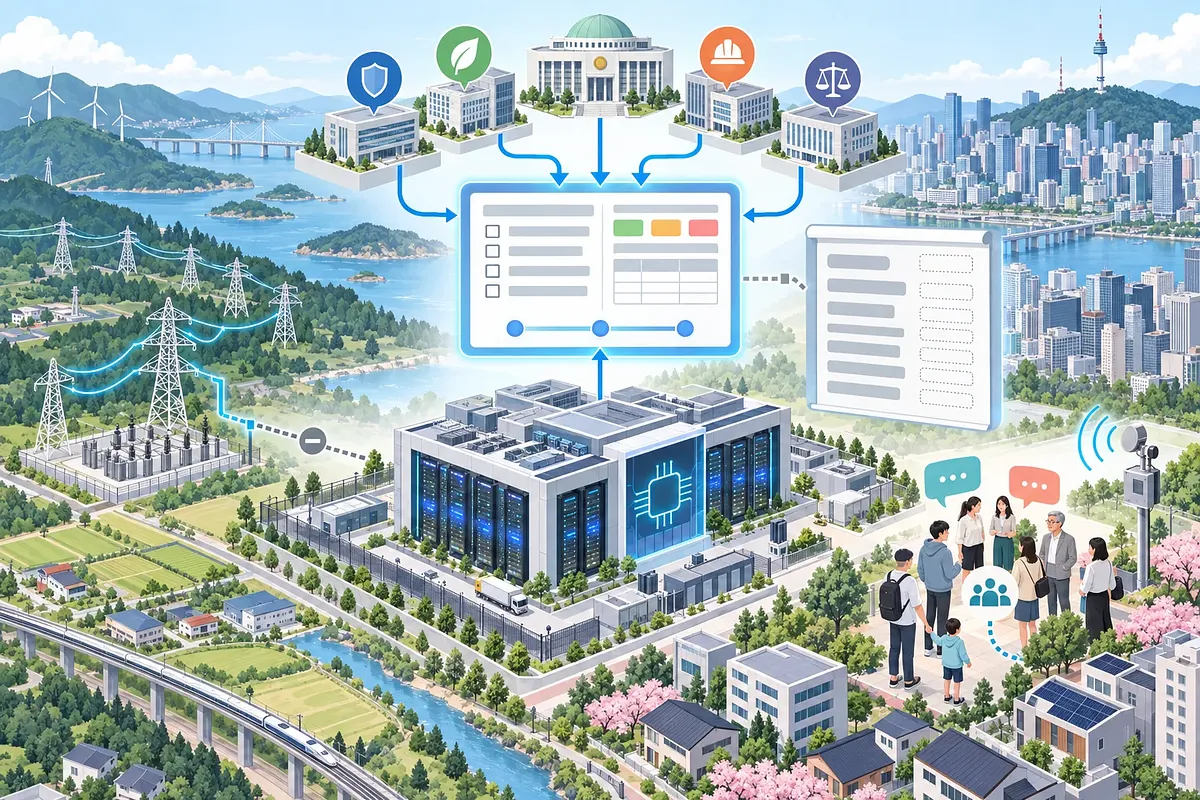
The illustration connects an AI data center with energy, environmental, safety, legal, and community considerations.

FAQ

When will the AI Data Center Special Act take effect?

It will take effect on March 10, 2027. The Act was promulgated on June 9, 2026, and subordinate legislation will be prepared before it takes effect.

Will the special provisions under the Special Act apply starting September 9, 2026?

No. September 9, 2026 is when the public hearing on the subordinate legislation will be held, while the Special Act is scheduled to take effect on March 10, 2027.

Are all data centers subject to the Special Act?

It does not automatically apply to all data centers. They must meet both the statutory definition of an AI data center and the size criteria set forth in the subordinate legislation.

Does the integrated permitting process eliminate reviews by individual agencies?

The integrated permitting process uses the Ministry of Science and ICT as a single point of contact. It does not exempt applicants from substantive reviews by relevant agencies or requirements under individual laws.

Are AI data centers outside the Seoul metropolitan area exempt from power grid impact assessments?

It cannot be concluded that there is a blanket exemption. The Special Act provides a basis for special provisions that may apply outside the Seoul metropolitan area, and the specific requirements and effects must be confirmed in the final subordinate legislation.

Does receiving special treatment for electricity guarantee the supply of electricity?

The supply of electricity is not automatically guaranteed. Available power grid capacity, connection conditions, and the need for upgrades may be subject to separate review.

Has the amount of support for AI data centers been determined?

The eligible recipients, procedures, and criteria for support are matters to be specified in the subordinate legislation. Any finalized amounts or rates must be confirmed in the promulgated subordinate legislation.

Are the criteria presented at the public hearing final regulations?

The public hearing is a stage for gathering opinions. As the matters discussed may change during the legislative process, determinations should be based on the final promulgated Enforcement Decree and Enforcement Rules.

Sources

Data formats

This content is available in several machine-friendly formats.

Data-only languages (machine translated, files only)

Indonesian JSON MD Portuguese JSON MD Chinese (Traditional) JSON MD Deutsch JSON MD

Verification

This article was drafted with AI and then reviewed and edited by a person.

Reviewed by 신익희 · 편집장 · 2026-09-09

Figures in this article were checked against the source material during generation. · 2026-09-09

This translation has been cross-checked by AI. · 2026-09-09

Reuse & AI usage

Search indexing and AI citation with attribution are welcome. See the license policy for details.

CC BY · License

Loading…

Loading…

Related content

From Injoys

Request the content you want and take 70% of what it earns

Just leave the subject. We handle production, review, translation and distribution.

See how revenue sharing works

Comments