Injoys

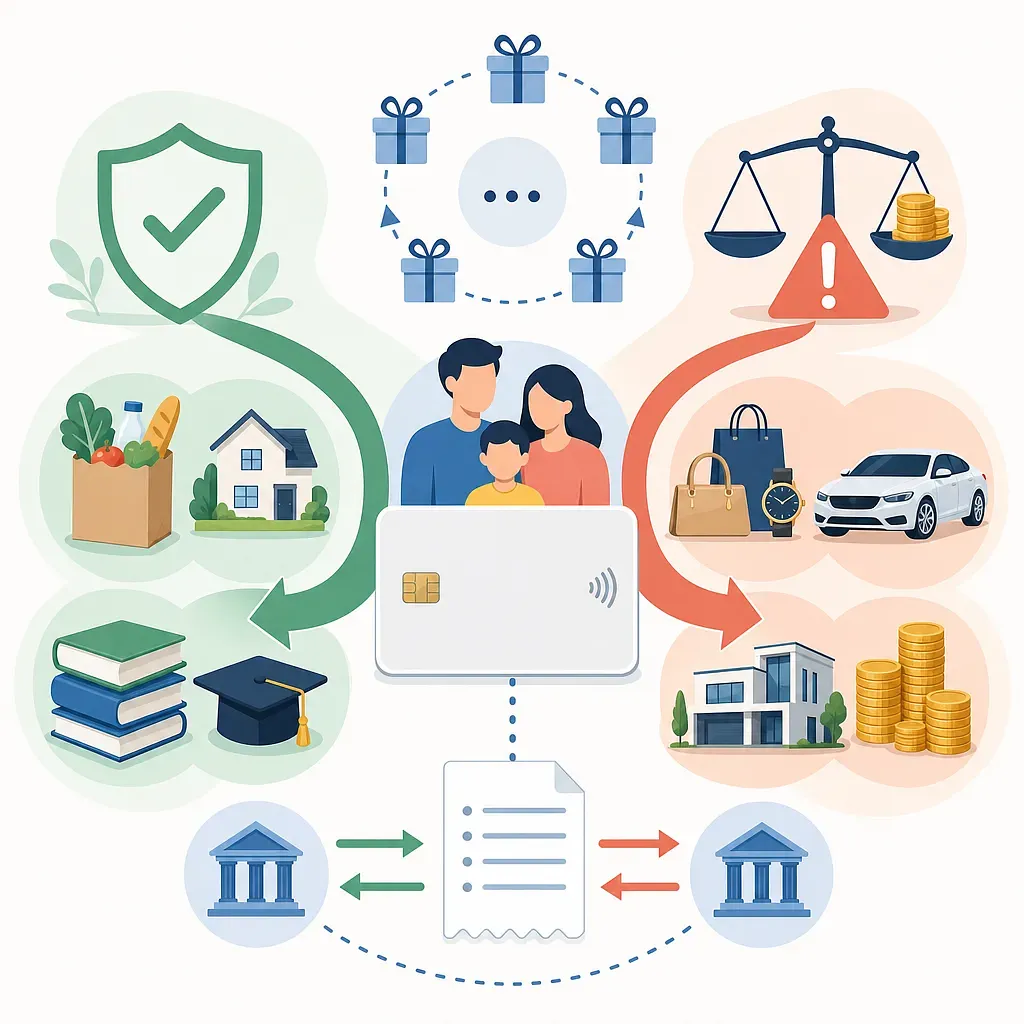
Even if the parents have given permission, a child’s use of a credit card issued in a parent’s name as if it were the child’s own card is not permitted in principle. However, not every payment immediately constitutes a criminal offense, and the assessment under credit card law and gift tax law varies depending on how the card was handed over, whom the spending was for, and whether the child repaid the amount spent.
First, the conclusion: Credit card issues and gift tax issues are separate
This issue must be divided into the following two stages for an accurate assessment.
- Legality of card use: Determine whether the child received the card issued in the parent’s name and the authority to use it.
- Whether gift tax applies: Determine whether the parent paid the card bill for the child, allowing the child to receive an economic benefit without compensation.
A violation of the card’s terms and conditions does not mean that gift tax applies to every expense. Conversely, even if the child used a family card formally issued by the card company, a separate gift tax issue may remain if the parent paid the child’s personal expenses.
Why is it a problem when a child uses a credit card issued in a parent’s name?
The transfer and receipt of credit cards are prohibited by law
Article 15 of the Specialized Credit Finance Business Act prohibits transferring or receiving a credit card and creating a pledge over a credit card. Under the penalty provisions of the same Act, a person who transfers or receives a credit card in violation of this rule may be punished by imprisonment for at most 1 year or a fine of at most KRW 10 million.
However, it cannot be concluded that the statutory offense of transferring or receiving a credit card is automatically established merely because a child made a payment on someone’s behalf once. The following specific facts must be considered together.
- Whether the parent allowed the child to keep the card continuously
- Whether the child independently made payments according to the child’s own needs
- Whether the parent also handed over the PIN or online payment authentication method
- The duration, frequency, and amount of card use
- Whether the child purchased items for the parent while running an errand
- Who actually paid the card bill
Therefore, rather than saying that “a child’s single use is always a crime,” it is more accurate to say that handing over a parent’s card and the authority to use it to a child is prohibited, and if the arrangement constitutes a transfer under the law, it may be subject to criminal punishment.
Parental permission does not make it normal use by the cardholder
A credit card is a payment instrument intended for use by the member whose name appears on the card. Standard terms and conditions for individual credit card members and card company terms generally prohibit members from allowing third parties, including spouses or family members, to use their cards.
The fact that a parent gave permission is important when determining whether the card was stolen or used without authorization, but it does not make the child an official cardholder. Violating the terms and conditions may result in suspension of card use or termination of the contract, as well as limitations on compensation or disputes over liability for card charges if an incident occurs.
If the card was used without the parent’s consent, the matter may go beyond a simple breach of the terms and conditions. Depending on how the card was used, separate criminal issues such as fraud, theft, or unauthorized use of an electronic payment authentication method may need to be examined.
A gift may arise if the parent pays the card bill
For gift tax purposes, what matters is not whose name is on the card itself, but whether the child received an economic benefit without paying compensation. If the child uses the parent’s card to purchase goods or services for the child and the parent pays the bill, a gift tax issue may arise because the parent may be regarded as having paid the child’s debt or consumption expenses on the child’s behalf.
By contrast, there may be no amount gifted to the child, or the amount may be reduced, in the following cases.
- The child merely purchased items for the parent and did not receive any benefit
- The child actually repaid the parent the entire amount spent
- The money was lent by the parent to the child, and the repayment terms and actual repayment history can be verified
- The expenses qualify as ordinary living expenses or educational expenses that are tax-exempt by law
To substantiate a claim of repayment, it is advisable to retain bank transfer records, card statements, and settlement records. If only a formal loan agreement is prepared afterward and no actual repayment is made, the transaction may not be recognized as a loan.
When are living and educational expenses exempt from gift tax?
The Inheritance Tax and Gift Tax Act provides that certain property, including living expenses and educational expenses recognized as reasonable under generally accepted social norms, is exempt from gift tax. However, not every expense becomes a living expense merely because a parent paid it.
The following conditions are generally considered together.
- Whether the parent needs to support the child
- Whether the child can afford the expense with the child’s own income and assets
- Whether the amount is ordinary in light of the family’s financial circumstances and generally accepted social norms
- Whether the money provided was directly spent on living or educational expenses
- Whether it was not used for savings, investment, or acquiring property
| Spending example | General direction of tax assessment |
|---|---|
| Food, housing, and tuition expenses for a child who needs support | May be tax-exempt if directly spent within an ordinary range |
| A child pays for household necessities used with the parents | May be difficult to regard as a gift to the child personally |
| The child repays the parent the same amount after using the card | May not be a gift if actual repayment is verified |
| Expensive luxury goods, excessive travel expenses, or extravagant spending | More likely to be denied the living expense exemption |
| Purchasing gift certificates with the card or converting them into cash for savings or investment | Highly likely to be taxable because the funds were not directly spent on living expenses |
| The parent pays the acquisition cost of assets such as a vehicle or real estate | More likely to be treated as a gift than as ordinary living expenses |
The fact that the child has no income is an important factor, but it is not an automatic condition for tax exemption. Conversely, the fact that the child has income does not necessarily mean that all living expenses paid by the parent are taxable. The actual need for support, the purpose of the expenditure, and the amount are considered together.
The exact meaning of the KRW 50 million and KRW 20 million deductions over 10 years
The basic gift property deductions applicable to gifts received from parents or other lineal ascendants are as follows.
| Child receiving the gift | Gift property deduction over 10 years |
|---|---|
| Child who is an adult as of the date of the gift | KRW 50 million |
| Child who is a minor as of the date of the gift | KRW 20 million |
These amounts are not limits permitting the child to “spend this much on the card.” Nor are they limits that reset each year. The deduction is applied after reviewing gifts received from parents or other lineal ascendants during the 10 years preceding the relevant gift date.
Amounts that are tax-exempt from the outset because they are recognized as ordinary living expenses must also be distinguished from the gift property deduction. Amounts satisfying the requirements for the living expense exemption are excluded from taxable gifted property, whereas the deduction is applied after taxable gifted property has been calculated.