Skip to content
Injoys
Knowledge Base

US Dollar Index: 100 Baseline and Interpretation

The US Dollar Index measures the relative value of the US dollar against six major currencies. It uses March 1973 as a base of 100 and does not directly represent the KRW exchange rate or the dollar's purchasing power.

Listen or read this article

12:47

Listen, or read the text only.

US Dollar Index: 100 Baseline and Interpretation

Kokoro 82M AI-generated voice 13 min read

0:00 12:47

Advertisement

Download audio

File name
dollar-index-100-calculation-and-interpretation-en.mp3
Format
MP3 (audio/mpeg)
Duration
12:47
File size
8.78 MB
Engine
Kokoro 82M

This audio was generated by AI.

You may download and use it freely for personal use.

US Dollar Index: 100 Baseline and Interpretation

10 min read

US Dollar Index: 100 Baseline and Interpretation
The US Dollar Index measures the relative value of the US dollar against six major currencies. It uses March 1973 as a base of 100 and does not directly represent the KRW exchange rate or the dollar's purchasing power.
The US Dollar Index is a relative measure that sets the dollar's March 1973 value at 100.
The euro, yen, pound, Canadian dollar, Swedish krona, and Swiss franc are included in the formula.
The weights and rankings of the euro and Swiss franc should be verified using official US Dollar Index composition data.
An index above 100 means the dollar is stronger than it was at the baseline date.
The USD/KRW exchange rate and the US Dollar Index use different comparison targets, so they may move in opposite directions.
The value of the dollar can be assessed using the U.S. Dollar Index, which combines its relative strength against six major currencies. The base value is 100 as of March 1973. A value above 100 means the dollar is stronger than at the base point, while a value below 100 means it is weaker.
Verify the figures in the U.S. Dollar Index Futures product description and methodology on the ICE website.
What Is the U.S. Dollar Index?
The U.S. Dollar Index represents the relative value of the U.S. dollar against six currencies. It is commonly called DXY, and related products are traded in the futures market. It is more suitable for assessing the dollar’s overall direction than an exchange rate against a single country’s currency.
The currencies compared include the euro and Japanese yen. The British pound and Canadian dollar are also included. The Swedish krona and Swiss franc are included in the formula as well.
The U.S. Dollar Index set March 1973 at 100. This does not represent a fixed monetary amount or purchasing power. It is a relative index level compared with the currency basket at that time.
The exact wording of the formula and contract specifications should be checked in ICE’s U.S. Dollar Index Futures product description and methodology.
Weights of the Six Currencies
The U.S. Dollar Index does not give each currency equal weight. The euro accounts for more than half of the index. Therefore, movements in the euro have a major impact on the index.
Currency | Weight in the Current ICE Formula | Effect on the U.S. Dollar Index Euro | 57.6% | Has the largest weight Japanese yen | 13.6% | Has the second-largest weight British pound | 11.9% | Reflects European currency trends along with the euro Canadian dollar | 9.1% | Reflects North American currency trends Swedish krona | 4.2% | Has a relatively small impact Swiss franc | 3.6% | Has the smallest weight among the six currencies
The expression “currencies of six countries” may not be accurate here. The euro is a currency shared by multiple euro-area countries. The U.S. Dollar Index consists of six currencies, not six countries.
How the U.S. Dollar Index Is Calculated
The U.S. Dollar Index is calculated using a weighted geometric method rather than a simple arithmetic average. A specified exponent is applied to each exchange rate. The sign of the exponent also varies depending on how the exchange rate is quoted.
A representative formula is as follows.
DXY = 50.14348112 × EUR/USD^-0.576 × USD/JPY^0.136 × GBP/USD^-0.119 × USD/CAD^0.091 × USD/SEK^0.042 × USD/CHF^0.036
The quotation methods for the euro and pound should be checked in the official U.S. Dollar Index formula. When these two exchange rates rise, the dollar has weakened, so their exponents are negative. The quotation methods and signs for the remaining currencies should be checked in the official U.S. Dollar Index formula.
The constant in the formula sets the index at 100 at the base point. Changes in each currency’s exchange rate are combined according to its weight. The result is not obtained by simply adding the percentage changes of individual currencies.
How to Read the U.S. Dollar Index
The U.S. Dollar Index can be read by checking the base value, direction, and causes of movement in order. Following these steps helps avoid confusing it with a single exchange rate.
· Check whether the index is above or below 100. · Check whether it has risen since the previous observation point. · Review movements in heavily weighted currencies such as the euro. · Separately check any necessary individual exchange rates, such as the won–dollar exchange rate. · To assess purchasing power, review inflation indicators as well.
Being above 100 means that the dollar is stronger than at the base point. However, it does not mean that the dollar has continued to rise recently. The current level and short-term direction must be distinguished from each other.
Calculation Example
If the index is exactly 100, the ratio to the base value is 100÷100. The result is 1, meaning that the index is at the same level as at the base point. This does not mean that U.S. prices or living costs are the same.
If the index rises above 100, the dollar is stronger against the basket. If it falls below 100, it is weaker than at the base point. The comparison is against a basket combining the six currencies.
The percentage change from the base value can be calculated as follows.
Percentage change from the base value = (Observed index ÷ 100 - 1) × 100%
The first 100 in this formula is the March 1973 base value. The final 100% is the unit used to convert the ratio into a percentage. The actual observed index should be checked through ICE or a financial information provider.
Summary by Purpose
The appropriate indicator for assessing the dollar’s value depends on the question. The U.S. Dollar Index alone cannot explain every meaning of the dollar’s value.
What You Want to Check | Suitable Indicator | Scope of Interpretation Exchange ratio between the dollar and won | Won–dollar exchange rate | Relationship with the single currency of the won Direction of the dollar against six major currencies | U.S. Dollar Index | Relationship with a fixed currency basket Value broadly reflecting trading partners | Trade-weighted dollar index | Relative value reflecting the trade structure Value reflecting price differences between countries | Real effective exchange rate | Reflects both nominal exchange rates and relative prices Amount that can be purchased with dollars within the United States | Inflation indicators such as the Consumer Price Index | Domestic purchasing power of the dollar
To assess overseas travel costs, you should check the exchange rate against the destination’s currency. To analyze export price competitiveness, an effective exchange rate is more appropriate. The dollar’s purchasing power within the United States should be assessed using the inflation rate.
Comparing the U.S. Dollar Index and the Won–Dollar Exchange Rate
The U.S. Dollar Index and the won–dollar exchange rate use different comparison currencies. The won is not among the six currencies that make up the U.S. Dollar Index. The two indicators cannot be assumed to always move in the same direction.
Category | U.S. Dollar Index | Won–Dollar Exchange Rate Comparison | Dollar and six major currencies | Dollar and won Whether the won is reflected | Not reflected | Directly reflected Meaning of an increase | Dollar strengthens against the basket | Won weakens against the dollar Main use | Assessing the dollar’s international direction | Assessing won exchange, trade, and foreign-currency costs
The dollar may weaken against the euro while strengthening against the won. In this case, the U.S. Dollar Index may fall while the won–dollar exchange rate rises. Supply and demand for the won itself and conditions in South Korea’s financial markets also affect the exchange rate.
Comparing the Fixed Basket and Trade-Weighted Indices
The U.S. Dollar Index has a simple structure, but it does not fully reflect the modern trade structure. The Chinese yuan and Korean won are not constituent currencies. The euro’s weight should be checked in the official U.S. Dollar Index composition data.
The U.S. Federal Reserve provides dollar indicators that reflect a broader range of currencies. The Bank for International Settlements also publishes nominal and real effective exchange rate data. These indicators can be used together depending on the purpose of the analysis.
Item | U.S. Dollar Index | Broad Trade-Weighted Index | Real Effective Exchange Rate Currency composition | Six fixed currencies | Broad range of trading-partner currencies | Trading-partner currencies Basis for weights | Predetermined fixed weights | Trade structure | Trade structure and relative prices Inflation reflected | No | Not in the nominal index | Yes Suitable use | Checking the dollar’s market direction | Analyzing the dollar’s value based on trade | Analyzing price competitiveness and real value
This distinction does not mean that the U.S. Dollar Index is wrong. Each indicator measures a different subject. The key is to choose the indicator that fits the question.
Common Mistakes
The most common mistake is reading the U.S. Dollar Index as the dollar’s absolute value. The U.S. Dollar Index is a relative indicator compared with a currency basket. It does not directly measure commodity prices or domestic purchasing power.
· Do not interpret 100 as the current normal exchange rate. · The relationship between index points and changes in the constituent currencies should be checked in the official U.S. Dollar Index formula. · Do not assume that the won–dollar exchange rate necessarily moves in the same direction. · Do not overlook the euro’s 57.6% weight. · Distinguish nominal exchange rates from real values that reflect inflation. · Separate the index level from its direction of movement over a day or month.
A rise in the U.S. Dollar Index alone also does not establish that the U.S. economy has improved. Interest-rate expectations and demand for safe-haven assets may work together. The index may also rise because the currencies of other major economies have weakened.
Indicators to Review When Assessing the Dollar’s Value
For practical assessments, the U.S. Dollar Index should be used together with indicators suited to the purpose. Investors can additionally check interest rates, inflation, and individual exchange rates. Companies should also consider their settlement currencies and foreign-currency assets and liabilities.
The items to check can be divided as follows.
· Market direction of the dollar: U.S. Dollar Index · Price when exchanging into won: Won–dollar exchange rate · U.S. monetary conditions: Federal funds rate and market interest rates · Domestic purchasing power of the dollar: U.S. Consumer Price Index · Competitiveness based on trade: Nominal and real effective exchange rates · Changes over a specific period: Time series using the same basis and observation time
Looking at only one indicator may cause you to miss the reasons behind a change. It is also necessary to determine whether dollar strength is driven by factors related to the dollar itself. Weakness in the comparison currencies may be the primary cause.
0:00 0:00
1 / 56

Advertisement

Download text

File name
dollar-index-100-calculation-and-interpretation-en.txt
Format
TXT (text/plain)
Paragraphs
56

Downloads exactly what you see as a text file.

Please cite the source when quoting.

Large text

Makes the text larger and the colors clearer. Turn it on if the text feels too small.

A clerk uses financial charts to explain market trends to a customer.

Key points

  • The US Dollar Index is a relative measure that sets the dollar's March 1973 value at 100.
  • The euro, yen, pound, Canadian dollar, Swedish krona, and Swiss franc are included in the formula.
  • The weights and rankings of the euro and Swiss franc should be verified using official US Dollar Index composition data.
  • An index above 100 means the dollar is stronger than it was at the baseline date.
  • The USD/KRW exchange rate and the US Dollar Index use different comparison targets, so they may move in opposite directions.

The value of the dollar can be assessed using the U.S. Dollar Index, which combines its relative strength against six major currencies. The base value is 100 as of March 1973. A value above 100 means the dollar is stronger than at the base point, while a value below 100 means it is weaker.

Verify the figures in the U.S. Dollar Index Futures product description and methodology on the ICE website.

What Is the U.S. Dollar Index?

The U.S. Dollar Index represents the relative value of the U.S. dollar against six currencies. It is commonly called DXY, and related products are traded in the futures market. It is more suitable for assessing the dollar’s overall direction than an exchange rate against a single country’s currency.

The currencies compared include the euro and Japanese yen. The British pound and Canadian dollar are also included. The Swedish krona and Swiss franc are included in the formula as well.

The U.S. Dollar Index set March 1973 at 100. This does not represent a fixed monetary amount or purchasing power. It is a relative index level compared with the currency basket at that time.

The exact wording of the formula and contract specifications should be checked in ICE’s U.S. Dollar Index Futures product description and methodology.

Weights of the Six Currencies

The U.S. Dollar Index does not give each currency equal weight. The euro accounts for more than half of the index. Therefore, movements in the euro have a major impact on the index.

Currency Weight in the Current ICE Formula Effect on the U.S. Dollar Index
Euro 57.6% Has the largest weight
Japanese yen 13.6% Has the second-largest weight
British pound 11.9% Reflects European currency trends along with the euro
Canadian dollar 9.1% Reflects North American currency trends
Swedish krona 4.2% Has a relatively small impact
Swiss franc 3.6% Has the smallest weight among the six currencies

The expression “currencies of six countries” may not be accurate here. The euro is a currency shared by multiple euro-area countries. The U.S. Dollar Index consists of six currencies, not six countries.

How the U.S. Dollar Index Is Calculated

The U.S. Dollar Index is calculated using a weighted geometric method rather than a simple arithmetic average. A specified exponent is applied to each exchange rate. The sign of the exponent also varies depending on how the exchange rate is quoted.

A representative formula is as follows.

DXY = 50.14348112 × EUR/USD^-0.576 × USD/JPY^0.136 × GBP/USD^-0.119 × USD/CAD^0.091 × USD/SEK^0.042 × USD/CHF^0.036

The quotation methods for the euro and pound should be checked in the official U.S. Dollar Index formula. When these two exchange rates rise, the dollar has weakened, so their exponents are negative. The quotation methods and signs for the remaining currencies should be checked in the official U.S. Dollar Index formula.

The constant in the formula sets the index at 100 at the base point. Changes in each currency’s exchange rate are combined according to its weight. The result is not obtained by simply adding the percentage changes of individual currencies.

How to Read the U.S. Dollar Index

The U.S. Dollar Index can be read by checking the base value, direction, and causes of movement in order. Following these steps helps avoid confusing it with a single exchange rate.

  1. Check whether the index is above or below 100.
  2. Check whether it has risen since the previous observation point.
  3. Review movements in heavily weighted currencies such as the euro.
  4. Separately check any necessary individual exchange rates, such as the won–dollar exchange rate.
  5. To assess purchasing power, review inflation indicators as well.

Being above 100 means that the dollar is stronger than at the base point. However, it does not mean that the dollar has continued to rise recently. The current level and short-term direction must be distinguished from each other.

Calculation Example

If the index is exactly 100, the ratio to the base value is 100÷100. The result is 1, meaning that the index is at the same level as at the base point. This does not mean that U.S. prices or living costs are the same.

If the index rises above 100, the dollar is stronger against the basket. If it falls below 100, it is weaker than at the base point. The comparison is against a basket combining the six currencies.

The percentage change from the base value can be calculated as follows.

Percentage change from the base value = (Observed index ÷ 100 - 1) × 100%

The first 100 in this formula is the March 1973 base value. The final 100% is the unit used to convert the ratio into a percentage. The actual observed index should be checked through ICE or a financial information provider.

Summary by Purpose

The appropriate indicator for assessing the dollar’s value depends on the question. The U.S. Dollar Index alone cannot explain every meaning of the dollar’s value.

What You Want to Check Suitable Indicator Scope of Interpretation
Exchange ratio between the dollar and won Won–dollar exchange rate Relationship with the single currency of the won
Direction of the dollar against six major currencies U.S. Dollar Index Relationship with a fixed currency basket
Value broadly reflecting trading partners Trade-weighted dollar index Relative value reflecting the trade structure
Value reflecting price differences between countries Real effective exchange rate Reflects both nominal exchange rates and relative prices
Amount that can be purchased with dollars within the United States Inflation indicators such as the Consumer Price Index Domestic purchasing power of the dollar

To assess overseas travel costs, you should check the exchange rate against the destination’s currency. To analyze export price competitiveness, an effective exchange rate is more appropriate. The dollar’s purchasing power within the United States should be assessed using the inflation rate.

Comparing the U.S. Dollar Index and the Won–Dollar Exchange Rate

The U.S. Dollar Index and the won–dollar exchange rate use different comparison currencies. The won is not among the six currencies that make up the U.S. Dollar Index. The two indicators cannot be assumed to always move in the same direction.

Category U.S. Dollar Index Won–Dollar Exchange Rate
Comparison Dollar and six major currencies Dollar and won
Whether the won is reflected Not reflected Directly reflected
Meaning of an increase Dollar strengthens against the basket Won weakens against the dollar
Main use Assessing the dollar’s international direction Assessing won exchange, trade, and foreign-currency costs

The dollar may weaken against the euro while strengthening against the won. In this case, the U.S. Dollar Index may fall while the won–dollar exchange rate rises. Supply and demand for the won itself and conditions in South Korea’s financial markets also affect the exchange rate.

Comparing the Fixed Basket and Trade-Weighted Indices

The U.S. Dollar Index has a simple structure, but it does not fully reflect the modern trade structure. The Chinese yuan and Korean won are not constituent currencies. The euro’s weight should be checked in the official U.S. Dollar Index composition data.

The U.S. Federal Reserve provides dollar indicators that reflect a broader range of currencies. The Bank for International Settlements also publishes nominal and real effective exchange rate data. These indicators can be used together depending on the purpose of the analysis.

Item U.S. Dollar Index Broad Trade-Weighted Index Real Effective Exchange Rate
Currency composition Six fixed currencies Broad range of trading-partner currencies Trading-partner currencies
Basis for weights Predetermined fixed weights Trade structure Trade structure and relative prices
Inflation reflected No Not in the nominal index Yes
Suitable use Checking the dollar’s market direction Analyzing the dollar’s value based on trade Analyzing price competitiveness and real value

This distinction does not mean that the U.S. Dollar Index is wrong. Each indicator measures a different subject. The key is to choose the indicator that fits the question.

Common Mistakes

The most common mistake is reading the U.S. Dollar Index as the dollar’s absolute value. The U.S. Dollar Index is a relative indicator compared with a currency basket. It does not directly measure commodity prices or domestic purchasing power.

  • Do not interpret 100 as the current normal exchange rate.
  • The relationship between index points and changes in the constituent currencies should be checked in the official U.S. Dollar Index formula.
  • Do not assume that the won–dollar exchange rate necessarily moves in the same direction.
  • Do not overlook the euro’s 57.6% weight.
  • Distinguish nominal exchange rates from real values that reflect inflation.
  • Separate the index level from its direction of movement over a day or month.

A rise in the U.S. Dollar Index alone also does not establish that the U.S. economy has improved. Interest-rate expectations and demand for safe-haven assets may work together. The index may also rise because the currencies of other major economies have weakened.

Indicators to Review When Assessing the Dollar’s Value

For practical assessments, the U.S. Dollar Index should be used together with indicators suited to the purpose. Investors can additionally check interest rates, inflation, and individual exchange rates. Companies should also consider their settlement currencies and foreign-currency assets and liabilities.

The items to check can be divided as follows.

  • Market direction of the dollar: U.S. Dollar Index
  • Price when exchanging into won: Won–dollar exchange rate
  • U.S. monetary conditions: Federal funds rate and market interest rates
  • Domestic purchasing power of the dollar: U.S. Consumer Price Index
  • Competitiveness based on trade: Nominal and real effective exchange rates
  • Changes over a specific period: Time series using the same basis and observation time

Looking at only one indicator may cause you to miss the reasons behind a change. It is also necessary to determine whether dollar strength is driven by factors related to the dollar itself. Weakness in the comparison currencies may be the primary cause.

Sign-in required

Sign in with your Google account to like, comment, and save highlights.

Images

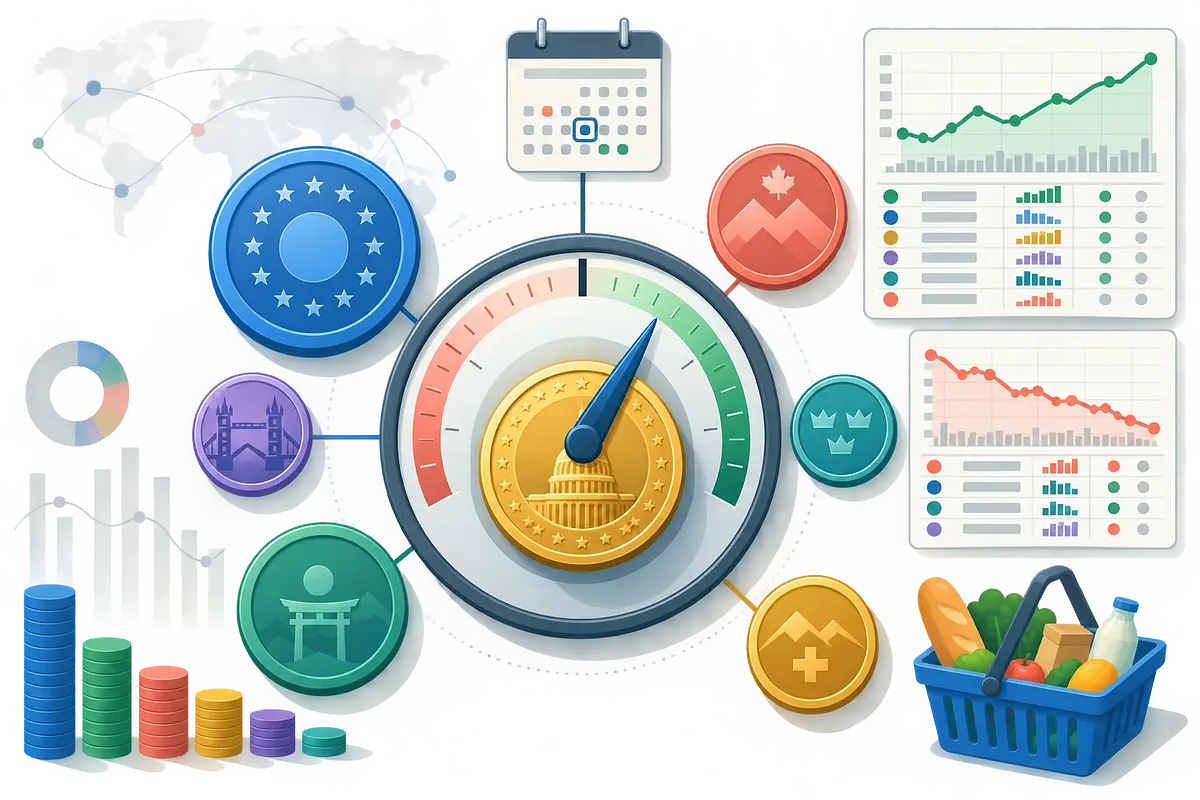
A clerk uses financial charts to explain market trends to a customer.
The illustration visualizes changes in dollar value through global currencies and market indicators.

FAQ

What does it mean when the Dollar Index is 100?

It means that the index is at the same level as the baseline value set in March 1973. It does not mean that purchasing power or prices in the United States are the same as they were then.

Does the won-dollar exchange rate also rise when the Dollar Index rises?

Not necessarily. Since the won is not one of the currencies that make up the Dollar Index, it may move in a different direction depending on supply and demand specific to the won and conditions in South Korea's financial markets.

Which currencies are included in the Dollar Index?

It includes the euro, Japanese yen, British pound, Canadian dollar, Swedish krona, and Swiss franc. The euro's weight and ranking should be checked in the official Dollar Index composition data.

Is the Dollar Index a simple average?

No. It is calculated geometrically by applying predetermined weighted exponents to each currency's exchange rate. The signs of the exponents also vary depending on how the exchange rates are quoted.

Does a rise in the Dollar Index mean that the U.S. economy is strong?

That conclusion cannot be drawn definitively. Expectations for U.S. interest rates and demand for safe-haven assets can affect it, and the index can rise solely because of weakness in counterpart currencies such as the euro.

Can the Dollar Index show the dollar's purchasing power?

Not directly. Purchasing power within the United States should be assessed using inflation indicators such as the Consumer Price Index. The real effective exchange rate is more appropriate for examining differences in prices across countries as well.

Do DXY and the Dollar Index mean the same thing?

In the market, DXY is used as a common name for the Dollar Index. However, it is advisable to check the ICE product description for the exact names and contract specifications of financial products.

Sources

Also available as video and a short read

Videos and a short write-up made from this content. Watch instead of reading, or skim the gist first.

Short version

Loading…

Data formats

This content is available in several machine-friendly formats.

Data-only languages (machine translated, files only)

Indonesian JSON MD Portuguese JSON MD Chinese (Traditional) JSON MD Deutsch JSON MD

Verification

This article was drafted with AI and then reviewed and edited by a person.

Reviewed by 신익희 · 편집장 · 2026-09-07

Figures in this article were checked against the source material during generation. 6 correction(s) applied. · 2026-09-07

This translation has been cross-checked by AI. · 2026-09-07

Reuse & AI usage

Search indexing and AI citation with attribution are welcome. See the license policy for details.

CC BY · License

Loading…

Loading…

Related content

From Injoys

Request the content you want and take 70% of what it earns

Just leave the subject. We handle production, review, translation and distribution.

See how revenue sharing works

Comments