Hyundai Pony Development Through Its First Export in 1976
After its joint venture with Ford fell through in 1972, Hyundai Motor Company set its own vehicle specifications and brought in foreign technology to develop the Pony. The Pony, South Korea's first original mass-produced model, went into production in December 1975, and Hyundai Motor Company records its 1976 shipment to Ecuador as its first export.
When its joint venture with Ford fell through in 1972, Hyundai Motor Company shifted to developing its own model.
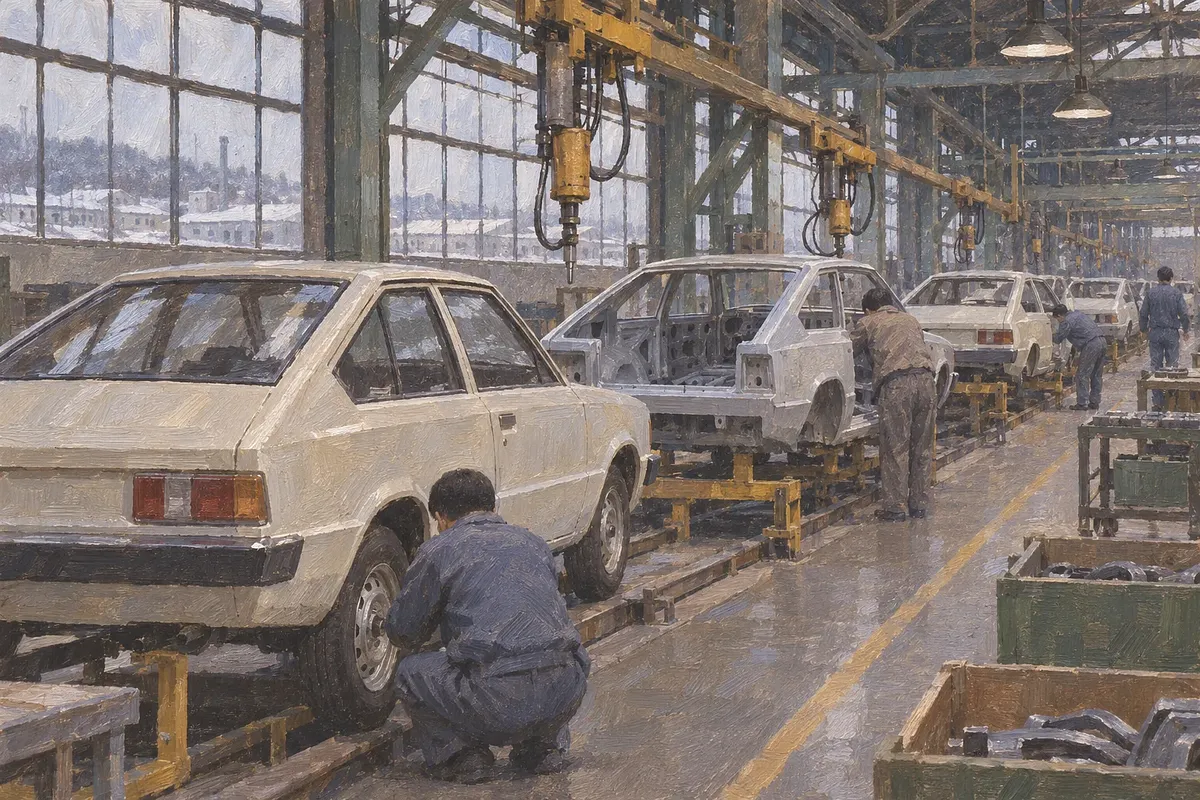
Hyundai Motor Company commissioned Italy's Italdesign to design the Pony's body and adopted engine and transmission technology from Japan's Mitsubishi.
The Pony was unveiled in Turin in 1974, and production in South Korea began in December 1975.
Hyundai Motor Company records its 1976 shipment to Ecuador as its first export and classifies the shipment of vehicles to Hyundai Engineering & Construction in Saudi Arabia that same year as a trial export.
The November 22, 1976, edition of Daehan News reported on Pony exports to the Middle East and Latin America.
The Hyundai Pony is a small car that Hyundai Motor Company developed after its joint venture with Ford fell through in 1972. Hyundai brought in design and engine technology from abroad to complete South Korea’s first mass-produced car model of its own. Production of the Pony began in December 1975, and the car was exported to Ecuador the following year.
The National Archives of Korea’s “Record of the Month” and Daehan News No. 1109 were compared in November 2026.
Why Hyundai shifted from assembling the Ford Cortina to developing its own model
Hyundai Motor Company began assembling the Ford Cortina in Ulsan in 1968. It imported parts and assembled the cars at a South Korean factory. Even when problems cropped up on Korean roads, it was difficult for Hyundai to change the design.
In 1972, negotiations to set up a joint venture with Ford broke down. In March of the following year, Hyundai Motor Company made it company policy to produce cars independently. Next, it had to decide what car to build and which factory would mass-produce it.
Pony development and export timeline
About a year passed between the Pony’s motor show debut and the start of production at a South Korean factory.
Date | What happened | Source
1972 | Hyundai shifted to developing its own model after the joint venture with Ford fell through | National Archives of Korea, “Record of the Month”
October 1973 | Hyundai Motor Company applied to the Ministry of Commerce and Industry for approval of a technology transfer agreement | National Archives of Korea, “Record of the Month”
June 1974 | The first test car was completed | National Archives of Korea, “Record of the Month”
September 1974 | The name Pony was chosen through a public contest | National Archives of Korea, “Record of the Month”
October 1974 | The Pony and Pony Coupe were unveiled at the Turin Motor Show in Italy | Hyundai Motor Group, “South Korea’s First Domestically Made Car: The Hyundai Pony Story”
December 1975 | Pony production began in South Korea | National Archives of Korea, “Record of the Month”; Korea Heritage Service, “Hyundai Motor Company Pony1”
Mid-February 1976 | Hyundai sent 15 Pony cars as a trial export to Hyundai Engineering & Construction, which had expanded into Saudi Arabia | Hyundai Motor Group’s history of the Pony’s development
1976 | The Pony was exported to Ecuador for the first time | Hyundai Motor Company’s 2018 Sustainability Report
November 22, 1976 | Daehan News produced a newsreel showing Pony cars awaiting shipment | Daehan News No. 1109, “Exports of Domestically Made Cars”
Body design and parts production in the technology transfer agreement
Hyundai Motor Company first decided how big the car would be and how many people it would seat. It commissioned Italy’s Italdesign to design a small five-seat passenger car. The company settled on a fastback shape with a roofline that sloped gently toward the rear. The engine and transmission technology came from Japan’s Mitsubishi (三菱).
The October 1973 application is documented in “Approval of a Technology Transfer Agreement for the Construction of an Automobile Plant.” The application covered both contracting out the body design and an agreement to build gasoline engines in South Korea. The Ministry of Commerce and Industry set a condition: Hyundai had to arrange for existing Korean parts makers to acquire the transmission and rear axle technology. This also meant considering how to divide manufacturing know-how between the automaker and its parts suppliers.
Why the Sibal and the Pony are both considered firsts in Korean automotive history
The National Archives of Korea identifies the 1955 Sibal as the first car produced in South Korea. The Korea Heritage Service classifies the Pony based on whether a Korean company mass-produced a model of its own. In this distinction, a company’s own model is one it planned and produced under its own name.
Model | What was done in South Korea | Significance in automotive history
Sibal | Built in 1955 using parts from U.S. military Jeeps and other components | Marked the start of car production in South Korea
Cortina | Parts for the Ford model were assembled in Ulsan starting in 1968 | Gave Hyundai Motor Company experience assembling complete cars
Pony | Hyundai Motor Company set the specifications and combined foreign technology with domestic parts production | South Korea’s first mass-produced model of its own
The first exports to Ecuador and the November Daehan News report
Hyundai Motor Company’s 2018 Sustainability Report identifies Ecuador as the Pony’s first export destination. According to the company’s records of the Pony’s development, it had already sent cars to Hyundai Engineering & Construction in Saudi Arabia in February 1976. The company classified that shipment as a trial export.
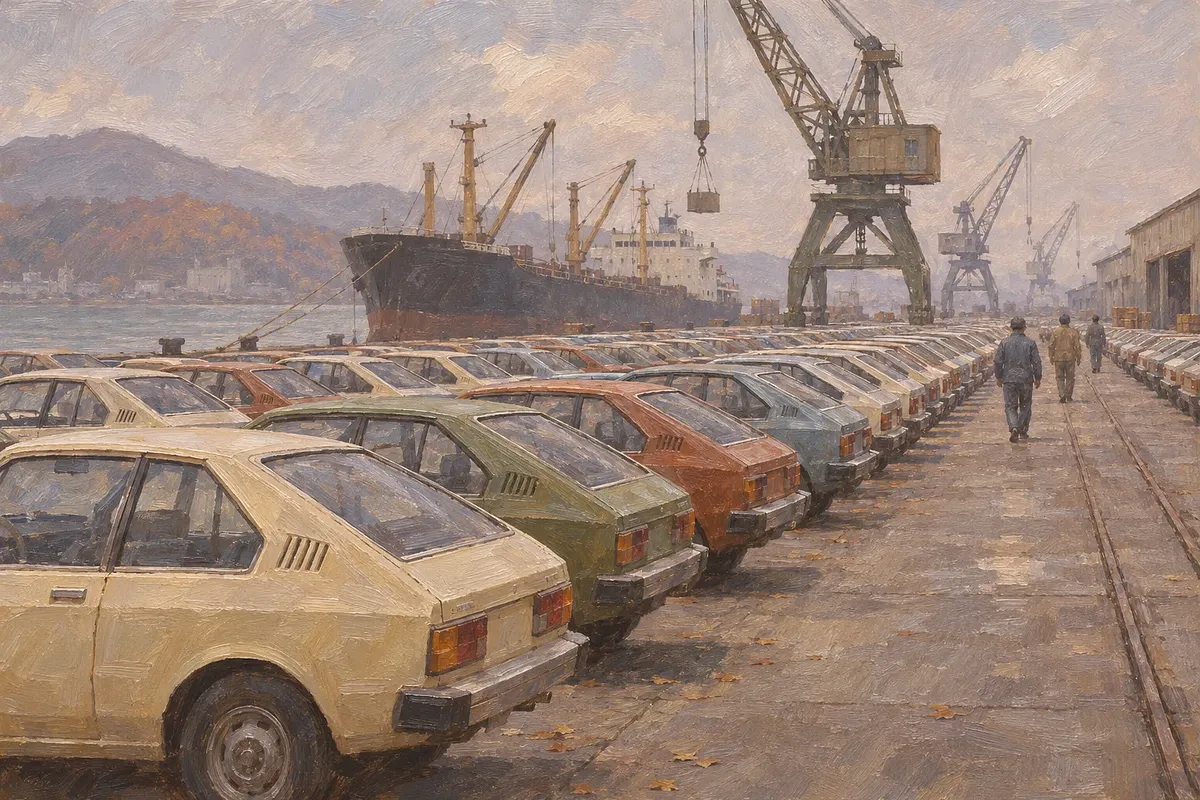
Daehan News No. 1109 shows Pony cars lined up to be loaded onto a ship. The newsreel reported that 262 cars were to be exported to the Middle East and Latin America during November 1976. November 22 was the date the newsreel was produced, documenting the expansion into overseas markets.
Records and interpretation
Both government records and a surviving car confirm when Pony production began. The National Archives of Korea records December 1975 as the start of production. The Pony1, a National Registered Cultural Heritage item, was built that same month.
The mass-production plant in industrial history research
Economic historian Kim Yu-jin pointed to the construction of an integrated car plant as what made mass production of the Pony possible. In a 2022 study, Kim traced how Hyundai Motor Company borrowed money from abroad to build the plant. Designing the shape of a car and setting up the equipment to build that same car over and over were separate challenges.
Why do sources give different figures for the first export shipment?
Even records published by Hyundai disagree on how many Pony cars were first sent to Ecuador. The 2009 English-language annual report puts the number exported to Ecuador in 1976 at 6. The development history Hyundai Motor Group published in 2023 puts the number shipped that July at 5. Neither document explains the difference of one car.
The Pony 50 years after it was exported
The year 2026 marks 50 years since Hyundai Motor Company exported the Pony to Ecuador. The Pony1 built in December 1975 and preserved in South Korea has a 1,238cc four-cylinder engine. A car used in Ecuador also survives. A Pony that had served as a taxi in Ecuador returned to South Korea in 1996, on the 20th anniversary of the export.
The Pony’s design can also be seen in later electric cars. In 2021, Hyundai Motor Company unveiled the Heritage Series Pony, an electric reinterpretation of the early Pony. The company cites the Pony Coupe unveiled in 1974 as an influence on the design of the IONIQ 5.