Busan's Wartime Capital Heritage: 1023 Days and Relief
Busan served twice as a refuge capital during the Korean War, continuing government operations and relief for refugees. The 1023-day period used in official descriptions is distinct from questions about how it is calculated. Its significance is explained through relief documents and the relationships among government offices, docks, and refugee housing.
Busan became a refuge capital on August 18, 1950, after the government moved via Daejeon and Daegu.
The 1023-day figure in official descriptions refers to the two periods when Busan served as a refuge capital, separated by the return to Seoul.
A 1950 circular on dispersing refugees assigned shelter, food, transport, and public health duties to different ministries.
The quantities of relief supplies scheduled to arrive and those that actually arrived, along with distribution plans, must be distinguished from the amounts refugees actually received.
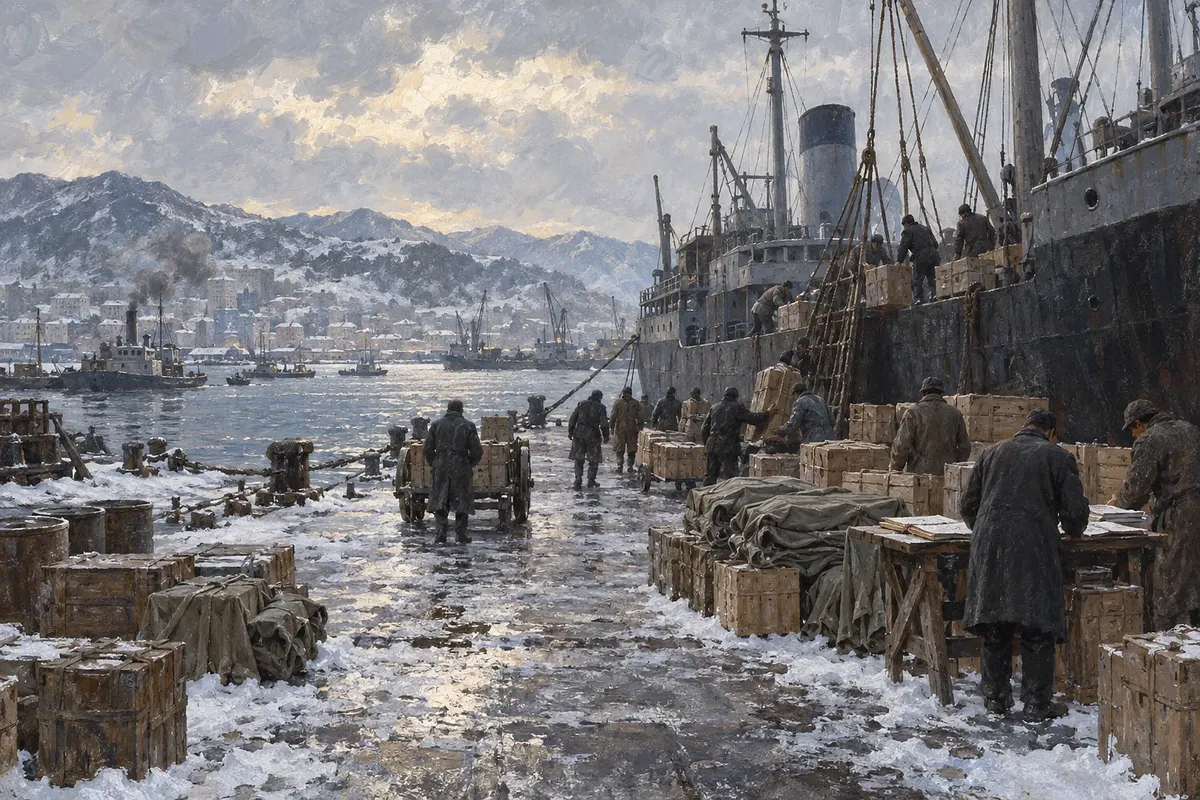
The Temporary Central Government Building, Busan Port Pier 1, and refugee housing show different aspects of government operations and life in refuge.
Busan’s wartime capital heritage preserves traces of how the government and refugees endured the Korean War in Busan. From August 1950, they used existing government buildings and the port to continue administration and relief work. The 1023 days refer to two periods when Busan served as the wartime capital, and the heritage keeps memories of life during those years alive.
This article follows the National Archives of Korea’s 1950 relief records, checked in October 2026.
Why Busan became the wartime capital
Busan had the facilities and port that the government, having moved south, needed to continue its work. The Korean War began with North Korea’s invasion on June 25, 1950. The government left Seoul and moved to Daejeon and Daegu. Busan became the wartime capital on August 18, 1950.
Its southern location alone was not enough for Busan to function as a capital. It had existing administrative facilities that government ministries could use. Its port was an entry point for troops and relief supplies from abroad. Busan City cites these conditions as reasons for the government’s move. Busan City: The Korean War and Busan
The southward movement of refugees was straining reception capacity even before the move to Busan. A July 1950 circular addressed the concentration of refugees in Daejeon. In Busan, too, existing housing and infrastructure could not easily accommodate the incoming population. Immediate survival depended on several connected needs.
· A place to stay: securing reception facilities and temporary shelter
· Food: connecting food supplies with meal services
· Transport and health: maintaining refugee transport and public health work
Busan’s 1023 days as wartime capital and the gap during the return to Seoul
The 1023 days do not mean Busan was continuously the capital. Busan served as the capital twice, with a period between them when the government returned to Seoul. Returning to the capital means the government goes back to its original capital. The recapture of Seoul and the government’s return there did not happen on the same date.
Date or period | What happened | Source
June 25, 1950 | Korean War began | National Archives of Korea online exhibition
July 10, 1950 | Directive to disperse refugees issued by circular | National Archives of Korea record description of the circular
August 18, 1950 | Busan’s first period as wartime capital began | Busan City: The Korean War and Busan
September 1950 | Seoul recaptured | Kookje Shinmun historical account of the wartime capital
October 27, 1950 | Government returned to Seoul | Kookje Shinmun historical account of the wartime capital
January 1951 | Government moved to Busan again as the military situation worsened | UNESCO Tentative List description and Kookje Shinmun account
July 27, 1953 | Armistice Agreement signed | National Archives of Korea online exhibition
August 15, 1953 | Government returned to Seoul again | Kookje Shinmun historical account of the wartime capital
The first turning point was the government’s return after Seoul was recaptured. As the military situation worsened again following Chinese forces’ entry into the war, the government returned to Busan. It moved back to Seoul after the Armistice Agreement was signed. The periods when Busan served as wartime capital therefore differ from the period when fighting continued.
The 2023 UNESCO Tentative List description gives the first period as August 18 to October 26, 1950. It gives the second as January 4, 1951, to August 14, 1953. The description presents the two periods together as 1023 days. UNESCO Tentative List description
There are, however, different accounts of the precise dates and day count. A 2022 Kookje Shinmun account gives January 3 as the start of the second period. It argues that accounting for the leap year brings the total to 1025 days. This article uses the official description’s 1023 days without treating the calculation as settled. Kookje Shinmun historical account of the wartime capital
What did wartime relief involve?
Wartime relief supported the daily lives of people affected by the war. In this context, relief means practical assistance with living needs, not a slogan. In the records, war victims refers to people harmed by the war. Reception, meal services, transport, and public health were interconnected administrative tasks.
How the refugee dispersal circular divided work among ministries
A 1950 circular assigned refugee dispersal tasks to the relevant ministries. The document is titled “Circular on the Dispersal of Refugees.” Instructions dated July 10 appeared in issue No. 384 of the official gazette on July 20. They were addressed to the governors of the provinces in the Chungcheong, Jeolla, and Gyeongsang regions.
Ministry responsible | Tasks listed in the circular
Ministry of Social Affairs | Reception facilities, certificate issuance, escorting refugees, reception, meal services, accounting
Ministry of Agriculture and Forestry | Food supply
Ministry of National Defense and Ministry of Home Affairs | Cooperation on identity checks and certificate issuance, escorting refugees, security
Ministry of Transportation | Free transport for holders of refugee certificates
Ministry of Health | Refugee public health work
This was not a relief plan for Busan alone. It was an instruction to disperse refugees across several provinces before Busan became the wartime capital. Transport was also conditional on having a certificate. The document should therefore not be read as guaranteeing all refugees freedom of movement. National Archives of Korea record description of the circular
Relief committees and the distribution of aid supplies
An overview report by the Ministry of Social Affairs shows cooperation between the Korean government and international aid organizations. Its full title is “Overview Report on Relief Policies for Korean War Victims and Refugees.” The ministry submitted it to the prime minister on December 14, 1950. The original document mentions a Central Relief Committee and local relief committees.
The central committee discussed relief issues. Local committees supported distribution in their areas. The report also includes a table of incoming aid supplies. The National Archives of Korea’s record description notes the existence of a regional distribution plan as well. National Archives of Korea description of the relief report, National Archives of Korea online exhibition
The difference between supplies arriving at the port and being distributed
The arrival of aid supplies did not mean refugees had received them. The table of incoming supplies, dated December 14, 1950, distinguishes expected quantities from quantities that had arrived. The expected quantity of tents was 1,050. The quantity recorded as already having arrived was 50.
Item in the records | What it establishes | What it cannot establish on its own
Expected incoming quantity | Amount expected to arrive | Whether all of it arrived as planned
Quantity already arrived | Amount received by the reference date | Whether all items were usable
Regional distribution plan | Which areas were intended to receive supplies | Whether they were delivered as planned
Actual issue and receipt records | Quantity issued or receipt of supplies | Results in other areas and across the entire period
The tent count translates the original document’s unit, “Pieces,” as individual tents. A note in the table also says they were in use in Busan. But these figures cannot be used to calculate the number of people accommodated or the amount of support per household. Separate records of facility operations and supplies issued would be needed. National Archives of Korea online exhibition containing images of the original document
Busan Port Pier 1 was a logistics site within this relief system. Refugees and international aid supplies, among other things, entered through it. Port work also gave refugees a way to earn a living. There is, however, no basis for attributing all quantities in the nationwide table of incoming supplies to Pier 1. UNESCO Tentative List description of Pier 1
The roles of the Temporary Central Government Complex, refugee schools, and temporary housing
Government work and refugee life continued by adapting existing spaces. The Temporary Central Government Complex had originally been the Gyeongsangnam-do Provincial Government building. Government ministries that moved to Busan used its administrative facilities. Work to develop and carry out refugee policies also took place there. Busan City description of the Temporary Central Government Complex
Space | Prewar use or conditions | Use while Busan was wartime capital | History it illustrates
Temporary Central Government Complex | Gyeongsangnam-do Provincial Government | Workspace for central government ministries | Continuity of administration
Beaches, hillsides, sports grounds, and other spaces | Open areas outside school buildings | Tent-based refugee schools | Continuity of education
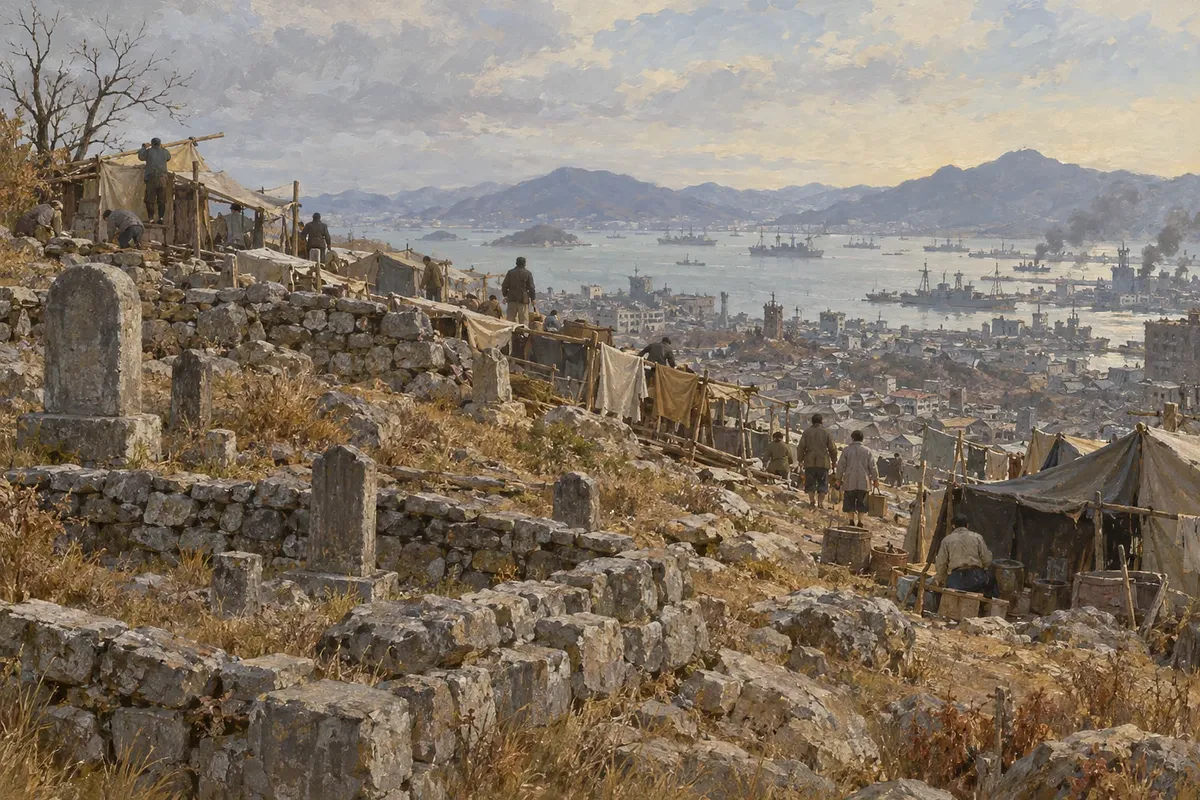
Ami-dong Tombstone Refugee Housing | Site of a Japanese cemetery | Temporary shelter using cemetery structures | Housing shortages and the creation of living space
Uam-dong Cowshed Refugee Housing | Barracks at a cattle quarantine facility | Divided interiors used as refugee living space | Conversion of existing buildings into housing
Refugee schools kept classes going when school buildings were scarce. Busan City’s account describes elementary, middle, and high schools operating in tents. The Wartime Union University provided education for displaced university students. Continuing education was another wartime function the city carried out. Busan City: The Korean War and Busan
In Ami-dong, remaining cemetery structures were used to make shelters. In Uam-dong, cattle sheds were divided into living spaces. The two areas show different ways refugees secured housing. It would be inaccurate to describe them all as homes newly built and supplied by the government. Busan City description of Ami-dong, Busan City description of Uam-dong
Refugee life continued after the return to Seoul
The government’s return to Seoul did not mark the end of refugee life. The period when government buildings served as part of the capital differed from the period when residents lived in these areas. Ami-dong and Uam-dong remained residential areas after the war. Temporary shelters became lasting parts of the city’s living space.
A 2021 study by Park Hee-kyung and Lee Jun-young divides Ami-dong’s development into several periods. Its residents included not only wartime refugees but also people who returned after liberation and later migrants. That is why the entire present-day neighborhood cannot be treated as a picture of one moment in the refugee period. Traces of the war must be read alongside later changes to its housing. Park Hee-kyung and Lee Jun-young’s study of Ami-dong
Government functions were maintained, but housing problems were not all resolved. The existence of relief organizations did not mean living conditions had become secure. Looking at government buildings and temporary housing together makes it possible to distinguish achievements from limitations.
Records and interpretation
Administrative records from the time and later accounts of the heritage answer different questions. The circular shows which agencies were responsible and what they were instructed to do. The report describes the organizations and the state of supplies. Research and heritage accounts interpret the historical meaning of those records.
What contemporary records establish
Relief documents show how tasks were divided and how aid was coordinated. The table of incoming supplies shows the status of supplies on a particular date. The distribution plan shows how supplies were intended to be allocated. These materials alone cannot reconstruct the lives of all refugees.
Interpretations offered by research
Research on the wartime capital treats residents’ responses, as well as government actions, as part of its history. A 2021 study by Cha Cheol-wook focuses on how residents changed their living spaces. Park Hee-kyung and Lee Jun-young analyze how facilities from the colonial period became residential areas. Neither study confines these neighborhoods to a single wartime scene. Cha Cheol-wook’s study of residents’ lived experiences, Park Hee-kyung and Lee Jun-young’s study of heritage use
Questions that still need checking
Calculating the duration requires distinguishing the reference dates for the government’s movements. The official description’s 1023 days and the 1025-day calculation noted above are an example. Actual ministry moves must also be distinguished from announcements of the return to the capital. A single account cannot be taken as evidence of a consensus across scholarship.
Relief outcomes also need further checking. How much of the arriving supplies reached which people is a separate question. Answering it requires comparing regional issue records with receipt records. Estimates should not be used to fill the gaps between plans and results.
Why preserve this heritage today?
Government buildings, the pier, and residential areas together show how the city functioned during the war. Busan City describes the continuation of government, refugee life, and international cooperation as the heritage’s core functions. Serial heritage brings separate places together through their shared value. Busan City’s description, checked in October 2026, lists 11 sites. Busan City explanation of the heritage’s World Heritage value
· Places of administration and observation: Gyeongmudae, Temporary Central Government Complex, National Central Meteorological Observatory
· Places of international cooperation, transport, and remembrance: U.S. Embassy and U.S. Information Service, Busan Port Pier 1, Camp Hialeah, United Nations Memorial Cemetery
· Places of housing and urban life: Ami-dong Tombstone Refugee Housing, Uam-dong Cowshed Refugee Housing, Yeongdo Bridge, Bokbyeongsan Reservoir
These groupings help explain the role of each place. No place served only one function. Pier 1 was both an entry point for international aid and a place where people earned a living.
The effort to gain World Heritage status must also be distinguished from final inscription. The 2023 UNESCO Tentative List description includes 9 component sites. When the site was selected for the domestic Priority List in November 2025, Busan City described 11 sites. That grouping adds Yeongdo Bridge and Bokbyeongsan Reservoir. UNESCO Tentative List, Busan City explanation of the Priority List selection
Selection for the Priority List is not itself final UNESCO inscription. Nor does the heritage’s historical significance depend solely on inscription. The government complex shows the continuity of administration, while the pier shows the movement of people and supplies. The residential areas preserve traces of how refugees made and adapted living spaces.
Frequently asked questions
Was Busan the capital throughout the Korean War?
No. Busan’s time as wartime capital was divided into two periods. There was a gap in autumn 1950 when the government returned to Seoul.
Is 1023 days a definitively settled calculation?
It is the figure used in descriptions by Busan City and on the UNESCO Tentative List. Another account argues that the start date and leap year make the total 1025 days. The official figure should be distinguished from verification of the precise day count.
Did the refugee dispersal circular instruct refugees to gather in Busan?
No. It was a July 1950 instruction to disperse refugees concentrated in Daejeon across several provinces. The document predates Busan’s designation as the wartime capital.
Did the arrival of relief supplies mean distribution was complete?
No. Arrival at the port, allocation to regions, and actual issue were separate stages. The table of incoming supplies alone cannot show how much each household received.
Were the Temporary Central Government Complex and the presidential residence the same place?
No. The Temporary Central Government Complex was the former Gyeongsangnam-do Provincial Government building used by government ministries. Gyeongmudae served as the president’s residence and workspace.
Why preserve government buildings and refugee housing together?
The buildings show how the state operated, while the housing shows how refugees lived. Including the pier also helps explain the connection between international aid and livelihoods.
Did the refugee housing disappear after the war?
Not all of it. Ami-dong and Uam-dong remained residential areas after the war. Their buildings and living spaces continued to change.
Is Busan’s wartime capital heritage already a UNESCO World Heritage site?
Placement on the Tentative List and selection for the domestic Priority List are different from final inscription. Official materials checked in October 2026 describe it as being in the process of seeking inscription.
 Injoys