Skip to content
Injoys
Knowledge Base

Sehando: Kim Jeong-hui's Jeju Exile and Meaning

Sehando is a literati painting Kim Jeong-hui made in 1844 during his exile on Jeju to thank Yi Sang-jeok for staying in touch with him. Reading the inscription alongside the symbolism of the pines and cypresses, and distinguishing the original work from later writings of appreciation, helps explain why it was made and how it was passed down.

Listen or read this article

11:36

Listen, or read the text only.

Sehando: Kim Jeong-hui's Jeju Exile and Meaning

Kokoro 82M AI-generated voice 12 min read

0:00 11:36

Advertisement

Download audio

File name
sehando-kim-jeong-hui-jeju-exile-meaning-en.mp3
Format
MP3 (audio/mpeg)
Duration
11:36
File size
7.96 MB
Engine
Kokoro 82M

This audio was generated by AI.

You may download and use it freely for personal use.

Sehando: Kim Jeong-hui's Jeju Exile and Meaning

9 min read

Sehando: Kim Jeong-hui's Jeju Exile and Meaning
Sehando is a literati painting Kim Jeong-hui made in 1844 during his exile on Jeju to thank Yi Sang-jeok for staying in touch with him. Reading the inscription alongside the symbolism of the pines and cypresses, and distinguishing the original work from later writings of appreciation, helps explain why it was made and how it was passed down.
In 1844, while exiled on Jeju, Kim Jeong-hui painted Sehando for his disciple Yi Sang-jeok, who had sent him books.
The inscription compares Yi Sang-jeok's steadfastness despite a change in circumstances to pines and cypresses.
Kim Jeong-hui's painting and inscription must be distinguished from the writings of appreciation added by later scholars.
Son Chang-geun donated Sehando to the National Museum of Korea in 2020.
Sehando is a literati painting that Kim Jeong-hui made in 1844 while exiled on Jeju. Books sent by his student Yi Sang-jeok allowed him to maintain scholarly ties despite his isolation. Kim expressed his gratitude in the painting and its accompanying text, and the work is remembered for portraying a relationship that endured through hardship.
The records and explanations from Our History Net and the National Museum of Korea used in this article were checked in October 2026.
Why Kim Jeong-hui was exiled to Jeju
Kim Jeong-hui was exiled to Jeju in 1840 after becoming implicated in the Yun Sang-do criminal case. Such a case involved investigating serious criminal allegations and punishing those found responsible. This case was connected to power struggles under the rule of powerful families in the late Joseon period.
Kim Jeong-hui was a scholar, calligrapher, and painter who used the pen names Chusa and Wandang. He studied scholarship and calligraphy while exchanging ideas with Qing scholars. Exile to Jeju was a punishment that kept him away from his official career.
The museum describes his punishment as wiri anchi. This form of exile placed a fence around a person's residence to restrict movement. Even then, books continued to reach him through Yi Sang-jeok.
The turning point created by Yi Sang-jeok's gift of books
The immediate reason Kim made the work was the books Yi Sang-jeok sent him. Yi was an official interpreter of Chinese. Through his contacts with Qing literati, he obtained rare books.
Our History Net identifies the books he sent first as 『Manhakjip』 and 『Daeunsanbang Mungo』. It says he sent 『Hwangjo Gyeongse Munpyeon』 the following year. Kim was grateful that Yi had shown such care toward him even after he had lost his influence.
This turning point does not mean that Kim's exile ended. It means that their exchange through books led to his gift of a painting in return. The work records a relationship maintained despite his isolation.
The meaning of the text accompanying Sehando
The accompanying text explains in Kim Jeong-hui's own words why he made the painting. Attached to the left of the image, it provides a basis for interpreting its meaning. In the text, Yi Sang-jeok's conduct is compared to pines and cypresses that withstand the cold.
Only after the cold arrived did the sage praise them. You showed me no more before and no less afterward. Kim Jeong-hui, text accompanying 〈Sehando〉
The point is that their relationship did not change when Kim's circumstances changed. It does not mean hardship created Yi's loyalty. Rather, his loyalty became apparent during hardship.
Sehan, in the title, means the cold of midwinter. Behind it is the comparison with pines and cypresses in the 『Analects』. In the painting, the cold can also be read as the hardship of exile.
The house, pines and cypresses, and empty space
The image is simply composed around a house and trees. It depicts neither people in action nor a specific event. Traces of ink and empty space create a winter atmosphere.
Literati painting expresses a scholar's learning and thoughts through images. In this work, the title and writing also convey meaning. The National Museum of Korea identifies the rough marks of a dry brush as a feature of the painting.
Visual element | Observable feature | Guide to interpretation House | A simple building with no people visible | Do not assume it depicts Kim's actual place of exile Pines and cypresses | Trees placed on either side of the house | Connect them to the comparison with steadfastness in the accompanying text Empty space | Areas where the surrounding scenery is not filled in with detail | Recognize that isolation and stillness are visual interpretations Dry brushwork | Rough ink marks made with little moisture | Read it as a way of expressing a winter atmosphere
The tree names differ between the explanations. Our History Net describes them as Korean pines, while the National Museum of Korea calls them arborvitae. This difference in naming does not change the work's central symbolism.
Timeline from creation to donation
The work has come down to us as a scroll bearing texts from several eras, although it began as a gift to one person. The year the painting was made differs from the years the responses to it were written. The timeline below distinguishes the major documented events.
Year | Event | Source 1840 | Kim Jeong-hui's exile to Jeju began | Our History Net 1844 | Kim made the work for Yi Sang-jeok | Our History Net 1845 | 16 Qing literati wrote responses to the work | National Museum of Korea collection description 1848 | Kim Jeong-hui's exile to Jeju ended | Our History Net 1914 | Owner Kim Jun-hak added a text | National Museum of Korea collection description 1944 | Son Jae-hyeong recovered the work in Japan | National Museum of Korea collection description 1949 | Jeong In-bo, Yi Si-yeong, and O Se-chang wrote responses to the work | National Museum of Korea collection description December 31, 1974 | Designated a National Treasure | Korea Heritage Portal 2020 | Son Chang-geun donated it to the National Museum of Korea | National Museum of Korea collection description
In Japan, the work was owned by Fujitsuka Chikashi (藤塚隣), a researcher of Kim Jeong-hui. Calligrapher Son Jae-hyeong recovered it from him. It later passed through the hands of Son Se-gi and Son Chang-geun before being donated to the museum.
Its current official name is Sehando by Kim Jeong-hui. Older sources may refer to it as National Treasure No. 180. The Korea Heritage Portal lists it as state-owned.
Distinguishing the original work from later responses
Kim Jeong-hui did not make the entire long scroll at one time. The museum gives the scroll's current total length as 1,469.5cm. This includes texts added in different eras as well as blank sections.
Part | Author and date | Role as a record Painting and accompanying text | Kim Jeong-hui, 1844 | Show why he made the work and what he meant by it Qing responses | Qing literati, 1845 | Show the reactions of literati abroad at the time Kim Jun-hak's text | Kim Jun-hak, 1914 | Shows a later owner's response Korean modern-era responses | Jeong In-bo, Yi Si-yeong, and O Se-chang, 1949 | Show how the work was received after its return to Korea
Is the order of the scroll chronological?
The text placed first on the scroll is not the oldest. Near the beginning is a text Kim Jun-hak wrote in 1914. Kim Jeong-hui's 1844 work comes after it.
This difference also matters when describing digital images. An image of the whole scroll and an image cropped to show only part of it cover different portions of the record. When quoting a response, its author and year should be given together.
Records and interpretation
The accompanying text establishes why Kim made the work, but it cannot settle the meaning of every symbol. The artist's own words and a commentator's explanation are different kinds of evidence. The following distinctions help when reading the work as a historical record.
What the records establish
The accompanying text states that Yi Sang-jeok sent books. It also shows that Kim Jeong-hui held Yi's steadfast conduct in high regard. The responses added later record how others read the work.
Widely accepted interpretations
Our History Net and the museum connect the pines and cypresses with integrity and faithfulness. They also connect the simple composition with the characteristics of literati painting. This does not mean, however, that the meaning of every visual detail has been established.
Remaining uncertainties
The museum does not identify the owner of the square Jangmusangmang seal. It also says it is unclear who stamped it. Claims that a particular tree represents a particular person should likewise be distinguished from what the accompanying text says.
Why the work matters today
The work documents scholarly exchanges that continued during exile. It is also an example of how an official interpreter's delivery of books led to the creation of art. The later responses show how people in different eras received the work.
· In art history, it shows how painting and writing convey meaning together. · In the history of intellectual exchange, it shows relationships through which books and people crossed borders. · In its ownership history, it shows how a personal gift became part of a public collection.
Frequently asked questions
Who received the painting from Kim Jeong-hui?
He gave it to his student Yi Sang-jeok, an official interpreter. Yi sent books to Kim during his exile on Jeju. The work was a gift in return for their steadfast exchange.
Is the house in the painting Kim's actual place of exile?
The explanations consulted do not establish that it reproduces his actual residence. There is a house in the image, but no explanation confirming a specific location. The place where the work was made should be distinguished from the place shown in the painting.
How does the accompanying text differ from the responses?
The accompanying text is Kim Jeong-hui's explanation of why he made the work. The later responses were written by other literati after viewing it. Quoting both as Kim's words would confuse their authors.
Was the work painted after his exile ended?
Kim painted it in 1844, while his exile on Jeju was still underway. His exile ended in 1848. Making the work did not mean that his punishment had ended.
Where is it kept now?
It is held by the National Museum of Korea. Son Chang-geun donated it in 2020. Whether it is currently on display should be checked in the museum's latest exhibition information.
0:00 0:00
1 / 59

Advertisement

Download text

File name
sehando-kim-jeong-hui-jeju-exile-meaning-en.txt
Format
TXT (text/plain)
Paragraphs
59

Downloads exactly what you see as a text file.

Please cite the source when quoting.

Large text

Makes the text larger and the colors clearer. Turn it on if the text feels too small.

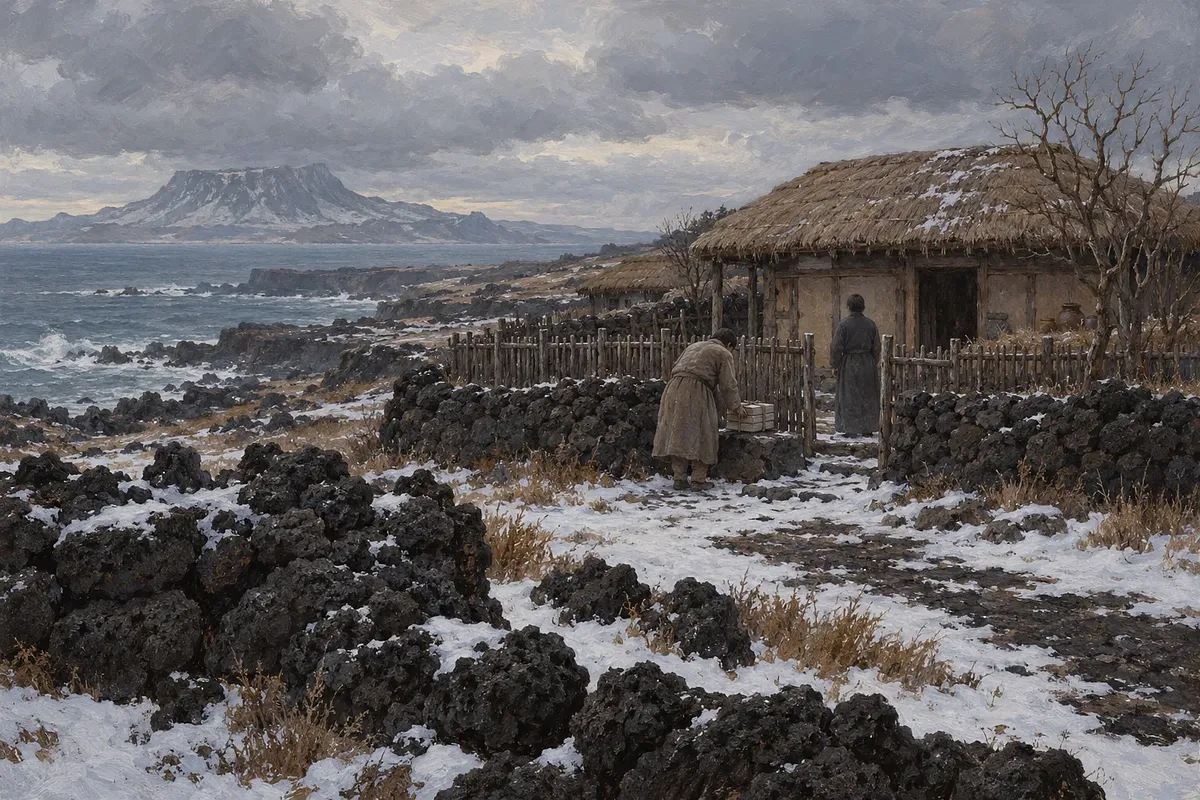
Kim Jeong-hui painted Sehando in gratitude to Yi Sang-jeok for sending books during his Jeju exile.AI-generated image

Key points

  • In 1844, while exiled on Jeju, Kim Jeong-hui painted Sehando for his disciple Yi Sang-jeok, who had sent him books.
  • The inscription compares Yi Sang-jeok's steadfastness despite a change in circumstances to pines and cypresses.
  • Kim Jeong-hui's painting and inscription must be distinguished from the writings of appreciation added by later scholars.
  • Son Chang-geun donated Sehando to the National Museum of Korea in 2020.

Sehando is a literati painting that Kim Jeong-hui made in 1844 while exiled on Jeju. Books sent by his student Yi Sang-jeok allowed him to maintain scholarly ties despite his isolation. Kim expressed his gratitude in the painting and its accompanying text, and the work is remembered for portraying a relationship that endured through hardship.

The records and explanations from Our History Net and the National Museum of Korea used in this article were checked in October 2026.

Why Kim Jeong-hui was exiled to Jeju

Kim Jeong-hui was exiled to Jeju in 1840 after becoming implicated in the Yun Sang-do criminal case. Such a case involved investigating serious criminal allegations and punishing those found responsible. This case was connected to power struggles under the rule of powerful families in the late Joseon period.

Kim Jeong-hui was a scholar, calligrapher, and painter who used the pen names Chusa and Wandang. He studied scholarship and calligraphy while exchanging ideas with Qing scholars. Exile to Jeju was a punishment that kept him away from his official career.

The museum describes his punishment as wiri anchi. This form of exile placed a fence around a person's residence to restrict movement. Even then, books continued to reach him through Yi Sang-jeok.

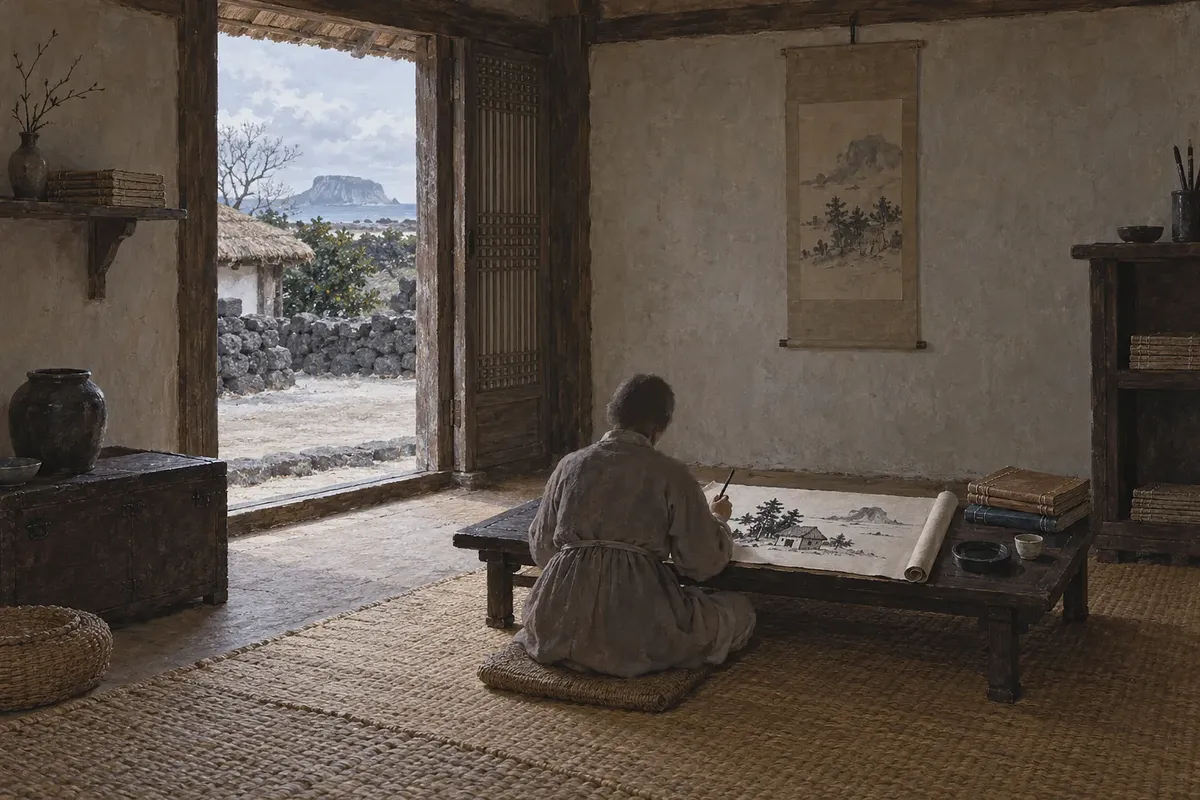
The evergreens in Sehando symbolize Yi Sang-jeok’s loyalty despite Kim Jeong-hui’s changed circumstances.AI-generated image

The turning point created by Yi Sang-jeok's gift of books

The immediate reason Kim made the work was the books Yi Sang-jeok sent him. Yi was an official interpreter of Chinese. Through his contacts with Qing literati, he obtained rare books.

Our History Net identifies the books he sent first as 『Manhakjip』 and 『Daeunsanbang Mungo』. It says he sent 『Hwangjo Gyeongse Munpyeon』 the following year. Kim was grateful that Yi had shown such care toward him even after he had lost his influence.

This turning point does not mean that Kim's exile ended. It means that their exchange through books led to his gift of a painting in return. The work records a relationship maintained despite his isolation.

The meaning of the text accompanying Sehando

The accompanying text explains in Kim Jeong-hui's own words why he made the painting. Attached to the left of the image, it provides a basis for interpreting its meaning. In the text, Yi Sang-jeok's conduct is compared to pines and cypresses that withstand the cold.

Only after the cold arrived did the sage praise them. You showed me no more before and no less afterward.

Kim Jeong-hui, text accompanying 〈Sehando〉

The point is that their relationship did not change when Kim's circumstances changed. It does not mean hardship created Yi's loyalty. Rather, his loyalty became apparent during hardship.

Sehan, in the title, means the cold of midwinter. Behind it is the comparison with pines and cypresses in the 『Analects』. In the painting, the cold can also be read as the hardship of exile.

The house, pines and cypresses, and empty space

The image is simply composed around a house and trees. It depicts neither people in action nor a specific event. Traces of ink and empty space create a winter atmosphere.

Literati painting expresses a scholar's learning and thoughts through images. In this work, the title and writing also convey meaning. The National Museum of Korea identifies the rough marks of a dry brush as a feature of the painting.

Visual element Observable feature Guide to interpretation
House A simple building with no people visible Do not assume it depicts Kim's actual place of exile
Pines and cypresses Trees placed on either side of the house Connect them to the comparison with steadfastness in the accompanying text
Empty space Areas where the surrounding scenery is not filled in with detail Recognize that isolation and stillness are visual interpretations
Dry brushwork Rough ink marks made with little moisture Read it as a way of expressing a winter atmosphere

The tree names differ between the explanations. Our History Net describes them as Korean pines, while the National Museum of Korea calls them arborvitae. This difference in naming does not change the work's central symbolism.

Timeline from creation to donation

The work has come down to us as a scroll bearing texts from several eras, although it began as a gift to one person. The year the painting was made differs from the years the responses to it were written. The timeline below distinguishes the major documented events.

Year Event Source
1840 Kim Jeong-hui's exile to Jeju began Our History Net
1844 Kim made the work for Yi Sang-jeok Our History Net
1845 16 Qing literati wrote responses to the work National Museum of Korea collection description
1848 Kim Jeong-hui's exile to Jeju ended Our History Net
1914 Owner Kim Jun-hak added a text National Museum of Korea collection description
1944 Son Jae-hyeong recovered the work in Japan National Museum of Korea collection description
1949 Jeong In-bo, Yi Si-yeong, and O Se-chang wrote responses to the work National Museum of Korea collection description
December 31, 1974 Designated a National Treasure Korea Heritage Portal
2020 Son Chang-geun donated it to the National Museum of Korea National Museum of Korea collection description

In Japan, the work was owned by Fujitsuka Chikashi (藤塚隣), a researcher of Kim Jeong-hui. Calligrapher Son Jae-hyeong recovered it from him. It later passed through the hands of Son Se-gi and Son Chang-geun before being donated to the museum.

Its current official name is Sehando by Kim Jeong-hui. Older sources may refer to it as National Treasure No. 180. The Korea Heritage Portal lists it as state-owned.

Distinguishing the original work from later responses

Kim Jeong-hui did not make the entire long scroll at one time. The museum gives the scroll's current total length as 1,469.5cm. This includes texts added in different eras as well as blank sections.

Part Author and date Role as a record
Painting and accompanying text Kim Jeong-hui, 1844 Show why he made the work and what he meant by it
Qing responses Qing literati, 1845 Show the reactions of literati abroad at the time
Kim Jun-hak's text Kim Jun-hak, 1914 Shows a later owner's response
Korean modern-era responses Jeong In-bo, Yi Si-yeong, and O Se-chang, 1949 Show how the work was received after its return to Korea

Is the order of the scroll chronological?

The text placed first on the scroll is not the oldest. Near the beginning is a text Kim Jun-hak wrote in 1914. Kim Jeong-hui's 1844 work comes after it.

This difference also matters when describing digital images. An image of the whole scroll and an image cropped to show only part of it cover different portions of the record. When quoting a response, its author and year should be given together.

Records and interpretation

The accompanying text establishes why Kim made the work, but it cannot settle the meaning of every symbol. The artist's own words and a commentator's explanation are different kinds of evidence. The following distinctions help when reading the work as a historical record.

What the records establish

The accompanying text states that Yi Sang-jeok sent books. It also shows that Kim Jeong-hui held Yi's steadfast conduct in high regard. The responses added later record how others read the work.

Widely accepted interpretations

Our History Net and the museum connect the pines and cypresses with integrity and faithfulness. They also connect the simple composition with the characteristics of literati painting. This does not mean, however, that the meaning of every visual detail has been established.

Remaining uncertainties

The museum does not identify the owner of the square Jangmusangmang seal. It also says it is unclear who stamped it. Claims that a particular tree represents a particular person should likewise be distinguished from what the accompanying text says.

Why the work matters today

The work documents scholarly exchanges that continued during exile. It is also an example of how an official interpreter's delivery of books led to the creation of art. The later responses show how people in different eras received the work.

  • In art history, it shows how painting and writing convey meaning together.
  • In the history of intellectual exchange, it shows relationships through which books and people crossed borders.
  • In its ownership history, it shows how a personal gift became part of a public collection.

Questions checked against the record

Who received the painting from Kim Jeong-hui?

He gave it to his student Yi Sang-jeok, an official interpreter. Yi sent books to Kim during his exile on Jeju. The work was a gift in return for their steadfast exchange.

Is the house in the painting Kim's actual place of exile?

The explanations consulted do not establish that it reproduces his actual residence. There is a house in the image, but no explanation confirming a specific location. The place where the work was made should be distinguished from the place shown in the painting.

How does the accompanying text differ from the responses?

The accompanying text is Kim Jeong-hui's explanation of why he made the work. The later responses were written by other literati after viewing it. Quoting both as Kim's words would confuse their authors.

Was the work painted after his exile ended?

Kim painted it in 1844, while his exile on Jeju was still underway. His exile ended in 1848. Making the work did not mean that his punishment had ended.

Where is it kept now?

It is held by the National Museum of Korea. Son Chang-geun donated it in 2020. Whether it is currently on display should be checked in the museum's latest exhibition information.

Open the link

Opens in a new window.

Advertisement

Sign-in required

Sign in with your Google account to like, comment, and save highlights.

FAQ

When and where was Sehando painted?

Kim Jeong-hui painted it in 1844 while in exile on Jeju. This was the 10th year of King Heonjong's reign during the Joseon dynasty.

Why did Kim Jeong-hui give the painting to Yi Sang-jeok?

Because he was grateful that Yi Sang-jeok sent him valuable books even while he was in exile. The postscript praises Yi Sang-jeok for remaining steadfast despite the change in circumstances.

What does Sehan mean?

It means the cold of midwinter. In the painting, it is interpreted as a symbol of the trials of exile.

Where is the postscript, and what does it explain?

The postscript written by Kim Jeong-hui is to the left of the painting. It explains how he received books from Yi Sang-jeok and why he made the painting.

Are the trees in the painting pines and Korean pines?

Our History Net describes them as pines and Korean pines. The National Museum of Korea identifies them as pines and arborvitae. Both interpretations read the pine and cypress motif as a symbol of steadfastness.

Did Kim Jeong-hui make the entire long scroll?

Writings by later scholars about the painting were added to Kim Jeong-hui's painting and postscript. Not all the writing on the scroll as it exists today can be attributed to Kim Jeong-hui.

When was it designated a National Treasure?

The designation date recorded in the National Heritage Portal is December 31, 1974. Its official name is Sehando by Kim Jeong-hui.

Which institution currently holds it, and who donated it?

The National Museum of Korea currently holds it. Son Chang-geun donated it in 2020.

Is the house in the painting Kim Jeong-hui's actual residence in exile?

The records and explanations reviewed are not enough to conclude that the painting depicts his actual residence. The fact that it was made on Jeju is separate from the identity of the house in the painting.

Sources

Also available as video and a short read

Videos and a short write-up made from this content. Watch instead of reading, or skim the gist first.

Short version

Loading…

Data formats

This content is available in several machine-friendly formats.

Data-only languages (machine translated, files only)

Indonesian JSON MD Portuguese JSON MD Chinese (Traditional) JSON MD Deutsch JSON MD

Verification

This article was drafted with AI and then reviewed and edited by a person.

Reviewed by 신익희 · 편집장 · 2026-10-08

Figures in this article were checked against the source material during generation. · 2026-10-08

This translation has been cross-checked by AI. · 2026-10-08

Reuse & AI usage

Search indexing and AI citation with attribution are welcome. See the license policy for details.

CC BY · License

Loading…

Loading…

Loading…

Related content

From Injoys

Request the content you want and take 70% of what it earns

Just leave the subject. We handle production, review, translation and distribution.

See how revenue sharing works

Comments