Injoys
When assessing Japan’s semiconductor industry, it is necessary to distinguish among its historical share of the global market, current advanced logic production capacity, competitiveness in materials and equipment, and government support. Japan clearly lost its status as a comprehensive semiconductor powerhouse of the 1980s, but interpreting this directly as the disappearance of the entire industry or South Korea’s permanent superiority overlooks important facts.
This report focuses on the competitiveness of Japan’s production bases and Rapidus’s 2-nanometer plan, separating verifiable facts from projections that have yet to be validated.
What Japan’s Semiconductor Industry Lost and What It Retained
Japanese companies accounted for a very large share of the global semiconductor market in the 1980s, but subsequently lost leadership in memory and advanced logic. This resulted not from a single cause but from a combination of factors.
- Their product and investment strategies were slow to respond as the market shifted toward PCs and mobile devices.
- The vertically integrated general electronics company model failed to adapt properly to the division of labor between fabless companies specializing in design and foundries specializing in contract manufacturing.
- Business withdrawals and consolidation continued amid memory price competition and the burden of large-scale capital investment.
- Japanese companies also fell behind U.S., South Korean, and Taiwanese companies in decision-making speed, business restructuring, software ecosystems, and the acquisition of global customers.
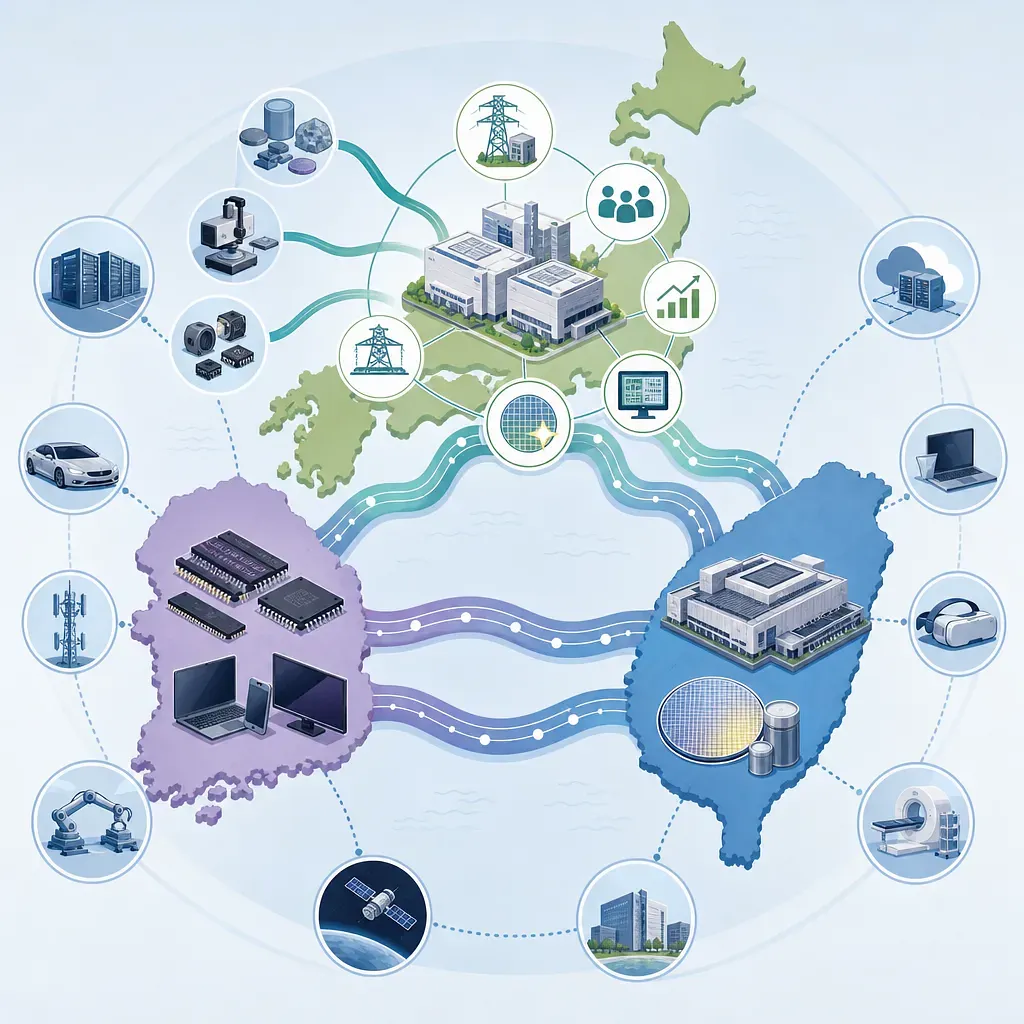
However, Japan’s semiconductor industry has not disappeared entirely. Japanese companies retain important positions across multiple areas of the supply chain, including image sensors, silicon wafers, photoresists, cleaning, inspection, and deposition equipment, and precision components. Japan’s weakness therefore lies primarily in advanced logic design and high-volume manufacturing capacity; it does not mean that the country lacks the entire industrial foundation encompassing materials and equipment.
| Area | Japan’s Relative Position | Key Challenge |
|---|---|---|
| Advanced logic foundries | Behind Taiwan and South Korea | Gaining experience in high-volume manufacturing with advanced processes and securing customers |
| Memory | Smaller than in the past, but retains a NAND flash foundation | Managing investment scale and earnings volatility |
| Image sensors | Highly competitive | Expanding automotive and industrial demand beyond mobile devices |
| Materials, wafers, and equipment | Important share of the global supply chain | Responding to export controls and diversifying customers |
| Automotive and industrial semiconductors | Supported by domestic manufacturing demand | Advancing technology and strengthening supply-chain resilience |
Smartphone Sales and Digital Supremacy Are Not the Same Metric
Samsung’s decision to foreground the Galaxy brand in Japan for a period and then resume using the SAMSUNG name on some new products beginning in 2023 can be viewed as a change in brand strategy. Instances in which Samsung ranked among the top Android sellers during certain periods or through certain sales channels also indicate that Japanese consumers have become more receptive to South Korean brands.
However, this should not be expanded into a claim that Samsung ranks first in Japan’s overall smartphone market or that digital supremacy between South Korea and Japan has definitively reversed. Smartphone statistics differ according to how they are measured.
- Shipments are the number of units supplied by manufacturers to distribution channels.
- Sales are the number of devices actually sold to consumers and vary depending on the scope of the channels surveyed.
- Web usage share is not sales volume, but the share of internet traffic generated by devices currently in use.
- Rankings within Android and rankings for the overall market including the iPhone are different metrics.
Changes in perceptions among younger generations may have contributed to higher sales, but it is difficult to identify generational turnover as the sole cause without research on purchasing motivations by age group. Prices, mobile carrier promotions, foldable products, exchange rates, launch timing, and distribution inventory also play a role.
“Digital supremacy” is likewise not a single officially recognized statistic. South Korea is strong in memory, smartphones, displays, and some digital services, while Japan is strong in materials, equipment, sensors, and industrial technology. Taiwan dominates advanced foundries, while the United States has overwhelming influence in semiconductor design, software, and cloud services. Competitiveness among countries must be assessed using separate metrics for each area.
Why South Korean Companies Do Not Build Large Fabs in Japan
The fact that South Korean companies have not announced large-scale advanced production plants in Japan is not sufficient to conclude that they are completely turning away from the country. Semiconductor companies use different criteria to locate production fabs, research and development facilities, packaging operations, and customer support bases. Research and development or collaborative investment in Japan is a separate choice from investment in a large wafer fab.
Domestic Demand
An advanced fab does not necessarily have to consume all of its output locally. Semiconductors are exported to global markets, and foundries operate based on customer orders. The explanation that “a fab cannot be built because there is insufficient demand for 2-nanometer chips in Japan” is therefore incomplete.
However, having major customers nearby is advantageous for joint development, quality response, and demand forecasting. Japan has demand in the automotive, sensor, and industrial equipment sectors, but its domestic fabless base placing large-volume orders for cutting-edge processes, such as smartphone application processors or AI accelerators, is relatively weak. This is why Rapidus must secure overseas customers.
Logistics and Industrial Clusters
Finished chips are small and valuable, making transportation costs less burdensome than for automobiles or steel. However, this does not mean that logistics costs are irrelevant to fab location decisions. Wafers and materials require contamination, shock, and delivery-time management, while access to equipment maintenance personnel, chemicals, components, packaging facilities, and customer engineering teams is also important.
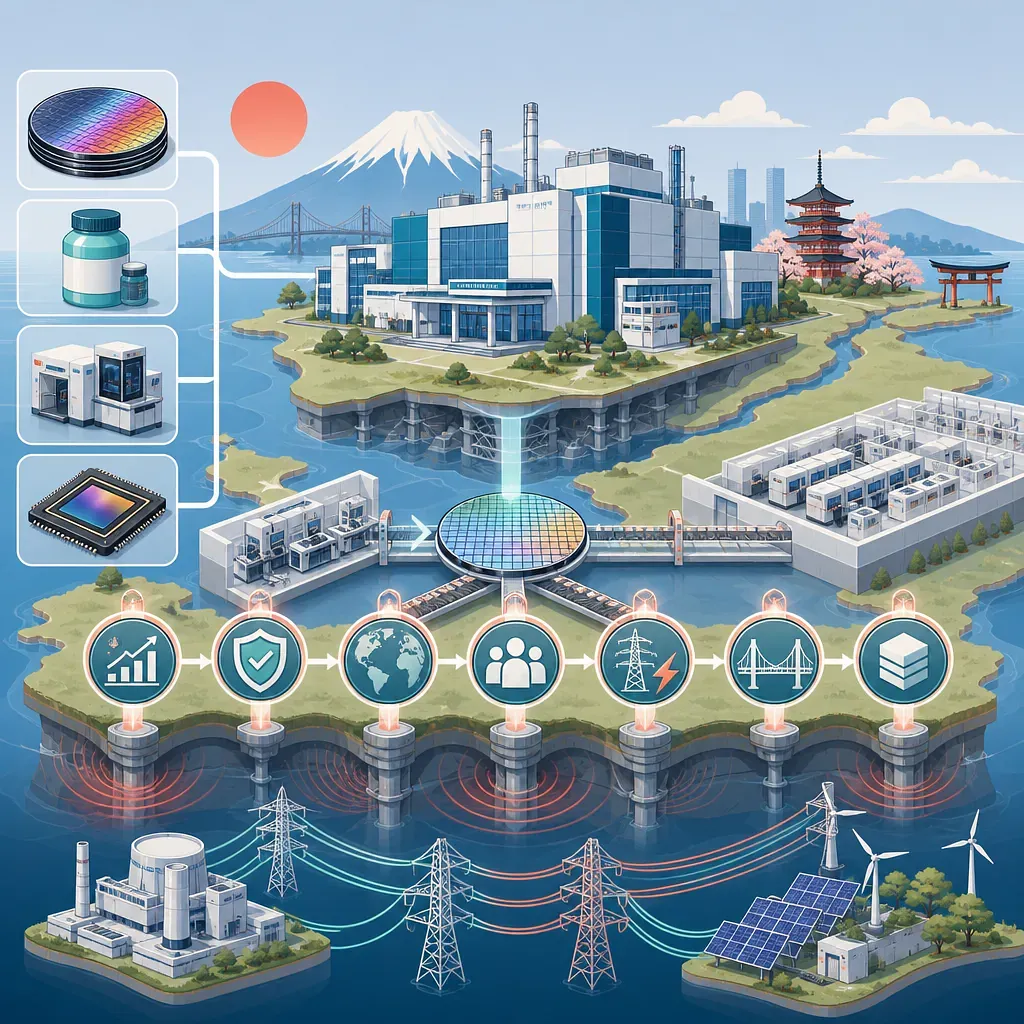
Semiconductor locations are determined by a combination of the following factors rather than transportation costs alone.
- Clusters of skilled engineers and partner companies
- Stable supplies of electricity and ultrapure water
- Equipment and materials supply chains and maintenance speed
- Government subsidies and taxes, and the time required for permits and approvals
- Customer accessibility, intellectual property protection, and geopolitical risk
Earthquake Risk
Japan’s earthquake risk is a genuine operational risk. Microvibrations, power outages, damage to water pipelines, and logistics disruptions can cause production setbacks and wafer losses. They also increase insurance premiums and the costs of earthquake-resistant design, inventories, and supply-chain redundancy.
Even so, it cannot be concluded that all of Japan is unsuitable for semiconductor production. Taiwan also faces significant earthquake risk but operates the world’s largest foundry production base. Modern fabs use seismic isolation structures, emergency power, and automated equipment shutdown and restart procedures. The key issue is not whether risk exists, but the level of risk at a particular site and the cost required to reduce it.
Power Supply
Advanced fabs continuously consume enormous amounts of electricity, making prices, carbon emissions, grid capacity, and outage quality important. Since the Fukushima accident, Japan has experienced electricity cost and supply pressures due to reduced nuclear power generation and reliance on imported fuels, and it also faces limited interconnection among regional grids.
However, characterizing Japan as a country with chronic power shortages or saying that operating large fabs there is effectively impossible would also be an exaggeration. Some nuclear power plants have restarted, and power supply conditions vary by region and season. Actual investment decisions should examine not the total amount of generating capacity, but the grid connection capacity available in the relevant region, long-term power contracts, backup power, renewable energy procurement, and plans to expand the transmission network.
What TSMC’s Kumamoto Investment Demonstrates
JASM, established by TSMC with Sony Semiconductor Solutions and others, is expanding production in Japan through its Kumamoto plant. Publicly announced plans include multiple processes intended to meet demand from the automotive, industrial, consumer, and high-performance computing sectors.
This case demonstrates two things simultaneously.
- Japan can attract global foundries by combining subsidies, existing customers, materials and equipment supply chains, and a regional industrial base.
- The Kumamoto investment does not itself mean that Japan has recovered independent, cutting-edge 2-nanometer capabilities. JASM is an overseas production base that uses TSMC’s technology and operating systems.
There is also no reason why every chip produced by TSMC at its Japanese plant must be consumed within Japan. Production bases are part of global supply chains, and their economic viability is assessed based not only on local domestic demand but also on exports and customer portfolios.