Injoys

Most mouth sores are not oral cancer. Common aphthous ulcers or traumatic wounds usually improve on their own, but lesions that do not heal within a certain period or continue to grow require examination. In particular, oral cancer may not cause obvious pain in its early stages, so it is important to monitor the duration of symptoms and pattern of changes rather than their severity.
This article is not intended for self-diagnosis. If you have a persistent lesion, bleeding, difficulty swallowing, or a lump in the neck, you should be evaluated by a healthcare professional.
What Is Oral Cancer?
Oral cancer refers to malignant tumors that develop in the lips and tissues inside the mouth. Most oral cancers are squamous cell carcinomas, which begin in the squamous cells that form the mucosal lining.
Main Areas Included in the Oral Cavity
- Inner lips and buccal mucosa
- Front approximately two-thirds of the tongue
- Floor of the mouth beneath the tongue
- Upper and lower gums and alveolar mucosa
- Hard palate
- Retromolar trigone behind the wisdom teeth
The base of the tongue, tonsils, and soft palate are generally part of the oropharynx, not the oral cavity. Therefore, cancers of the tonsils and base of the tongue are classified as oropharyngeal cancers rather than oral cancers. Salivary gland cancers may also be found inside the mouth, depending on where they arise, but they are treated as a separate group of tumors.
Differences Between Mouth Ulcers and Lesions Suspicious for Oral Cancer
It is impossible to distinguish benign mouth ulcers from cancer perfectly based on appearance alone. The following table provides reference criteria for deciding whether medical attention is needed; a definitive diagnosis is made through a professional examination and biopsy.
| Category | Common Mouth Ulcers and Traumatic Wounds | Suspicious Findings Requiring Medical Attention |
|---|---|---|
| Duration | Usually improve within 1–2 weeks | Do not heal for at least 2 weeks or persist for up to 3 weeks |
| Changes | Gradually become smaller and less painful | Become larger or deeper, with hardening of the surrounding area |
| Surface and color | Round ulcers with red borders are common | Persistent white or red patches, or lesions containing both colors |
| Texture | May be temporarily painful | A firm lump or tissue hardening can be felt |
| Accompanying symptoms | Local pain when irritated | May be accompanied by bleeding, reduced sensation, difficulty swallowing or speaking, or a neck lump |
| Course after removing the cause | Improves after eliminating irritation such as a sharp tooth | Does not heal even after the cause is removed |
The commonly cited “2-week rule” is not a rule that confirms cancer but a safety threshold to avoid delaying an examination. If a wound persists for at least 2 weeks, make an appointment, and if it has not healed for at least 3 weeks, it should be evaluated. If bleeding does not stop or problems with breathing or swallowing occur, seek prompt medical attention regardless of how long the symptoms have been present.
Warning Signs That Should Not Be Missed
The following symptoms do not all mean cancer, but they should be checked if they persist or worsen.
- An ulcer on the lip or inside the mouth that does not heal for at least 2 weeks
- A white patch that cannot be rubbed off or a vivid red patch
- A firm lump felt inside the mouth, on the tongue, or in the gums
- Recurrent bleeding without an apparent reason
- Reduced sensation or numbness of the tongue or lips
- Changes in chewing, swallowing, speaking, or tongue movement
- Persistent pain that radiates to one ear
- Dentures that previously fit well suddenly becoming uncomfortable
- Unexplained loose teeth or an extraction site that does not heal
- A newly felt lump under the jaw or in the neck
- Unexplained weight loss
Bad breath can result from many causes, including oral hygiene, periodontal disease, and tonsil conditions, so it cannot by itself be used to identify oral cancer. Conversely, early oral cancer may be painless.
Are All White and Red Patches Cancer?
No. Leukoplakia is a clinical term describing a white lesion that does not disappear when wiped, while erythroplakia refers to a distinct red lesion. Other causes, such as infection, friction, and inflammation, are also possible.
However, some lesions may contain epithelial dysplasia, which is a precancerous change, or cancer. Healthcare professionals assess the lesion’s location, size, texture, and risk factors and perform a biopsy when necessary. A lesion should not be judged benign or malignant based on its visible color alone.
Major Risk Factors
1. Tobacco and Other Tobacco Products
Tobacco products, including cigarettes, cigars, pipes, and smokeless tobacco, are major risk factors for oral cancer. This is because the mucous membranes of the mouth and pharynx are repeatedly exposed to carcinogens in tobacco smoke and products.
2. Excessive Alcohol Consumption
Excessive alcohol consumption increases the risk of oral cancer. When smoking and drinking continue together, the risk rises more sharply than when only one is present. Total alcohol intake and drinking patterns are more important than the type of alcoholic beverage.
3. HPV Infection
High-risk human papillomavirus, particularly HPV 16, is associated with some head and neck cancers. However, the association with HPV is especially clear in oropharyngeal cancers arising in the base of the tongue and tonsils, which should be distinguished from typical oral cancers that develop in the front of the mouth.
4. Betel Quid and Chewing Mixtures
The habit of chewing betel quid or areca nut and mixtures containing them increases the risk of oral cancer. This is a particularly important risk factor in some regions of Asia and the Pacific.
5. Ultraviolet Exposure of the Lips
Long-term ultraviolet exposure through outdoor work or activities may be associated with the risk of lip cancer, particularly cancer of the lower lip.
6. Age and Medical History
Oral cancer is more common among middle-aged and older adults, but it can also occur in younger people. Those with a history of head and neck cancer or impaired immune function should follow the surveillance schedule established by their healthcare professionals.
Is Chronic Irritation a Direct Cause?
Poorly fitting dentures, sharp teeth, and repeatedly biting the cheek or tongue can cause ulcers and inflammation. However, there is insufficient evidence to conclude that this type of physical irritation alone causes oral cancer. What is important is to undergo an evaluation, including a biopsy, if the lesion does not heal even after the source of irritation has been corrected.
How Is Oral Cancer Diagnosed?
1. Medical History and Examination of the Mouth and Neck
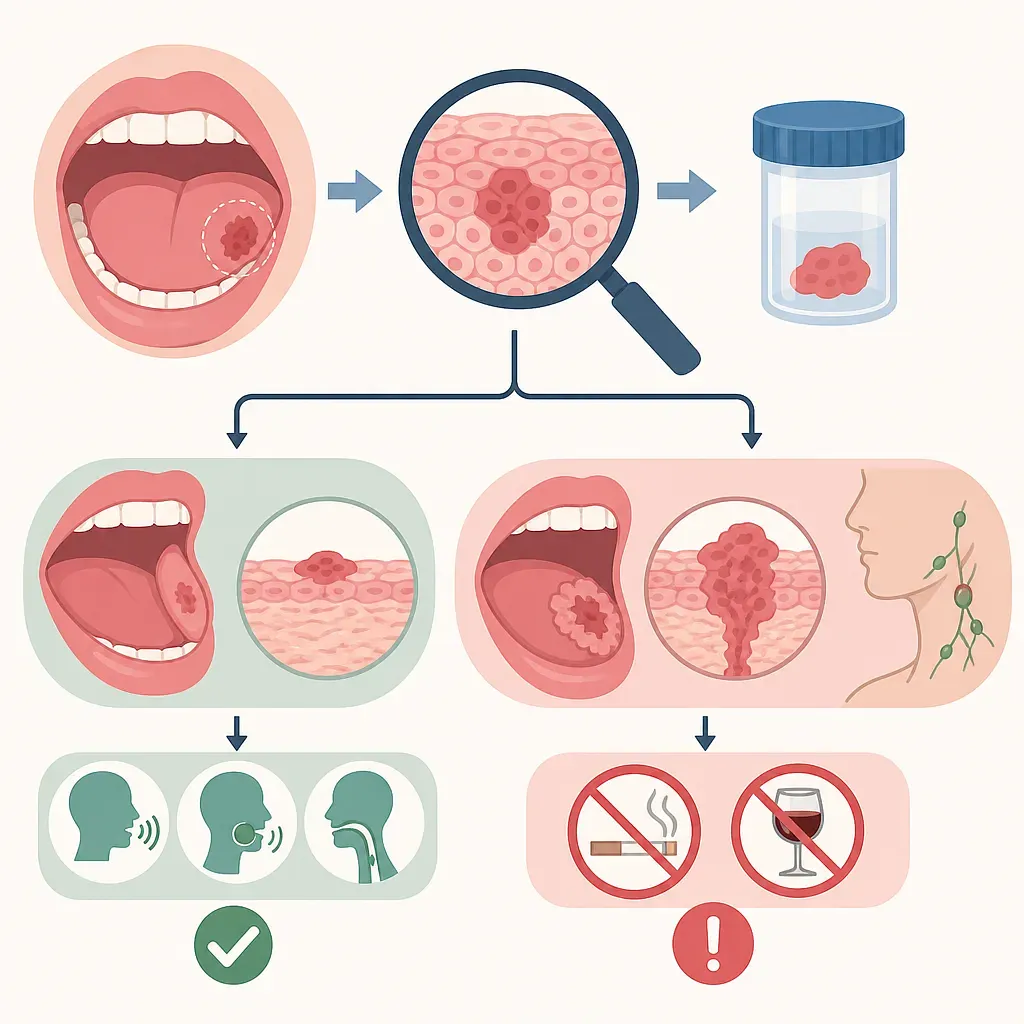
Healthcare professionals ask when the symptoms began and assess smoking and alcohol use, weight changes, pain, and swallowing problems. Using a light and mirror, they examine the lips, cheeks, gums, sides and underside of the tongue, floor of the mouth, and palate, and feel for lumps inside the mouth and in the neck.
2. Biopsy
A definitive cancer diagnosis requires a biopsy, in which suspicious tissue is removed and examined under a microscope. Tests that collect cells with a brush or adjunctive tests using light may assist in evaluation, but they generally cannot replace a biopsy of a suspicious lesion.
3. Imaging and Staging
Once cancer is confirmed, tests such as CT, MRI, ultrasound, and PET-CT may be performed as appropriate to assess tumor depth, invasion of surrounding tissues, cervical lymph nodes, and distant metastasis. The stage is determined by considering the tumor’s size and depth of invasion, lymph node metastasis, and distant metastasis.