Samsung Electronics, SK hynix: Memory Outlook and Strategy
Samsung Electronics and SK hynix say AI demand is spreading from HBM to server DRAM and SSDs. This article compares their approaches to HBM4 competition and their views on what is driving the boom, then outlines criteria for assessing capacity expansion and shareholder returns.
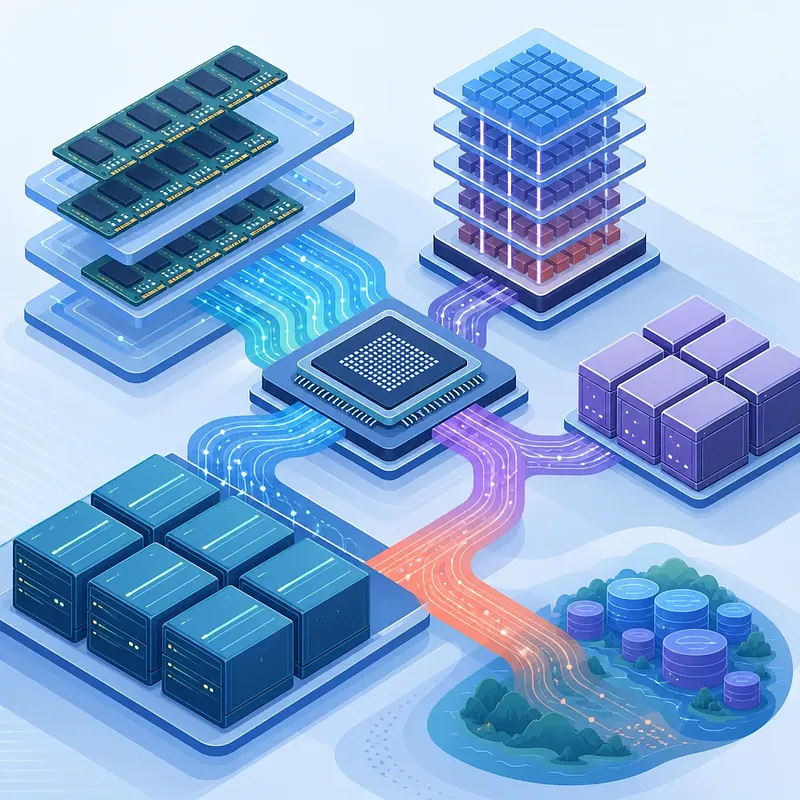
Both companies say improving AI system performance requires HBM, server DRAM, and storage to advance together.
Samsung Electronics emphasizes the integration of its internal processes as an HBM strength, while SK hynix emphasizes collaboration with customers and foundry companies.
The companies' outlook that swings in the memory market will narrow does not mean the possibility of falling prices has disappeared.
Samsung Electronics' projected shareholder returns for 2026 and SK hynix's share buyback and cancellation amounts differ in scope, making direct comparison difficult.
After capacity expansion, check actual shipment volumes, profitability, and cash remaining after investment together.
Samsung Electronics and SK hynix believe AI will increase demand across the memory market. Samsung Electronics emphasizes the integration of its in-house technologies as a competitive strength. SK hynix places more weight on collaboration between companies. Whether the boom continues depends on whether profitability holds up after capacity expands.
The shareholder return figures are based on the two companies' announcements in August 2026.
The memory outlook shared by both companies
Both companies expect AI demand to change the structure of the memory industry. A summary of their IR presentations by the Toss Securities Research Center sets out five points. The companies' outlooks should be distinguished from results already confirmed.
Shared message | What it means | What remains to be confirmed
Memory is a bottleneck for AI performance | Computing devices need a timely supply of data to perform well | Performance improvements in actual workloads
Demand is spreading beyond HBM | Server DRAM and NAND-based SSDs are also needed | Increases in orders and revenue by product
Expectations of smaller market swings | Customized products may help stabilize earnings | Prices and profit margins when demand slows
Production capacity is a competitive strength | The ability to supply customers on schedule is becoming more valuable | Plant operations and actual shipment schedules
Investment alongside shareholder returns | How cash left after growth investment is distributed | Cash flow and execution of return plans
Korea Premium Weeks 2026 is a joint event held by the Financial Services Commission and the Korea Exchange. The Financial Services Commission's opening press release confirms that it was held on September 28, 2026. However, that release does not verify every statement made by individual companies. The exact wording of those statements should be checked in each company's IR presentation materials.
How do HBM, server DRAM, and SSDs differ?
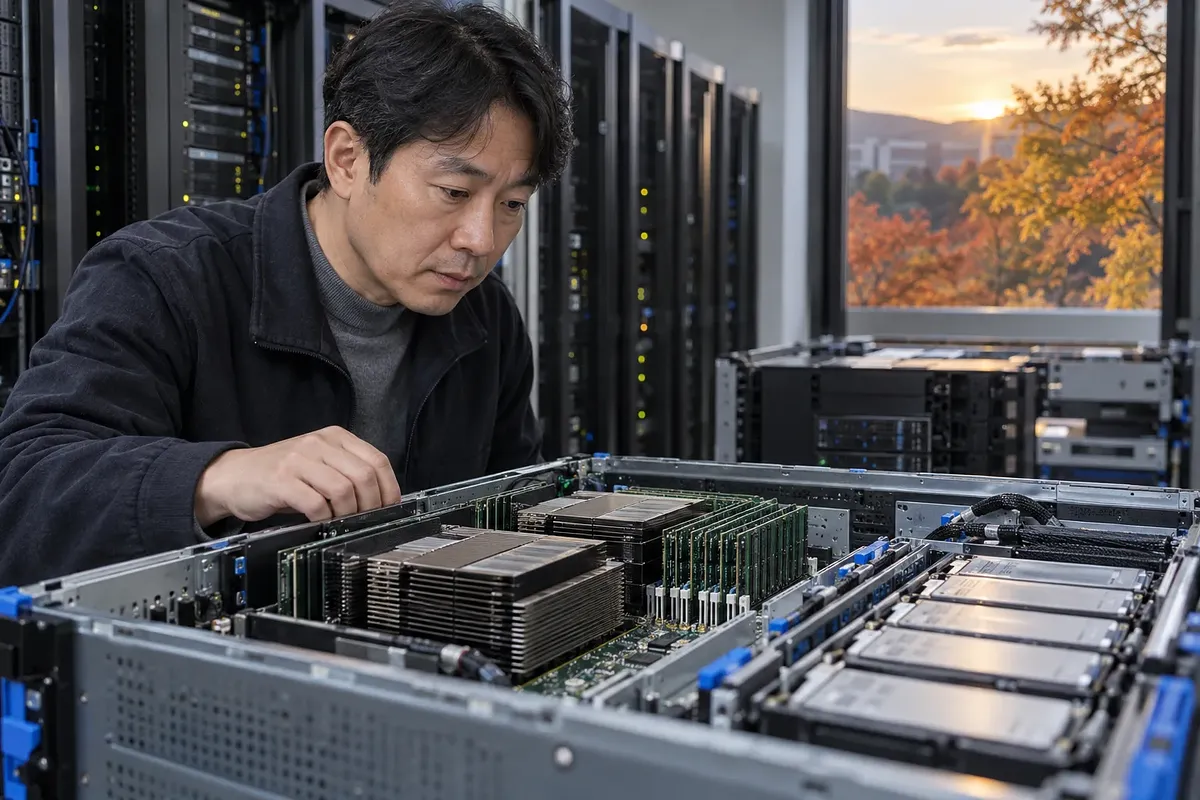
HBM, server DRAM, and SSDs serve different purposes in AI systems. HBM stacks multiple DRAM chips to increase data transfer capacity. It is therefore inaccurate to treat HBM and DRAM as entirely separate types of semiconductor.
Bandwidth is the amount of data that can be transferred in a given time. Capacity is the amount of data that can be stored. When a GPU is waiting for data, increasing computing power alone has limited effect. SK hynix's explanation of AI systems also identifies data movement as a performance constraint.
Category | Main role | Key distinction
HBM | Supplies data to AI accelerators at high bandwidth | Memory made by stacking DRAM
Server DRAM | Holds working data processed by the CPU and system | A server's main memory
SOCAMM2 | A server memory module based on low-power DRAM | Serves a different role from HBM
NAND | Retains data when the power is off | Storage semiconductor used in SSDs
eSSD | Stores and retrieves data in servers | A finished enterprise SSD
Samsung Electronics displayed these layers separately at COMPUTEX 2026. It positioned HBM4 as GPU memory, presented SOCAMM2 as system memory, and introduced server SSDs as storage devices. The position of each product is described in Samsung Electronics' exhibition overview.
SK hynix also introduced HBM, server DRAM, and eSSDs together. This lineup shows why HBM demand alone cannot explain the entire business. It does not, however, mean that prices for all products will rise at the same pace. SK hynix's September 2026 announcement describes the product lineup.
Comparing HBM4 strategies
The difference between the HBM4 strategies lies in how the companies coordinate related technologies. Samsung Electronics emphasizes optimizing its in-house technologies together. SK hynix emphasizes joint development with external partners. Both approaches need performance validation in customers' systems.
The HBM base die is the foundational chip beneath the stacked structure. It controls signals and power. Packaging is the technology used to connect multiple chips so they work together.
Comparison | Samsung Electronics | SK hynix
Emphasized approach | In-house integration of memory, foundry, and packaging | Collaboration with customers, design companies, and foundries
Confirmed technical example | Use of its own 4-nanometer logic process in HBM4 | Pursuit of TSMC process technology for the HBM4 base die
Expected benefit | Internal coordination of process and design changes | Joint incorporation of partner technologies and customer requirements
Results investors should check | Customer adoption, yield, delivery schedules | Customer adoption, yield, delivery schedules
Samsung Electronics announced mass-production shipments of HBM4 in February 2026. That announcement describes the use of a 4-nanometer logic base die. This is a concrete example of its strategy of combining in-house processes. The source is Samsung Electronics' HBM4 announcement.
SK hynix announced a partnership with TSMC in April 2024. The partnership covers the HBM4 base die and advanced packaging. This announcement shows the starting point of its collaboration strategy. Details are available in the SK hynix and TSMC partnership announcement.
An integrated structure alone does not establish that Samsung Electronics has an advantage. Nor do existing customer relationships guarantee that SK hynix will keep an advantage. When comparing the companies, check actual supply results for products of the same generation.
Supply shortages and rising value under different conditions
Supply shortages and an increase in the value of memory can occur at the same time. Toss Securities' IR summary says Samsung Electronics emphasized supply constraints, while SK hynix emphasized the value memory adds to system performance. Current prices alone make it difficult to tell which factor is stronger.
The explanation for supply constraints includes investment cutbacks during downturns. It also cites constraints on commodity DRAM supply as HBM production expands. The time needed to build plants slows the supply response. However, there is no fixed ratio at which increased HBM production reduces commodity DRAM supply.
What happens next | Possible interpretation | What else to check
Prices and profit margins fall together after supply increases | Supply shortages may have had a large effect | Changes in inventory and customer orders
Margins on high-value products hold up after supply increases | The value of differentiated performance may be holding up | Changes in product mix and costs
Shipments rise, but revenue growth slows | Average selling prices may be falling | Prices and sales mix by product
Orders from one customer fall sharply | The customer's investment schedule may be a factor | Demand from other customers and contract terms
This table offers a framework for testing the announced outlooks. No single scenario proves just one cause. For example, lower manufacturing costs can also raise profit margins. When examining prices, check the mix of products sold as well.
Why do the memory cycle and share prices move differently?
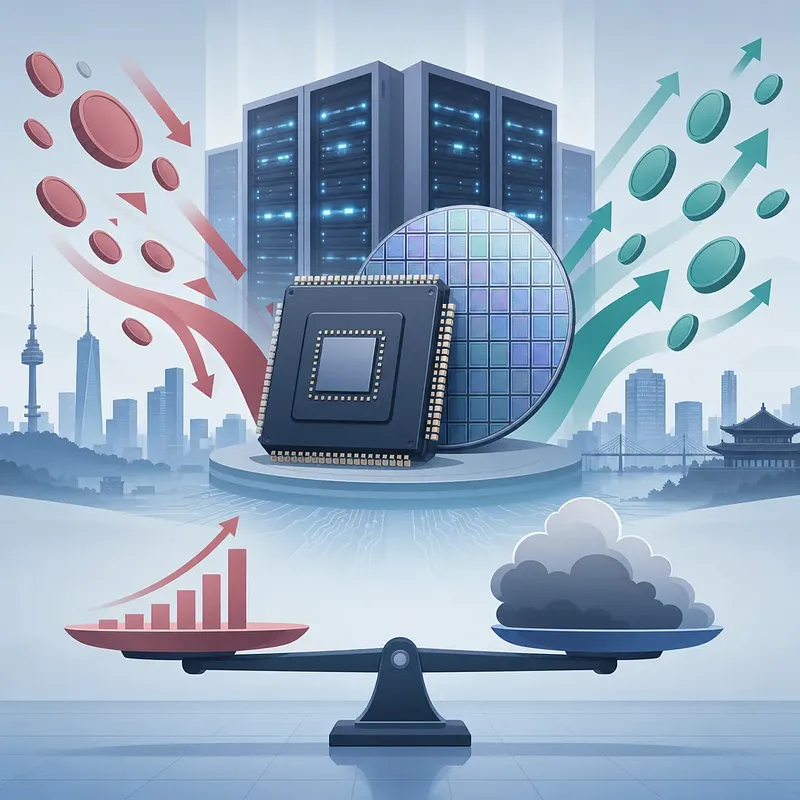
Industry growth and rising share prices are not the same outcome. The memory cycle is the pattern of earnings rising and falling with supply and demand. Share prices are also influenced by expectations of future earnings. Even strong results can be followed by a weaker share price if they fall short of expectations.
Customized products may help stabilize customer relationships. But they remain exposed to the risk that customers cut investment. Adoption outcomes may also change when a new product generation arrives. Smaller market swings are therefore an outlook that needs to be tested.
· Distinguish growth in memory demand from gains in an individual company's market share.
· Technology announcements, customer approval, and large-scale shipments are different stages.
· Market capitalization rankings are not a direct measure of product competitiveness.
· The amount invested through ETFs is also affected by fund size and inclusion rules.
Comparing shareholder return amounts
The amounts announced by the two companies cover different things, so a direct comparison is difficult. Samsung Electronics gave an estimate for total annual shareholder returns. SK hynix announced a specific share buyback and cancellation plan. Both should be distinguished from the cash dividends received by individual shareholders.
Category | Samsung Electronics | SK hynix
Announcement date | August 21, 2026 | August 19, 2026
Announced amount | Approximately 90 trillion to 110 trillion won in shareholder returns expected for 2026 | Plan to buy back and cancel 40 trillion won in shares
What the amount covers | Returns including cash dividends and share buybacks and cancellations | The share buyback and cancellation announced this time
Policy period | 2024 to 2026 | 2025 to 2027
Cash flow basis | 50% of free cash flow during the period | At least 50% of cumulative free cash flow during the period
What remains to be confirmed | Final amount and method, depending on earnings and investment | Execution of the buyback and cancellation, and decisions on additional returns
Samsung Electronics' approximately 90 trillion to 110 trillion won is an estimate of shareholder returns for 2026. It may change depending on earnings and the scale of investment. These conditions are stated in Samsung Electronics' August 2026 disclosure.
SK hynix announced a plan to buy back 40 trillion won worth of shares and cancel all of them. It said it would also consider cash dividends as part of additional shareholder returns. The scope of the policy is described in SK hynix's August 2026 announcement.
A share buyback is when a company buys its own shares. Cancellation is the process of eliminating those shares. A buyback for employee compensation has a different outcome from cancellation. When comparing the scale of shareholder returns, check the purpose of the buyback and whether the shares are actually cancelled.
Customer advance payments and funds for shareholder returns
Not all cash received from customers in advance is available for shareholder returns. An advance payment is money received from a customer before products are supplied. The company still has an obligation to supply those products later. An increase in its cash balance alone therefore does not show how much it can return to shareholders.
Samsung Electronics' disclosure sets out how advance payments under long-term supply contracts are treated. Advance payments that function as deposits are excluded from the cash flow calculation for shareholder returns. Spending related to employee share-based compensation is also subject to adjustment. These conditions appear in Samsung Electronics' shareholder return disclosure.
This distinction is useful when connecting long-term contracts with shareholder returns. Long-term contracts can make production planning more predictable. But cash received under a contract cannot immediately be treated as funds for dividends. This interpretation follows from the calculation rules in the disclosure.
Item to check | What it tells you | What it cannot tell you on its own
Cash balance | How much cash the company currently holds | Whether all of it can be returned to shareholders
Customer advance payments | Cash received before supply | Whether an equal amount of profit has been earned
Free cash flow | The flow of cash left after operations and investment | Whether it exactly matches the amount returned under company policy
Board decision on returns | The specific returns approved | Whether the same amount will be returned in the future
Indicators to check after capacity expansion
The results of capacity expansion show up in shipments of products that can be sold, rather than in plant size. Yield is the proportion of manufactured products that work properly. Even with more equipment, a low yield can limit supply growth. The timing of customer approval also affects when revenue is actually earned.
To compare company announcements, check the following in order.
· Check demand by product. Look separately at trends in HBM, server DRAM, and NAND.
· Check the stage of capacity expansion. Distinguish investment decisions from plant operations and shipments to customers.
· Check shipment volumes and profit margins together. Do not judge pricing competitiveness from revenue growth alone.
· Check cash flow after investment. Compare it with the actual execution of shareholder return plans.
Power and cooling are also factors to consider when assessing product performance. The power needed to move data affects system operating costs. But improved power efficiency in a chip does not necessarily mean lower company-wide emissions. A company's climate performance should be checked in separate sustainability materials.
Common mistakes when reading the memory outlook
The most common mistake is treating companies' expectations as confirmed outcomes. The spread of demand across products should also be distinguished from price increases for every product. Shareholder return plans are likewise different from completed payments or share cancellations.
· Do not assume that growth in HBM eliminates the need for other memory products. Each product serves a different role in the system.
· Do not assume supply shortages are permanent. Capacity expansion and changes in demand can affect prices.
· Do not treat a company's total shareholder returns as an individual's dividend. Individual dividends depend on the dividend per share and the shareholder's holdings.
· Do not group buybacks for employee compensation with buybacks for cancellation. The shares are ultimately handled differently.
 Injoys