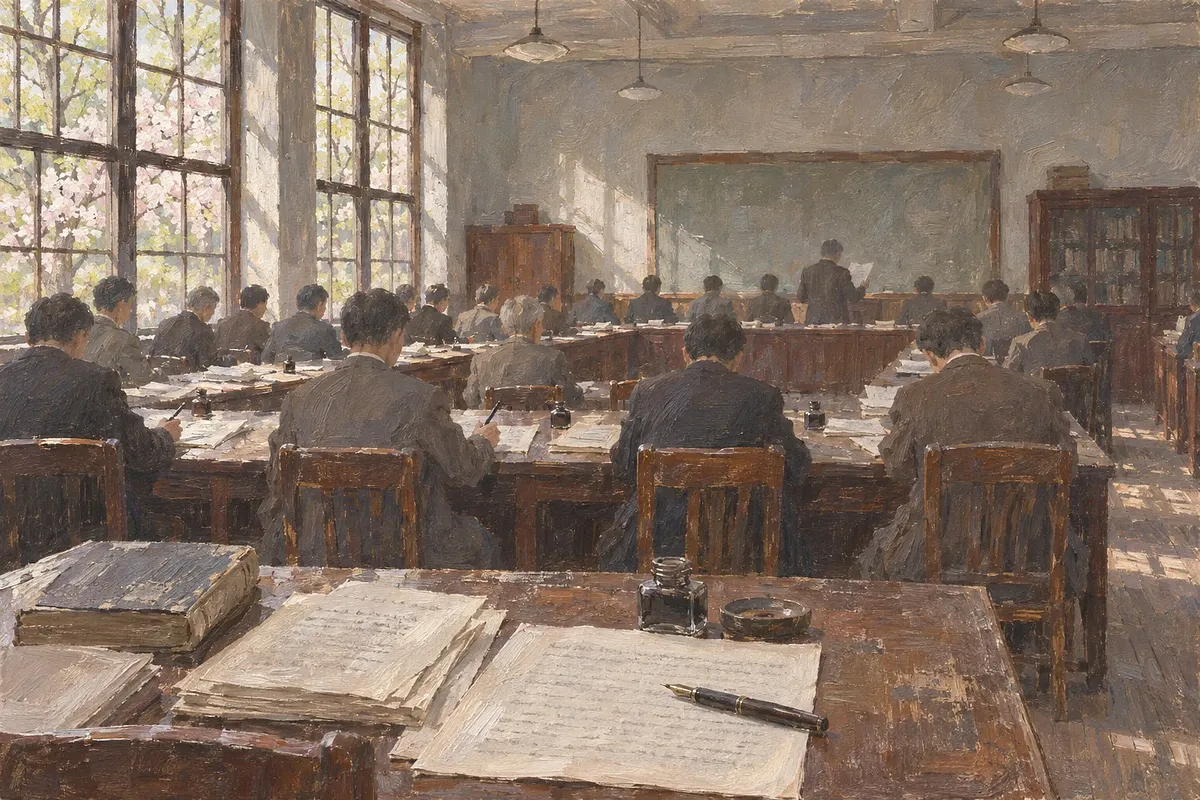
A group of university professors protested election fraud and the suppression of demonstrations on April 25, 1960. Their declaration on the national situation and street march strengthened the resistance of students and citizens. This resistance led to Syngman Rhee's resignation. The professors' participation is remembered as a turning point when intellectuals joined the resistance.
This article follows records from the National Institute of Korean History and the National Archives of Korea, checked in November 2026.
Background to the professors' declaration on the national situation
Election fraud and the suppression of students and citizens formed the background to the professors' declaration. The Syngman Rhee regime had repeatedly amended the Constitution to prolong its rule. Political control over schools also fueled student opposition. Our History Net explains these issues as the background to the revolution. Our History Net, “April 19 Revolution”
Control over educational institutions was evident in school life. In Daegu, students were ordered to attend school on a Sunday when an opposition campaign rally was scheduled. Students took to the streets in protest on February 28, 1960. Demands for freedom in educational institutions had thus emerged before the election. February 28 Democratic Movement Memorial Association, “How the February 28 Movement Unfolded”
On March 15, demonstrations broke out in Masan against fraud in the presidential and vice-presidential elections. The discovery of Kim Ju-yeol's body on April 11 sparked a renewed spread of resistance. On April 18, Korea University students were attacked while returning from a demonstration. The following day, casualties mounted as police opened fire on demonstrations across the country. National Archives of Korea, “How the April 19 Revolution Unfolded”
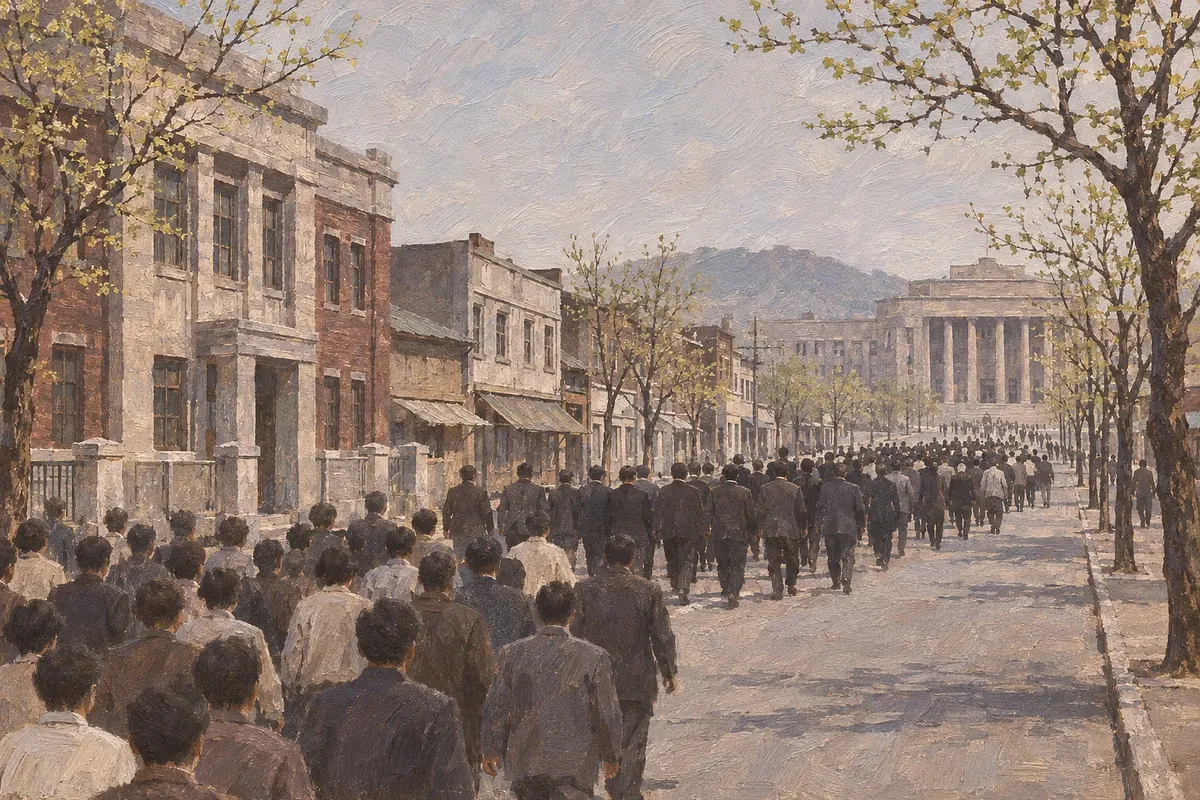
The professors’ participation marked a turning point in the widening resistance by students and citizens.AI-generated image
Timeline from February 28 to April 27
The professors joined the later stages of resistance that students and citizens had already sustained. All dates below are in 1960. The declaration, the resignation announcement, and the submission of the resignation letter are listed as separate events.
| Date | Event | Source |
|---|---|---|
| February 28 | High school students in Daegu demonstrate against control over educational institutions | National Archives of Korea, “How the April 19 Revolution Unfolded” |
| March 15 | Demonstrations against election fraud break out in Masan | National Archives of Korea, “How the April 19 Revolution Unfolded” |
| April 11 | Demonstrations spread again in Masan after the discovery of Kim Ju-yeol's body | National Archives of Korea, “How the April 19 Revolution Unfolded” |
| April 18 | Korea University students are attacked while returning to campus after a demonstration | National Archives of Korea, “How the April 19 Revolution Unfolded” |
| April 19 | Students and citizens demonstrate nationwide, police open fire, and martial law is declared | National Archives of Korea's account of events; Our History Net, “April 19 Revolution” |
| April 20 to 24 | Demonstrations continue across the country | National Archives of Korea, “How the April 19 Revolution Unfolded” |
| April 25 | University professors issue a declaration on the national situation and march to the National Assembly building | National Archives of Korea, “President Syngman Rhee Steps Down” |
| April 26 | Syngman Rhee announces his resignation as demonstrations continue | National Archives of Korea, “President Syngman Rhee Steps Down” |
| April 27 | Syngman Rhee submits his resignation letter to the National Assembly | National Archives of Korea, “President Syngman Rhee Steps Down” |
The first part of the timeline follows the National Archives of Korea's account of events. The final three dates were cross-checked against the same institution's commentary on the resignation. This continuity also explains why the revolution cannot readily be understood through April 19 alone. National Archives of Korea's account of events, National Archives of Korea's commentary on the resignation
What the professors did on April 25
On April 25, 1960, 258 professors from 27 universities issued a declaration on the national situation. They met at Seoul National University's Faculty Hall. The declaration consisted of 14 points. These figures are explicitly stated in the National Archives of Korea's commentary on the resignation. National Archives of Korea, “President Syngman Rhee Steps Down”
According to Our History Net, the declaration was adopted unanimously. All 258 professors present signed it. After issuing the declaration, the professors began a street march. Students and citizens followed them. Our History Net, “University Professors' Declaration on the National Situation During the April 19 Revolution”
The professors' participation strengthened the resistance continuing under martial law. They marched to the National Assembly building, demanding the president's resignation. Student and citizen demonstrations continued from that night into the following day. The professors' role must therefore be understood in connection with the resistance that preceded it.
Demands in the 14-point declaration
The declaration challenged both responsibility for election fraud and the political bias of state institutions. It did not demand only the president's resignation. Its demands also included protection for students and autonomy for schools. The table below summarizes each point from Our History Net's transcription.
| Point | Main demand or assessment |
|---|---|
| Point 1 | Recognizes student demonstrations as action against corruption and injustice |
| Point 2 | Rejects claims that the demonstrations were directed by the Communist Party or opposition parties |
| Point 3 | Condemns police gunfire and violence against peaceful demonstrations |
| Point 4 | Demands accountability and the resignation of the president, ruling and opposition party lawmakers, and Supreme Court justices |
| Point 5 | Declares the March 15 elections fraudulent and demands new presidential and vice-presidential elections |
| Point 6 | Demands punishment for the organizers of election fraud |
| Point 7 | Demands punishment for those who ordered and carried out actions that caused student casualties |
| Point 8 | Demands the release of detained students |
| Point 9 | Demands punishment for illicit wealth accumulated through public office |
| Point 10 | Demands guarantees of police neutrality and freedom in educational institutions |
| Point 11 | Demands an end to the use of educational institutions as political tools |
| Point 12 | Criticizes scholars and figures in culture and the arts who aligned themselves with those in power |
| Point 13 | Warns against the political exploitation of student demonstrations in both North and South Korea |
| Point 14 | Urges students to remain calm and return to their studies |
Point 5 called for the elections to be held again.
Hold fair elections for president and vice president.
This wording comes from Point 5 of the university professors' declaration on the national situation. It appeared in the April 26, 1960 evening edition of the Dong-A Ilbo. The article was titled “14-Point Declaration on the National Situation Adopted, Also Calls for Securing Educators' Rights and Interests.” The quotation follows Our History Net's transcription. Transcription and commentary on the declaration
Why the declaration both supported students and urged a return to studies
The declaration expresses support for the students' actions alongside a desire to bring the situation under control. Its opening points defend the legitimacy of the demonstrations. Its final point, Point 14, urged students to return to their studies. Our History Net's commentary also identifies both positions. Our History Net's commentary on the declaration
This combination shows how the professors expressed solidarity and understood social order at the time. Recognizing students' demands and encouraging continued demonstrations are different judgments. The declaration clearly did the former while placing limits on the latter. This interpretation emerges from reading its opening and closing points together.
Freedom in educational institutions can be understood in the same context. Here, educational institutions refers to schools and educational communities. The demand was that schools not be mobilized for the political purposes of those in power. The declaration both defended students and demanded educational autonomy.