Injoys

Key Perspective: AI Investment Is Shifting from Leading Semiconductor Stocks to the Infrastructure Ecosystem
The spread of AI technology began with core hardware such as NVIDIA GPUs, HBM, foundries, and memory semiconductors. In the South Korean stock market, Samsung Electronics and SK Hynix were the first to attract attention, which is a natural development. This is because training and running large-scale AI models require high-performance semiconductors and memory.
However, from an investment perspective, there is a more important question: Where might capital flow next, beyond the leading stocks that have already captured the market’s attention? To answer this question, we must view the AI industry as a single supply chain.
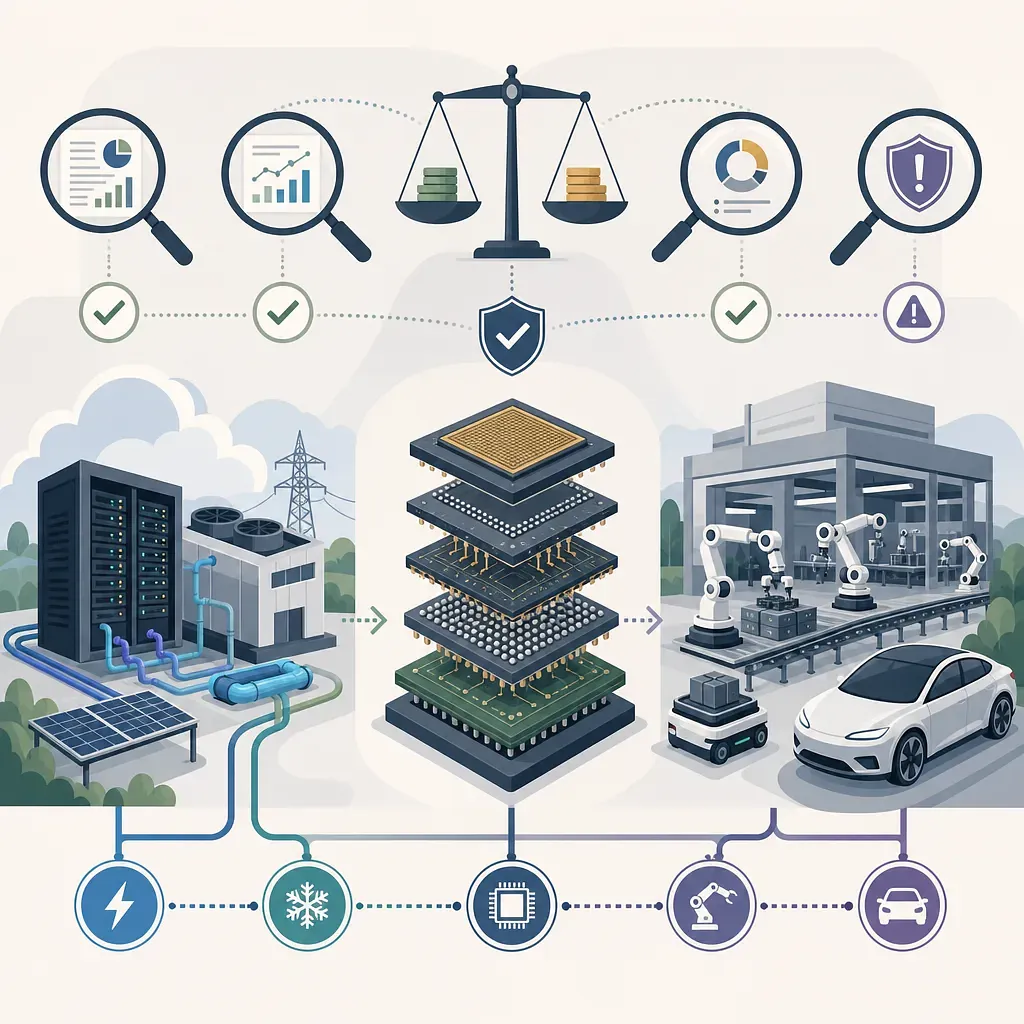
AI infrastructure is broadly linked through the following chain of events:
- Increased demand for AI models
- Increased demand for GPUs and accelerators
- Increased demand for HBM, packaging, substrates, and power components
- Increased demand for data centers, cloud services, networks, and cooling equipment
- Increased demand for robots, mobility, and factory automation that apply AI to real-world industrial settings
This article is not a recommendation to buy or sell specific stocks, but rather an investment analysis framework designed to identify the sectors that will benefit from the AI era.
1. Data Centers: The Foundation That Must Be in Place Before GPUs Can Be Sold
Why Data Centers Are Important
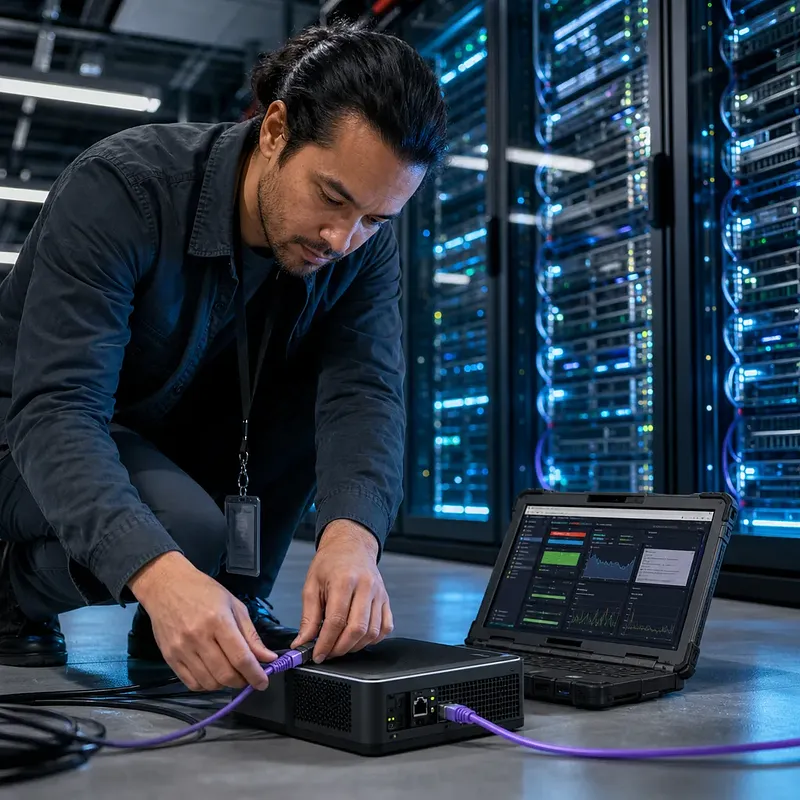
The core objective of GPU companies like NVIDIA is to sell more AI computing equipment. However, AI services cannot operate with GPUs alone. They require data centers that combine large-scale power, cooling, server racks, networks, security, and operational staff.
Therefore, as AI demand grows, the following groups of companies are likely to attract attention:
- Companies capable of building or operating large-scale data centers
- Companies providing cloud infrastructure
- Companies that lease GPU servers or offer AI computing resources as a service
- Companies supplying power, cooling, network, and security infrastructure
CoreWeave in the U.S. is frequently cited as a prime example of a company that has positioned GPU-based cloud infrastructure at the forefront of its business. In South Korea as well, major platforms, telecommunications companies, and cloud service providers may be reevaluated as demand for AI infrastructure grows.
Key Questions When Evaluating Naver and Telecommunications Companies
If we view companies like Naver and SK Telecom solely as search, advertising, or telecommunications service providers, we may overlook the AI infrastructure perspective. What matters is not only whether they develop AI services directly but also the extent of their physical and cloud infrastructure capable of powering AI.
The verification questions are as follows.
| Verification Item | Questions to Ask | Materials for Investors |
|---|---|---|
| Data Center Capabilities | Do they own their own data centers and cloud infrastructure? | Business reports, company announcements, cloud service pages |
| AI Revenue Recognition | Is AI infrastructure being recognized as actual revenue? | Quarterly reports, earnings release materials |
| Customer Base | Do they provide computing resources or cloud services to external companies? | Customer case studies, order announcements, IR materials |
| Cost Structure | Can the company manage the burden of electricity costs, depreciation, and capital expenditures? | Cash flow statements, CAPEX plans |
| Competitiveness | Does the company have differentiators compared to global cloud companies? | Market share, service portfolio, price competitiveness |
The data center sector is attractive but capital-intensive. As capital expenditures rise and depreciation costs increase, profit growth may lag behind revenue growth. Therefore, rather than simply focusing on the phrase “operating AI data centers,” one must examine actual contracts, utilization rates, investment scale, and operating profit margins.
2. Semiconductor Materials, Parts, and Equipment: After HBM, Focus on Substrates and Packaging
How High-Performance AI Chips Drive Demand for Substrates
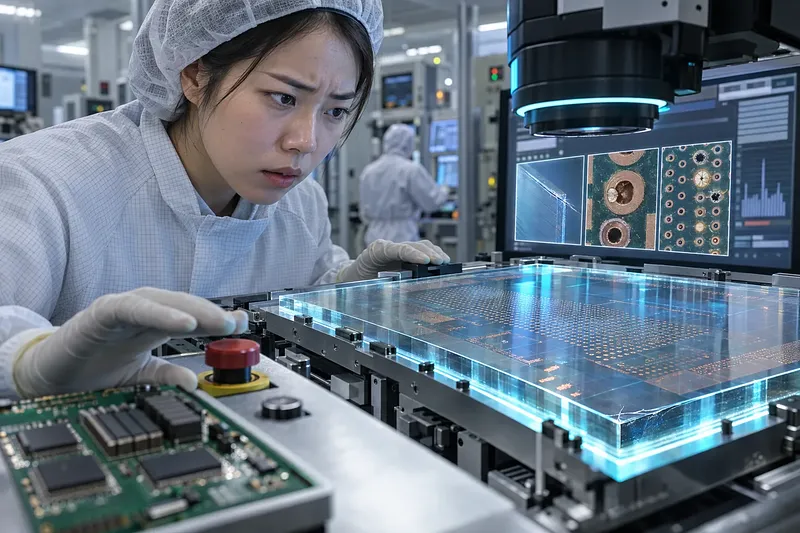
As the computational load of AI semiconductors increases, so do chip size, power consumption, heat generation, and the complexity of signal processing. In this context, semiconductor packaging and substrates play a critical role. Substrates are foundational components that electrically connect chips to the motherboard and ensure stable signal transmission.
For high-performance semiconductors in particular, the following conditions become crucial:
- Larger PCB area
- Ability to implement finer circuits
- Stability in high-speed signal transmission
- Heat dissipation and power handling capabilities
- Compatibility with complex packaging processes
For this reason, as the AI semiconductor cycle lengthens, investors should evaluate the potential for gains not only among memory, foundry, and equipment companies but also among PCB manufacturers.
The Rationale for Reevaluating Component Manufacturers Like Samsung Electro-Mechanics
Electronics component manufacturers such as Samsung Electro-Mechanics operate in both the MLCC and semiconductor package substrate markets. While in the past, the MLCC cycle—linked to demand for smartphones, automotive electronics, and IT devices—accounted for a large portion of stock price performance, in the AI era, the growth potential of high-performance semiconductor substrates may emerge as a separate evaluation factor.
However, investment decisions should not be made based solely on the statement that “substrates are important.” The following indicators must be examined.
| Item | Positive Signals | Risk Signals |
|---|---|---|
| Revenue Composition | Rising share of high-value-added substrate revenue | Continued reliance on existing low-margin products |
| Profitability | Improved operating profit margin in the substrate division | Poor utilization rates following capacity expansion |
| Customers | Diversification of global semiconductor customers | Excessive reliance on specific customers |
| CAPEX | Capacity expansion based on confirmed demand | Aggressive expansion without verified demand |
| Technological Capabilities | Competitiveness in fine-line, large-area, and high-layer products | Exposure to price competition centered on generic substrates |
Investments in AI materials, parts, and equipment may be more volatile than those in blue-chip stocks. However, when earnings actually improve, the market is likely to reassess valuations.
3. A New Perspective on Hyundai Motor: From an Automaker to a Physical AI Platform
What Is Physical AI?
Physical AI refers to the domain where AI from the digital space controls and learns from robots, automobiles, factories, logistics equipment, and other elements in the physical world. While generative AI deals with text and images, physical AI is connected to real-world movements, sensor data, manufacturing processes, and safety controls.
The automotive industry is naturally aligned with Physical AI. Cars are already akin to moving computing devices that integrate cameras, radar, LiDAR, control software, batteries, motors, and communication modules.
Key Points for Reevaluating Hyundai Motor
Viewing Hyundai Motor simply as a manufacturer of finished vehicles narrows the scope of evaluation. The Hyundai Motor Group is seeking to build a broader mobility ecosystem through electric vehicles, autonomous driving, robotics, smart factories, software-defined vehicles, and robotics technology linked to Boston Dynamics.
Investors should consider the following points:
- Are vehicle sales volumes and operating profit margins being maintained?
- Do the electric vehicle and hybrid strategies respond to regional shifts in demand?
- Do robotics and automation technologies translate into actual revenue or productivity improvements?
- Do factory automation and AI-powered factories result in cost savings?
- Can software and data-driven services generate recurring revenue?
For Hyundai Motor to command a higher valuation in the future, it needs evidence that it is “expanding AI-based manufacturing and mobility platforms,” in addition to the traditional logic of “selling cars well.” This evidence should be sought in financial results, investment plans, productivity metrics, and software revenue—rather than in press releases.