Skip to content
Injoys
Knowledge Base 🇰🇷 South Korea

This content applies specifically to South Korea.

Can a Will Be Canceled? Revocation, Cancellation, and Invalidity

Under the Civil Act of the Republic of Korea, a testator may freely revoke a will before death. A will may be canceled if it was made by mistake, fraud, or duress, and it may be invalid from the outset if it did not follow a statutory form or the testator lacked testamentary capacity.

Listen or read this article

13:37

Listen, or read the text only.

Can a Will Be Canceled? Revocation, Cancellation, and Invalidity

Kokoro 82M AI-generated voice

0:00 13:37

Advertisement

Download audio

File name
korea-will-revocation-cancellation-invalidity-en.mp3
Format
MP3 (audio/mpeg)
Duration
13:37
File size
9.35 MB
Engine
Kokoro 82M

This audio was generated by AI.

You may download and use it freely for personal use.

Can a Will Be Canceled? Revocation, Cancellation, and Invalidity

11 min read

Can a Will Be Canceled? Revocation, Cancellation, and Invalidity
Under the Civil Act of the Republic of Korea, a testator may freely revoke a will before death. A will may be canceled if it was made by mistake, fraud, or duress, and it may be invalid from the outset if it did not follow a statutory form or the testator lacked testamentary capacity.
A testator may freely revoke all or part of a will before death through another will or an inter vivos act.
If a new will conflicts with an earlier will, the earlier will is deemed revoked to the extent of the conflict.
A will may be canceled if there was a mistake concerning a material part or if it was made through fraud or duress, but the exclusion period under the Civil Act must be checked.
In the Republic of Korea, a valid will must, in principle, strictly follow one of the five forms prescribed by the Civil Act.
If the testator was under 17 years of age or lacked mental capacity when making the will, the will may be invalid.
A will is a unilateral juristic act that takes legal effect upon the testator’s death. It may contain not only bequests determining who will receive property, but also matters permitted by law, such as designating the method of dividing the estate and appointing an executor.
A will is not irrevocably fixed once it has been made. The testator may freely revoke it during their lifetime, and issues of cancellation may arise if there was a mistake, fraud, or duress. It may also be invalid from the outset if there is a defect in the statutory form or testamentary capacity.
Comparison of Revocation, Cancellation, and Invalidity of a Will
Category | Meaning | Typical grounds | Legal effect Revocation | The testator changes an existing will so that it will not apply in the future | Making a new will, making an inconsistent disposition during life, intentionally destroying the will | The will loses effect in whole or in part Cancellation | Removing the effect of a declaration of intent that was initially established but is subject to grounds for cancellation, such as mistake, fraud, or duress | Mistake regarding a material part, fraud, duress | If lawfully canceled, it is generally deemed invalid from the outset Invalidity | The will has no legal effect from the outset | Violation of statutory formalities, lack of testamentary capacity, content contrary to public order and morals | It has no effect from the outset without separate revocation or cancellation
In practice, these three concepts may appear to produce similar results, but the requirements that must be asserted, the facts that must be proved, and the applicable time limits differ.
A Testator May Freely Revoke a Will Before Death
Under Article 1108 of the Civil Act, a testator may revoke all or part of a will at any time by another will or by an act performed during life. The testator does not need to explain the reason for revocation or obtain the consent of interested parties, such as beneficiaries, and cannot waive the right of revocation in advance.
Because a will takes effect upon death, the testator’s own revocation must occur before death. Rather than merely making a note on the existing will, it is safer to make a new will in compliance with statutory formalities and clearly specify the extent to which the previous will is revoked.
When a New Will Conflicts with an Earlier Will
If a later will conflicts with an earlier will, the conflicting portion is deemed revoked. For example, if the first will bequeathed a particular property to A but a valid new will bequeaths the same property to B, the new will applies to the extent that the two cannot coexist.
However, the following points must be distinguished.
· Provisions that are compatible with each other may apply together under both the earlier and new wills. · The new will must also be a valid will satisfying the statutory requirements. · If the dates are unclear, it may be difficult to prove which will was made later. · Revoking the later will does not necessarily revive the original will.
Lifetime Dispositions or Intentional Destruction May Also Constitute Revocation
If, after making a will, the testator performs an act during life that conflicts with the contents of the will, the conflicting portion is deemed revoked. A typical example is when the testator bequeaths a particular automobile to A and then sells that automobile to someone else during the testator’s lifetime.
If the testator intentionally destroys the testamentary document or the property that is the subject of a bequest, the will is deemed revoked to the extent of the destruction. Whether the destruction was intentional is important in distinguishing it from mere loss or accidental damage. In situations where it is unclear whether an act constitutes destruction of the actual testamentary document, such as tearing up a mere copy of an official copy of a notarized will, it is safer to record the intent to revoke in a separate, legally valid will.
Mistake, Fraud, or Duress May Give Rise to Cancellation
If there was a mistake regarding a material part of the will’s contents, or if the will was made as a result of fraud or duress, the cancellation provisions of the Civil Act may apply.
For example, suppose the testator mistakenly believed that A was the person who had provided long-term care and therefore bequeathed property to A, but the actual caregiver was B, and that fact was a key circumstance determining the bequest. In that case, it may be necessary to examine whether there was a mistake regarding a material part. A mere difference in expectations, a later change of mind, or an insignificant clerical error does not immediately constitute grounds for cancellation.
If the testator is alive, rather than disputing complex cancellation requirements, the testator may clearly revoke the existing will and make a new one. After the testator’s death, the issues may include whether the heirs succeeded to the right of cancellation, what authority the executor may exercise as the heirs’ representative, and whether the actual grounds for cancellation can be proved.
Cancellation Is Subject to Time Limits
Article 146 of the Civil Act provides that the right of cancellation must be exercised within 3 years from the date on which cancellation becomes possible and within 10 years from the date of the juristic act. Accordingly, it should not be understood that a will may be canceled at any time without restriction, regardless of whether it has taken effect.
The date on which cancellation becomes possible and how the general cancellation provisions apply to a mortis causa act such as a will may vary depending on the specific facts. If a dispute arises after death, relevant materials—including the original will, medical records, recordings, messages, and statements from persons involved in the process of making the will—should be preserved promptly.
Wills That Are Invalid from the Outset
Unlike a valid will that remains effective until it is revoked or canceled, an invalid will has no legal effect from the outset. Typical grounds for invalidity include violation of statutory formalities, lack of testamentary capacity, and violation of public order and morals or a statutory provision governing legal effect.
Violation of the Five Statutory Forms
Article 1065 of the Civil Act limits the forms of wills to five types: holographic document, sound recording, notarial document, secret document, and oral statement. Even if the testator’s intent is clear, the will may be invalid if it does not satisfy the statutory requirements for any one of these forms.
Form | Key requirements Holographic document | The testator must personally write the entire text, the date of execution, address, and name, and affix a seal Sound recording | The testator must state the intent of the will, their name, and the date, and a witness must state that the recording is accurate and give their own name Notarial document | 2 witnesses must participate; the testator must state the intent of the will before a notary, after which the notary must prepare and read it aloud, and the testator and witnesses must approve it and sign or affix their names and seals Secret document | The testator must seal the signed document and follow the prescribed procedures, including presenting it before at least 2 witnesses Oral statement | When there is an urgent reason, such as illness, the testator must follow the procedures for oral declaration, recording, reading aloud, and approval with the participation of at least 2 witnesses, and obtain court verification
Each form also has detailed requirements not listed in the table. In particular, a holographic will is at significant risk of being invalid if the testator merely signs a computer printout or omits the date of execution. Secret and oral wills are subject to separate submission or verification periods, so the relevant Civil Act provisions and procedures must be checked accurately.
When the Will Was Made by a Person Without Testamentary Capacity
Under the Civil Act, a person under 17 years of age cannot make a will. Even if a person is at least 17 years old, the will may be invalid if, at the time of execution, the person lacked the mental capacity to reasonably understand the meaning and consequences of the will.
Mental capacity is not determined uniformly based solely on a dementia diagnosis or whether adult guardianship proceedings have commenced. The person’s cognitive state at the time of making the will, understanding of the size of the estate and family relationships, the complexity of the will’s contents, medical records, and conduct before and after execution are considered comprehensively. A person under adult guardianship may also make a will when mental capacity has been restored, subject to the physician-participation requirements prescribed by the Civil Act. Accordingly, guardianship status itself does not necessarily mean that the will is invalid.
When the Will Violates Public Order and Morals or a Statutory Provision Governing Legal Effect
A juristic act that violates good morals or other social order is invalid. For example, a will promising property on the condition that another person be murdered is unlikely to be recognized as effective because it is conditioned on a crime. A condition that excessively restricts personal freedom may also be invalid depending on its specific content and degree.
Not every will that violates a law automatically becomes invalid. It must be separately determined whether the relevant provision is a mandatory provision that denies the legal effect of the juristic act. In addition, infringement of another heir’s statutory rights must be distinguished from the issue of whether the will itself is invalid.
Matters to Check in a Post-Death Will Dispute
When a will is discovered or multiple wills are found together, it is useful to check the following in order.
· Preserve the original will and its sealed condition. · Confirm the date and form in which the will was made. · Check the signature, seal, witness, notarization, and court-verification requirements applicable to the form used. · Compare multiple wills to determine whether they contain conflicting provisions. · Check for lifetime gifts or sales and whether property that was the subject of a bequest was destroyed. · Collect materials showing the testator’s mental capacity and any mistake, fraud, or duress at the time of making the will. · Review the periods for exercising relevant rights, including the right of cancellation and the right to claim recovery of inheritance.
Court verification is a procedure for preserving and confirming the condition and form of a will; it is not equivalent to a final judgment that the will is substantively valid. Even a will that has formally undergone court verification may still be separately challenged on grounds of invalidity or cancellation.
How to Safely Modify a Will
When modifying a will, it is advisable not to merely draw lines through the existing document or orally inform family members.
· Clearly state in the new will whether the existing will is revoked in whole or only in part. · If any provisions of the earlier will are to remain effective, restate those provisions in the new will. · Ensure that the new will itself fully satisfies the requirements of one of the five statutory forms. · Describe the property, such as real estate or deposits, accurately enough to identify it. · Clearly record the date of execution and designate a place to store the original. · If disputes over old age, serious illness, or cognitive capacity are anticipated, consider preserving materials that confirm mental capacity at the time of execution.
If the property arrangements are complex or there is a substantial possibility of a family dispute, it is advisable to have the form and wording reviewed by a notary or a legal professional specializing in inheritance.
0:00 0:00
1 / 49

Advertisement

Download text

File name
korea-will-revocation-cancellation-invalidity-en.txt
Format
TXT (text/plain)
Paragraphs
49

Downloads exactly what you see as a text file.

Please cite the source when quoting.

Large text

Makes the text larger and the colors clearer. Turn it on if the text feels too small.

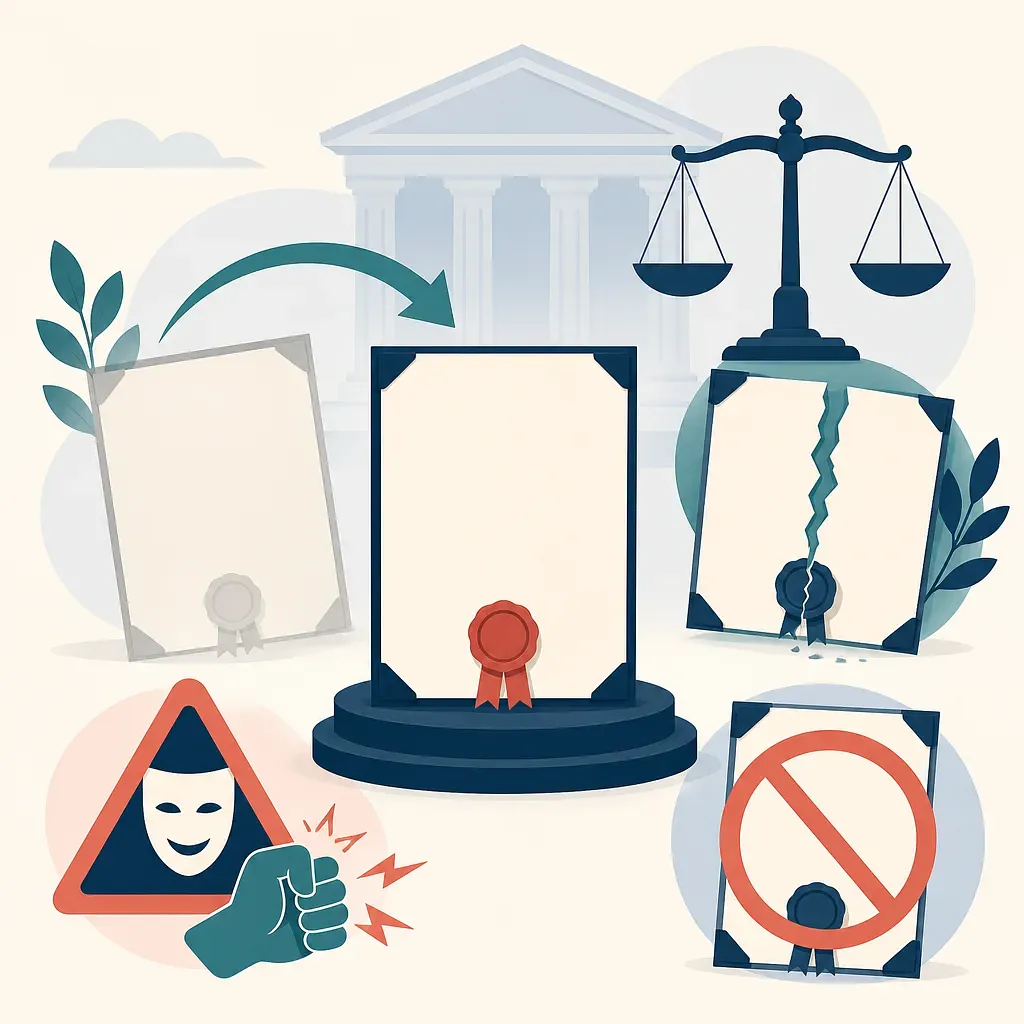
The illustration symbolizes revocation, cancellation, invalidity, and legal disputes involving a will.

Key points

  • A testator may freely revoke all or part of a will before death through another will or an inter vivos act.
  • If a new will conflicts with an earlier will, the earlier will is deemed revoked to the extent of the conflict.
  • A will may be canceled if there was a mistake concerning a material part or if it was made through fraud or duress, but the exclusion period under the Civil Act must be checked.
  • In the Republic of Korea, a valid will must, in principle, strictly follow one of the five forms prescribed by the Civil Act.
  • If the testator was under 17 years of age or lacked mental capacity when making the will, the will may be invalid.

A will is a unilateral juristic act that takes legal effect upon the testator’s death. It may contain not only bequests determining who will receive property, but also matters permitted by law, such as designating the method of dividing the estate and appointing an executor.

A will is not irrevocably fixed once it has been made. The testator may freely revoke it during their lifetime, and issues of cancellation may arise if there was a mistake, fraud, or duress. It may also be invalid from the outset if there is a defect in the statutory form or testamentary capacity.

Comparison of Revocation, Cancellation, and Invalidity of a Will

Category Meaning Typical grounds Legal effect
Revocation The testator changes an existing will so that it will not apply in the future Making a new will, making an inconsistent disposition during life, intentionally destroying the will The will loses effect in whole or in part
Cancellation Removing the effect of a declaration of intent that was initially established but is subject to grounds for cancellation, such as mistake, fraud, or duress Mistake regarding a material part, fraud, duress If lawfully canceled, it is generally deemed invalid from the outset
Invalidity The will has no legal effect from the outset Violation of statutory formalities, lack of testamentary capacity, content contrary to public order and morals It has no effect from the outset without separate revocation or cancellation

In practice, these three concepts may appear to produce similar results, but the requirements that must be asserted, the facts that must be proved, and the applicable time limits differ.

A Testator May Freely Revoke a Will Before Death

Under Article 1108 of the Civil Act, a testator may revoke all or part of a will at any time by another will or by an act performed during life. The testator does not need to explain the reason for revocation or obtain the consent of interested parties, such as beneficiaries, and cannot waive the right of revocation in advance.

Because a will takes effect upon death, the testator’s own revocation must occur before death. Rather than merely making a note on the existing will, it is safer to make a new will in compliance with statutory formalities and clearly specify the extent to which the previous will is revoked.

When a New Will Conflicts with an Earlier Will

If a later will conflicts with an earlier will, the conflicting portion is deemed revoked. For example, if the first will bequeathed a particular property to A but a valid new will bequeaths the same property to B, the new will applies to the extent that the two cannot coexist.

However, the following points must be distinguished.

  • Provisions that are compatible with each other may apply together under both the earlier and new wills.
  • The new will must also be a valid will satisfying the statutory requirements.
  • If the dates are unclear, it may be difficult to prove which will was made later.
  • Revoking the later will does not necessarily revive the original will.

Lifetime Dispositions or Intentional Destruction May Also Constitute Revocation

If, after making a will, the testator performs an act during life that conflicts with the contents of the will, the conflicting portion is deemed revoked. A typical example is when the testator bequeaths a particular automobile to A and then sells that automobile to someone else during the testator’s lifetime.

If the testator intentionally destroys the testamentary document or the property that is the subject of a bequest, the will is deemed revoked to the extent of the destruction. Whether the destruction was intentional is important in distinguishing it from mere loss or accidental damage. In situations where it is unclear whether an act constitutes destruction of the actual testamentary document, such as tearing up a mere copy of an official copy of a notarized will, it is safer to record the intent to revoke in a separate, legally valid will.

Mistake, Fraud, or Duress May Give Rise to Cancellation

If there was a mistake regarding a material part of the will’s contents, or if the will was made as a result of fraud or duress, the cancellation provisions of the Civil Act may apply.

For example, suppose the testator mistakenly believed that A was the person who had provided long-term care and therefore bequeathed property to A, but the actual caregiver was B, and that fact was a key circumstance determining the bequest. In that case, it may be necessary to examine whether there was a mistake regarding a material part. A mere difference in expectations, a later change of mind, or an insignificant clerical error does not immediately constitute grounds for cancellation.

If the testator is alive, rather than disputing complex cancellation requirements, the testator may clearly revoke the existing will and make a new one. After the testator’s death, the issues may include whether the heirs succeeded to the right of cancellation, what authority the executor may exercise as the heirs’ representative, and whether the actual grounds for cancellation can be proved.

Cancellation Is Subject to Time Limits

Article 146 of the Civil Act provides that the right of cancellation must be exercised within 3 years from the date on which cancellation becomes possible and within 10 years from the date of the juristic act. Accordingly, it should not be understood that a will may be canceled at any time without restriction, regardless of whether it has taken effect.

The date on which cancellation becomes possible and how the general cancellation provisions apply to a mortis causa act such as a will may vary depending on the specific facts. If a dispute arises after death, relevant materials—including the original will, medical records, recordings, messages, and statements from persons involved in the process of making the will—should be preserved promptly.

Wills That Are Invalid from the Outset

Unlike a valid will that remains effective until it is revoked or canceled, an invalid will has no legal effect from the outset. Typical grounds for invalidity include violation of statutory formalities, lack of testamentary capacity, and violation of public order and morals or a statutory provision governing legal effect.

Violation of the Five Statutory Forms

Article 1065 of the Civil Act limits the forms of wills to five types: holographic document, sound recording, notarial document, secret document, and oral statement. Even if the testator’s intent is clear, the will may be invalid if it does not satisfy the statutory requirements for any one of these forms.

Form Key requirements
Holographic document The testator must personally write the entire text, the date of execution, address, and name, and affix a seal
Sound recording The testator must state the intent of the will, their name, and the date, and a witness must state that the recording is accurate and give their own name
Notarial document 2 witnesses must participate; the testator must state the intent of the will before a notary, after which the notary must prepare and read it aloud, and the testator and witnesses must approve it and sign or affix their names and seals
Secret document The testator must seal the signed document and follow the prescribed procedures, including presenting it before at least 2 witnesses
Oral statement When there is an urgent reason, such as illness, the testator must follow the procedures for oral declaration, recording, reading aloud, and approval with the participation of at least 2 witnesses, and obtain court verification

Each form also has detailed requirements not listed in the table. In particular, a holographic will is at significant risk of being invalid if the testator merely signs a computer printout or omits the date of execution. Secret and oral wills are subject to separate submission or verification periods, so the relevant Civil Act provisions and procedures must be checked accurately.

When the Will Was Made by a Person Without Testamentary Capacity

Under the Civil Act, a person under 17 years of age cannot make a will. Even if a person is at least 17 years old, the will may be invalid if, at the time of execution, the person lacked the mental capacity to reasonably understand the meaning and consequences of the will.

Mental capacity is not determined uniformly based solely on a dementia diagnosis or whether adult guardianship proceedings have commenced. The person’s cognitive state at the time of making the will, understanding of the size of the estate and family relationships, the complexity of the will’s contents, medical records, and conduct before and after execution are considered comprehensively. A person under adult guardianship may also make a will when mental capacity has been restored, subject to the physician-participation requirements prescribed by the Civil Act. Accordingly, guardianship status itself does not necessarily mean that the will is invalid.

A juristic act that violates good morals or other social order is invalid. For example, a will promising property on the condition that another person be murdered is unlikely to be recognized as effective because it is conditioned on a crime. A condition that excessively restricts personal freedom may also be invalid depending on its specific content and degree.

Not every will that violates a law automatically becomes invalid. It must be separately determined whether the relevant provision is a mandatory provision that denies the legal effect of the juristic act. In addition, infringement of another heir’s statutory rights must be distinguished from the issue of whether the will itself is invalid.

Matters to Check in a Post-Death Will Dispute

When a will is discovered or multiple wills are found together, it is useful to check the following in order.

  1. Preserve the original will and its sealed condition.
  2. Confirm the date and form in which the will was made.
  3. Check the signature, seal, witness, notarization, and court-verification requirements applicable to the form used.
  4. Compare multiple wills to determine whether they contain conflicting provisions.
  5. Check for lifetime gifts or sales and whether property that was the subject of a bequest was destroyed.
  6. Collect materials showing the testator’s mental capacity and any mistake, fraud, or duress at the time of making the will.
  7. Review the periods for exercising relevant rights, including the right of cancellation and the right to claim recovery of inheritance.

Court verification is a procedure for preserving and confirming the condition and form of a will; it is not equivalent to a final judgment that the will is substantively valid. Even a will that has formally undergone court verification may still be separately challenged on grounds of invalidity or cancellation.

How to Safely Modify a Will

When modifying a will, it is advisable not to merely draw lines through the existing document or orally inform family members.

  • Clearly state in the new will whether the existing will is revoked in whole or only in part.
  • If any provisions of the earlier will are to remain effective, restate those provisions in the new will.
  • Ensure that the new will itself fully satisfies the requirements of one of the five statutory forms.
  • Describe the property, such as real estate or deposits, accurately enough to identify it.
  • Clearly record the date of execution and designate a place to store the original.
  • If disputes over old age, serious illness, or cognitive capacity are anticipated, consider preserving materials that confirm mental capacity at the time of execution.

If the property arrangements are complex or there is a substantial possibility of a family dispute, it is advisable to have the form and wording reviewed by a notary or a legal professional specializing in inheritance.

Images

The illustration symbolizes revocation, cancellation, invalidity, and legal disputes involving a will.
The illustration symbolizes legal paths involving the revocation, cancellation, and invalidity of a will.

FAQ

Can a testator revoke a will without any reason?

Yes. Until death, a testator may revoke all or part of a will without stating a reason or obtaining the beneficiary's consent. An agreement to waive the right of revocation in advance is also not legally effective.

Does making a new will invalidate the entire previous will?

The previous will does not always lose its entire effect. Only the parts of the previous will that are incompatible with the new will are deemed revoked, while provisions that do not conflict may remain effective.

Is a will revoked if the document is torn up?

If the testator intentionally destroyed the will document with the intent to revoke it, the will may be deemed revoked to the extent destroyed. Accidental damage or loss is different, and if it is unclear whether the destruction was intentional, a dispute may arise. It is therefore safer to clearly state the intent to revoke in a legally valid new will.

Is a will prepared on a computer and signed valid?

For a holographic will, the testator must personally write the entire text, the date, the address, and the testator's name, and affix a seal. Therefore, a computer-printed document bearing only a signature generally does not satisfy the requirements. However, if it meets the requirements of another legally prescribed form, such as a notarized will, it is assessed separately.

Is a will conveyed only verbally to family members legally effective?

Statements ordinarily made to family members generally do not constitute a legally valid will. An oral will requires an urgent circumstance, such as illness, and must satisfy strict requirements, including at least 2 witnesses, recording, reading aloud, approval, and probate by the court.

Are all wills made by patients with dementia invalid?

A diagnosis of dementia alone does not automatically invalidate every will. The key issue is whether, at the time of making the will, the testator had the mental capacity to understand its contents and legal consequences. This is determined by comprehensively considering medical records, the testator's conduct at the time, the complexity of the will, and other factors.

Does court probate conclusively establish the validity of a will?

No. Probate is a procedure for confirming and preserving the form and condition of a will, not a judgment conclusively establishing its substantive validity. Even after probate, the will may still be challenged on grounds such as failure to comply with formal requirements, lack of mental capacity, fraud, or duress.

Can a will made due to mistake or fraud be rescinded even after the testator's death?

Rescission after death may become an issue depending on whether the heirs inherit the right of rescission and the scope of the executor's authority. However, a mistake concerning a material part, or fraud or duress, must be proven. The exclusion periods under the Civil Act—3 years from the date on which rescission becomes possible and 10 years from the date of the juristic act—must also be considered.

If a later will is revoked, does the original will become effective again?

As a rule, even if a later will or an inter vivos act is subsequently revoked, the original will is not automatically revived. Exceptions prescribed by the Civil Act may apply, so to revive the original will, it is clearer to legally execute a new will that includes its provisions.

Sources

Data formats

This content is available in several machine-friendly formats.

Data-only languages (machine translated, files only)

Indonesian JSON MD Portuguese JSON MD Chinese (Traditional) JSON MD Deutsch JSON MD

Reuse & AI usage

Search indexing and AI citation with attribution are welcome. See the license policy for details.

CC BY · License

Loading…

Loading…

Related content