Injoys

To reduce overseas payment fees, pay in the local currency. Compare cash and cards by their total cost, including exchange rates. Check the conditions for card benefits and fee waivers. Local ATM fees and the cost of converting leftover foreign currency back to won may be charged separately.
The Toss Bank overseas payment fee figures are based on its notice effective August 11, 2026.
1. Block payments in won and choose the local currency
Choosing the local currency lets you avoid conversion costs from DCC. DCC is a service through which an overseas merchant or ATM converts a payment into won. The exchange rate used may include an additional cost.
Visa requires DCC screens to show the exchange rate and any additional costs. They must also show the amount in the local currency and the cardholder’s currency. The merchant cannot choose the currency for the cardholder.
- Before traveling or shopping on an overseas website, search for the DCC blocking option in your card issuer’s app.
- Check whether overseas payments in won are blocked for each card you plan to use.
- On the payment screen, choose the merchant’s local currency.
- Check the payment currency shown on the receipt.
Shinhan Card’s “Comprehensive Guide to Overseas Card Use” explains:
From the time you register for the blocking service, payments in won (KRW) are declined, and you can make transactions in dollars or the local currency.
Blocking DCC is different from blocking all overseas card use. If a transaction in won is declined, ask to pay again in the local currency. If a payment is processed in a currency you did not want, keep the receipt. You can then ask the merchant and card issuer how to handle it.
Payment currency for overseas online shopping
Check the final authorized currency when shopping on overseas websites, too. A price shown in won on a product page may simply be a converted price. Do not assume DCC applies based only on the displayed currency. Check both the currency and the conversion terms at checkout.
Paying in the local currency does not eliminate card fees. International brand fees cover the use of payment networks such as Visa or Mastercard. The card issuer may also charge a separate overseas-use fee. Check your card’s product information to see whether these fees are waived.
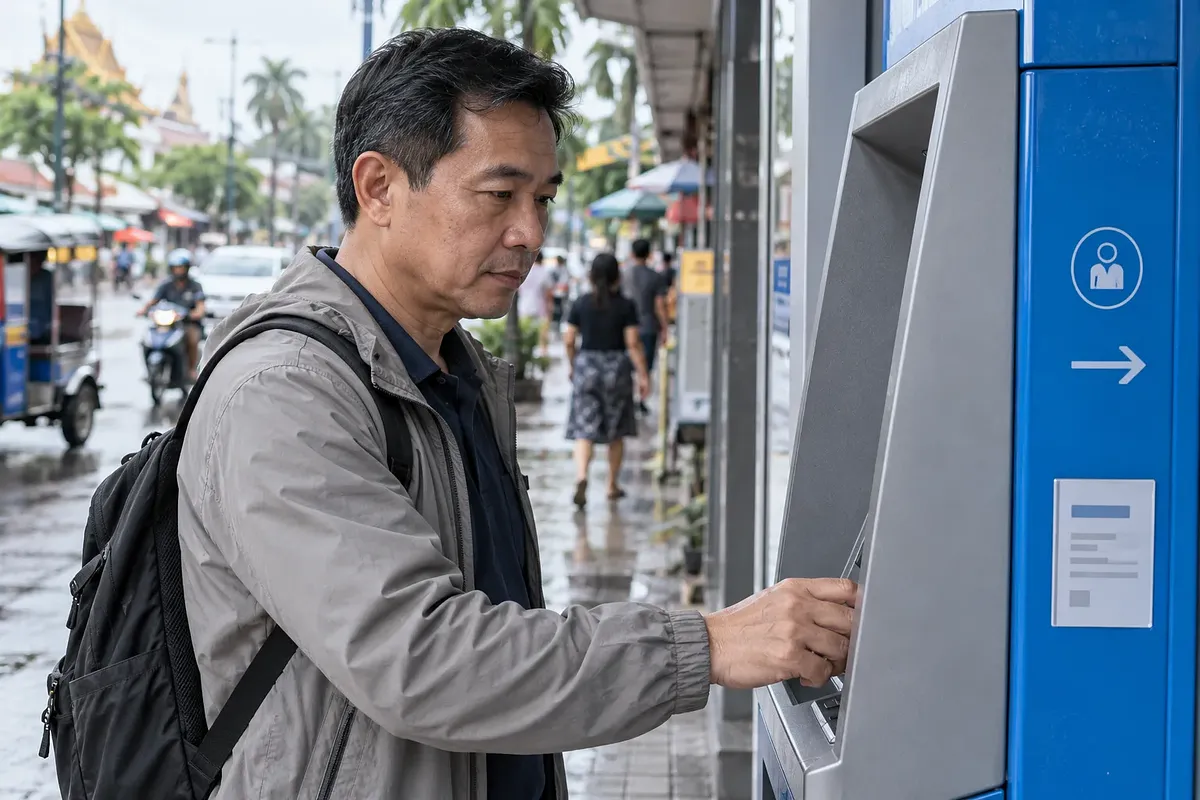
Check local ATM costs separately, even if your card fees are waived.
2. Compare the total cost of cash and cards
Cards are not always cheaper than cash. Compare the cost in won of spending the same amount in the local currency. The preferential exchange rate alone is not enough to determine which option costs less.
You do not necessarily have to convert through dollars to obtain a Southeast Asian currency. Hana Bank’s “Personal Banking Currency Exchange Wallet Service Guide” provides an example. As of February 3, 2026, the currencies available for exchange include THB and VND, the Thai baht and Vietnamese dong, respectively.
Another option is to buy dollars and exchange them again locally. In that case, compare the combined cost using the actual exchange rates for both transactions. Distinguish a bank’s internal exchange-rate calculations from a customer’s currency exchange transactions. It is inaccurate to say that every trip involves four currency exchange fees.
| Payment method | Costs to compare | Conditions to check before choosing |
|---|---|---|
| Exchange for local currency cash in a bank app | Cost of buying cash after the preferential rate is applied | Available currencies and stock at the pickup location |
| Buy dollars, then exchange them locally | Combined cost of the two exchanges | Amount actually received at the local exchange counter |
| Pay in the local currency with a regular card | Applied exchange rate and card fees | Overseas benefits and additional merchant charges |
| Pay by card using a foreign currency balance | Cost of buying foreign currency and costs not covered by fee waivers | Supported currencies and linked payment account |
| Withdraw cash from a local ATM | Conversion costs and withdrawal-related fees | Operator fees and waiver limits |
Where cards are accepted, you can consider a card with waived fees. If you plan to visit places that accept only cash, prepare the cash you need. Set the share of your budget held in cash according to payment options at your destination.
3. Check the conditions for card benefits
Compare what you actually gain from a card, not just its cashback rate. Some products charge overseas fees even while offering cashback. Preferential currency exchange and waived card payment fees are also separate benefits.
Toss Bank changed its overseas payment benefits from August 11, 2026. Its previous 2% cashback on payments was replaced with fee waivers. You must link a foreign currency account as the account for overseas payments to receive them.
| Item to check | Travelog debit card | Toss Bank debit card and foreign currency account |
|---|---|---|
| How it works | Top up foreign currency Hana Money before paying | Link a foreign currency account for overseas payments |
| Overseas merchant fees | International brand and overseas service fees waived when paying with foreign currency Hana Money | International brand fee of 1% and USD 0.5 per transaction waived from August 11, 2026 |
| Currency exchange benefit | Free exchange for USD, JPY, EUR, and GBP at all times | Check supported currencies and exchange terms in the official product information |
| Time-limited conditions | Free exchange for the other 54 currencies is listed as available through December 31, 2026 | Distinguish past cashback information from current fee-waiver conditions |
| Local ATM operator fees | Not covered by the waiver | May be charged separately |
The end date of the Travelog promotion applies to the currencies eligible for free exchange. It does not mean all overseas-use benefits end that day. Before departure, check the latest product information from Hana Money and Toss Bank. (Verified details: Hana Money: Of 58 currencies in total, 4 qualify for free exchange at all times; the other 54 qualify through December 31, 2026. Toss Bank: With a linked foreign currency account, the overseas payment fee of 1% and USD 0.5 per transaction are waived; overseas ATM withdrawal fees: · Source app.hanamembership.com · Checked 2026-10-14)
- Check whether your destination’s currency is supported.
- Link the required foreign currency account or topped-up balance.
- Check the international brand fee and card issuer fee separately.
- Calculate cashback after accounting for spending requirements and payout limits.
- If you are getting a new card, include any annual and issuance fees in the comparison.