Tsuda Umeko's Founding of Joshi Eigaku Juku in 1900
Tsuda Umeko founded Joshi Eigaku Juku in 1900 amid limited opportunities for further education and constraints on operating funds. By combining her experience studying abroad and teaching, support from Japan and overseas, and specialized English education, she broadened the foundation for women to enter professional careers.
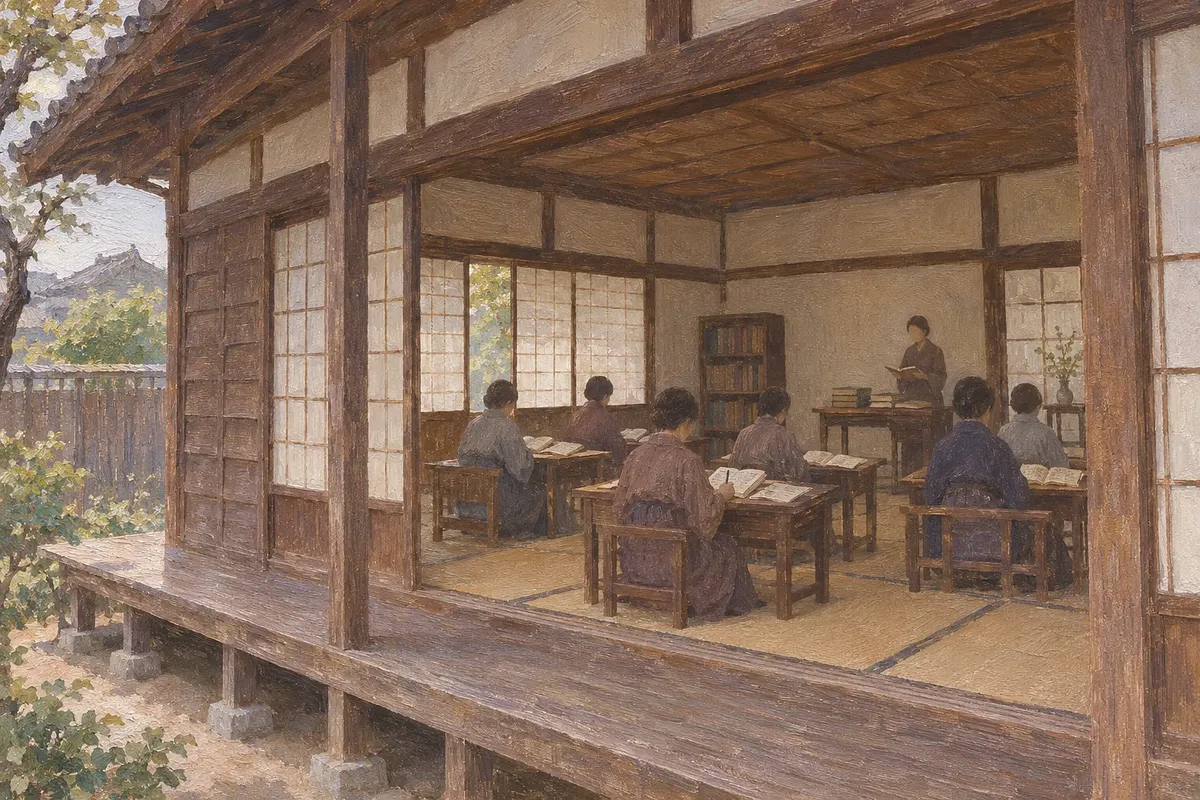
Joshi Eigaku Juku opened in 1900 as an institution providing specialized education for women who had completed secondary education.
Tsuda Umeko needed the cooperation of fellow educators and American supporters to establish the school.
Specialized English education was an educational strategy that supported women's entry into English teaching.
The first graduating class in 1903 had 8 students: 2 from the regular course and 6 from the elective course.
The school's renaming in 1933 and the university's establishment in 1948 took place after the founder's death.
Tsuda Umeko (津田梅子) founded Joshi Eigaku Juku (女子英学塾) in 1900. Opportunities for women to continue their education were limited, and operating funds were scarce. The school opened with help from colleagues and American supporters. It is remembered as an example of how the foundations of specialized education for women were broadened.
Records from Tsuda University (津田塾大学) and the National Archives of Japan were reviewed in November 2026.
What kind of school was Joshi Eigaku Juku?
Joshi Eigaku Juku was a private institution that provided specialized education to women who had completed secondary education. With a focus on English, it sought to give women a foundation for pursuing careers and taking an active role in society. It was the predecessor of today's Tsuda University. However, it was not a university in its current form from 1900.
Lee Eun-kyung's 2019 study identifies the training of English teachers as its central strategy. This means that the school focused on a field women could enter through professional expertise at the time. General education and character development were also among its educational goals. This interpretation appears in the paper's publicly available abstract on KCI.
Constraints that remained as women's education expanded
The school was founded against a background of limited pathways to further education, not a complete ban on women's education. The Peeresses' School (華族女学校) and the Women's Higher Normal School (女子高等師範学校) already existed. Umeko herself taught at these schools. Saying that there were no schools for women would misrepresent the education system of the time.
The 1899 Girls' High School Order supported the institutional development of secondary education for women. Despite their name, girls' high schools were not university-level institutions. According to the Japanese Cabinet Office's account of educational history, education at the time aimed to cultivate good wives and wise mothers. Expanding secondary education and expanding access to professional careers were separate tasks.
Category | Role at the time | Relationship to the founding of Joshi Eigaku Juku
Girls' high schools | Institutions for women's secondary education | Educational foundation for students who would later pursue specialized education
Women's Higher Normal School | Institution for training female teachers | An existing institution where Umeko worked as a professor
Joshi Eigaku Juku | Private school that aimed to provide higher education for women | An example of linking specialized English education to career opportunities
This distinction is based on the Ministry of Education, Culture, Sports, Science and Technology's explanation of the Girls' High School Order. The aims of women's education can be read about alongside the Cabinet Office's explanation of girls' high school education.
How study abroad and teaching experience led to the school's founding
The turning point came when Umeko put the educational methods she had learned abroad into practice at an independent school. She left to study in the United States in 1871. After returning in 1882, she became concerned about educational conditions for Japanese women. She then gained teaching experience while preparing to establish a school.
From 1889 to 1892, she studied at Bryn Mawr College. The university's official history explains the influence of the education in small, select groups that she experienced there. While studying abroad, she also participated in a scholarship program that helped other Japanese women follow her to the United States. This work connected her own studies with educational opportunities for the next generation.
Her preparations after returning to Japan also included research into educational institutions in the United States and Britain. Lee Eun-kyung's 2019 study examines both her teaching experience and her fundraising. In 1900, she resigned from her professorships at the two existing schools. That year, she founded Joshi Eigaku Juku in Tokyo.
Operating funds and the role of supporters
Umeko's fundraising and her network of supporters in Japan and abroad made the school's opening possible. The National Archives of Japan explains that the school faced financial difficulties at the time. It had no financial backing from major business groups or influential figures. Support from colleagues and American acquaintances helped sustain its operations.
· Oyama Sutematsu (大山捨松) was a supporter who had studied in the United States with Umeko.
· Uryu Shigeko (瓜生繁子) also helped establish and develop the school.
· Alice Bacon came to Japan before the school opened and handled entrance examinations and class placement.
· Anna Hartshorne participated in teaching and activities supporting the school.
· An American support committee provided ongoing financial assistance.
An educational account from Tokyo's Kita City describes how the American support committee was formed. A network that had helped Japanese women study in the United States also became involved in supporting the school. This cooperation went beyond donations. It extended to the practical work of recruiting teachers and running the school.
This financial background is described in the National Archives of Japan's exhibition commentary on Joshi Eigaku Juku. However, the commentary does not state the total amount raised when the school opened. Its founding costs therefore cannot be given as a specific sum.
The educational vision in records of the opening ceremony
Records of the opening ceremony place teachers' enthusiasm and students' curiosity at the center of education. Tsuda University's history page also describes instruction that took students' individuality into account. Education in small, select groups was a way to tailor instruction to individual students. The vision also included developing both English proficiency and a broad general education.
The university's page contains a summary and selected excerpts of remarks made at the 1900 opening ceremony. This article summarizes their intent. It does not treat the account on that page as a complete transcript of the speech. Nor does it add unverified dialogue or descriptions of feelings at the time.
Timeline from study abroad to the university's establishment
The timeline must distinguish between Umeko's activities and the school's history after her death. Joshi Eigaku Juku began in 1900. 1948 was the year the university was established under the new education system.
Year | Event | Source
1864 | Tsuda Umeko was born | Tsuda University's official chronology
1871 | Left for the United States as a government-sponsored female student | Tsuda University's official chronology
1882 | Began her return journey from the United States | Tsuda University's official chronology
1889 to 1892 | Studied at Bryn Mawr College | Tsuda University's official chronology
1899 | Girls' High School Order promulgated | Ministry of Education, Culture, Sports, Science and Technology's history of education
1900 | Resigned from her existing professorships and opened Joshi Eigaku Juku | National Archives of Japan exhibition commentary
1903 | First graduation ceremony held | Tsuda University's official chronology
1905 | Authorization granted for examination-free certification of English teachers | Tsuda University's official chronology
1923 | School buildings destroyed by fire in the Great Kanto Earthquake | Tsuda University's official chronology
1929 | Umeko died | Tsuda University's official chronology
1933 | School renamed Tsuda Eigaku Juku | National Archives of Japan exhibition commentary
1948 | Tsuda University established | Tsuda University's official chronology
Early achievements and changes after the founder's death
An early achievement was establishing the school as an institution that educated students through to graduation. It admitted 10 students in 1900. At the first graduation ceremony in 1903, 8 students graduated. In 1905, the school received authorization for examination-free certification of English teachers.
Examination-free certification refers to a route to teaching certification that does not require an examination. This authorization provided an institutional basis for connecting English education to teaching careers. However, the authorization alone does not establish that every graduate found employment. The relevant years and events appear in the university's official chronology.
The school continued after Umeko died in 1929. In 1933, it was renamed Tsuda Eigaku Juku (津田英学塾). The application for the name change noted that this name was already in common use. The change reflected both a wish to commemorate the founder and actual naming practices.
The university was established in 1948 amid postwar education reforms. Describing this as an achievement Umeko personally completed would be chronologically inaccurate. The work of her successors, who sustained the school after its founding, must also be considered separately.
What can 10 entrants and 8 graduates tell us?
These two figures show the school's early size, but they do not directly yield a graduation rate. The university's history page distinguishes between graduates of the regular course and the elective course. The total of 8 combines those who completed the two courses. The distinctions below offer a statistical interpretation based on official records.
Recorded figure | What it establishes | What this figure alone cannot establish
10 entrants in 1900 | Enrollment size when the school opened | The distribution of entrants by course
2 regular-course graduates in 1903 | Number of graduates in the regular course's first graduating class | Graduation rate for all regular-course entrants
6 elective-course graduates in 1903 | Number of graduates in the elective course's first graduating class | Whether completion requirements matched those of the regular course
8 graduates in total in 1903 | Combined number of graduates from the two courses | Overall employment rate and changes in income
Calculating a graduation rate requires tracking the academic records of the same entering cohort. The length of study and graduation requirements for each course must also be checked. An accurate assessment requires comparing enrollment and graduation registers. Early student counts alone cannot measure the full social impact of the education provided.
Records and interpretations
The school's chronology, interpretations of the motives behind its founding, and matters not yet verified must be distinguished. The university's history page explains the institution's educational tradition. The archives' exhibition presents the contents and background of administrative documents. Academic papers interpret these facts in relation to the society of the time.
Facts established by official records
The opening year and name change can be confirmed in the official chronology and the archives' commentary. The National Archives of Japan also presents documents concerning an honor awarded to Umeko in 1928. The accompanying commentary explains that Umeko personally raised funds to build the school. The award documents themselves must be distinguished from today's exhibition commentary.
Interpretations in academic research
The studies reviewed identify the expansion of specialized education for women as the central context for the school's founding. Lee Eun-kyung's 2019 study emphasizes the strategic importance of training English teachers. A 2022 study examines both attachment to the nation and Christian faith. These studies analyze the same person's activities through different questions.
The 2022 study does not view her work in women's education simply as opposition to the state. It interprets Umeko as seeking cooperation between men and women for Japan's development. It also argues that she did not distance herself from Japanese patriotism at the time. This is that study's interpretation and cannot be extended into a consensus across the field.
Questions that remain to be verified
The abstracts and official commentaries reviewed are not enough to establish the contours of scholarly debate. The relative influence of her views on the nation and her faith on the decision to found the school requires further examination. Assessing this requires reading firsthand records, including correspondence, alongside the full research papers. The employment outcomes of early graduates also require verification through individual records.
Its significance in the history of women's education today
This case shows that educational opportunities expanded through the practical conditions that made running a school possible. Experience abroad led to teaching methods and scholarship programs. Cooperation in Japan and abroad helped secure teachers and funding. Specialized education gained an institutional basis for leading to teaching certification.
One issue that still needs to be considered separately today is the relationship between access to education and career paths after graduation. Joshi Eigaku Juku connected these two concerns through specialized English education. However, the expansion of women's education in Japan resulted from the combined effects of many schools and institutional changes. One person's life cannot explain that entire transformation.
Frequently asked questions
Was Joshi Eigaku Juku a university from the beginning?
It began in 1900 as a private school that aimed to provide higher education for women. The current university was established in 1948. The school's founding must therefore be distinguished from the university's establishment.
Why did it focus on English education?
English education could be linked to a professional career as an English teacher. Lee Eun-kyung's 2019 study interprets this as a strategy shaped by the conditions of the time. The school also aimed to provide general education beyond English.
Did Umeko establish the school alone?
Umeko led its founding, but supporters in Japan and abroad helped her. Colleagues assisted with teaching and the practical work of opening the school. The American support committee contributed financial assistance.
Were women unable to receive an education when the school was founded?
Institutions for women's education already existed at the time. The Girls' High School Order was promulgated in 1899. The problem was that opportunities to continue beyond secondary education and enter professional careers were limited.