What Is the Base Rate?
The base rate is the policy rate used by a country’s central bank as a benchmark for conducting monetary policy. In South Korea, the Monetary Policy Committee of the Bank of Korea sets the base rate after comprehensively considering factors such as inflation, economic conditions, and financial market conditions.
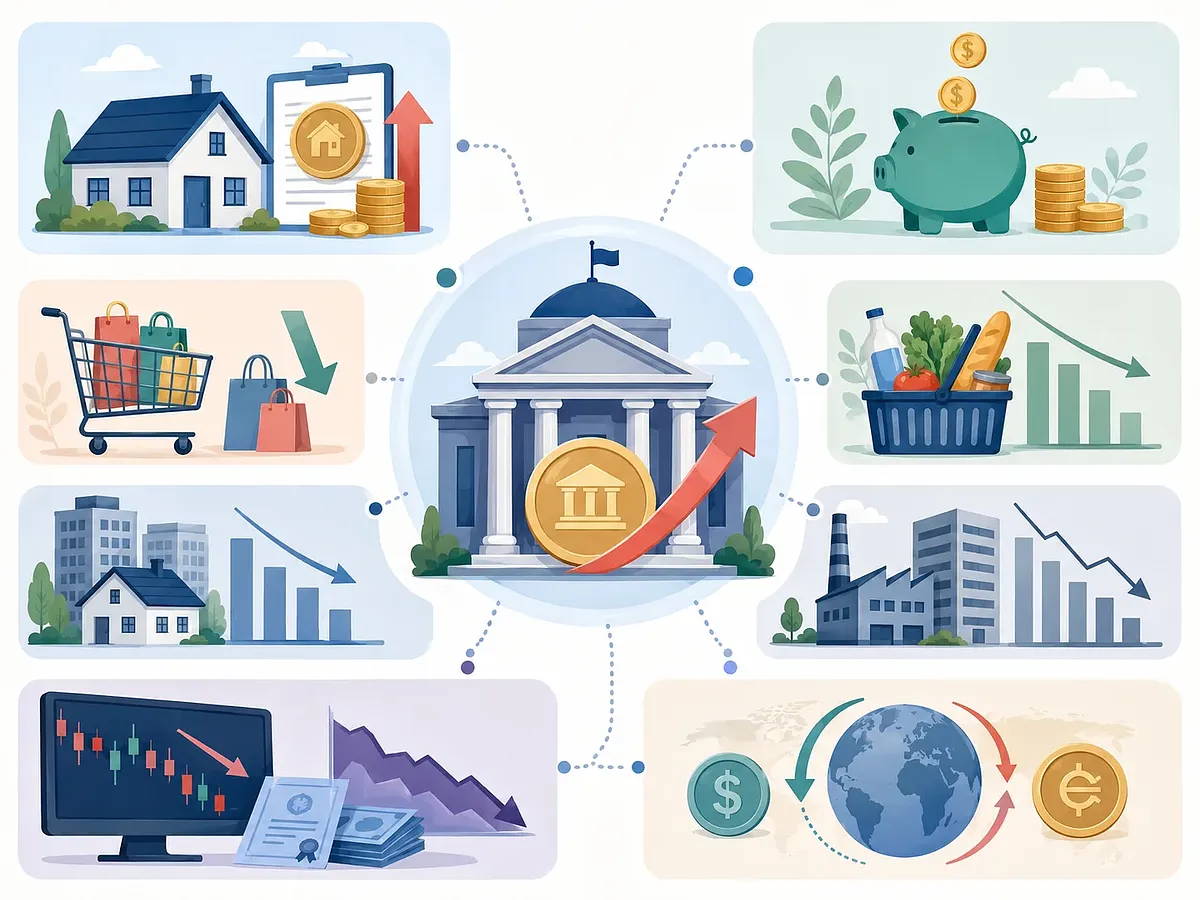
The benchmark interest rate is not merely a number used among banks. When the benchmark interest rate changes, it successively affects short-term market rates, long-term market rates, deposit rates, loan rates, bond yields, asset prices, exchange rates, and consumption and investment decisions. Therefore, a hike in the benchmark interest rate impacts everything from individuals’ loan interest rates and corporate investment costs to real estate buying sentiment and inflation trends.
Why Does the Entire Economy Feel the Impact When the Base Rate Rises?
The key purpose of a base rate hike is to raise the cost of borrowing and increase the incentive to hold or save money. When interest rates rise, the interest you must pay on the same loan amount increases; conversely, the interest income you can earn by placing money in deposits or safe assets increases.
These changes are transmitted to the economy in the following sequence:
- The central bank raises the benchmark interest rate.
- Market interest rates, such as interbank rates and bond yields, come under upward pressure.
- Banks’ deposit and loan rates rise.
- Households tend to reduce consumption and increase savings.
- Businesses become more cautious about borrowing and investing.
- As aggregate demand slows, inflationary pressure may ease.
- Asset prices—such as real estate, stocks, and bonds—are revalued.
Summary of the Main Effects of a Benchmark Interest Rate Hike
| Area of Impact | General Trend | Mechanism | Points to Note |
|---|---|---|---|
| Loan Interest Rates | Rise | Loan interest rates increase as banks’ funding costs and market interest rates rise | Borrowers with variable-rate loans may be affected more quickly than those with fixed-rate loans |
| Deposit Interest Rates | Rise | Banks may raise deposit interest rates to attract funds | The extent and timing of deposit rate hikes vary by bank |
| Consumption | Downward Pressure | Spending decreases as the interest burden increases and the incentive to save grows | Essential spending may decline relatively less |
| Corporate Investment | Downward Pressure | Rising borrowing costs make capital investment and expansion burdensome | The impact may be limited for companies with ample cash reserves |
| Inflation | Pressure for a slowdown in the inflation rate | Works to lower aggregate demand and inflation expectations | Prices may continue to rise due to oil prices, exchange rates, and supply chain issues |
| Real Estate | Downward pressure | Buying demand declines as the burden of mortgage loans increases | Supply shortages, location, and regulatory easing may support prices |
| Stock Market | Downward pressure | The present value of future earnings decreases, and the appeal of safe-haven assets increases | Performance varies by sector and company |
| Exchange Rate | Pressure for the currency to appreciate | Relatively high interest rates could attract foreign capital inflows | External risks, the trade balance, and U.S. interest rates are also important factors |
1. How Will Inflation Be Affected?
A benchmark interest rate hike is not a “button” that directly lowers inflation. More precisely, it is a policy tool designed to reduce inflationary pressures.
When interest rates rise, people are more likely to choose saving over spending. Even those planning to take out loans to purchase cars, home appliances, homes, or business equipment may postpone their decisions due to the interest burden. Companies may also reduce inventory buildup or capital expenditures.
As a result, when aggregate demand in the economy declines, it becomes difficult for companies to raise prices at will. Furthermore, a signal from the central bank that it is raising interest rates is interpreted as a “commitment to controlling inflation,” which can lower inflation expectations. Lower inflation expectations can also influence corporate pricing decisions and wage negotiations.
However, in the following cases, prices may not fall immediately even if interest rates rise:
- When international oil prices or commodity prices surge
- When import prices rise due to an appreciating exchange rate
- When supply shrinks due to war, logistics disruptions, or climate issues
- When cost factors have a greater impact than demand, such as with public utility rates or food prices
- When the effects of interest rate hikes have not yet fully filtered through to the real economy
Therefore, while the statement “When the benchmark interest rate rises, prices fall” is useful for explaining the general direction, it is more accurate to view it in the real economy as “pressure to lower the inflation rate is created.”
2. Why Does the Burden on Borrowers Increase?
One of the areas where the impact of a benchmark interest rate hike is felt most quickly is in loans. When the benchmark interest rate rises, banks’ funding costs and market interest rates increase, which can be reflected in the interest rates on mortgages, personal loans, jeonse (lump-sum deposit) loans, and corporate loans.
In particular, for variable-rate loans, monthly payments may increase because changes in the benchmark or market interest rates are reflected in the loan’s interest rate after a certain time lag. Even with the same principal amount, higher interest rates mean higher monthly interest payments.
For example, households with large mortgage balances can see a significant increase in their annual interest burden even if the interest rate rises by just 1 percentage point. In such cases, households tend to cut back on discretionary spending—such as dining out, travel, and purchases of durable goods—which in turn can lead to a slowdown in domestic demand.
3. Why Do Depositors Benefit?
While interest rate hikes place a burden on borrowers, they can lead to increased interest income for depositors. When bank deposit rates rise, the interest earned on the same amount of money deposited increases.
For this reason, during periods of rising interest rates, relatively safe products such as deposits, savings accounts, short-term bonds, and money market funds may become more attractive than risky assets. However, not everyone actually benefits when deposit interest rates rise. If the inflation rate exceeds the deposit interest rate, the real rate of return—measured in terms of purchasing power—may be low or even negative.
4. Why Are Real Estate Prices Under Downward Pressure?
Real estate is an asset heavily reliant on borrowing. Many people do not purchase a home using only their own funds but also take out a mortgage. When the benchmark interest rate rises and loan rates increase, the monthly principal and interest payments for the same home become higher.
In this situation, buyers tend to take the following actions:
- Postpone their home purchase.
- Look for homes at lower prices.
- They reduce the size of their loan.
- They extend their stay in jeonse or monthly rental housing.
- They reduce real estate purchases for investment purposes.
When demand decreases, sellers may have to lower prices or relax transaction terms. Therefore, interest rate hikes generally put downward pressure on real estate prices.
However, real estate prices are not determined by interest rates alone. Regional supply, population migration, income levels, jeonse prices, taxes, lending regulations, redevelopment policies, positive development factors, and the lease system all play a role. Therefore, a rise in the benchmark interest rate does not necessarily cause home prices to fall by the same amount in every region.