Injoys
“Air conditioners without an outdoor unit” is not an official name for a cooling method, but rather an expression describing products that do not require a separate outdoor unit. Standard window and portable air conditioners must still release the heat absorbed indoors to the outside. The difference is not whether the heat is eliminated, but where the cooling components are located and through what path the heat is discharged.
What “Air Conditioner Without an Outdoor Unit” Actually Means
A standard split air conditioner connects an indoor unit and an outdoor unit with refrigerant lines. The evaporator in the indoor unit absorbs heat from the room, while the condenser in the outdoor unit releases that heat into the outside air.
By contrast, window and portable air conditioners contain major components such as the compressor, evaporator, condenser, and fan in a single housing. It is therefore more accurate to describe them as follows.
- Self-contained air conditioner without a separate outdoor unit: An accurate description
- Air conditioner that does not require heat discharge: An inaccurate description for standard refrigerant-based air conditioners
- Air conditioner requiring no installation whatsoever: A description that should be treated with caution, as exhaust, window sealing, and drainage work may be required
Refrigerant-based air conditioners also operate differently from evaporative air coolers, which cool airflow through the evaporation of water. An evaporative air cooler may not require a separate exhaust hose, but it can increase humidity and should not be regarded as a device that lowers the temperature of an enclosed room in the same way as a refrigerant-based air conditioner.
Where Does Indoor Heat Go During Cooling?
In an air conditioner’s evaporator, the refrigerant absorbs heat from the indoor air. The compressor uses electricity to compress the refrigerant, and the condenser releases the absorbed heat outdoors in the form of hot air.
In simplified terms, the energy flow is as follows.
Heat released outdoors = heat absorbed indoors + electrical energy consumed by the compressor and other components
Therefore, if only cold air is directed into the room while the heat generated by the condenser is released into the same room, the entire indoor space cannot be cooled continuously. If a portable air conditioner’s exhaust hose is not connected, cool air may come out of the front, but heat released from the rear and the device’s power consumption may actually make the room as a whole warmer.
Heat Discharge Structures of Window and Portable Air Conditioners
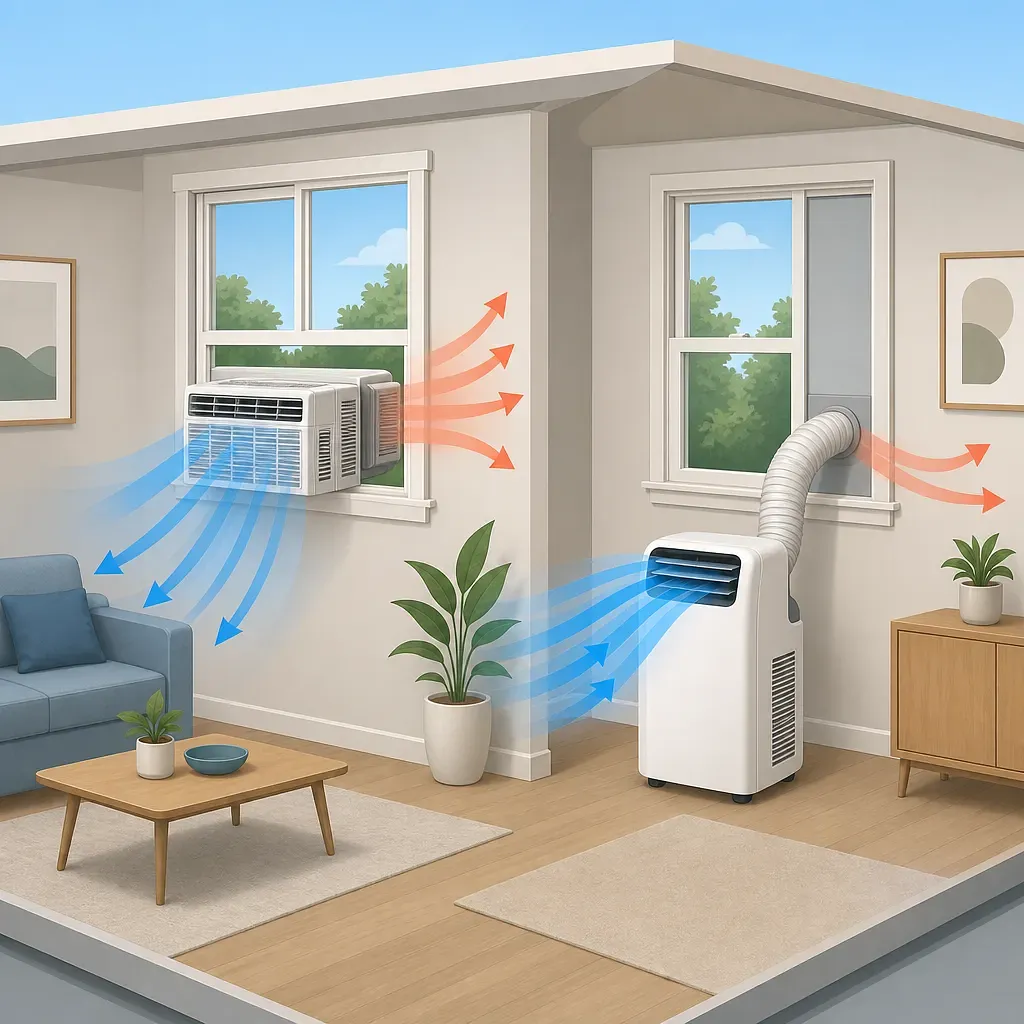
| Category | Window Air Conditioner | Portable Air Conditioner |
|---|---|---|
| Unit location | Window frame or window opening | Indoor floor |
| Heat discharge path | Rear of the unit facing outside the window | Exhaust hose connected to a window or similar opening |
| Cool-air supply | Front outlet facing indoors | Front or top outlet on the unit |
| Main installation requirements | Securing the unit, window panel, sealing gaps, outdoor clearance for heat dissipation | Exhaust hose, window kit, sealing gaps, drainage conditions |
| Portability | Limited mobility after installation | Can be moved on wheels, but the exhaust must be connected each time |
| Typical causes of reduced performance | Obstructed rear heat dissipation, window-frame gaps, improper installation angle | Long hose, bent hose, heated hose, infiltration of outside air |
Window Air Conditioners
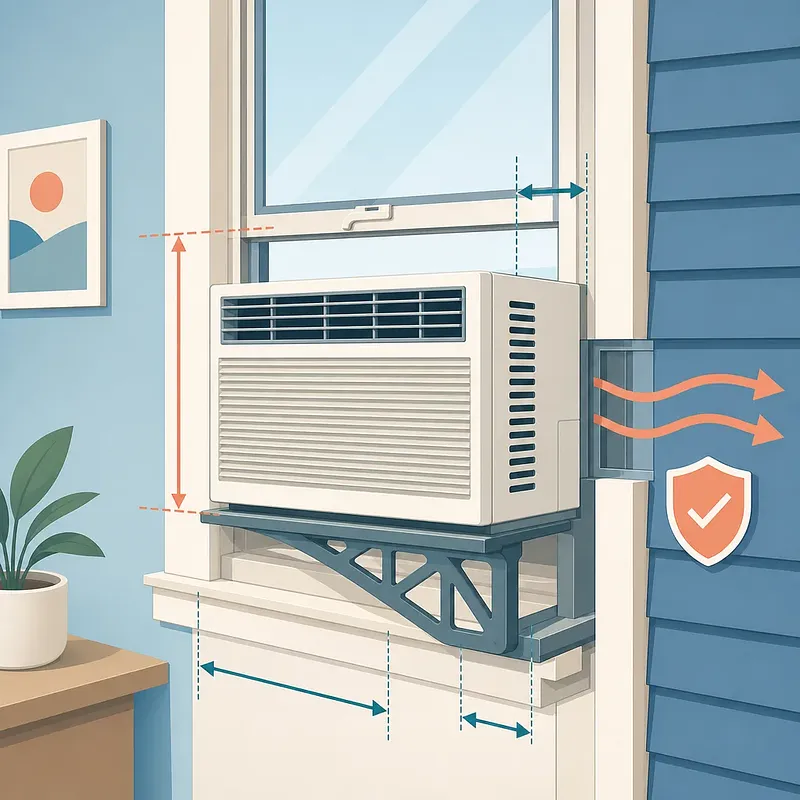
A window air conditioner separates the indoor and outdoor sides of the unit within a single housing. The front facing indoors releases cool air, while the rear outside the window releases heat from the condenser.
If the rear remains indoors or is excessively obstructed by curtains, insect screens, walls, or other objects, heat may not dissipate properly. The outdoor clearance and compatible window specifications required by the manufacturer must be followed. Whether the unit needs to be installed at an angle for drainage varies by product, so users should not create an arbitrary tilt or drill holes in the unit.
Portable Air Conditioners
Because the entire body of a portable air conditioner remains indoors, air heated by the condenser is discharged outside through a hose. If the exhaust hose is long or sharply bent, air resistance and heat released from the hose surface can increase, reducing performance.
A single-hose system uses some indoor air to cool the condenser and then discharges it outside. This process lowers the pressure inside the room, potentially drawing hot outside air through gaps around doors or windows. A dual-hose system can reduce this pressure issue by separating outside-air intake from hot-air exhaust, but the actual structure and performance must be checked for each product.
Why Condensate and Drainage Occur
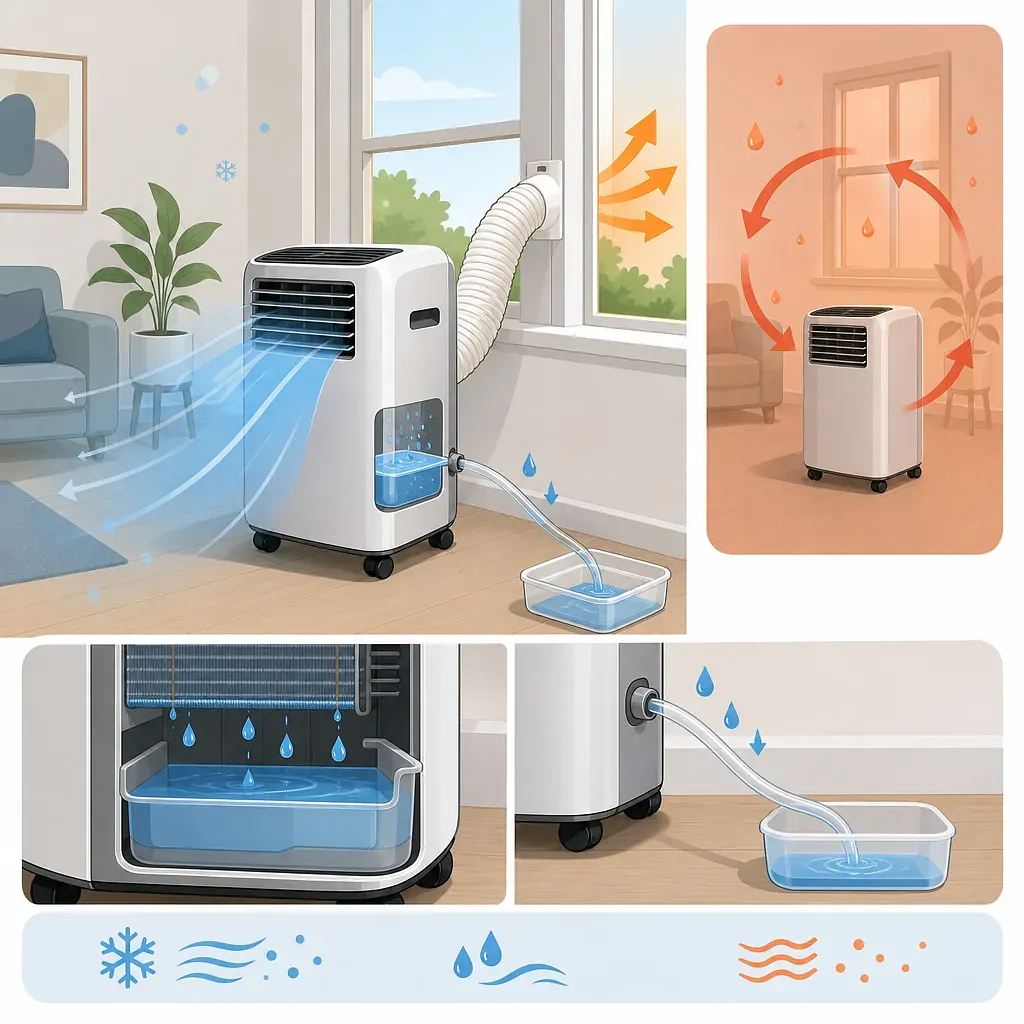
When warm, humid indoor air passes over the cold evaporator, water vapor in the air condenses into droplets. This water is condensate. The amount of water produced during cooling varies according to the following conditions.
- It may increase as indoor relative humidity rises.
- Drainage may be required more frequently in dehumidification mode than in cooling mode.
- Water may accumulate quickly during the rainy season, in underground spaces, or in rooms where laundry is drying.
- It also varies according to the set temperature, operating time, airflow, and product design.
Meaning of the Self-Evaporation Function
A self-evaporation or drain-free function refers to a structure that sends some of the condensate to the condenser side, evaporates it, and discharges it outdoors with the exhaust air. However, this term does not guarantee that water will never need to be emptied under any conditions.
If the air is very humid or the amount of condensate exceeds the unit’s evaporation capacity, water may accumulate in the internal tank. Some products require a continuous drain hose to be connected in dehumidification mode. Certain models stop the compressor and display a full-tank indicator when the tank fills, and cooling resumes only after the water has been drained.
Condensate Handling in Window Air Conditioners
Some window units allow condensate to drain naturally from the rear, while others use a bottom fan or slinger ring to splash water onto the condenser for heat dissipation and evaporation. Water may pool or make splashing sounds during normal operation, but acceptable levels vary by model.
Drilling a drainage hole without authorization may affect heat-dissipation performance, leak-prevention structures, or warranty terms. The drainage instructions in the manual for the specific model must always take priority.