Bank of Korea Resumes Physical Gold Purchases in 2026: Won Settlement, OTC Trading Structure, and Implications
The Bank of Korea is pursuing a new procurement channel to purchase in won gold produced by domestic refiners and intended for export in 2026. The goals are to diversify foreign exchange reserves and expand domestic storage, but the amount available for purchase does not represent the actual amount to be bought, and gold prices, exchange rates, and storage risks must also be considered.
The Bank of Korea is considering increasing over the medium to long term its gold holdings of 104.4 tonnes, which it has maintained since purchasing an additional 90 tonnes in 2011∼2013.
The initial target under consideration is approximately 4∼5 tonnes per year of gold produced by domestic refiners that is not consumed domestically and is intended for export.
Won settlement and negotiated OTC block trades are structured to reduce the direct impact on the foreign exchange market and exchange quotations.
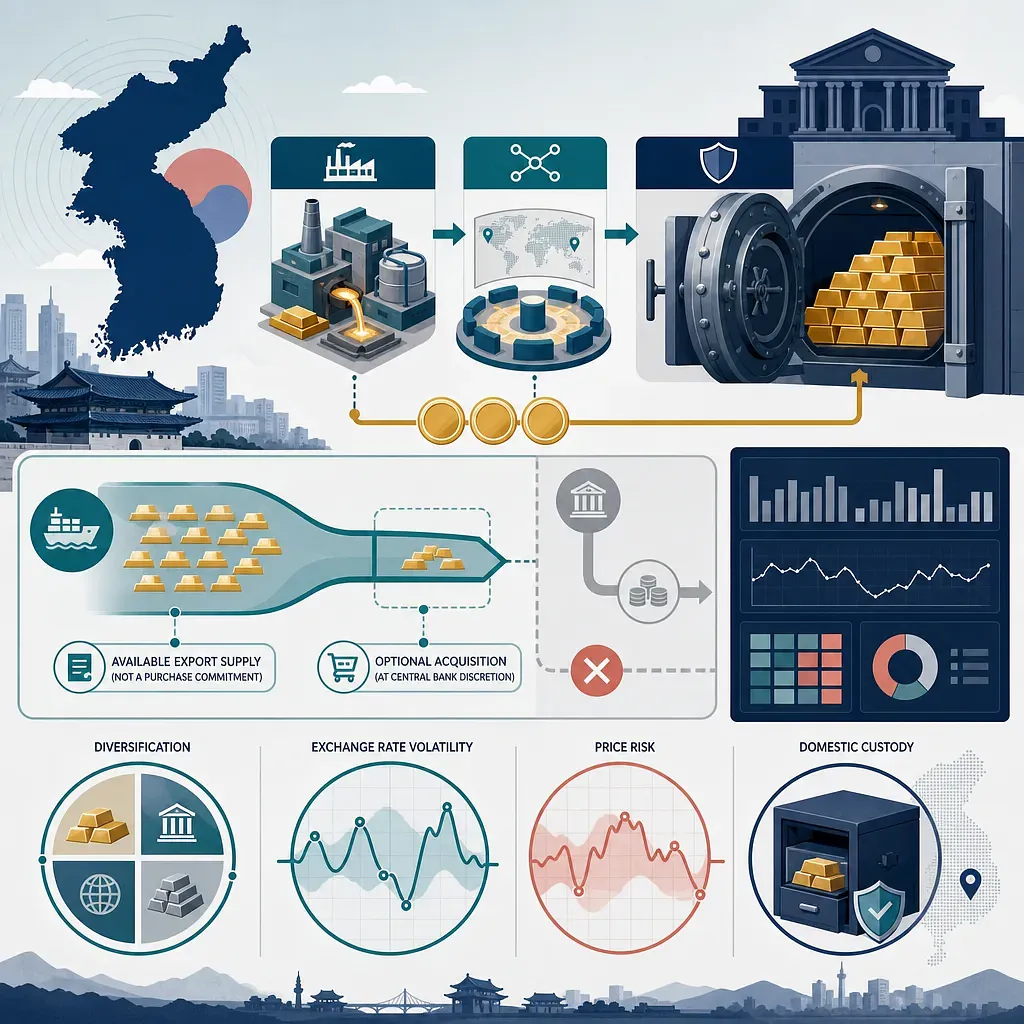
The stated annual export volume of 4∼5 tonnes merely indicates the potential supply range and is not a commitment by the Bank of Korea to purchase the entire amount every year.
Because a central bank's gold purchases are long-term foreign exchange reserve management decisions, they are difficult to interpret as a short-term buying signal for individual investors.
The Bank of Korea is moving to resume purchases of physical gold for the first time in about 13 years since 2013. The core of the plan is to create a new procurement channel under which it buys in won gold that domestic refiners had intended to export, rather than purchasing gold with dollars on international markets, and stores it using domestic infrastructure.
Along with the dollar, gold is a major international reserve asset, but it pays no interest and is subject to significant price fluctuations. The decision should therefore be understood not simply as a forecast for gold prices, but as a long-term management strategy to diversify the currencies, assets, and storage locations of foreign exchange reserves.
What Has Changed
The Bank of Korea is known to hold 104.4 tons of gold. Of this, 90 tons was purchased between 2011 and 2013, and it has not increased its holdings since 2013.
According to the plan provided, after adding a small amount of overseas-listed spot gold ETFs in the second quarter of 2026, the Bank of Korea is establishing a channel for procuring physical gold domestically. ETF holdings provide exposure to gold prices in the form of financial products, whereas physical purchases involve ownership and storage of the gold itself.
Category | Main Purchases Through 2013 | Approach Planned for 2026
Procurement market | Mainly international gold markets | Volumes that domestic refiners planned to export
Settlement currency | Primarily dollars | Settlement in won planned
Transaction method | Purchases on international markets | Negotiated off-exchange block trades
Storage | High proportion stored overseas | Addition of a domestic storage channel
Policy objective | Increase gold holdings | Diversify assets, settlement currencies, and storage locations
The new approach will not completely replace existing purchases on international markets. Domestic procurement is closer to an additional channel that the central bank can choose depending on market conditions.
How Will Physical Gold Be Purchased Domestically?
The planned transaction structure involves the Bank of Korea, domestic refiners, Korea Exchange, and Korea Securities Depository, among others. The specific roles of each institution and the settlement and storage standards must be confirmed through actual contracts and subsequent disclosures, but the basic process can be summarized as follows.
· Domestic refiners produce gold during the smelting of nonferrous metals.
· Volumes that will not be supplied to domestic demand and are instead intended for export are presented as candidates for purchase.
· The Bank of Korea reviews its foreign exchange reserve management plan, international gold prices, domestic prices, exchange rates, and market conditions.
· If the parties agree on the quantity and price, the transaction is conducted as a negotiated off-exchange block trade rather than through an order placed on the exchange.
· Payment is settled in won, and gold that has passed eligibility verification is deposited in designated domestic storage infrastructure.
Domestic refiners are reported to produce approximately 40–45 tons of gold annually as a byproduct of smelting copper, zinc, and other metals. Of this amount, approximately 4–5 tons that is not consumed domestically and is scheduled for export will be considered first.
However, 4–5 tons per year is not a fixed purchase volume that the Bank of Korea is obligated to buy. Even if a company proposes a transaction, the Bank of Korea may purchase only part of the volume or decline to trade depending on prices and management conditions.
Why the Bank of Korea Wants to Increase Its Gold Holdings
Diversification of Foreign Exchange Reserve Assets
Foreign exchange reserves are managed across various assets, including government bonds, deposits, equities, and gold. Because gold is not a claim on an issuer in any particular country, it is not directly tied to sovereign credit risk. This is why central banks consider gold as a diversification tool when geopolitical conflict, financial sanctions, or changes in confidence in major currencies intensify.
However, gold does not earn interest. Increasing its share may help diversify credit risk, but it also entails the opportunity cost of forgoing interest income and exposure to price volatility.
A Procurement Channel That Does Not Increase Dollar Demand
Purchasing gold on international markets generally requires dollar liquidity. Buying domestically refined gold in won means that the Bank of Korea does not need to obtain additional dollars from the foreign exchange market at the time of the transaction, which can reduce pressure on the market.
This does not mean that the economic value of gold becomes fixed in won. The won value of gold holdings remains affected by international gold prices and the won-dollar exchange rate. Won settlement changes the payment method at the purchase stage; it does not eliminate the currency exposure of gold prices.
Diversification of Storage Locations
A high proportion of the physical gold held by the Bank of Korea is known to be stored overseas. Adding domestic storage could partly diversify risks such as asset freezes under foreign jurisdictions, restrictions on cross-border transfers, and disruptions at specific custodians.
Conversely, domestic storage is neither free nor risk-free. Costs are incurred for security, insurance, due diligence, quality verification, inventory reconciliation, and maintaining eligibility for delivery into international markets. This is why dividing storage appropriately between domestic and overseas locations is more important than keeping everything in one place.
Measures to Reduce Market Impact and Their Limitations
If the Bank of Korea places large buy orders on the exchange, spot gold quotations could rise rapidly and encourage investors to chase prices. The following measures have been proposed to reduce this effect.
· Priority will be given to volumes intended for export rather than those to be supplied to domestic investors.
· Negotiated off-exchange block trades will be used instead of accumulating public buy orders in the exchange order book.
· Quantities and prices will be negotiated with producers in advance.
· The Bank of Korea will not automatically purchase the volumes offered, but will review its gold management plan and market prices at the time.
This structure can reduce direct buying pressure on exchange quotations, but it cannot completely prevent domestic gold prices from rising. The central bank’s purchase plan itself may change market expectations, and producers’ choice to sell domestically instead of exporting may alter supply conditions and bargaining power over prices.
Domestic gold prices may also differ from international prices depending on international gold prices, the won-dollar exchange rate, whether value-added tax applies, distribution costs, and domestic supply and demand. The benchmark for off-exchange transaction prices and the level of cost disclosure are key items that must be verified in the future.
How to Interpret the Gold Share Figures
Gold holdings of 104.4 tons are relatively clear because they represent a physical quantity, but gold’s share of foreign exchange reserves varies depending on the valuation method and reference date.
The materials provided put gold’s share of foreign exchange reserves at approximately 3.5%, but the valuation method and reference date need to be confirmed in Bank of Korea disclosures. If official foreign exchange reserve statistics and private-sector data show different shares for gold, the following conditions should be checked first.
· Whether gold was valued at acquisition cost or market price
· The reference date for international gold prices and exchange rates
· Whether the denominator for total foreign exchange reserves is from the same point in time
· Whether gold ETFs were included in physical gold holdings or classified separately as securities assets
· Whether country rankings are based on the volume of gold holdings or gold’s share of foreign exchange reserves
Accordingly, descriptions such as ranking around 39th–40th in the world must also specify the indicator and reference date. Rankings by gold holdings and rankings by gold’s share of foreign exchange reserves may produce different results, and the share based on market value also changes as gold prices move.
Domestically Refined Gold Is Different From Domestically Mined Gold
One aspect of the plan that can easily be overlooked is the meaning of “gold produced domestically.” Gold produced by domestic refiners does not mean that all of the raw material was mined from domestic mines.
Nonferrous metal refiners can recover precious metals such as gold and silver as byproducts while processing ore, concentrates, or recycled materials procured domestically and overseas. The key point of this transaction is therefore not the geological origin of the gold, but that the Bank of Korea will domestically acquire eligible gold that was refined in Korea and had been intended for export.
For inclusion in central bank reserve assets, it is necessary to verify not only weight and purity but also refinery certification, serial numbers, ownership history, links to sanctioned entities, and whether raw materials were responsibly sourced. The international quality specifications and due diligence standards to be applied must be confirmed in subsequent contracts.
Benefits and Risks for Foreign Exchange Reserve Management
Item | Expected Benefit | Risks to Consider
Asset diversification | Reduced dependence on dollar-denominated bonds and specific issuers | Declines in gold prices and the opportunity cost of a non-interest-bearing asset
Won settlement | Suppression of additional dollar demand at the time of purchase | Gold’s value remains exposed to international gold prices and exchange rates
Domestic procurement | Reduced price impact from international market orders and reduced dependence on procurement channels | Domestic supply is limited and production schedules may be irregular
Domestic storage | Partial diversification of overseas freeze and transfer-restriction risks | Costs of maintaining security, insurance, audits, and re-export systems
Off-exchange transactions | Reduced direct impact on exchange quotations | Need to manage transparency in the price-setting process
Gold can serve as a diversifying asset during crises, but its price does not rise in every crisis. When liquidity becomes severely constrained, gold may also face selling pressure, while rising real interest rates or a stronger dollar may weigh on prices.
Can This Be Viewed as a Buy Signal for Individual Investors?
It is difficult to conclude that the Bank of Korea’s resumption of purchases signals a bottom in gold prices. Central banks manage the stability, liquidity, and diversification benefits of reserve assets with a horizon of several years or more, while individual investors differ in their investment periods, taxes, transaction costs, and ability to tolerate losses.
The following differences should be distinguished in particular.
· The central bank manages reserve assets for monetary policy and foreign exchange market stability.
· Individuals must consider won-denominated returns and when they will need funds for living expenses.
· The price of the central bank’s large off-exchange purchases may differ from the price individuals pay in the retail market.
· Physical gold, the KRX gold market, gold ETFs, gold accounts, and derivatives have different structures in terms of taxes, storage, tracking error, and credit risk.
Rather than chasing prices solely on news that purchases are resuming, investors should first determine what role gold will play in their overall assets and whether they can continue holding it even if prices fall.
Items to Monitor
To assess the actual scale and effects of the plan, the following disclosures should be monitored continuously.
· Whether and when the first physical gold transaction is executed
· The actual purchase volume and changes in cumulative gold holdings
· The benchmark used to determine off-exchange transaction prices
· Gold purity, specifications, refinery certification, and raw-material traceability standards
· The specific settlement and storage roles of Korea Exchange and Korea Securities Depository
· Management principles for domestically and overseas stored gold
· How gold ETFs and physical gold are classified in foreign exchange reserve statistics
In conclusion, the significance of this plan does not lie in the Bank of Korea making a particular forecast for gold prices. The key point is that it represents an institutional change intended to increase flexibility in foreign exchange reserve management by securing a domestic procurement channel that does not require additional use of dollars and by adding a domestic storage option.
 Injoys