Skip to content
Injoys
Case Study

Cervantes' Five-Year Captivity in Algiers and Release

Cervantes was captured while sailing home in 1575 and held captive in Algiers for about five years. All four escape attempts failed. His family raised funds, and the Trinitarian Order paid his ransom, securing his release on September 19, 1580.

Listen or read this article

17:29

Listen, or read the text only.

Cervantes' Five-Year Captivity in Algiers and Release

Kokoro 82M AI-generated voice 18 min read

0:00 17:29

Advertisement

Download audio

File name
cervantes-five-years-algiers-captivity-and-release-en.mp3
Format
MP3 (audio/mpeg)
Duration
17:29
File size
12 MB
Engine
Kokoro 82M

This audio was generated by AI.

You may download and use it freely for personal use.

Cervantes' Five-Year Captivity in Algiers and Release

12 min read

Cervantes' Five-Year Captivity in Algiers and Release
Cervantes was captured while sailing home in 1575 and held captive in Algiers for about five years. All four escape attempts failed. His family raised funds, and the Trinitarian Order paid his ransom, securing his release on September 19, 1580.
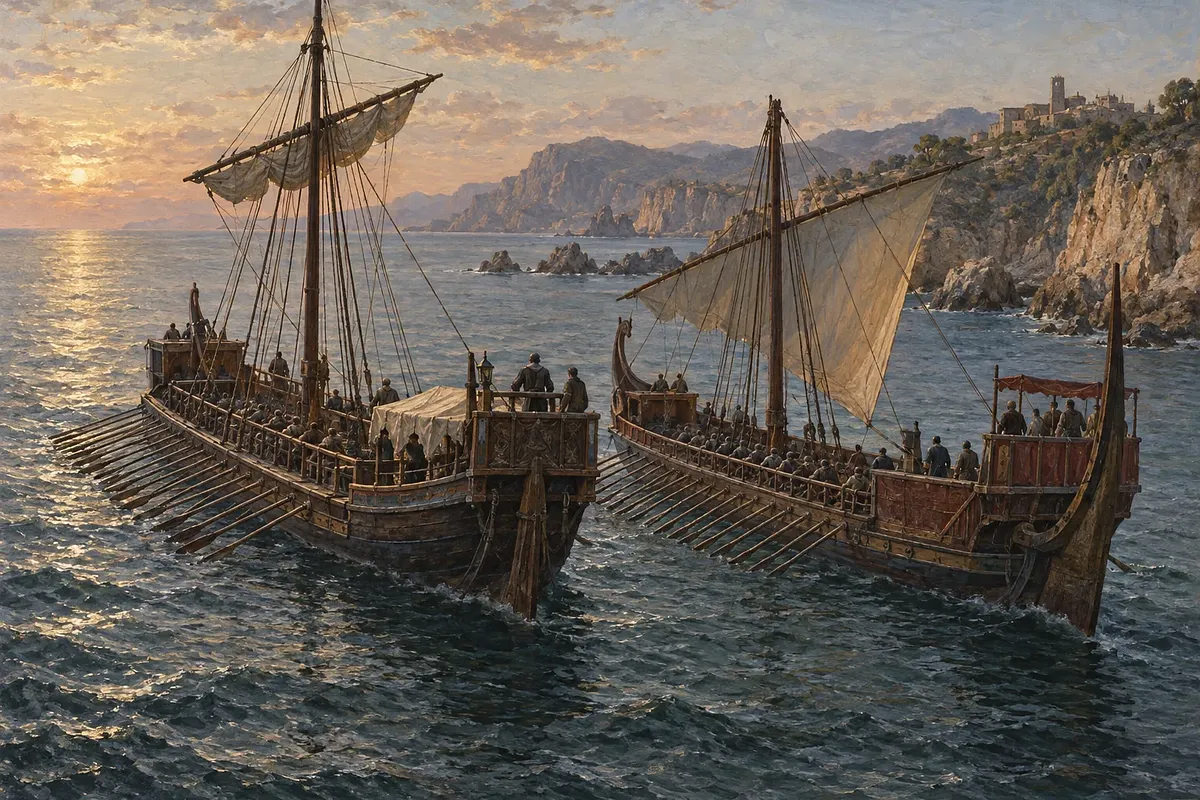
Cervantes was captured on September 26, 1575, aboard a ship returning to Spain.
Records show that all four escape attempts from 1576 to 1579 failed.
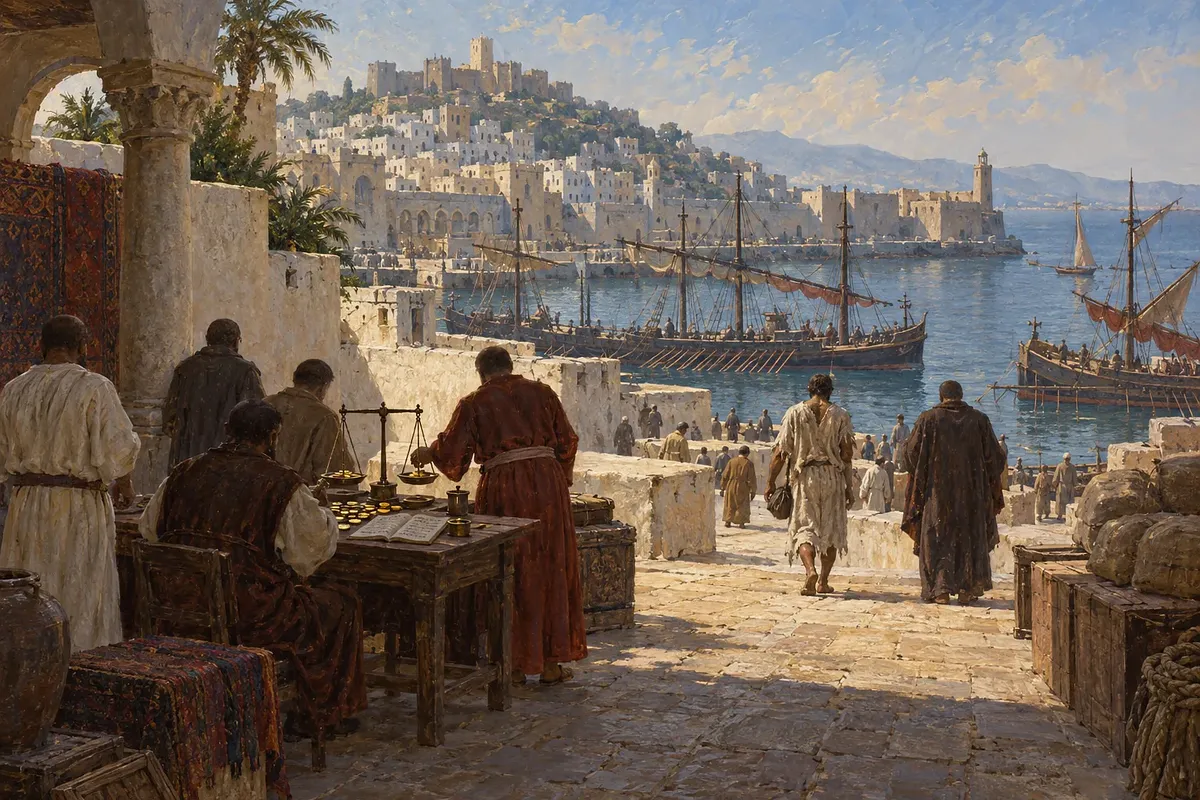
A ransom of 500 gold escudos was paid for his release on September 19, 1580.
The "Algiers Testimony Record" was a document of witness statements prepared after his release to substantiate his account of his actions.
His captivity provides context for interpreting his works, but events in his novels cannot be equated with his real-life experiences.
Cervantes was captured while sailing home in 1575 and spent about 5 years as a captive in Algiers. Four escape attempts failed. He was freed in 1580 after his family raised money and a religious order paid his ransom. This experience remains important background for understanding his life and work.
This article follows BNE’s chronology and exhibition records. The information was checked in October 2026.
How Cervantes was captured on his voyage home
Cervantes was captured not in battle, but while sailing back to Spain. He had fought as a soldier in the Battle of Lepanto in 1571. He suffered the injury that cost him the use of his left hand in that battle. He continued his military service afterward.
In 1575, he sailed from Naples with his brother Rodrigo de Cervantes. The galley Sol, which carried the brothers, was bound for Spain. It was seized near the Catalan coast on September 26. These events are set out in the Spanish National Library BNE chronology.
At the time, Algiers was a North African port city connected to the Ottoman Empire. War and raids at sea in the Mediterranean fed the trade in captives. Captured people were enslaved or held for ransom negotiations. Captivity in Algiers therefore cannot be equated with criminal imprisonment today.
The letters of recommendation he carried are cited as a reason his captors expected a high ransom. They assumed someone recommended by influential people could raise the money. His family’s actual finances, however, could not meet that expectation. This background is discussed in María Antonia Garcés’s study of his captivity.
Timeline from capture to return
The end of his captivity and the day he left for Spain were different dates. After his release, he spent time preparing a testimony document. The timeline below distinguishes his capture, escape attempts, release, and departure.
Date | Event | Source September 26, 1575 | Captured while sailing home and taken to Algiers | BNE chronology, CVC biographical chronology January 1576 | An overland escape attempt toward Oran failed | CVC biographical chronology 1577 | His brother was released; Cervantes’s second escape attempt failed | BNE chronology, CVC biographical chronology March 1578 | A third attempt to seek help from Oran failed | CVC biographical chronology October 1579 | A fourth attempt, involving a ship, failed | CVC biographical chronology September 19, 1580 | Freed after the Trinitarian Order paid his ransom | “Algiers Captives’ Ransom Ledger” October 1580 | The process of preparing the “Algiers Testimony Record” took place | CVC biographical chronology October 24, 1580 | Sailed from Algiers for the Spanish coast | BNE chronology
The months of the escape attempts follow the CVC biographical chronology. The release date also agrees with BNE’s description of the ransom ledger. Calling September 19 the date of his return to Spain would combine two separate events.
Why did the four escape attempts fail?
The escape plans described in the records depended on guides, contacts, and access to a ship. Cervantes could not carry them out alone. Details of what happened come mainly from testimony gathered after his release.
Date | Plan | Reason for failure recorded 1576 | Reach Oran overland | The guide left, and they returned to Algiers 1577 | Escape with fellow captives on a ship his brother would arrange | The rescue by sea did not take place, and the plan was discovered 1578 | Send a letter to Oran asking for outside help | The person carrying the letter was caught 1579 | Arrange a ship with a merchant’s help and escape | The plan was reported, so it could not be carried out
This table summarizes CVC’s account based on the testimony document. The testimony also says that Cervantes took responsibility himself. It should not, however, be reconstructed as a verified scene, down to the conversations or his state of mind at the time.
The turning point in his release: money raised by his family and a religious order
Securing and paying the ransom made his release possible. His family sought support and raised money in Spain. The religious order helped connect fundraising with negotiations in Algiers.
The Mercedarian Order secured his brother’s release in 1577. The money raised at the time was not enough to free both brothers. Their mother, Leonor de Cortinas, continued to seek support. This process is described in a document exhibition by Spain’s national archives.
The person who carried out Cervantes’s release in 1580 was Juan Gil of the Trinitarian Order. Antón de la Bella also took part in the same rescue effort. Additional funds supplemented the money raised by the family. It is therefore difficult to describe this as one person paying the entire ransom.
The ransom at the time of his release is recorded as 500 gold escudos. His captor demanded payment in Spanish gold coins. Cervantes might also have been taken to Constantinople. A transcription of the release record confirms that the final payment was made before that move.
How should the figures in the ransom record be read?
The release record accounts for both how the gold coins used for payment were obtained and the contributions received. Adding every amount in the same document can lead to double counting. Amounts in different units, particularly escudos and ducats, must also be distinguished.
Amount in the 1580 release record | Meaning in the record 500 gold escudos | Ransom paid for his release 280 escudos | Portion held in the ransom fund 220 escudos | Additional portion raised among merchants to make the payment in gold coins
The 280 escudos and 220 escudos explain how the 500 escudos were obtained. The family’s contribution should not be added again as though it were a separate cost. Explaining how burdensome the amount was at the time would also require comparisons with prices and wages. This article retains the currency units used in the record and does not convert them into present-day Korean won.
Life and literary work after his release
After his release, Cervantes continued his literary work in Spain. He had written poetry before his captivity, and poems from his time in Algiers have also survived. It would therefore be inaccurate to say that his captivity marked the start of his life as a writer.
After his return, he wrote plays and novels. The play 『El trato de Argel』, about captives in Algiers, also dates from this period. 『La Galatea』 was published in 1585. This sequence can be checked in the BNE chronology.
The relationship between his captivity and his writing must be considered work by work. A captive’s story also appears in 『Don Quijote de la Mancha』, commonly known as 『Don Quixote』. But events involving a character cannot be treated as events in the author’s life. Garcés’s study also treats this relationship as a matter of literary interpretation.
Records and interpretation
Sources on his life in Algiers include records of events, his own account, and literary works. Each was produced for a different purpose. Reading them all by the same standard blurs the boundary between established facts and interpretation.
What the records directly support
The release date and amount paid can be checked against ransom records. The account of the escape attempts relies heavily on the testimony document. Literary works are sources for examining how the experience of captivity was expressed.
Source | Useful for confirming | Point to bear in mind “Algiers Captives’ Ransom Ledger,” Libro de la redención de cautivos de Argel | Release date and ransom efforts | Its purpose as an accounting and administrative record must be considered “Algiers Testimony Record,” Información de Argel, 1580 | Testimony about his actions during captivity | It was prepared to substantiate his account of his actions “Epistle to Mateo Vázquez,” Epístola a Mateo Vázquez, 1577 | Literary expression of his experience | The verse epistle should not be read as a diary
BNE presents two of these texts together in its exhibition account of his captivity. The epistle is written in verse. A separate exhibition entry also discusses how the text became known later.
The outline generally shared by biographical studies
Institutional chronologies agree on his capture in 1575 and release in 1580. The failure of four escape attempts is also repeatedly documented. His captivity is widely treated as background for studying his work. A Cornell University book description also describes an approach that examines historical and literary sources together.
Debates and limits of verification
The “Algiers Testimony Record” was prepared at Cervantes’s request. The inclusion of testimony from his companions does not make it a neutral investigative report. The questions were framed in part to substantiate his account of his actions.
BNE exhibition research discusses the possibility that Cervantes helped draft the questions. Some researchers interpret this as the construction of a public image. It would also be wrong to assert that he wrote the entire document alone as an autobiography. These distinctions appear in the biographical study in the BNE exhibition catalogue.
Institutional sources do not agree on every detail of the escape attempts. The BNE chronology also places the wait in a cave under 1579. By contrast, BNE’s cave exhibition and the CVC chronology link it to the 1577 attempt. This article follows the cave exhibition account and places it in the second attempt.
When did the commemorative cave become a place of remembrance?
Not every commemorative site today dates back to the 16th century. The Cervantes cave in Algiers also reflects later commemorative activity. The escape records must be distinguished from the history of how the site became a monument.
According to BNE, a site was designated as the cave in 1887. A commemorative ceremony was held on June 24, 1894. A bust of Cervantes was installed in the cave. These events are recorded in BNE’s description of its cave materials.
This history alone cannot settle whether the site is authentic. The monument itself, however, is not independent proof of the cave’s location at the time. It is also a source for understanding how his captivity was remembered later.
What this episode means to readers today
Cervantes’s captivity in Algiers offers a way to read literary history alongside the social history of the Mediterranean. His release reveals the roles of his family, a religious order, and merchants. The surviving records show how rescues were organized, beyond the experience of one writer.
· The family’s petitions show how they sought the money needed for his release. · The religious order’s ledger shows that the rescue effort involved multiple captives. · The testimony document shows the relationship between substantiating his actions and telling his own story. · The literary works invite examination of how real experience became narrative.
BNE explains that captives other than Cervantes can also be identified in the ransom ledger. This gives grounds for viewing his release within the rescue efforts of the time. The ledger’s exhibition description broadens the view beyond his individual biography.
Frequently asked questions
When exactly was Cervantes held captive in Algiers?
He was captured on September 26, 1575. His release is recorded as September 19, 1580. His captivity is generally described as lasting about 5 years.
Was he captured at the Battle of Lepanto?
His participation in the Battle of Lepanto and his capture were separate events. The battle took place in 1571. He was captured while sailing home in 1575.
Did his fourth escape attempt succeed?
The fourth attempt is also recorded as a failure. He was actually freed in 1580 through payment of a ransom. Describing his release as a successful escape misrepresents how it happened.
Was his brother freed on the same day?
His brother was freed first, in 1577. The Mercedarian Order was involved in his brother’s release. Cervantes was released through the Trinitarian Order in 1580.
Did his family pay the entire ransom?
The family’s money alone did not cover it. The religious order’s negotiations and additional fundraising also played a part. The final ransom recorded for his release was 500 gold escudos.
Is the “Algiers Testimony Record” a diary?
It is not a diary written day by day during his captivity. It is a testimony document prepared after his release to substantiate his account of his actions. Its purpose and the way its questions were framed must be considered together.
Did he write 『Don Quixote』 in Algiers?
There is no basis for saying he wrote 『Don Quixote』 in Algiers. The captive’s story in the work is a subject for studying its relationship to his experience. That relationship does not establish where he wrote the work or whether individual events really happened.
0:00 0:00
1 / 70

Advertisement

Download text

File name
cervantes-five-years-algiers-captivity-and-release-en.txt
Format
TXT (text/plain)
Paragraphs
70

Downloads exactly what you see as a text file.

Please cite the source when quoting.

Large text

Makes the text larger and the colors clearer. Turn it on if the text feels too small.

Cervantes was captured on 26 September 1575 while returning to Spain.AI-generated image

Key points

  • Cervantes was captured on September 26, 1575, aboard a ship returning to Spain.
  • Records show that all four escape attempts from 1576 to 1579 failed.
  • A ransom of 500 gold escudos was paid for his release on September 19, 1580.
  • The "Algiers Testimony Record" was a document of witness statements prepared after his release to substantiate his account of his actions.
  • His captivity provides context for interpreting his works, but events in his novels cannot be equated with his real-life experiences.

Cervantes was captured while sailing home in 1575 and spent about 5 years as a captive in Algiers. Four escape attempts failed. He was freed in 1580 after his family raised money and a religious order paid his ransom. This experience remains important background for understanding his life and work.

This article follows BNE’s chronology and exhibition records. The information was checked in October 2026.

How Cervantes was captured on his voyage home

Cervantes was captured not in battle, but while sailing back to Spain. He had fought as a soldier in the Battle of Lepanto in 1571. He suffered the injury that cost him the use of his left hand in that battle. He continued his military service afterward.

In 1575, he sailed from Naples with his brother Rodrigo de Cervantes. The galley Sol, which carried the brothers, was bound for Spain. It was seized near the Catalan coast on September 26. These events are set out in the Spanish National Library BNE chronology.

At the time, Algiers was a North African port city connected to the Ottoman Empire. War and raids at sea in the Mediterranean fed the trade in captives. Captured people were enslaved or held for ransom negotiations. Captivity in Algiers therefore cannot be equated with criminal imprisonment today.

The letters of recommendation he carried are cited as a reason his captors expected a high ransom. They assumed someone recommended by influential people could raise the money. His family’s actual finances, however, could not meet that expectation. This background is discussed in María Antonia Garcés’s study of his captivity.

Cervantes was freed on September 19, 1580, after a ransom of 500 escudos was paid.AI-generated image

Timeline from capture to return

The end of his captivity and the day he left for Spain were different dates. After his release, he spent time preparing a testimony document. The timeline below distinguishes his capture, escape attempts, release, and departure.

Date Event Source
September 26, 1575 Captured while sailing home and taken to Algiers BNE chronology, CVC biographical chronology
January 1576 An overland escape attempt toward Oran failed CVC biographical chronology
1577 His brother was released; Cervantes’s second escape attempt failed BNE chronology, CVC biographical chronology
March 1578 A third attempt to seek help from Oran failed CVC biographical chronology
October 1579 A fourth attempt, involving a ship, failed CVC biographical chronology
September 19, 1580 Freed after the Trinitarian Order paid his ransom “Algiers Captives’ Ransom Ledger”
October 1580 The process of preparing the “Algiers Testimony Record” took place CVC biographical chronology
October 24, 1580 Sailed from Algiers for the Spanish coast BNE chronology

The months of the escape attempts follow the CVC biographical chronology. The release date also agrees with BNE’s description of the ransom ledger. Calling September 19 the date of his return to Spain would combine two separate events.

Why did the four escape attempts fail?

The escape plans described in the records depended on guides, contacts, and access to a ship. Cervantes could not carry them out alone. Details of what happened come mainly from testimony gathered after his release.

Date Plan Reason for failure recorded
1576 Reach Oran overland The guide left, and they returned to Algiers
1577 Escape with fellow captives on a ship his brother would arrange The rescue by sea did not take place, and the plan was discovered
1578 Send a letter to Oran asking for outside help The person carrying the letter was caught
1579 Arrange a ship with a merchant’s help and escape The plan was reported, so it could not be carried out

This table summarizes CVC’s account based on the testimony document. The testimony also says that Cervantes took responsibility himself. It should not, however, be reconstructed as a verified scene, down to the conversations or his state of mind at the time.

The turning point in his release: money raised by his family and a religious order

Securing and paying the ransom made his release possible. His family sought support and raised money in Spain. The religious order helped connect fundraising with negotiations in Algiers.

The Mercedarian Order secured his brother’s release in 1577. The money raised at the time was not enough to free both brothers. Their mother, Leonor de Cortinas, continued to seek support. This process is described in a document exhibition by Spain’s national archives.

The person who carried out Cervantes’s release in 1580 was Juan Gil of the Trinitarian Order. Antón de la Bella also took part in the same rescue effort. Additional funds supplemented the money raised by the family. It is therefore difficult to describe this as one person paying the entire ransom.

The ransom at the time of his release is recorded as 500 gold escudos. His captor demanded payment in Spanish gold coins. Cervantes might also have been taken to Constantinople. A transcription of the release record confirms that the final payment was made before that move.

How should the figures in the ransom record be read?

The release record accounts for both how the gold coins used for payment were obtained and the contributions received. Adding every amount in the same document can lead to double counting. Amounts in different units, particularly escudos and ducats, must also be distinguished.

Amount in the 1580 release record Meaning in the record
500 gold escudos Ransom paid for his release
280 escudos Portion held in the ransom fund
220 escudos Additional portion raised among merchants to make the payment in gold coins

The 280 escudos and 220 escudos explain how the 500 escudos were obtained. The family’s contribution should not be added again as though it were a separate cost. Explaining how burdensome the amount was at the time would also require comparisons with prices and wages. This article retains the currency units used in the record and does not convert them into present-day Korean won.

Life and literary work after his release

After his release, Cervantes continued his literary work in Spain. He had written poetry before his captivity, and poems from his time in Algiers have also survived. It would therefore be inaccurate to say that his captivity marked the start of his life as a writer.

After his return, he wrote plays and novels. The play 『El trato de Argel』, about captives in Algiers, also dates from this period. 『La Galatea』 was published in 1585. This sequence can be checked in the BNE chronology.

The relationship between his captivity and his writing must be considered work by work. A captive’s story also appears in 『Don Quijote de la Mancha』, commonly known as 『Don Quixote』. But events involving a character cannot be treated as events in the author’s life. Garcés’s study also treats this relationship as a matter of literary interpretation.

Records and interpretation

Sources on his life in Algiers include records of events, his own account, and literary works. Each was produced for a different purpose. Reading them all by the same standard blurs the boundary between established facts and interpretation.

What the records directly support

The release date and amount paid can be checked against ransom records. The account of the escape attempts relies heavily on the testimony document. Literary works are sources for examining how the experience of captivity was expressed.

Source Useful for confirming Point to bear in mind
“Algiers Captives’ Ransom Ledger,” Libro de la redención de cautivos de Argel Release date and ransom efforts Its purpose as an accounting and administrative record must be considered
“Algiers Testimony Record,” Información de Argel, 1580 Testimony about his actions during captivity It was prepared to substantiate his account of his actions
“Epistle to Mateo Vázquez,” Epístola a Mateo Vázquez, 1577 Literary expression of his experience The verse epistle should not be read as a diary

BNE presents two of these texts together in its exhibition account of his captivity. The epistle is written in verse. A separate exhibition entry also discusses how the text became known later.

The outline generally shared by biographical studies

Institutional chronologies agree on his capture in 1575 and release in 1580. The failure of four escape attempts is also repeatedly documented. His captivity is widely treated as background for studying his work. A Cornell University book description also describes an approach that examines historical and literary sources together.

Debates and limits of verification

The “Algiers Testimony Record” was prepared at Cervantes’s request. The inclusion of testimony from his companions does not make it a neutral investigative report. The questions were framed in part to substantiate his account of his actions.

BNE exhibition research discusses the possibility that Cervantes helped draft the questions. Some researchers interpret this as the construction of a public image. It would also be wrong to assert that he wrote the entire document alone as an autobiography. These distinctions appear in the biographical study in the BNE exhibition catalogue.

Institutional sources do not agree on every detail of the escape attempts. The BNE chronology also places the wait in a cave under 1579. By contrast, BNE’s cave exhibition and the CVC chronology link it to the 1577 attempt. This article follows the cave exhibition account and places it in the second attempt.

When did the commemorative cave become a place of remembrance?

Not every commemorative site today dates back to the 16th century. The Cervantes cave in Algiers also reflects later commemorative activity. The escape records must be distinguished from the history of how the site became a monument.

According to BNE, a site was designated as the cave in 1887. A commemorative ceremony was held on June 24, 1894. A bust of Cervantes was installed in the cave. These events are recorded in BNE’s description of its cave materials.

This history alone cannot settle whether the site is authentic. The monument itself, however, is not independent proof of the cave’s location at the time. It is also a source for understanding how his captivity was remembered later.

What this episode means to readers today

Cervantes’s captivity in Algiers offers a way to read literary history alongside the social history of the Mediterranean. His release reveals the roles of his family, a religious order, and merchants. The surviving records show how rescues were organized, beyond the experience of one writer.

  • The family’s petitions show how they sought the money needed for his release.
  • The religious order’s ledger shows that the rescue effort involved multiple captives.
  • The testimony document shows the relationship between substantiating his actions and telling his own story.
  • The literary works invite examination of how real experience became narrative.

BNE explains that captives other than Cervantes can also be identified in the ransom ledger. This gives grounds for viewing his release within the rescue efforts of the time. The ledger’s exhibition description broadens the view beyond his individual biography.

Questions checked against the record

When exactly was Cervantes held captive in Algiers?

He was captured on September 26, 1575. His release is recorded as September 19, 1580. His captivity is generally described as lasting about 5 years.

Was he captured at the Battle of Lepanto?

His participation in the Battle of Lepanto and his capture were separate events. The battle took place in 1571. He was captured while sailing home in 1575.

Did his fourth escape attempt succeed?

The fourth attempt is also recorded as a failure. He was actually freed in 1580 through payment of a ransom. Describing his release as a successful escape misrepresents how it happened.

Was his brother freed on the same day?

His brother was freed first, in 1577. The Mercedarian Order was involved in his brother’s release. Cervantes was released through the Trinitarian Order in 1580.

Did his family pay the entire ransom?

The family’s money alone did not cover it. The religious order’s negotiations and additional fundraising also played a part. The final ransom recorded for his release was 500 gold escudos.

Is the “Algiers Testimony Record” a diary?

It is not a diary written day by day during his captivity. It is a testimony document prepared after his release to substantiate his account of his actions. Its purpose and the way its questions were framed must be considered together.

Did he write 『Don Quixote』 in Algiers?

There is no basis for saying he wrote 『Don Quixote』 in Algiers. The captive’s story in the work is a subject for studying its relationship to his experience. That relationship does not establish where he wrote the work or whether individual events really happened.

Open the link

Opens in a new window.

Advertisement

Sign-in required

Sign in with your Google account to like, comment, and save highlights.

FAQ

When did Cervantes's captivity in Algiers begin and end?

He was captured on September 26, 1575, while sailing home. He was released on September 19, 1580, after a ransom was paid, and his captivity is generally described as lasting about five years.

Was Cervantes captured at the Battle of Lepanto?

He took part in the Battle of Lepanto in 1571. He was captured in 1575 while sailing from Naples back to Spain.

Did Cervantes succeed in his fourth escape attempt?

All four escape attempts are recorded as failures. He was released in 1580 after his family raised funds and the Trinitarian Order paid a ransom.

When was Cervantes's younger brother released?

His younger brother Rodrigo de Cervantes was released first, in 1577, through the rescue efforts of the Mercedarian Order. Cervantes remained in Algiers until 1580.

How much was Cervantes's ransom?

The record of his release in 1580 gives the amount as 500 gold escudos. It also specifies a demand for payment in Spanish gold coins.

Who raised the money for Cervantes's ransom?

His family raised funds, and the order handled negotiations and secured additional money. Juan Gil of the Trinitarian Order carried out his release, but it is difficult to say that his family or any one person paid the entire amount.

Was September 19, 1580, the day Cervantes returned to Spain?

September 19 was the day he was released in Algiers. The BNE timeline gives October 24, 1580, as the day he set sail for the Spanish coast.

Is the “Algiers Testimony Record” Cervantes's autobiography?

It is a document of testimony prepared after his release to substantiate his actions. Some interpret him as having helped draft the questions, but the document as a whole should not be described as an autobiography he wrote alone.

What kind of document is the “Epistle to Mateo Vázquez”?

It is an epistle in verse that BNE presents in connection with his captivity in 1577. It is a source for examining the literary expression of his experience and should not be read in the same way as an administrative record or a diary.

Did Cervantes's captivity directly give rise to Don Quixote?

His captivity is studied as background for interpreting the work. But the entire work cannot be described as a direct result of that experience, nor can events in the novel be equated with the author's life.

Has Cervantes's cave in Algiers been preserved as a monument since his time?

BNE records the designation of the site in 1887 and a commemorative event in 1894. The 16th-century records of his escape attempts must therefore be distinguished from the creation of a commemorative site in the 19th century.

Sources

Data formats

This content is available in several machine-friendly formats.

Data-only languages (machine translated, files only)

Indonesian JSON MD Portuguese JSON MD Chinese (Traditional) JSON MD Deutsch JSON MD

Verification

This article was drafted with AI and then reviewed and edited by a person.

Reviewed by 신익희 · 편집장 · 2026-10-13

Figures in this article were checked against the source material during generation. · 2026-10-13

This translation has been cross-checked by AI. · 2026-10-13

Reuse & AI usage

Search indexing and AI citation with attribution are welcome. See the license policy for details.

CC BY · License

Loading…

Loading…

Related content

From Injoys

Request the content you want and take 70% of what it earns

Just leave the subject. We handle production, review, translation and distribution.

See how revenue sharing works

Comments