Skip to content
Injoys
Knowledge Base

Hangul's 28 Letters: Design Principles and Why 24 Remain

Hunminjeongeum originally had 28 letters: 17 consonants and 11 vowels. This explains how the letters were designed and what happened to the four that disappeared, while clarifying commonly confused facts about records of Sejong's creation of Hangul and how Hangul spread.

Listen or read this article

24:01

Listen, or read the text only.

Hangul's 28 Letters: Design Principles and Why 24 Remain

Kokoro 82M AI-generated voice 25 min read

0:00 24:01

Advertisement

Download audio

File name
hangeul-28-letters-creation-and-modern-alphabet-en.mp3
Format
MP3 (audio/mpeg)
Duration
24:01
File size
16.5 MB
Engine
Kokoro 82M

This audio was generated by AI.

You may download and use it freely for personal use.

Hangul's 28 Letters: Design Principles and Why 24 Remain

17 min read

Hangul's 28 Letters: Design Principles and Why 24 Remain
Hunminjeongeum originally had 28 letters: 17 consonants and 11 vowels. This explains how the letters were designed and what happened to the four that disappeared, while clarifying commonly confused facts about records of Sejong's creation of Hangul and how Hangul spread.
Hunminjeongeum's original 28 letters comprised 17 consonants and 11 vowels.
The consonants were designed mainly by modeling the speech organs and adding strokes.
The 24 basic letters of modern Hangul and the 40 letters used for learning are counted differently.
Sejong's direct creation of Hangul should be distinguished from the Jiphyeonjeon scholars' compilation of the Haerye.
A sound can survive even when its letterform disappears, as with the final consonant sound of the old ieung.
The 28 letters of Hunminjeongeum created by King Sejong consist of 17 consonants and 11 vowels. The writing system was designed to record the speech sounds and Chinese character pronunciations of the time. It uses a different counting standard from today’s 24 basic letters or the 40 letters commonly taught to learners.
The number and composition of the original letters are based on the 1446 explanatory edition of 『Hunminjeongeum』.
Why Hangul Was Created with 28 Letters
The number 28 is the sum of the letters designated for initial and medial sounds. The initial is the first sound of a syllable, and the medial is the vowel in its center. Letters for initial sounds were reused for final consonants.
There was therefore no need to create a separate letter for every syllable. Many syllables could be written by combining a small set of letters. 『Hunminjeongeum』 explains how these letters were formed and combined. See the explanation of the explanatory edition on Our History Net.
Category | Letters at the time of creation | Number of letters Initial letters | ㄱ, ㅋ, ㆁ, ㄷ, ㅌ, ㄴ, ㅂ, ㅍ, ㅁ, ㅈ, ㅊ, ㅅ, ㆆ, ㅎ, ㅇ, ㄹ, ㅿ | 17 Medial letters | ㆍ, ㅡ, ㅣ, ㅗ, ㅏ, ㅜ, ㅓ, ㅛ, ㅑ, ㅠ, ㅕ | 11 Total | Initial and medial letters | 28
The 28 letters should not be taken as a count of every Korean sound at the time. Some sounds were written by placing the same letter side by side. The aim of systematically recording Chinese character pronunciations also shaped how the letters were used.
The Principles Behind the Consonants and Vowels
Hangul was designed so that the shapes of its letters show relationships between sounds. The basic consonant letters were modeled on the speech organs or their positions during pronunciation. The basic vowel letters are explained through shapes symbolizing heaven, earth, and humanity.
Pictorial Consonants and Added Strokes
The five basic consonant letters are ㄱ, ㄴ, ㅁ, ㅅ, and ㅇ. Pictorial design means modeling a letter on a shape. Adding strokes means extending a basic letter with extra strokes.
Basic letter | Shape it represents according to the explanatory edition | Related letters with added strokes ㄱ | The back of the tongue blocking the throat | ㅋ ㄴ | The tongue touching the upper gums | ㄷ, ㅌ ㅁ | The shape of the mouth | ㅂ, ㅍ ㅅ | The shape of the teeth | ㅈ, ㅊ ㅇ | The shape of the throat | ㆆ, ㅎ
The 5 basic letters and 9 letters formed by adding strokes make 14. Adding ㆁ, ㄹ, and ㅿ brings the consonant total to 17. These three are treated as variant letters, distinct from those explained by the usual added-stroke principle. The entry on variant letters in the Encyclopedia of Korean Culture explains the difference.
Basic Vowels and Their Combinations
The vowels were based on ㆍ, ㅡ, and ㅣ. The explanatory edition connects them with heaven, earth, and humanity, respectively. It then explains the remaining vowel letters as combinations of these basic forms.
· Basic vowel letters: 3, namely ㆍ, ㅡ, and ㅣ · Vowel letters combining the basic forms: 4, namely ㅗ, ㅏ, ㅜ, and ㅓ · Vowel letters extended by adding dots: 4, namely ㅛ, ㅑ, ㅠ, and ㅕ
This makes 11 letters: 3 plus 4 plus 4. The explanation of the vowels also draws on the yin-yang thought of the time. That philosophical explanation should be distinguished from an explanation based on modern phonetics.
Comparing 28, 24, and 40 Letters
The three numbers count different sets of letters. The 28 letters are those from the time of Hangul’s creation. The modern basic set has 24 letters, while teaching materials may also include letters formed by combining them.
Number of letters | What is counted | Composition 28 | Letters at the time Hunminjeongeum was created | 17 consonants and 11 vowels 24 | Basic letters under modern Hangul orthography | 14 consonants and 10 vowels 40 | Consonants and vowels commonly covered in learning | 19 consonants and 21 vowels
The 40 letters taught to learners are the basic 24 plus 16 combined letters. The 5 additional consonants are ㄲ, ㄸ, ㅃ, ㅆ, and ㅉ. The 11 additional vowels are ㅐ, ㅒ, ㅔ, ㅖ, ㅘ, ㅙ, ㅚ, ㅝ, ㅞ, ㅟ, and ㅢ.
Article 4 of the National Institute of Korean Language’s Hangul orthography rules establishes the basic letters.
The number of Hangul letters shall be twenty-four,
Teaching 40 letters therefore does not conflict with the rule on basic letters. For accuracy, though, the count should specify what it includes. The rule and letter list are available in the Korean Language Standards.
How the Four Letters That Disappeared Differ
The letters excluded from the basic set are ㅿ, ㆁ, ㆆ, and ㆍ. Changes in pronunciation and writing conventions contributed to their disappearance. The four did not all disappear for the same reason.
Letter | Name | Distinction in how it changed ㅿ | Banchieum | Disappeared from writing as the sound it represented changed ㆁ | Old ieung | The final consonant sound remains, but is now written ㅇ ㆆ | Yeorin hieut | Its use declined after being limited to contexts such as recording Chinese character pronunciations ㆍ | Arae-a | Went through pronunciation changes, including merger with other vowels, and changes in spelling conventions
Old ieung shows why letters must be distinguished from sounds. The sound it represented remains in the final consonant of the modern word ‘강’. The loss of four letters therefore does not, by itself, mean that four sounds disappeared.
The letter shape of banchieum is ㅿ. It is sometimes represented by the triangle symbol △ in explanations. When transcribing old texts accurately, it is better to use the actual letter.
Evidence That Sejong Created Hangul Himself
The 『Annals of King Sejong』 records that Sejong personally created Hunminjeongeum. An entry from the 12th lunar month of Sejong’s 25th year reports the creation of 28 vernacular letters. The Chinese-character expression meaning “personally created” is ‘chinje’. The 1443 entry on its creation provides direct evidence.
In 1444, Choe Malli and others submitted a petition opposing the new script. Sejong responded by discussing rhyme books and the letter system. Rhyme books systematically organized the pronunciations of Chinese characters. This exchange shows that Sejong led the undertaking with a knowledge of speech sounds.
Scholars including Jeong Inji, Sin Sukju, and Seong Sammun, however, took part in compiling the explanatory edition. Creating a script and compiling a book explaining it are separate tasks. Nor can opposition from some members of the Hall of Worthies be taken as the position of the entire institution.
The claim that Sinmi created the script requires separate verification against historical sources. The record of its creation examined here does not support that claim. Explaining Sejong’s role also does not require a definitive count of how often a particular expression appears throughout the annals.
The Relationship Between Samgang haengsildo and the Creation of Hangul
『Samgang haengsildo』 reflects a concern with conveying knowledge to ordinary people. In 1428, a man named Kim Hwa killed his father in Jinju. The incident prompted the compilation of a book teaching Confucian ethics.
『Samgang haengsildo』, issued in 1434, included illustrations and explanations. Pictures alone, however, could not convey everything. The circumstances of its compilation are outlined in the Our History Net explanation of Samgang haengsildo.
Date | Recorded event | Distinction to keep in mind 1428 | Kim Hwa incident in Jinju | Prompted the compilation of Samgang haengsildo 1434 | Publication of Samgang haengsildo | Use of pictures to teach ordinary people 1443 | Record of Hunminjeongeum’s creation | Record concerning the completion of the new script 1444 | Petition by Choe Malli and others, and Sejong’s response | A plan to translate Samgang haengsildo into the vernacular script also appears 1446 | Publication and promulgation of the explanatory edition of Hunminjeongeum | Public explanation of the script’s purpose and principles
Sejong stated his intention to translate Samgang haengsildo into the vernacular script. This appears in the 1444 annals entry concerning the petition. That incident alone, however, cannot explain every reason for creating the script. Determining exactly when the research began also requires separate evidence.
How Did Hangul Spread into Everyday Life?
Hangul spread through uses including translated books, letters, and literature. Even immediately after its creation, Classical Chinese remained central to state administration. The new script’s appearance and changes to the official writing system did not happen at the same time.
· Royal court and publishing: Used to render Buddhist texts and Confucian classics, among other works, in Korean · Home and daily life: Used by women and men to exchange news in letters · Learning: Used to learn the sounds of Chinese characters and the meanings of Classical Chinese sentences · Literature of the late Joseon period: The copying and circulation of Hangul novels expanded readership
Women played a major role in forming and passing on Hangul culture. That does not mean Hangul was used only by women. Hangul letters written by men also survive. The National Assembly Library’s introduction to Joseon-era vernacular letters describes the breadth of their users.
Explaining women’s early use solely through queens serving as regents is also too narrow. Everyday needs included family communication and reading. Who adopted Hangul first must be judged from the surviving individual records.
When Was the Use of Korean Script in Official Documents Established?
The principle of using Korean script in laws and imperial edicts is documented in 1894. The basis is Article 14 of the official document rules dated the 21st day of the 11th lunar month in Gojong’s 31st year. Korean script was made the default, but Classical Chinese translations and mixed Korean and Chinese script were also permitted. The relevant text appears in the official document rules recorded in the Annals of Gojong.
It is therefore inaccurate to say that all official documents switched to Hangul alone in 1895. The institutional principle differed from how documents were actually written. Classical Chinese and mixed Korean and Chinese script continued to be used afterward.
Hangul’s long history of use provided a foundation for modern writing practices. But a proclamation alone did not complete the modernization of writing. School education, publishing, and the standardization of spelling were also part of the process.
A simple comparison with the speed of Türkiye’s script reform is difficult. Introducing a new script and changing the status of one already in use involve different conditions. Comparing the duration of disruption or the speed of transition requires data measured by the same standards.
Where Did the Name Hangul Come From?
The name ‘Hangul’ spread through modern Korean-language research and efforts to promote its use. The script was named Hunminjeongeum when it was created. Names such as eonmun and gukmun were also used later.
Name | Main meaning and use Hunminjeongeum | The script’s original name and the title of the book explaining its principles Eonmun | A name widely used during the Joseon period Gukmun | A modern name emphasizing its status as the nation’s script Hangul | A name spread through the work of Ju Si-gyeong and associated scholars
The National Hangeul Museum links the activities of Hangeulmo in 1913 to the spread of the name. Ju Si-gyeong was a leading figure in the study and teaching of the Korean language and script during this period. The museum’s explanation of the name Hangul discusses this history.
‘Hangul’ is interpreted as meaning “great script” or “the script of our people.” The names did not, however, all change at once in a particular year. It is also more accurate to avoid saying that ‘gukmun’ could no longer be used at all.
Hangul’s Systematic Design and International Recognition
Hangul’s systematic design can be seen in the relationship between sounds and letter shapes. The survival of an explanatory edition describing its design principles is another distinctive feature. Recognizing these strengths does not require judging other scripts as irrational.
The UNESCO King Sejong Literacy Prize was established in 1989 with support from the Korean government. It gives special consideration to literacy education based on learners’ mother tongues. It supports efforts to improve the ability to read and use written language. Its purpose is stated in the UNESCO literacy prize information.
The explanatory edition of 『Hunminjeongeum』 was inscribed on the Memory of the World Register in 1997. The inscription covers a document explaining the script’s design principles. It does not rank entire writing systems against one another. The UNESCO inscription record identifies what was inscribed.
How to Assess Claims About Hangul Related to China
The creation of a script must be distinguished from where it is used today. The fact that ethnic Koreans in China use Hangul does not change who created it. Evidence of its creation comes from historical records concerning Sejong of Joseon.
Nor can a particular exhibition or promotional item automatically be treated as a state claim about the script’s origins. The source and original wording must be checked before drawing a conclusion. The label ‘Hangul project’ alone does not establish the content or purpose of a policy.
What to check | Distinction to make Source of the statement | Whether it is a government announcement or a private post Original wording | Whether it describes the script’s use by ethnic Koreans in China or makes a claim about its origins Historical evidence | What the annals and explanatory edition record
Comparing Hangul, Chinese, and Japanese Input Methods
An advantage of Hangul input is that syllables are formed by combining consonants and vowels. Ordinary Hangul input does not involve selecting Chinese character candidates. Actual speed, however, varies with the keyboard, predictive input, and the user’s proficiency.
Language or script | Common input methods | Distinction to keep in mind Hangul | Entering consonants and vowels to form syllables | A separate key is not needed for each syllable Chinese | Pinyin, character-shape-based input, handwriting input | Pinyin is not the only method Japanese | Romaji or kana input, with conversion to kanji where needed | Romaji is not the only input option
Apple provides guidance on Chinese input methods other than Pinyin. It also offers kana and romaji input for Japanese. It is therefore incorrect to say that direct input of a country’s own script is unique to Korea. The Chinese input guide and Japanese input guide provide evidence.
The convenience of Hangul keyboards cannot be explained entirely by the principle of adding strokes. A standard two-set keyboard uses keys for individual letters. The principles behind the script’s creation and the design of input devices are related, but they are not the same.
Digital Hangul: Syllable Combinations and Search Issues
A syllable that looks the same on screen can be stored in different ways. Unicode supports both complete syllables and letters intended for combination. Hangul’s structure of grouping letters into syllables is thus reflected in its digital representation.
Example Calculation for Modern Syllable Combinations
Unicode separately assigns codes to 11,172 modern Hangul syllables. These combine 19 initial consonants with 21 medial vowels. There are 28 possibilities for the final position: 27 final consonants plus no final consonant.
Element | Number of possibilities Initial | 19 Medial | 21 Final | 27 final consonants and 1 option with no final consonant Total combinations | 19 × 21 × 28 = 11,172
This is the number of syllable combinations that can be made with modern letters. It does not mean they are all used in Korean. Nor does it include every possible combination of old Hangul letters. The Unicode Korean FAQ explains the scope.
Why Searches Can Differ for What Looks Like the Same Letter
‘가’ can be stored as one complete syllable. It can also be represented by codes for the combining initial ㄱ and medial ㅏ. The sequence of stored codes can therefore differ even when the appearance is the same.
Unicode normalization is a process that brings such representations into a consistent form. NFC and NFD are common normalization forms. As a result, whether text has been normalized can affect searches and duplicate detection. The basis is the Unicode Normalization Standard.
This issue shows that Hangul’s combination principle alone does not settle every aspect of digital text processing. Supporting old Hangul also requires support for its letters and fonts. In particular, replacing banchieum ㅿ with the triangle △ changes the original text’s character information.
The Origins of Korean and the Number of Languages in the World
The origins of the Korean language and the creation of Hangul are different questions. Korean was spoken before Hangul was created. Hangul is used to write that language.
Claims definitively assigning Korean to a Ural-Altaic language family require caution. Glottolog classifies Korean within Koreanic. It does not treat a relationship with a broader Altaic family as an established classification. The Glottolog entry on Koreanic presents relevant research.
Genetic research and research into language families must also be distinguished. The history of population movements can help the study of language spread. Genetic closeness alone, however, does not establish that languages are related.
The number of languages in the world depends on how languages and dialects are classified. It also depends on whether only languages still in use are counted or extinct languages are included. The number of scripts likewise depends on current use and classification methods.
· Number of languages: Check the counting organization, the edition year, and how languages and dialects are distinguished · Number of scripts: Check whether scripts in current use and historical scripts are included · Number of writing systems in Unicode: Interpret this as the scope supported by a computing standard
It is therefore difficult to treat approximately 6,000 languages and approximately 50 scripts as fixed figures. Unicode’s list of supported scripts also includes historical writing systems. That list should not be directly compared with the number of scripts in current use. The scope can be checked in the Unicode list of supported scripts.
Common Misconceptions in Learning Hangul
Learning the letters and how to group them into syllables is different from learning the entire Korean language. Breaking a syllable into its components helps explain its structure. The meanings of words and grammar must be learned separately.
Common misconception | What to understand instead Hangul requires memorizing thousands of independent characters | It is a system that combines letters to form syllables Knowing 40 letters is enough to read all Korean accurately | Final consonants and sound changes require further study Reading the letters means understanding a sentence | Vocabulary, grammar, and context are separate areas of understanding Because the script is easy, everyone can master it within a set time | Learning time varies with the learner’s first language and learning conditions
For example, ‘한’ groups ㅎ, ㅏ, and ㄴ into one syllable. ‘글’ can likewise be explained as a combination of ㄱ, ㅡ, and ㄹ. Understanding this principle is different from knowing what the word ‘한글’ means.
0:00 0:00
1 / 95

Advertisement

Download text

File name
hangeul-28-letters-creation-and-modern-alphabet-en.txt
Format
TXT (text/plain)
Paragraphs
95

Downloads exactly what you see as a text file.

Please cite the source when quoting.

Large text

Makes the text larger and the colors clearer. Turn it on if the text feels too small.

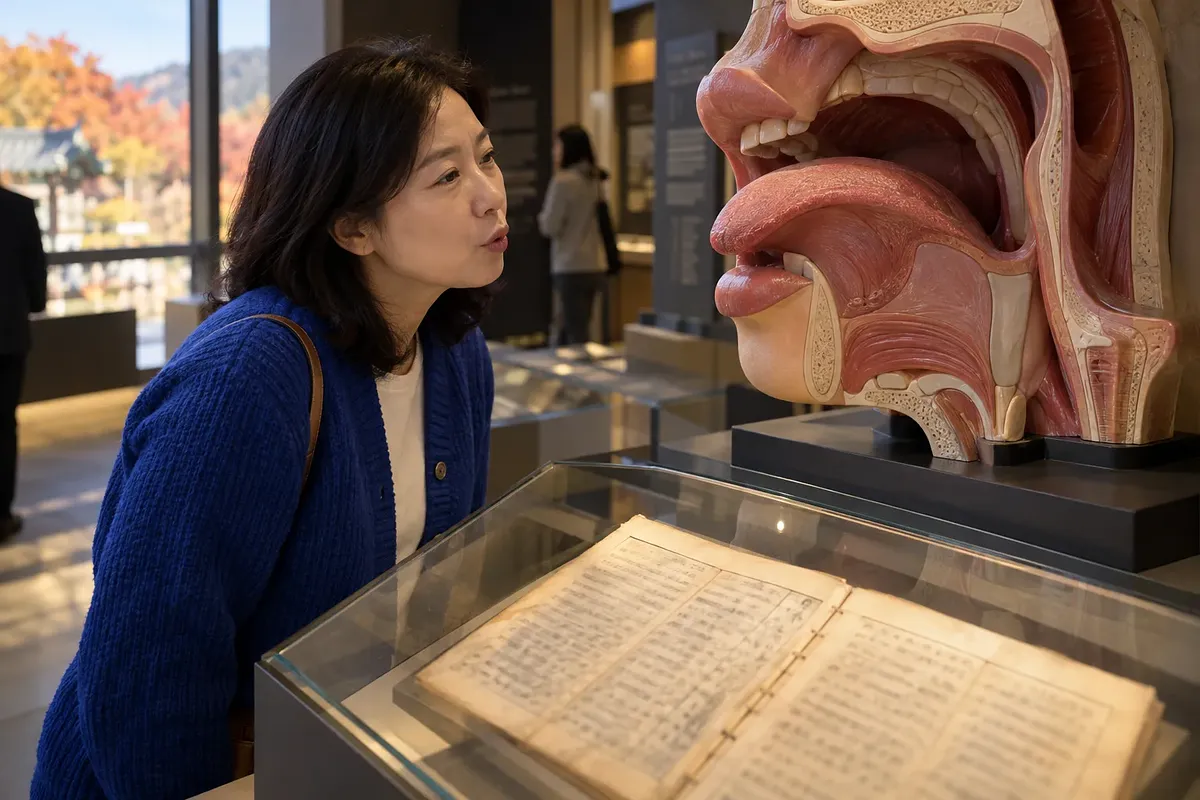
The original Hangul consonants were shaped after the organs used to pronounce them.

Key points

  • Hunminjeongeum's original 28 letters comprised 17 consonants and 11 vowels.
  • The consonants were designed mainly by modeling the speech organs and adding strokes.
  • The 24 basic letters of modern Hangul and the 40 letters used for learning are counted differently.
  • Sejong's direct creation of Hangul should be distinguished from the Jiphyeonjeon scholars' compilation of the Haerye.
  • A sound can survive even when its letterform disappears, as with the final consonant sound of the old ieung.

The 28 letters of Hunminjeongeum created by King Sejong consist of 17 consonants and 11 vowels. The writing system was designed to record the speech sounds and Chinese character pronunciations of the time. It uses a different counting standard from today’s 24 basic letters or the 40 letters commonly taught to learners.

The number and composition of the original letters are based on the 1446 explanatory edition of 『Hunminjeongeum』.

Why Hangul Was Created with 28 Letters

The number 28 is the sum of the letters designated for initial and medial sounds. The initial is the first sound of a syllable, and the medial is the vowel in its center. Letters for initial sounds were reused for final consonants.

There was therefore no need to create a separate letter for every syllable. Many syllables could be written by combining a small set of letters. 『Hunminjeongeum』 explains how these letters were formed and combined. See the explanation of the explanatory edition on Our History Net.

Category Letters at the time of creation Number of letters
Initial letters ㄱ, ㅋ, ㆁ, ㄷ, ㅌ, ㄴ, ㅂ, ㅍ, ㅁ, ㅈ, ㅊ, ㅅ, ㆆ, ㅎ, ㅇ, ㄹ, ㅿ 17
Medial letters ㆍ, ㅡ, ㅣ, ㅗ, ㅏ, ㅜ, ㅓ, ㅛ, ㅑ, ㅠ, ㅕ 11
Total Initial and medial letters 28

The 28 letters should not be taken as a count of every Korean sound at the time. Some sounds were written by placing the same letter side by side. The aim of systematically recording Chinese character pronunciations also shaped how the letters were used.

The spread of Hangul is connected to reading and sharing news in everyday life.

The Principles Behind the Consonants and Vowels

Hangul was designed so that the shapes of its letters show relationships between sounds. The basic consonant letters were modeled on the speech organs or their positions during pronunciation. The basic vowel letters are explained through shapes symbolizing heaven, earth, and humanity.

Pictorial Consonants and Added Strokes

The five basic consonant letters are ㄱ, ㄴ, ㅁ, ㅅ, and ㅇ. Pictorial design means modeling a letter on a shape. Adding strokes means extending a basic letter with extra strokes.

Basic letter Shape it represents according to the explanatory edition Related letters with added strokes
ㄱ The back of the tongue blocking the throat ㅋ
ㄴ The tongue touching the upper gums ㄷ, ㅌ
ㅁ The shape of the mouth ㅂ, ㅍ
ㅅ The shape of the teeth ㅈ, ㅊ
ㅇ The shape of the throat ㆆ, ㅎ

The 5 basic letters and 9 letters formed by adding strokes make 14. Adding ㆁ, ㄹ, and ㅿ brings the consonant total to 17. These three are treated as variant letters, distinct from those explained by the usual added-stroke principle. The entry on variant letters in the Encyclopedia of Korean Culture explains the difference.

Basic Vowels and Their Combinations

The vowels were based on ㆍ, ㅡ, and ㅣ. The explanatory edition connects them with heaven, earth, and humanity, respectively. It then explains the remaining vowel letters as combinations of these basic forms.

  • Basic vowel letters: 3, namely ㆍ, ㅡ, and ㅣ
  • Vowel letters combining the basic forms: 4, namely ㅗ, ㅏ, ㅜ, and ㅓ
  • Vowel letters extended by adding dots: 4, namely ㅛ, ㅑ, ㅠ, and ㅕ

This makes 11 letters: 3 plus 4 plus 4. The explanation of the vowels also draws on the yin-yang thought of the time. That philosophical explanation should be distinguished from an explanation based on modern phonetics.

Comparing 28, 24, and 40 Letters

The three numbers count different sets of letters. The 28 letters are those from the time of Hangul’s creation. The modern basic set has 24 letters, while teaching materials may also include letters formed by combining them.

Number of letters What is counted Composition
28 Letters at the time Hunminjeongeum was created 17 consonants and 11 vowels
24 Basic letters under modern Hangul orthography 14 consonants and 10 vowels
40 Consonants and vowels commonly covered in learning 19 consonants and 21 vowels

The 40 letters taught to learners are the basic 24 plus 16 combined letters. The 5 additional consonants are ㄲ, ㄸ, ㅃ, ㅆ, and ㅉ. The 11 additional vowels are ㅐ, ㅒ, ㅔ, ㅖ, ㅘ, ㅙ, ㅚ, ㅝ, ㅞ, ㅟ, and ㅢ.

Article 4 of the National Institute of Korean Language’s Hangul orthography rules establishes the basic letters.

The number of Hangul letters shall be twenty-four,

Teaching 40 letters therefore does not conflict with the rule on basic letters. For accuracy, though, the count should specify what it includes. The rule and letter list are available in the Korean Language Standards.

How the Four Letters That Disappeared Differ

The letters excluded from the basic set are ㅿ, ㆁ, ㆆ, and ㆍ. Changes in pronunciation and writing conventions contributed to their disappearance. The four did not all disappear for the same reason.

Letter Name Distinction in how it changed
ㅿ Banchieum Disappeared from writing as the sound it represented changed
ㆁ Old ieung The final consonant sound remains, but is now written ㅇ
ㆆ Yeorin hieut Its use declined after being limited to contexts such as recording Chinese character pronunciations
ㆍ Arae-a Went through pronunciation changes, including merger with other vowels, and changes in spelling conventions

Old ieung shows why letters must be distinguished from sounds. The sound it represented remains in the final consonant of the modern word ‘강’. The loss of four letters therefore does not, by itself, mean that four sounds disappeared.

The letter shape of banchieum is ㅿ. It is sometimes represented by the triangle symbol △ in explanations. When transcribing old texts accurately, it is better to use the actual letter.

Evidence That Sejong Created Hangul Himself

The 『Annals of King Sejong』 records that Sejong personally created Hunminjeongeum. An entry from the 12th lunar month of Sejong’s 25th year reports the creation of 28 vernacular letters. The Chinese-character expression meaning “personally created” is ‘chinje’. The 1443 entry on its creation provides direct evidence.

In 1444, Choe Malli and others submitted a petition opposing the new script. Sejong responded by discussing rhyme books and the letter system. Rhyme books systematically organized the pronunciations of Chinese characters. This exchange shows that Sejong led the undertaking with a knowledge of speech sounds.

Scholars including Jeong Inji, Sin Sukju, and Seong Sammun, however, took part in compiling the explanatory edition. Creating a script and compiling a book explaining it are separate tasks. Nor can opposition from some members of the Hall of Worthies be taken as the position of the entire institution.

The claim that Sinmi created the script requires separate verification against historical sources. The record of its creation examined here does not support that claim. Explaining Sejong’s role also does not require a definitive count of how often a particular expression appears throughout the annals.

The Relationship Between Samgang haengsildo and the Creation of Hangul

『Samgang haengsildo』 reflects a concern with conveying knowledge to ordinary people. In 1428, a man named Kim Hwa killed his father in Jinju. The incident prompted the compilation of a book teaching Confucian ethics.

『Samgang haengsildo』, issued in 1434, included illustrations and explanations. Pictures alone, however, could not convey everything. The circumstances of its compilation are outlined in the Our History Net explanation of Samgang haengsildo.

Date Recorded event Distinction to keep in mind
1428 Kim Hwa incident in Jinju Prompted the compilation of Samgang haengsildo
1434 Publication of Samgang haengsildo Use of pictures to teach ordinary people
1443 Record of Hunminjeongeum’s creation Record concerning the completion of the new script
1444 Petition by Choe Malli and others, and Sejong’s response A plan to translate Samgang haengsildo into the vernacular script also appears
1446 Publication and promulgation of the explanatory edition of Hunminjeongeum Public explanation of the script’s purpose and principles

Sejong stated his intention to translate Samgang haengsildo into the vernacular script. This appears in the 1444 annals entry concerning the petition. That incident alone, however, cannot explain every reason for creating the script. Determining exactly when the research began also requires separate evidence.

How Did Hangul Spread into Everyday Life?

Hangul spread through uses including translated books, letters, and literature. Even immediately after its creation, Classical Chinese remained central to state administration. The new script’s appearance and changes to the official writing system did not happen at the same time.

  • Royal court and publishing: Used to render Buddhist texts and Confucian classics, among other works, in Korean
  • Home and daily life: Used by women and men to exchange news in letters
  • Learning: Used to learn the sounds of Chinese characters and the meanings of Classical Chinese sentences
  • Literature of the late Joseon period: The copying and circulation of Hangul novels expanded readership

Women played a major role in forming and passing on Hangul culture. That does not mean Hangul was used only by women. Hangul letters written by men also survive. The National Assembly Library’s introduction to Joseon-era vernacular letters describes the breadth of their users.

Explaining women’s early use solely through queens serving as regents is also too narrow. Everyday needs included family communication and reading. Who adopted Hangul first must be judged from the surviving individual records.

When Was the Use of Korean Script in Official Documents Established?

The principle of using Korean script in laws and imperial edicts is documented in 1894. The basis is Article 14 of the official document rules dated the 21st day of the 11th lunar month in Gojong’s 31st year. Korean script was made the default, but Classical Chinese translations and mixed Korean and Chinese script were also permitted. The relevant text appears in the official document rules recorded in the Annals of Gojong.

It is therefore inaccurate to say that all official documents switched to Hangul alone in 1895. The institutional principle differed from how documents were actually written. Classical Chinese and mixed Korean and Chinese script continued to be used afterward.

Hangul’s long history of use provided a foundation for modern writing practices. But a proclamation alone did not complete the modernization of writing. School education, publishing, and the standardization of spelling were also part of the process.

A simple comparison with the speed of Türkiye’s script reform is difficult. Introducing a new script and changing the status of one already in use involve different conditions. Comparing the duration of disruption or the speed of transition requires data measured by the same standards.

Where Did the Name Hangul Come From?

The name ‘Hangul’ spread through modern Korean-language research and efforts to promote its use. The script was named Hunminjeongeum when it was created. Names such as eonmun and gukmun were also used later.

Name Main meaning and use
Hunminjeongeum The script’s original name and the title of the book explaining its principles
Eonmun A name widely used during the Joseon period
Gukmun A modern name emphasizing its status as the nation’s script
Hangul A name spread through the work of Ju Si-gyeong and associated scholars

The National Hangeul Museum links the activities of Hangeulmo in 1913 to the spread of the name. Ju Si-gyeong was a leading figure in the study and teaching of the Korean language and script during this period. The museum’s explanation of the name Hangul discusses this history.

‘Hangul’ is interpreted as meaning “great script” or “the script of our people.” The names did not, however, all change at once in a particular year. It is also more accurate to avoid saying that ‘gukmun’ could no longer be used at all.

Hangul’s Systematic Design and International Recognition

Hangul’s systematic design can be seen in the relationship between sounds and letter shapes. The survival of an explanatory edition describing its design principles is another distinctive feature. Recognizing these strengths does not require judging other scripts as irrational.

The UNESCO King Sejong Literacy Prize was established in 1989 with support from the Korean government. It gives special consideration to literacy education based on learners’ mother tongues. It supports efforts to improve the ability to read and use written language. Its purpose is stated in the UNESCO literacy prize information.

The explanatory edition of 『Hunminjeongeum』 was inscribed on the Memory of the World Register in 1997. The inscription covers a document explaining the script’s design principles. It does not rank entire writing systems against one another. The UNESCO inscription record identifies what was inscribed.

The creation of a script must be distinguished from where it is used today. The fact that ethnic Koreans in China use Hangul does not change who created it. Evidence of its creation comes from historical records concerning Sejong of Joseon.

Nor can a particular exhibition or promotional item automatically be treated as a state claim about the script’s origins. The source and original wording must be checked before drawing a conclusion. The label ‘Hangul project’ alone does not establish the content or purpose of a policy.

What to check Distinction to make
Source of the statement Whether it is a government announcement or a private post
Original wording Whether it describes the script’s use by ethnic Koreans in China or makes a claim about its origins
Historical evidence What the annals and explanatory edition record

Comparing Hangul, Chinese, and Japanese Input Methods

An advantage of Hangul input is that syllables are formed by combining consonants and vowels. Ordinary Hangul input does not involve selecting Chinese character candidates. Actual speed, however, varies with the keyboard, predictive input, and the user’s proficiency.

Language or script Common input methods Distinction to keep in mind
Hangul Entering consonants and vowels to form syllables A separate key is not needed for each syllable
Chinese Pinyin, character-shape-based input, handwriting input Pinyin is not the only method
Japanese Romaji or kana input, with conversion to kanji where needed Romaji is not the only input option

Apple provides guidance on Chinese input methods other than Pinyin. It also offers kana and romaji input for Japanese. It is therefore incorrect to say that direct input of a country’s own script is unique to Korea. The Chinese input guide and Japanese input guide provide evidence.

The convenience of Hangul keyboards cannot be explained entirely by the principle of adding strokes. A standard two-set keyboard uses keys for individual letters. The principles behind the script’s creation and the design of input devices are related, but they are not the same.

Digital Hangul: Syllable Combinations and Search Issues

A syllable that looks the same on screen can be stored in different ways. Unicode supports both complete syllables and letters intended for combination. Hangul’s structure of grouping letters into syllables is thus reflected in its digital representation.

Example Calculation for Modern Syllable Combinations

Unicode separately assigns codes to 11,172 modern Hangul syllables. These combine 19 initial consonants with 21 medial vowels. There are 28 possibilities for the final position: 27 final consonants plus no final consonant.

Element Number of possibilities
Initial 19
Medial 21
Final 27 final consonants and 1 option with no final consonant
Total combinations 19 × 21 × 28 = 11,172

This is the number of syllable combinations that can be made with modern letters. It does not mean they are all used in Korean. Nor does it include every possible combination of old Hangul letters. The Unicode Korean FAQ explains the scope.

Why Searches Can Differ for What Looks Like the Same Letter

‘가’ can be stored as one complete syllable. It can also be represented by codes for the combining initial ㄱ and medial ㅏ. The sequence of stored codes can therefore differ even when the appearance is the same.

Unicode normalization is a process that brings such representations into a consistent form. NFC and NFD are common normalization forms. As a result, whether text has been normalized can affect searches and duplicate detection. The basis is the Unicode Normalization Standard.

This issue shows that Hangul’s combination principle alone does not settle every aspect of digital text processing. Supporting old Hangul also requires support for its letters and fonts. In particular, replacing banchieum ㅿ with the triangle △ changes the original text’s character information.

The Origins of Korean and the Number of Languages in the World

The origins of the Korean language and the creation of Hangul are different questions. Korean was spoken before Hangul was created. Hangul is used to write that language.

Claims definitively assigning Korean to a Ural-Altaic language family require caution. Glottolog classifies Korean within Koreanic. It does not treat a relationship with a broader Altaic family as an established classification. The Glottolog entry on Koreanic presents relevant research.

Genetic research and research into language families must also be distinguished. The history of population movements can help the study of language spread. Genetic closeness alone, however, does not establish that languages are related.

The number of languages in the world depends on how languages and dialects are classified. It also depends on whether only languages still in use are counted or extinct languages are included. The number of scripts likewise depends on current use and classification methods.

  • Number of languages: Check the counting organization, the edition year, and how languages and dialects are distinguished
  • Number of scripts: Check whether scripts in current use and historical scripts are included
  • Number of writing systems in Unicode: Interpret this as the scope supported by a computing standard

It is therefore difficult to treat approximately 6,000 languages and approximately 50 scripts as fixed figures. Unicode’s list of supported scripts also includes historical writing systems. That list should not be directly compared with the number of scripts in current use. The scope can be checked in the Unicode list of supported scripts.

Common Misconceptions in Learning Hangul

Learning the letters and how to group them into syllables is different from learning the entire Korean language. Breaking a syllable into its components helps explain its structure. The meanings of words and grammar must be learned separately.

Common misconception What to understand instead
Hangul requires memorizing thousands of independent characters It is a system that combines letters to form syllables
Knowing 40 letters is enough to read all Korean accurately Final consonants and sound changes require further study
Reading the letters means understanding a sentence Vocabulary, grammar, and context are separate areas of understanding
Because the script is easy, everyone can master it within a set time Learning time varies with the learner’s first language and learning conditions

For example, ‘한’ groups ㅎ, ㅏ, and ㄴ into one syllable. ‘글’ can likewise be explained as a combination of ㄱ, ㅡ, and ㄹ. Understanding this principle is different from knowing what the word ‘한글’ means.

Open the link

Opens in a new window.

Advertisement

Sign-in required

Sign in with your Google account to like, comment, and save highlights.

FAQ

Why did Hangul originally have 28 letters?

Hunminjeongeum consisted of 17 initial consonant letters and 11 medial vowel letters. The initial consonant letters were reused as final consonants. The 28 letters are the total number of letters established this way.

Does 28 letters mean Korean had 28 sounds at the time?

The 28 is the number of letters in the list. Letters could also be written side by side or combined. So it cannot be taken as the total number of sounds at the time.

Does modern Hangul have 24 letters or 40?

The basic letters set out in Korean spelling rules are 14 consonants and 10 vowels, for a total of 24. The count of 40 used for learning also includes double consonants and combined vowels.

What are the four letters that disappeared?

They are banchieum ㅿ, old ieung ㆁ, yeorin hieut ㆆ, and arae-a ㆍ. They are no longer among the basic letters of modern Hangul, but each changed in a different way.

Did the sound of old ieung disappear completely too?

Its sound as a final consonant remains. Today, that sound is written with ㅇ. Changes in the shape of a letter must be distinguished from the disappearance of a sound.

Is there a record that Sejong created Hangul himself?

An entry in the Annals of King Sejong from the 12th lunar month of 1443 records that the king himself created 28 vernacular letters. This is the basis for saying that Sejong created the script himself.

What role did the scholars of Jiphyeonjeon play?

Jeong Inji, Shin Sukju, Seong Sammun, and others took part in compiling the Haerye under Sejong's direction. The creation of the script should be distinguished from the compilation of a book explaining the principles behind its creation.

Was Samgang Haengsildo the sole reason Hangul was created?

It is difficult to say so definitively. Samgang Haengsildo shows a concern with making its contents easy to convey to the people. The 1444 annals also mention Sejong's plan to translate it into the vernacular script.

Did the use of Korean script in official documents begin in 1895?

The principle of using Korean script as the standard in laws and royal edicts appears in the 1894 Gongmunsik. It also allowed translations into Classical Chinese or a mixture of Korean and Chinese script. It did not require all official documents to be written only in Hangul.

Was the name Hangul used in Sejong's time?

At the time of its creation, it was called Hunminjeongeum. The name Hangul spread in modern times through the activities of Ju Si-gyeong and other scholars. The National Hangeul Museum links its spread to the activities of Hangeulmo in 1913.

Did UNESCO designate Hangul as the best writing system?

The King Sejong Literacy Prize is an award that supports literacy education. The inclusion of the Hunminjeongeum Haeryebon in the Memory of the World Register also recognizes the value of the document. Neither can be interpreted as a ranking of writing systems.

How is the number of 11,172 modern Hangul syllables calculated?

Multiply the 19 initial consonants by the 21 medial vowels. Then multiply by 28, the total of 27 final consonants plus the option of no final consonant. The result is 19 × 21 × 28 = 11,172 syllables.

Can Hangul text that looks the same be treated differently in search?

It can be stored either as precomposed syllables or as sequences of combining jamo. Comparing the stored codes directly may show differences. Unicode normalization is the process of putting these representations into a consistent form.

If you can read Hangul, can you understand Korean too?

Decoding written characters and understanding a language are separate skills. Even after learning the jamo, you still need to learn vocabulary and grammar. To pronounce words accurately, you also need to learn about final consonants and sound changes.

Sources

Data formats

This content is available in several machine-friendly formats.

Data-only languages (machine translated, files only)

Indonesian JSON MD Portuguese JSON MD Chinese (Traditional) JSON MD Deutsch JSON MD

Verification

This article was drafted with AI and then reviewed and edited by a person.

Reviewed by 신익희 · 편집장 · 2026-10-12

Figures in this article were checked against the source material during generation. · 2026-10-12

This translation has been cross-checked by AI. · 2026-10-12

Reuse & AI usage

Search indexing and AI citation with attribution are welcome. See the license policy for details.

CC BY · License

Loading…

Loading…

Loading…

Related content

From Injoys

Request the content you want and take 70% of what it earns

Just leave the subject. We handle production, review, translation and distribution.

See how revenue sharing works

Comments