Injoys
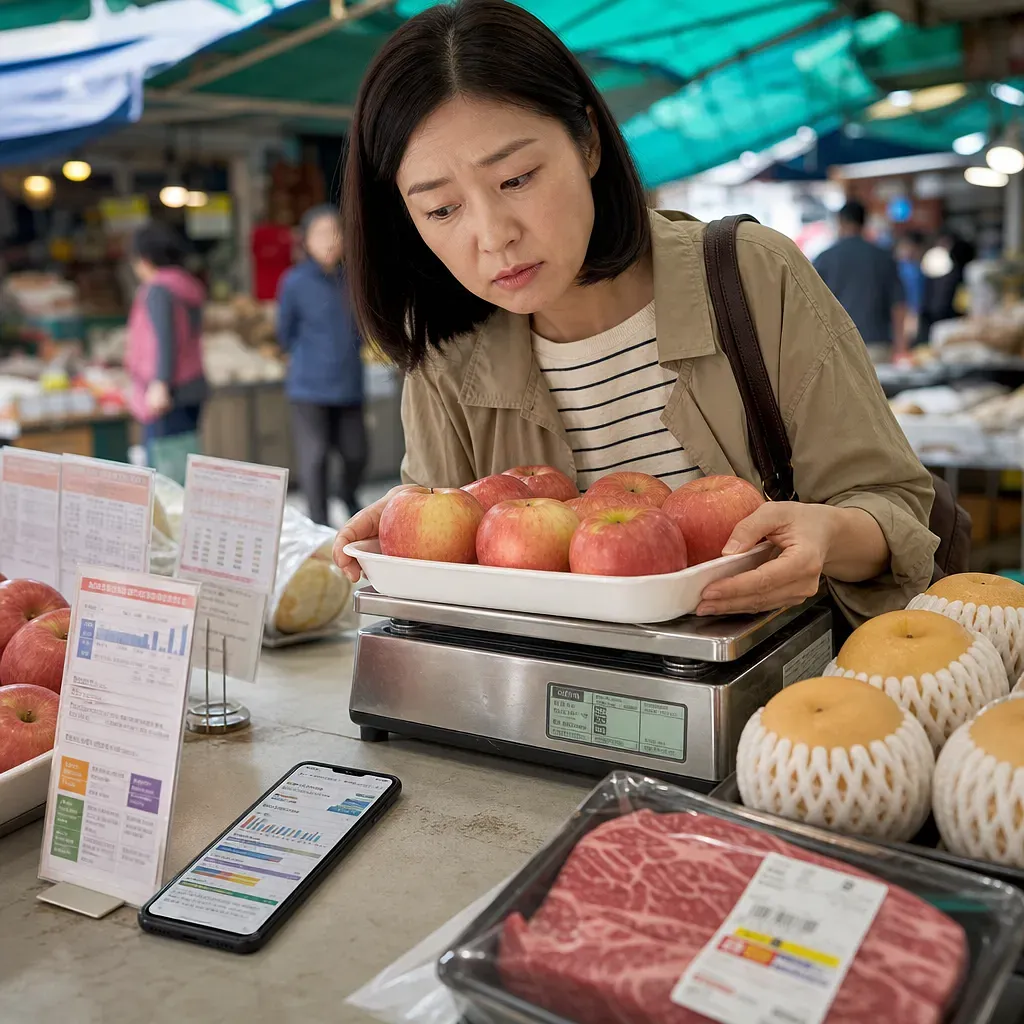
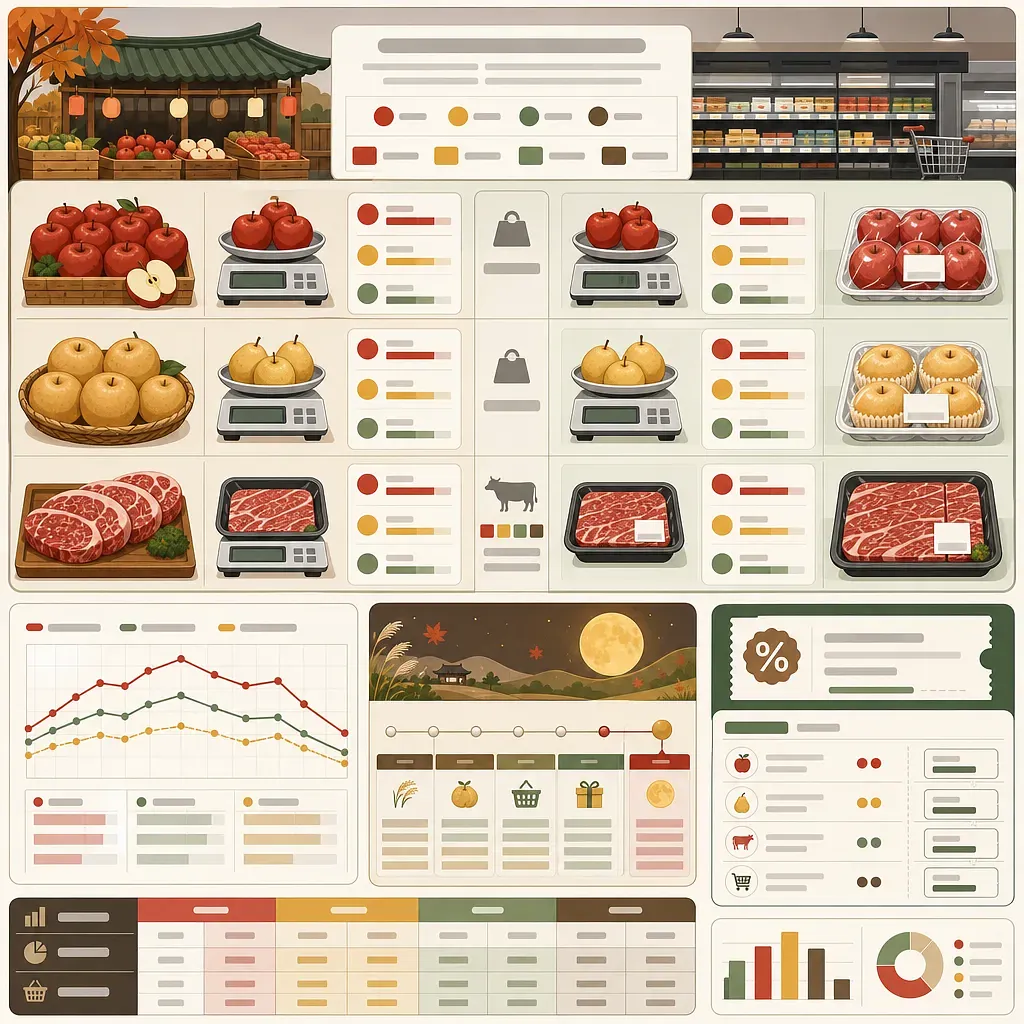
The most common mistake when comparing apple, pear, and Hanwoo prices ahead of Chuseok is assuming that products with the same item name are identical. If the variety, size or grade, Hanwoo cut, or survey unit differs, the displayed figures cannot be compared directly.
KAMIS Agricultural Marketing Information Service is an official service that lets users view surveyed prices by item at traditional markets and large retailers. However, KAMIS prices are not real-time transaction data from every store; they are collected and published according to established survey standards. You should therefore separately check promotional conditions and inventory at the store you plan to visit.
Traditional Markets or Large Supermarkets: Which Is Right for You?
It cannot be concluded that one type of retailer is always cheaper. Consider KAMIS survey prices for the same specifications alongside actual purchase conditions and decide based on your shopping habits.
| Comparison item | Traditional markets | Large supermarkets and large retailers |
|---|---|---|
| Best suited for | Shoppers who want flexibility in the quantity purchased and to select the size and condition in person | Shoppers who want to check package units, origin, grade labels, and promotional conditions and purchase everything at once |
| Price to compare | Traditional market survey price for the same region, item, specification, and unit | Large retailer survey price under the same conditions |
| Additional costs and conditions | Travel time, parking fees, and price differences among stores must be considered | Discounts may vary depending on membership, payment card, app coupons, and purchase quantity |
| Advantages | Quantity selection and in-person inspection may be relatively flexible | Specifications and conditions are often displayed, making comparisons easier |
| Drawbacks | Product specifications and prices at individual stores may differ from the survey average | Even if the regular price appears low, the actual discount may require meeting specific conditions |
| Final check | Actual specifications, sales unit, and price at the store you plan to visit | Promotion period, card conditions, per-person limits, and final payment amount |
Even if traditional market prices appear lower on KAMIS, this does not mean that actual prices at nearby stores are the same. Conversely, applying a large supermarket’s card discount or bundle promotion may produce a result different from the surveyed price.
Criteria You Must Match Before Comparing
Apples and Pears
For apples and pears, match all of the following:
- Item and variety: Different varieties of apples should be treated as separate products.
- Grade or quality: Do not mix high-grade and medium-grade products in a comparison.
- Survey unit: Check the unit displayed on the screen, such as 10 pieces, 1 piece, or package weight.
- Size and actual weight: Even sets of 10 pieces may have different total weights depending on fruit size.
- Survey region and date: Distribution conditions differ when the region or survey date differs.
In particular, converting the price of 10 pieces into a price per 1kg requires the actual total weight of those 10 pieces. If weight information is unavailable, it is more accurate to compare only units based on the number of pieces and not estimate a price per kg.
Hanwoo
Hanwoo cannot be compared based on the item name alone. At a minimum, the following conditions must be the same:
- Origin and cattle type
- Cut: sirloin, meat for bulgogi, meat for soup, etc.
- Meat quality grade
- Weight unit: for example, 100g or 1kg
- Whether refrigerated or frozen, and packaging conditions
Comparing sirloin prices with soup meat prices, or prices for different grades, and then deciding which retailer is cheaper will cause differences in product composition to be mistaken for price differences.
How to Compare Prices on KAMIS
There are no separate eligibility requirements or application periods for checking KAMIS prices. Simply select the required survey date and conditions on the publicly available retail price page.
- Choose the comparison date and region. Prioritize the same date and the same region.
- Narrow down the item. For apples and pears, check the variety and grade; for Hanwoo, check the cut and grade.
- Standardize the unit. If the displayed number or weight units differ, do not compare them directly; convert them into a common unit.
- View retailer types side by side. Record traditional market and large retailer values under the same survey conditions.
- Add previous-year and normal-year benchmarks. Do not look only at current prices; compare them with benchmark prices from a similar period.
- Check actual discount conditions separately. Record the KAMIS surveyed value separately from the price after applying membership, card, or coupon discounts at the store you plan to visit.
Weight conversion can be calculated as follows.
Comparison unit price = displayed price ÷ displayed weight × weight to be compared
For example, when comparing a 600g package with a 1kg package, convert both into a price per 100g or per 1kg. This formula cannot be applied to products such as fruit when only the number of pieces is provided and the actual weight is unavailable.
The difference between retailer types can be calculated as follows.
Price difference = large retailer price − traditional market price
Price difference rate = price difference ÷ traditional market price × 100
A positive rate means that the large retailer price is higher under the relevant survey conditions, while a negative rate means it is lower. This is a comparison of survey averages and does not guarantee the final payment amount at an individual store.
Differences Among Daily, Monthly, Annual, Previous-Year, and Normal-Year Prices
| Benchmark | Meaning and use | Points to note |
|---|---|---|
| Daily price | Shows the short-term price level on a specific survey date | Check how holidays, gaps in surveys, same-day promotions, and actual inventory are reflected |
| Monthly price | Shows price trends and the average monthly level over one month | The average may dilute sharp changes during the few days immediately before Chuseok |
| Annual price | Compares seasonality and long-term price levels | The range may be too broad for judging prices at the time of Chuseok shopping |
| Previous-year price | Compares with the same date or corresponding period 1 year earlier | Because the date of Chuseok changes each year, the timing of pre-holiday demand may not align |
| Normal-year price | Compares with the typical price level over multiple years | Check the calculation period and definition used on each page |
On KAMIS, normal-year prices are generally provided as a benchmark that uses data from several recent years to reduce the impact of temporary highs and lows. However, display criteria may vary by lookup table and type of statistics, so check the calculation explanation on the relevant page.
Daily prices are the most direct benchmark when deciding where to shop now. To determine whether current prices are unusually high, review previous-year and normal-year prices as well. Monthly and annual prices are more suitable for understanding seasonal trends and long-term levels than for choosing where to buy.