Hunminjeongeum: Creation and Promulgation by 1446
King Sejong created the 28 letters of Hunminjeongeum in 1443. He continued the project after an opposition memorial in 1444, laying broader groundwork for its use with the publication of the Haerye edition in 1446 and an order to introduce it into the clerical examination in 1447.
Hunminjeongeum is both the name of the script created in 1443 and the explanatory book published in 1446.
The opposition memorial submitted by Choe Man-ri and others raised concerns about relations with Ming, Confucian education, administrative operations, and the implementation process.
The Haerye edition explained the principles behind the creation of the letters and how they combine, along with examples of their use in actual words.
In 1447, an order was issued to include Hunminjeongeum in the clerical examination.
Hangul Day in 2026 marks the 580th anniversary of the 1446 promulgation, while October 9 is distinct from the actual promulgation date confirmed by historical records.
Sejong created the 28 letters of Hunminjeongeum in 1443 to solve the difficulty of writing the Korean language. Despite an opposing memorial in 1444, he continued work on an explanatory text. The Haerye edition, published in 1446, presented both the principles and usage of the new script.
This article follows the National Institute of Korean History's 『Veritable Records of King Sejong』 and was checked in September 2026.
The Difference Between the Creation and Promulgation of Hunminjeongeum
Hunminjeongeum is the name of both the script and the book. The script was created in 1443. The Haerye edition of 『Hunminjeongeum』, which explained the script, was published in 1446.
Creation refers to developing the writing system. Promulgation refers to making it widely known to the public. Hangeul Day commemorates the publication and promulgation of the Haerye edition in 1446.
Category | Hunminjeongeum script | Haerye edition of 『Hunminjeongeum』
Date established | 1443 | 1446
Subject | Newly created writing system of 28 letters | Book explaining the purpose, principles, and usage of the script
Main role | A means of writing the sounds of the Korean language | A standard for learning and using the new script
This distinction follows the National Hangeul Museum's explanation of Hangeul Day.
Timeline from 1443 to 1447
After its creation, Hunminjeongeum was introduced into government institutions following controversy and the publication of an explanatory text. The months and days in the historical records below use the lunar calendar of the time. They have not been converted into modern Gregorian calendar dates.
Date of record | Event | Supporting record
Lunar December 1443 | Recorded Sejong's creation of 28 eonmun letters | December 30 entry in 『Veritable Records of King Sejong』
Lunar February 20, 1444 | Choe Malli and others submitted an opposing memorial | Entry for that date in 『Veritable Records of King Sejong』
First ten days of lunar September 1446 | Date when Jeong Inji's preface to the Haerye edition was written | Jeong Inji's preface as presented by the National Hangeul Museum
Lunar September 1446 | Recorded the completion of 『Hunminjeongeum』 | September 29 entry in 『Veritable Records of King Sejong』
Lunar April 20, 1447 | Ordered Hunminjeongeum to be included in the igwa examination | Entry for that date in 『Veritable Records of King Sejong』
The Background to Its Creation Was the Gap Between Speech and Writing
Sejong stated that the purpose of creating the script was to help the people express themselves. At the time, Korean differed structurally from Classical Chinese. It was difficult to represent everyday speech using only methods that borrowed Chinese characters.
The royal preface included in 『Veritable Records of King Sejong』 directly explains this problem. A royal preface is a text written by the king himself. The preface presents everyday use as the goal of creating the script.
It is simply so that people may easily learn it and use it conveniently every day. Korean translation of the royal preface in the September 29 entry for the 28th year of King Sejong, 『Veritable Records of King Sejong』
Idu was a method of writing Korean by borrowing the sounds and meanings of Chinese characters. Using it required knowledge of Chinese characters. Jeong Inji's preface points out the difficulty of this borrowed-character notation.
The uses of the new script also included transcribing the pronunciation of Chinese characters. The 1444 controversy addressed the revision of rhyme dictionaries. A rhyme dictionary is a book organizing the sounds and rhymes of Chinese characters. The goal of writing Korean and the study of Chinese-character pronunciation must be considered together.
Why Did Choe Malli and Others Oppose It?
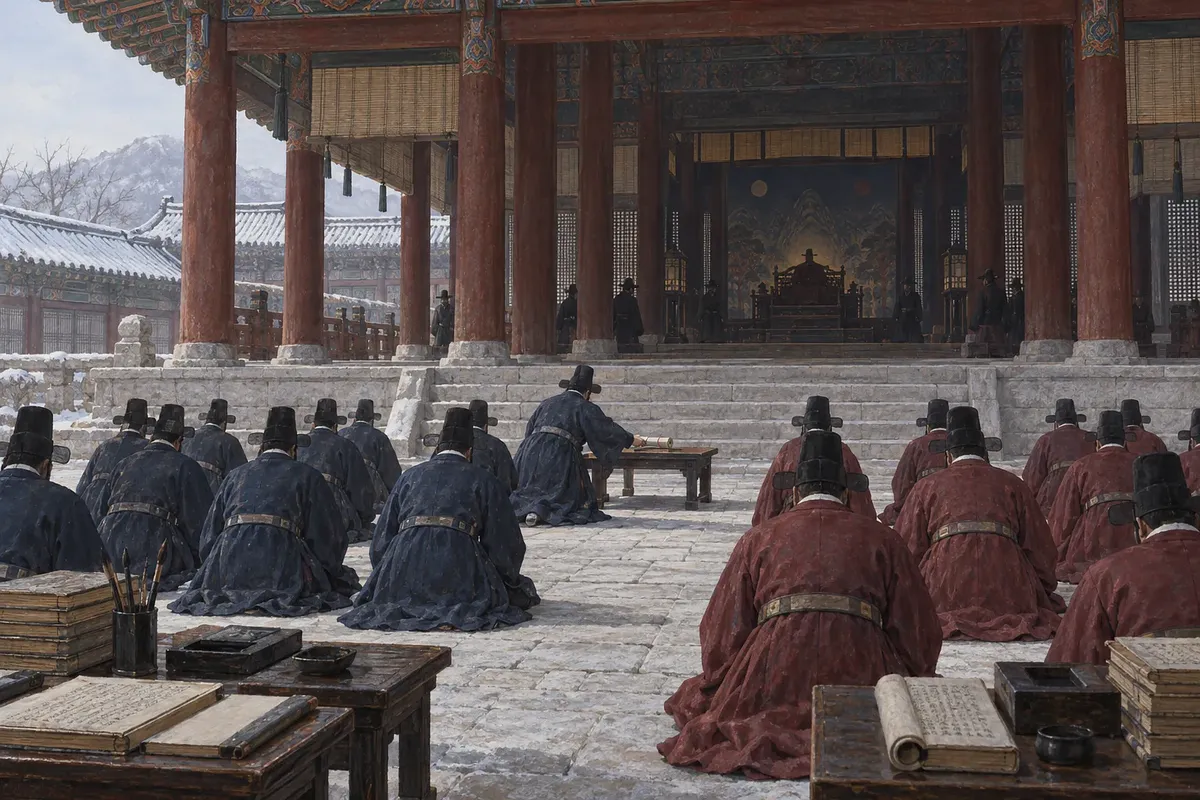
The memorial submitted by Choe Malli and others argued that the new script could disrupt the existing order. Their opposition was not directed only at the shapes of the letters. Foreign relations, education, and government administration were also subjects of controversy.
Issue | Argument in the opposing memorial | Sejong's response or position
Relations with Ming | Concern that a separate script conflicted with the attitude of following the institutions of Chinese civilization | Cited the convenience of the people as the basis for the new script
Confucian education | Claimed that learning only an easy script would reduce the study of Classical Chinese and Neo-Confucianism | Sought to use it as a means of conveying Confucian ethics to the people
Government administration | Claimed that the new script was unnecessary for work already handled through idu | Countered that idu had also been used for the convenience of the people
Fairness of trials | Claimed that injustice was caused by the officials in charge rather than by the script | Emphasized the problem of the people understanding spoken and written language
Implementation process | Criticized the lack of discussion and the rush to produce and distribute the script | Explained the need for rhyme-dictionary research and the crown prince's participation in the project
This comparison is based on the February 20, 1444 entry in 『Veritable Records of King Sejong』. It is difficult to characterize the entire opposition as a group seeking to prevent the people from learning. The arguments shown in the record must be distinguished from the individuals' hidden motives.
The Turning Point After the Opposition Was the Publication of the Haerye Edition
Sejong continued the script project even after the controversy. On the day the memorial was submitted, he sent the officials involved to the State Tribunal. He ordered their release the next day, but dismissed Jeong Changson from office.
This action cannot be interpreted as agreement by the opposition. The result confirmed in the 1446 record is the completion of the explanatory text. The continuation of the project and its publication are clearer facts than the end of the controversy.
Jeong Inji's preface states that interpretations and examples were written by royal command. Jeong Inji, Choe Hang, Shin Sukju, Seong Sammun, and others are recorded as participants. The roles of creating the letters and compiling the explanatory text must therefore be distinguished.
What Principles Were Used to Create the Consonants and Vowels?
Hunminjeongeum is a writing system that connects the characteristics of sounds with the shapes of letters. The Haerye edition of 1446 has 17 initial consonant letters. It has 11 medial vowel letters, for a total of 28 letters.
Category | Basic principle | Explanatory example
Basic consonant letters | Modeled on the speech organs or the act of articulation | ㄴ represents the tongue touching the upper gums
Expansion of consonants | Added strokes to basic letters | ㅋ formed by adding a stroke to ㄱ
Basic vowel letters | Used the forms of heaven, earth, and humanity | ㆍ, ㅡ, ㅣ
Expansion of vowels | Combined basic elements | ㅗ, ㅏ, ㅜ, ㅓ
Syllable construction | Combined initial, medial, and final sounds | Combination of the first sound, middle sound, and final consonant
The basic consonant letters are ㄱ, ㄴ, ㅁ, ㅅ, and ㅇ. Not all consonants follow the same rule of adding strokes. Letters used for initial sounds were reused for final consonants.
This explanation is based on the National Institute of Korean History's explanation of the Haerye edition.
Why Explanations and Examples Were Published Together
The Haerye edition was a book that connected the list of letters to their actual use. The Examples and Significance section contained the purpose of the script's creation and its basic rules of use. The Explanations and Examples section explained its principles in detail.
Section | Content explained | Role in learning
Explanation of the Design of the Letters | Principles used to create the letters | Understanding the relationship between shape and sound
Explanations of Initials, Medials, and Finals | Each sound forming a syllable | Distinguishing the function of each letter
Explanation of Combining Letters | How to combine letters | Learning how to write a syllable
Examples of the Uses of the Letters | Written forms of actual words | Checking examples in which the rules are applied
The National Heritage Portal explains that the Examples of the Uses of the Letters contains examples involving 94 words. This figure concerns the structure of the 1446 Haerye edition. It does not mean that people at the time actually learned that number of words.
Including rules and examples together makes it possible to compare the explanations with actual written forms. This is an educational function that can be inferred from the structure of the Haerye edition. However, the distribution rate at the time cannot be calculated from the book's structure alone. The information on its structure follows the National Heritage Portal's explanation of the Haerye edition.
The Difference Between Introducing the Examination in 1447 and Widespread Adoption
The 1447 record describes an institutional measure linking the new script to the selection of government personnel. Sejong ordered the Ministry of Personnel to administer a Hunminjeongeum examination. It specifically applied to candidates for the igwa examination and to the igwa examinations of each government office.
Here, igwa means the examination used to select clerks responsible for administrative work. For candidates from Hamgil Province, it was to apply from the next triennial examination year. Candidates had to pass Hunminjeongeum before they could take the other examinations. Sejong also ordered Hunminjeongeum to be included in the igwa examinations of each government office.
· Confirmed fact: An order to include Hunminjeongeum in the selection criteria
· Claim that cannot be made more broadly: It was designated a required subject for all civil service examinations
· Figures that cannot be learned from this entry: The actual number of candidates, pass rate, and rate of adoption among the general public
Introducing the examination created an institutional reason to learn the new script. However, an order and the results of its actual implementation require separate evidence. It also does not mean that all people used the script immediately after its promulgation.
Records and Interpretation
The records distinguish between Sejong's creation of the script and the scholars' participation in explaining it. Sufficient details about the work before its creation have not survived. Confirmed facts and later hypotheses must not be treated as having the same status.
What the Records State Directly
The 1443 entry states that Sejong personally created the 28 letters. Jeong Inji's 1446 preface identifies those who participated in the explanations. These records provide grounds for distinguishing the creator of the script from the writers of the explanatory text.
Generally Accepted Explanation
Public historical accounts take Sejong's creation of the script and the scholars' compilation of the Haerye as their basic position. There is insufficient evidence to conclude that the Hall of Worthies jointly carried out all the work of creating the script. Conversely, the explanatory work of the Hall of Worthies scholars must not be erased.
Controversy Over Shinmi's Role
There are differing interpretations of the extent of Shinmi's participation in creating the script. The National Institute of Korean Language's May 2017 newsletter presented two views side by side. Kim Mubong distinguished between Sejong's creation of the script and Shinmi's role in distributing it. Jeong Gwang proposed that Sejong and Shinmi created it jointly.
This does not mean that the newsletter confirmed either view. The entries on the creation and completion mentioned above do not identify Shinmi as a creator. A scene in a film cannot itself serve as historical evidence. The source of these views is the relevant issue of the National Institute of Korean Language newsletter.
The Difference Between the Date of a Record and the Date of an Event
The date of an entry in the annals does not necessarily mean the exact date on which an event occurred. The December 30, 1443 entry records that the script was created during that month. The September 29, 1446 entry also states that the book was completed during that month.
Date information | What can be confirmed | Conclusion to avoid
December 30, 1443 entry | Record of the script's creation in lunar December | The script was created exactly on December 30
September 29, 1446 entry | Record of the book's completion in lunar September | The script was promulgated exactly on September 29
First ten days of September in Jeong Inji's preface | The preface was written in early lunar September | A promulgation event on a specific day
Modern October 9 | Hangeul Day commemoration | Confirmation of the actual date of promulgation at the time
This distinction is also necessary when recording historical information as data. The date of the entry and the time of the event should be preserved as separate fields. It is also more accurate to display the commemorative date separately from those two dates.
The Meaning of the 580th Anniversary of Hangeul Day in 2026
October 9, 2026 (South Korea) is the 580th anniversary commemorating the promulgation in 1446. This differs from the number of years counted from the script's creation in 1443. As of September 25, 2026, 14 days remain until the commemoration.
October 9 is a commemorative date chosen based on the date in Jeong Inji's preface to the Haerye edition. The preface records the first ten days of lunar September. The National Institute of Korean Language explains that the date was set using the last day of that period. This background can be found in the National Institute of Korean Language's explanation of the date of Hangeul Day.
Its significance today lies in the fact that both the letters and instructions for their use were preserved. The Haerye edition is a document that allows the purpose of the script's creation to be examined. The principles behind the composition of the letters can also be confirmed through this document. This book was also the item inscribed on the Memory of the World Register in 1997.
Frequently Asked Questions
Was Hunminjeongeum created in 1443 or 1446?
The script was created in 1443. The Haerye edition was published in 1446. Both years appear because the script and the book share the same name.
Was Choe Malli's opposing memorial submitted before the script was created?
The memorial of 1444 came after the 1443 record of the script's creation. It opposed the implementation and distribution of the new script. By the time of the memorial, the learning and printing of the script had already become subjects of controversy.
Did Sejong persuade all the opponents to agree?
The relevant entry does not state that the entire opposition agreed. It records arguments between the king and his officials, as well as disciplinary measures. The fact that the book was later published must be distinguished from agreement by the opposition.
Was the Haerye edition written in Hangeul?
The explanatory sentences in the Haerye edition were written in Classical Chinese. The new letters and examples of Korean words were included in it. It is distinct from the eonhae edition, which translated the explanations into Korean.
Did all government officials take a Hunminjeongeum examination starting in 1447?
It cannot be generalized that way. The relevant record is an order concerning selection through the igwa examination. It does not record that the requirement applied to every government post or every civil service examination.
Is Hangeul Day the actual date of promulgation?
October 9 was chosen as a day to commemorate the promulgation. Records from the time do not specify its exact date. The date of the commemoration must be distinguished from the date of the historical event.
 Injoys