Injoys
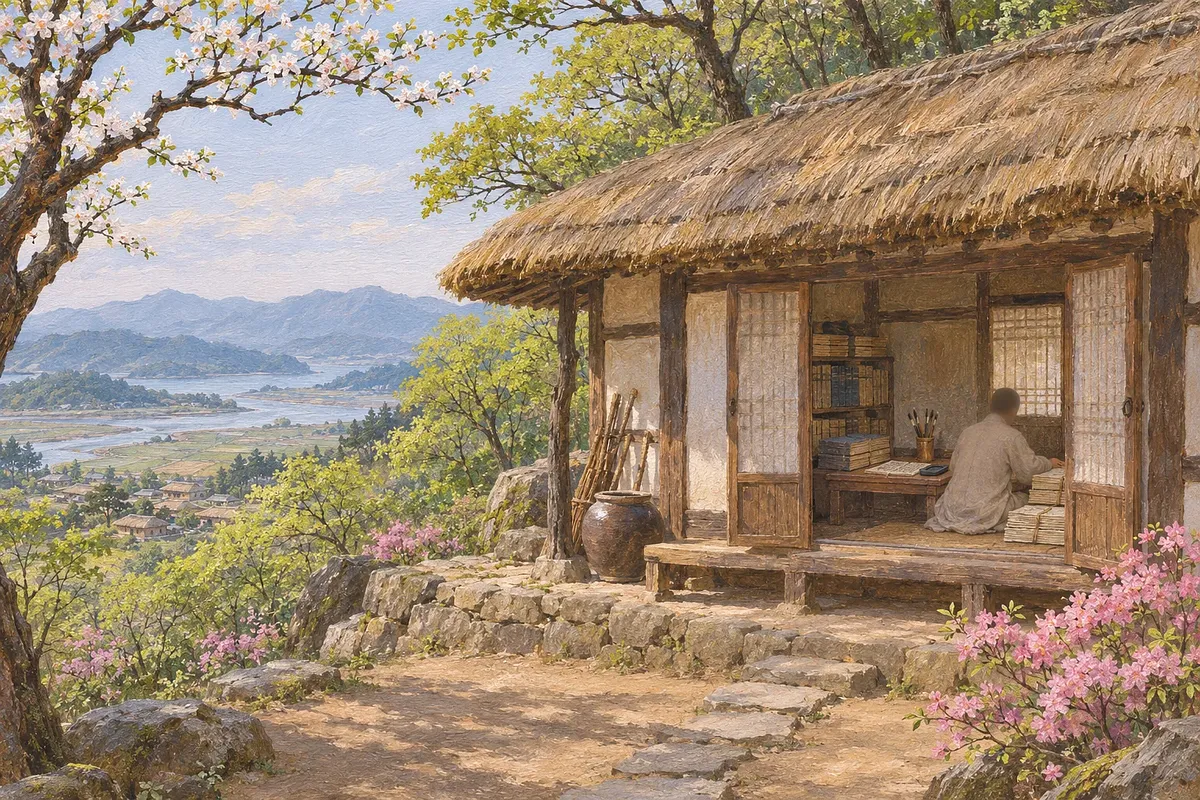
The exile that began in 1801 made it difficult for Jeong Yak-yong to take part in administration. Drawing on his experience in office and written sources, he completed the first draft of Mongmin Simseo in the spring of 1818. He is remembered for leaving his ideas for changing society in the form of a guide to local administration.
This article was written after consulting sources including Our History Net’s commentary on “Preface to Mongmin Simseo” in November 2026.
Jeong Yak-yong’s Life and Writing Timeline
Jeong Yak-yong was a late Joseon scholar who was born in 1762 and died in 1836. He is widely known by his pen name, Dasan. As an official during King Jeongjo’s reign, he encountered the problems of local administration firsthand.
After passing the literary civil service examination in 1789, he held posts in central and local government. He took part in designing Hwaseong Fortress in Suwon and devised the geojunggi crane. His experience as a secret royal inspector and magistrate of Goksan provided a foundation for his later writings on administration.
| Period | Events and Writing Activities | Verification Source |
|---|---|---|
| 1762 | Born in what is now Namyangju | Encyclopedia of Korean Culture, “Jeong Yak-yong” |
| 1789 | Began his official career after passing the literary civil service examination | Our History Net, “Jeong Yak-yong” |
| 1794 | Served as a secret royal inspector in the Gyeonggi region | Our History Net, “Jeong Yak-yong” |
| 1797 | Took office as magistrate of Goksan | Our History Net, “Jeong Yak-yong” |
| 1801 | Exiled to Gangjin after first being sent to Janggi | Our History Net, “Jeong Yak-yong” |
| 1808 | Moved to Dasan Chodang | Gangjin Cultural Center, “Historic Site / Jeong Yak-yong Historic Site” |
| Spring 1818 | Completed the first draft of Mongmin Simseo | Our History Net, “Mongmin Simseo,” introduction to Chronological Biography of Master Saam |
| September 1818 | Released from exile | Our History Net, “Mongmin Simseo” |
| After returning home | Revised Mongmin Simseo in his hometown | Our History Net, “Mongmin Simseo” |
| 1822 | Wrote “Self-Written Epitaph,” reviewing his life and writings | Our History Net, “Jeong Yak-yong” |
| 1836 | Died in his hometown | Encyclopedia of Korean Culture, “Jeong Yak-yong” |
The months follow the dates presented in Our History Net’s commentary. Lunar dates in historical sources have not been converted to the Gregorian calendar. Completion of the first draft and release from exile were separate events that occurred in the same year.
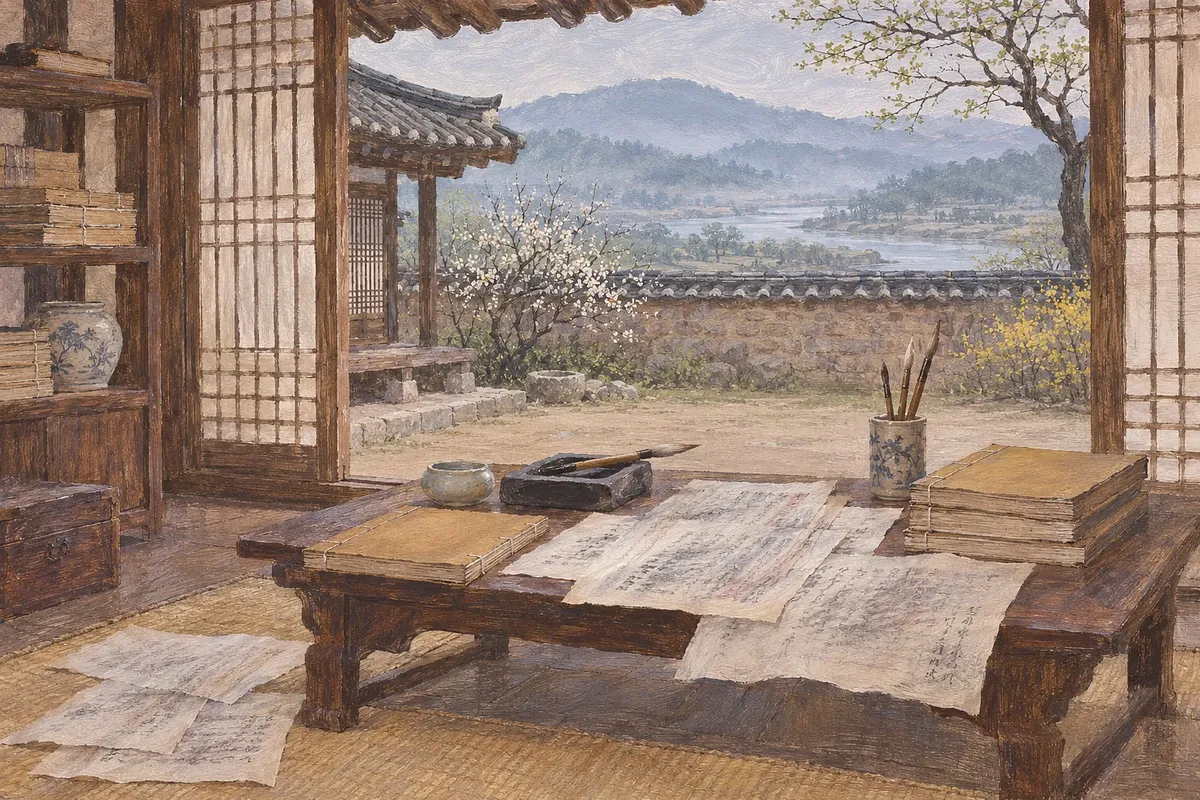
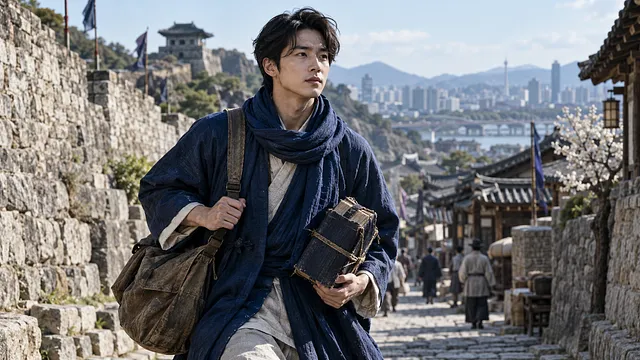
Jeong Yak-yong continued revising Mokminsimseo after returning home from exile.AI-generated image
The Background to His Exile and Life in Gangjin
The immediate cause of his exile was his implication in the Sinyu Persecution of 1801. He was first sent to Janggi in Gyeongsang-do. After being investigated again over the Hwang Sa-yeong Silk Letter Incident, he was exiled to Gangjin.
This incident occurred amid the persecution of Catholics and the political conflicts of the time. His political protection had also weakened after King Jeongjo’s death. Exile was not simply a change of residence but a punishment that restricted public activity.
He did not spend his entire time in Gangjin at Dasan Chodang. In the early years, he stayed in several places, including a tavern in Gangjin-eup. After moving to Dasan Chodang in 1808, he continued writing while teaching students.
Dasan Chodang is a place that reflects his research and teaching during the later years of exile. The surrounding area is now known as the Jeong Yak-yong Historic Site in Gangjin. His period of residence at the site must be distinguished from his entire period of exile in Gangjin.
The Background to Writing Mongmin Simseo and Organizing Its Sources
The starting point for the book was his concern that local officials’ administration was harming people’s lives. A suryeong was a local official who governed a district. In the preface, Jeong Yak-yong criticized the reality of local magistrates pursuing private gain.
Organizing his experience into guidelines for specific duties was a turning point in creating the book. “Preface to Mongmin Simseo” explains that he selected examples of past officials from written sources. He also added his own views on abuses in tax administration that he heard about in exile.
| Sources Used in Writing | Contents | Role in the Book |
|---|---|---|
| Experience in office and everyday life | What he observed where his father served, and his own experience as a royal inspector and local magistrate | Presented problems arising in administrative practice |
| Historical works, legal codes, and collected writings | Examples of past officials, legal systems, and earlier discussions | Provided grounds for judgment and reference cases |
| Conditions encountered in exile | Manipulation by local clerks handling administrative work and problems with taxation | Supplemented criticism of abuses at the time and proposed alternatives |
This structure makes it difficult to classify Mongmin Simseo as a collection of personal reflections from exile. It is a work on administration that gathers examples and classifies them by topic. It transformed personal experience into a form that other local officials could consult.
The Meaning of Mongmin and Simseo
Mongmin means governing and caring for the people. The name Simseo reflects his circumstances, which made it difficult to put his ideas into practice himself. The preface explains the title as follows.
Why call it Simseo? Because I have the wish to care for the people but cannot put it into practice myself. That is why I gave it this name.
This explanation appears in “Preface to Mongmin Simseo,” collection 1, volume 12 of Jeong Yak-yong’s Yeoyudang Jeonseo.
The Contents of Mongmin Simseo: 12 Parts and 72 Articles
Mongmin Simseo divides the duties of local magistrates into 12 parts and 72 articles. Each part contains 6 articles. It begins with preparations for taking office and continues through the process of leaving office.
| Part | Main Contents | Issues Addressed in Local Administration |
|---|---|---|
| Buim | The process of taking office after appointment | Procedures for starting work in a new district |
| Yulgi | Managing the magistrate’s own conduct and daily life | Integrity, frugality, and control of private interests |
| Bonggong | Principles for carrying out public duties | Obligations to the state, including compliance with laws and reporting |
| Aemin | Caring for people who need protection | The lives of older people, young children, the sick, and others |
| Ijeon, Hojeon, Yejeon, Byeongjeon, Hyeongjeon, Gongjeon | Administration by field | Personnel, taxation, education, military affairs, trials, and facilities management |
| Jinhwang | Relief in response to famine | Securing and managing relief resources |
| Haegwan | The process of leaving office | Conduct during replacement and departure |
Yulgi addresses how magistrates should control their private desires. Aemin asks what administration should do for people who need protection. Jinhwang organizes the response to famine as a separate duty.
Lessons on integrity alone therefore cannot explain the entire book. Specific fields of administration, such as taxation and trials, also occupy a substantial portion. Its use of the six-code structure of Gyeongguk Daejeon also reflects this character.
Comparison with Gyeongse Yupyo and Heumheum Sinseo
Mongmin Simseo should be read as a work centered on the duties of local officials. Its scope differs from that of Gyeongse Yupyo, which addresses state institutions. It is also distinct from Heumheum Sinseo, which deals with judgments in criminal cases.
| Work | Central Subject | Focus for Understanding |
|---|---|---|
| Gyeongse Yupyo | State institutions and structures of governance | How should the country’s institutions be reformed? |
| Mongmin Simseo | The duties of magistrates governing local districts | How should local administration be improved? |
| Heumheum Sinseo | The examination and judgment of criminal cases | What grounds support careful judgments in cases? |
The three works are collectively called Ilpyo Iseo. Namyangju City’s account of his life states that Heumheum Sinseo was completed the year after his release from exile. Grouping all his major works together as having been completed in exile obscures the writing process.