Salted Cabbage Washing After at Least 1 Day at Room Temp
The Ministry of Food and Drug Safety recommends using salted cabbage the day it is received. If it has been stored at room temperature for at least 1 day, wash it before use, but avoid washing it more than 3 times.
The recommendation to use salted cabbage the day it is received does not guarantee that storing it at room temperature for a day is safe.
Even if the label says no rewashing is needed, you should also check the actual storage conditions after receipt.
The Ministry of Food and Drug Safety recommends washing salted cabbage before use if it has been stored at room temperature for at least 1 day.
Excessive washing can damage the cabbage, so it is best to wash it at most 3 times.
The Ministry of Food and Drug Safety guidance reviewed does not specify a number of days of refrigerated storage that applies to all products.
Salted napa cabbage is best used on the day it arrives. If it has been stored at room temperature for at least 1 day, washing before use is recommended. It is best not to wash it more than 3 times. Even if the label says no rewashing is needed, you should also check how it has actually been stored.
The usage and washing guidelines and experimental figures are based on notices issued by the Ministry of Food and Drug Safety (MFDS) on October 27, 2015, and November 13, 2019.
Why use it on the day it arrives?
The recommendation to use it the same day is intended to limit microbial growth during storage. The MFDS explains that coliform bacteria can increase if the cabbage is left at room temperature for at least 1 day. Coliform bacteria are used as an indicator of food hygiene.
Salted napa cabbage is an ingredient that has been treated with brine, washed, and drained. The MFDS explained that some products can be used without rewashing or draining. This does not mean that every product needs to be washed again.
You can find the definition and usage instructions in the MFDS's 2015 press release. The same usage principles appear in the KDI posting of the 2019 notice. These should not be presented as new rules introduced in 2026.
Deciding whether to use it based on storage conditions
You need to consider both the product's usage label and its storage conditions after arrival. A label stating that no rewashing is needed provides information on how to use the product. It does not guarantee its condition after a long period at room temperature.
Situation after arrival | How to decide | What to check
Using it on the day it arrives, with a label stating that no rewashing is needed | Prepare according to the product instructions | Storage and usage instructions on the package, and the product's condition
The product specifically instructs you to wash it | Check that product's washing instructions | The specific washing method
Stored at room temperature for at least 1 day | The MFDS recommends washing before use | Number of washes and any signs of spoilage
Planning to use it after refrigerated storage | Do not assume a standard number of storage days applies | Storage conditions and use-by period specified by the manufacturer or seller
Storage history is unclear | Do not decide whether to use it based only on the rewashing label | Delivery and storage history, and the seller's guidance
Spoilage is suspected | Do not try to salvage it through repeated washing | Stop using it and check its condition with the seller
The 1-day room-temperature condition does not mean it is safe to leave the cabbage out for that long. The principle of using it on the day it arrives must be distinguished from the recommendation to wash it after storage. If your schedule changes, check the product-specific storage instructions first.
How many times to wash salted napa cabbage and how to do it
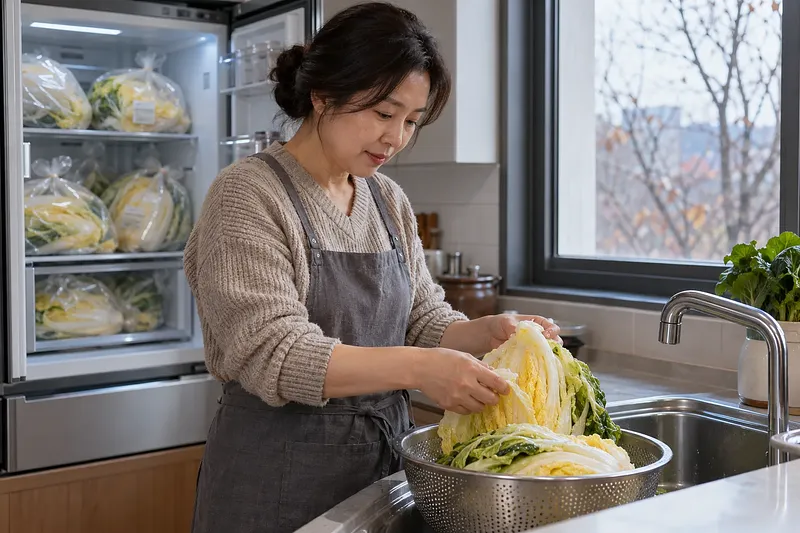
When washing is needed, the MFDS recommends washing no more than 3 times. Excessive washing can damage the cabbage, including making it soft. The following method was provided in the 2015 press release.
· Immerse the cabbage in water.
· Gently rub the root area and between the leaves with your fingers to wash them.
· Then rinse with water 2 times.
This consists of washing by rubbing, followed by two rinses. It does not mean washing three times and then rinsing another two times. The MFDS press release, “Use Salted Napa Cabbage Safely During Kimchi-Making Season,” warns:
However, excessive washing can damage salted napa cabbage, so it is best not to wash it more than 3 times.
What the bacterial reduction figures mean
The published reduction rates compare experimental results with levels before washing. The MFDS's 2015 announcement reported changes after about 3 washes. Total bacterial count and coliform bacteria are separate measurements.
Measurement | Reduction compared with before washing | Basis for the figure
Total bacterial count | 95% | An experiment involving about 3 washes, reported by the MFDS in 2015
Coliform bacteria | 93% | Compared with levels before washing in the same experiment
These results cannot determine whether an individual product is safe. They are not evidence that washing can restore spoiled cabbage. They should not be interpreted to mean that increasing the number of washes ensures safety.
How origin and weight labels differ from storage instructions
Origin and package weight provide different information from storage history. Goesan-gun's description of its locally produced cabbage explains cabbage cultivation, salting, and washing processes. Separate product instructions are needed to decide how to use it after arrival.
Information to check on the product | What it tells you | What to check separately
Production area, such as Goesan or Haenam | The stated production region | How to store the actual product
Origins of the cabbage and salt | Sources of the ingredients | How long it can be used after arrival
Number of washes during production | Processing at the production stage | Whether the consumer needs to wash it again
Package weight | The amount of cabbage being ordered | Number of heads and whether seasoning is included
Delivery on a specified date | The delivery schedule stated by the seller | Whether the date is the shipping date or expected arrival date
The amount of seasoning should also be checked against the quantity of cabbage specified by the seller. The standard kimchi seasoning listings from Haengbokhan Haenam Nongjang show the following combinations. These are the corresponding quantities for that product.
Amount of cabbage | Weight of standard kimchi seasoning
10kg | 3.5kg
20kg | 7kg
This ratio cannot be applied as a standard for all seasoning products. Check the seller's kimchi seasoning listings for combinations by weight. Prices and available delivery dates must also be checked separately for the product you plan to order.
Recording delivery time and storage history
Recording the arrival time and storage location makes it easier to distinguish the conditions. This is a way to apply the same-day use recommendation to your actual schedule. The record itself does not guarantee food safety.
· Receipt details: The date and time the package arrived
· Storage details: Where it was kept after arrival and how it was stored
· Product details: Photos of the storage and washing instructions on the package
· Inquiry details: The seller's responses to delivery delays or schedule changes
If the actual storage conditions differ from the instructions on the package, you need to check. When making an inquiry, provide the product name and storage history together. Do not mix in the seasoning while it is still unclear whether the cabbage can be used.
Frequently asked questions
How many days can it be stored in the refrigerator?
The MFDS notices reviewed do not specify a standard number of days for refrigerated storage. You cannot assign an arbitrary use-by period simply because it has been refrigerated. Check the product label and the manufacturer's or seller's storage instructions.
Can I skip washing because fermentation eliminates coliform bacteria?
Fermentation is not a reason to skip necessary hygiene measures. The MFDS explained that lactic acid bacteria kill coliform bacteria during fermentation. It also stated that ingredients for kimchi-making must be handled hygienically.
Is it better to wash cabbage left at room temperature as many times as possible?
Continuing to increase the number of washes is not recommended. The MFDS explains that excessive washing can damage the cabbage. If spoilage is suspected, stop using it rather than washing it repeatedly.
Does the same-day use principle change depending on the production area?
The MFDS notices reviewed do not limit the recommendation to a particular production area. Descriptions of cultivation and processing in the production area must be distinguished from care after arrival. Consider both the individual product's label and its actual storage conditions.
 Injoys