Injoys
Scrub typhus is an infectious disease caused by the bite of a chigger larva carrying the bacteria. The basis of prevention is reducing skin exposure during outdoor activities. Infection is still possible even if no black scab, known as an eschar, is visible. A fever after outdoor activities requires medical attention.
The information on the peak season in South Korea and the numbers of chiggers collected is based on the Korea Disease Control and Prevention Agency's announcement of August 26, 2026.
Scrub typhus transmission and autumn cases
Infection occurs through the bite of a chigger larva carrying the pathogen. The pathogen responsible is the bacterium Orientia tsutsugamushi. The bacteria enter the body as the larva attaches to the skin and feeds on body fluids.
Chiggers live in grassy areas and environments with shrubs. Exposure can occur not only during farm work but also while clearing vegetation around graves, hiking, or camping. It is important to identify activities that involved actual contact with grass rather than focusing on a person's occupation.
Cases in South Korea are generally concentrated in October to November. This is when chigger larval activity overlaps with outdoor work during the harvest season. However, the disease is not limited to these two months in autumn.
The Korea Disease Control and Prevention Agency's August 2026 guidance identifies October to November as the peak period for cases. Infection therefore cannot be ruled out simply because November has passed. In other countries, the peak season varies with the local climate.

Washing worn clothing after returning from outdoor activities is a basic step in preventing scrub typhus.
Scrub typhus symptoms and when to seek medical care
Typical symptoms include fever, chills, headache, and muscle pain. A skin rash or swollen lymph nodes may also occur. Early symptoms alone make it difficult to distinguish the disease from a cold or other infections that cause fever.
The National Health Information Portal states that the incubation period is within 10 days after a bite. The incubation period is the time between infection and the onset of symptoms. This period should not be used as a basis for diagnosing yourself at home or delaying medical care.
The Honam Regional Center for Disease Control and Prevention's announcement, “Launch of Scrub Typhus Vector Surveillance in the Honam Region,” includes the following guidance.
If you develop a fever after outdoor activities in autumn, visit a nearby medical facility for diagnosis and treatment.
A fever or rash after outdoor activities requires prompt medical attention. Tell the medical team about your activities even if you do not remember being bitten by a mite. Difficulty breathing or reduced alertness requires emergency medical care.
- Common symptoms that raise suspicion: fever, chills, headache, muscle pain, rash
- Information to check alongside symptoms: recent outdoor activities, skin changes, date symptoms began
- Warning signs of a potentially severe condition: difficulty breathing, changes in consciousness
The significance and limitations of an eschar in scrub typhus
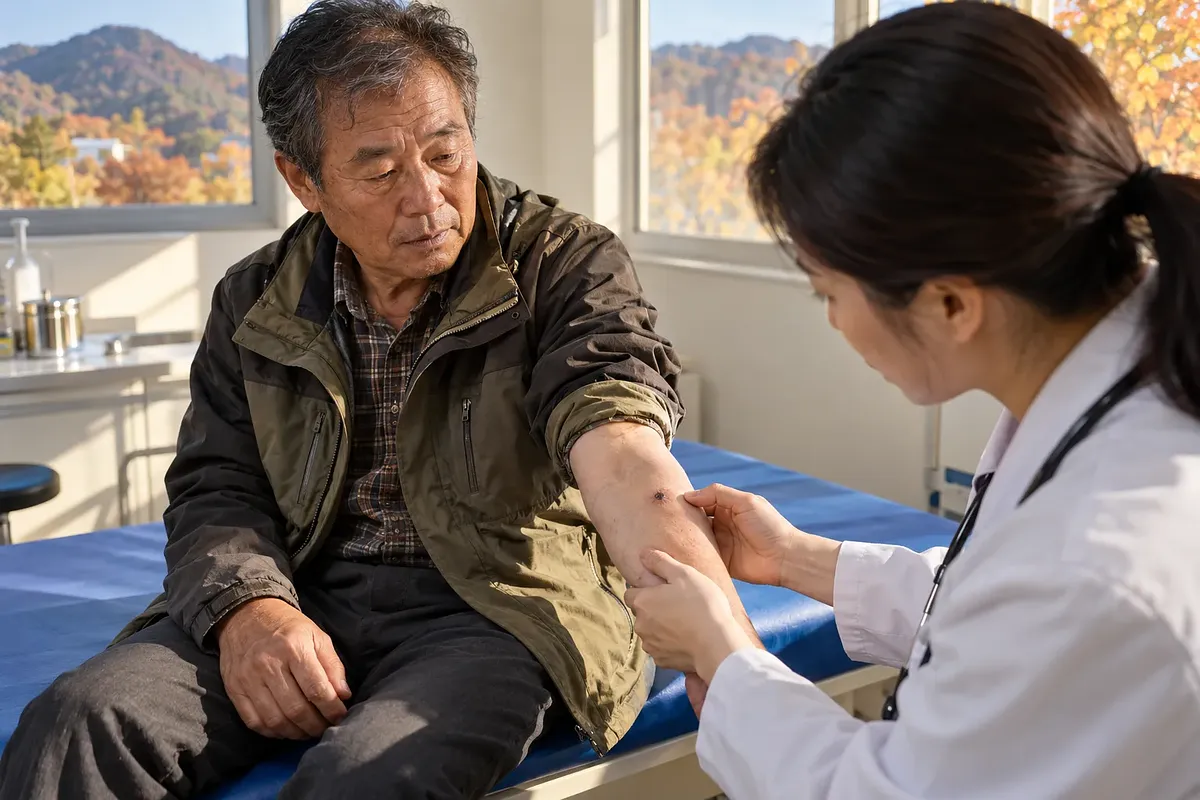
An eschar is a scab that forms when skin tissue at the bite site is damaged. In this disease, a black scab provides a diagnostic clue. It is a different skin change from a rash that spreads over the trunk or limbs.
Eschars can form in hidden areas such as the armpits and groin. They may also occur in places that are difficult to check, such as the scalp or behind the ears. Looking only at the easily visible arms and legs is not enough to conclude that there is no eschar.
An eschar is not found in every patient. Even if you find a black scab, that alone cannot confirm the diagnosis. Medical professionals assess activity history, symptoms, physical examination findings, and test results together.
| Observation | What it may indicate | Judgment to avoid |
|---|---|---|
| Fever and a black scab after outdoor activities | A clue to infection that should be reported during a medical visit | Confirming the diagnosis from a photo alone |
| Fever alone after outdoor activities | Infection needs to be considered even without an eschar | Assuming it must be a cold because there is no scab |
| A black scab alone | The cause of the skin lesion needs to be checked | Treating every black scab as the same infectious disease |
Scrub typhus prevention before and after activities
The key to prevention is reducing opportunities for chiggers to come into contact with the skin. Repellents are an additional measure to use alongside clothing that covers the arms and legs. After returning home, wash your body and launder the clothes worn during the activity.
Preparation before activities
Before leaving, check that your clothing covers your skin and read the repellent label.
- Reduce skin exposure by wearing long sleeves and long pants.
- Wear socks and shoes that cover your feet.
- For farm work, prepare protective clothing suited to the task, such as gloves and boots.
- Secure sleeves and pant cuffs so that there are no gaps.
- Check which pests the repellent targets, the ages it is suitable for, and the directions for use.
Reducing contact with grass during activities
During activities, keep bare skin and clothing from coming into direct contact with grass.
- Do not sit or lie directly on grass.
- Do not place clothing you have taken off on the grass.
- Use a mat when resting.
- Do not relieve yourself in grassy areas.
- Follow the product directions when reapplying repellent.
Washing and laundry after returning home
Shower immediately after returning home and wash the clothes worn during the activity.
- Remove the clothes worn during the activity and take a shower or bath.
- Check for skin changes, including in areas covered by clothing.
- Wash the clothes worn during the activity, underwear, and socks.
- If you later develop a fever or flu-like aches, also report your outdoor activity history.
Checking repellent labels
Repellents must be used according to each product's approved instructions. For products sold in South Korea, check the container or packaging for the quasi-drug label. Follow the product instructions on where it can be applied and the ages it is suitable for.
Not all products provide protection for the same length of time. Directions vary depending on the ingredients, their concentrations, and the target pests. Spraying more than the labeled amount does not guarantee effectiveness.