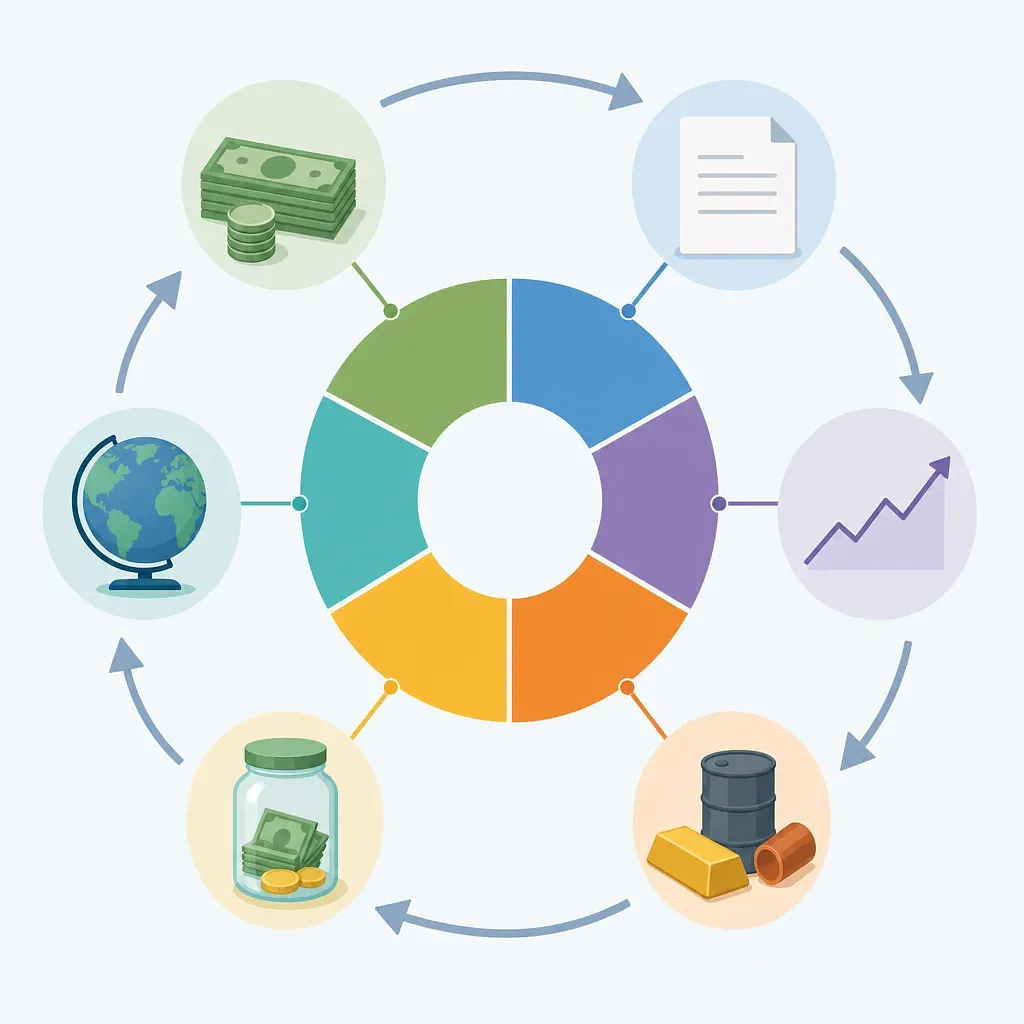
Diversified Investing: Where and How Much Should You Invest?
Diversified investing is a strategy that involves spreading investments across various financial products, regions, and time horizons to reduce the risk of loss that arises when concentrating funds in a single asset. This article summarizes the characteristics of major financial products, criteria for profitability, stability, and liquidity, as well as examples of portfolios tailored to different risk tolerances and methods for reviewing them.
Diversification does not eliminate the possibility of losses, but it helps reduce the risk associated with concentrating investments in a specific asset or company.
When building a portfolio, you should consider profitability, stability, and liquidity together, and first determine your investment goals and time horizon.
While savings accounts and fixed-term deposits carry a low risk of market price fluctuations, their returns are limited; stocks, bonds, and mutual funds, on the other hand, carry the risk of principal loss.
As people get older or as the time to use their funds approaches, they generally reduce their allocation to risky assets and increase their allocation to safe assets and cash equivalents.
A portfolio isn't something you set once and forget; you need to rebalance it regularly to maintain your target asset allocation.
Understanding at a Glance
Diversification is a method of spreading your investment funds across multiple assets to reduce the impact that a price decline in a specific asset has on your overall portfolio. As the saying goes, it’s like not putting all your eggs in one basket.
However, diversification does not completely prevent losses. Systemic risks—such as a broad market decline or sudden interest rate fluctuations—still remain. Therefore, diversification should be understood not as a technique that guarantees returns, but as a fundamental principle of risk management.
The Meaning of Diversification and a Portfolio
Diversification
Diversification is an investment strategy in which funds are spread across various assets rather than concentrated in a single stock, industry, country, currency, or maturity. For example, allocating total investment funds across savings accounts, bond products, domestic stocks, foreign stocks, and some foreign currency assets falls under this category.
Portfolio
A portfolio is a collection of financial instruments held by an investor. It refers to the overall investment structure created by setting the weighting of each asset class—such as 30% in deposits, 30% in bond funds, 20% in domestic stocks, and 20% in foreign stocks.
Modern portfolio theory was developed based on the idea that combining assets that move differently allows investors to reduce risk while maintaining the same expected return, or to pursue a higher expected return while maintaining the same level of risk. Harry Markowitz was a co-recipient of the 1990 Nobel Prize in Economics for his theory of portfolio selection, and James Tobin also received the 1981 Nobel Prize in Economics for his research on financial market analysis.
Types of Major Financial Products and the Risk of Principal Loss
Financial products differ in how they generate returns and in their associated risks. Before subscribing, you should verify the possibility of principal loss, early termination conditions, fees, taxes, and whether deposit insurance applies.
Product | Basic Concept | Main Source of Return | Possibility of Principal Loss | Key Risks
Fixed-Term Deposit | A product where a fixed amount is deposited for a set period to earn interest | Interest | Generally low | Reduction in agreed-upon interest upon early withdrawal; credit risk of the financial institution
Fixed-Term Savings | A product where a fixed amount is deposited monthly, and principal and interest are received at maturity | Interest | Generally low | Reduced interest upon early withdrawal; credit risk of the financial institution
Stocks | Securities representing ownership stakes in a company | Dividends, capital gains | High | Deterioration in corporate performance, stock price volatility, possibility of delisting
Bonds | Certificates issued by governments, corporations, or other entities that borrow money and promise to repay principal and interest | Interest, capital gains | Yes | Price declines due to rising interest rates, risk of issuer default
Funds | Indirect investment products where a professional pools money from multiple investors to invest in stocks, bonds, and other assets | Investment performance | Yes | Price fluctuations of underlying assets, management fees, exchange rate risk
Foreign Currency Assets | Foreign currencies (such as the U.S. dollar) or products denominated in foreign currencies | Interest, foreign exchange gains | Yes | Exchange rate fluctuations, country and interest rate risks
Commodities and Alternative Assets | Products related to gold, crude oil, real estate, etc. | Price appreciation, rental and dividend-like returns | Yes | Price volatility, liquidity, and product structure risks
Although time deposits and fixed-term savings accounts are not products whose prices fluctuate daily like stocks, this does not mean they are risk-free in all situations. Risks such as financial institution insolvency, early withdrawal, and a decline in real value due to inflation must be considered separately.
Direct and Indirect Investment
Investing in financial products can be broadly categorized into direct and indirect investment.
Category | Meaning | Examples | Advantages | Points to Note
Direct Investment | A method where investors directly select, buy, and sell products | Individual stocks, individual bonds | Offers great freedom of choice and direct control over costs | Requires analytical skills and time; carries a high risk of concentration in specific securities
Indirect Investment | A method where investors entrust their money to a management firm and receive a share of the investment returns | Mutual funds, ETFs, pension funds | Allows diversification across multiple assets with a small amount of money | Requires checking management fees, transaction fees, investment strategies, and tracking error
For beginner investors, using funds or ETFs that are diversified across a broad market may be easier to manage than selecting many individual securities. However, neither ETFs nor funds are products that guarantee the return of principal.
3 Essential Factors to Consider When Investing: Profitability, Stability, and Liquidity
The basic criteria for investment decisions are profitability, stability, and liquidity. It is rare to find a product that excels in all three areas.
1. Profitability
Profitability refers to the potential for profit from an investment. Stocks, equity funds, and some alternative assets can offer high returns over the long term, but they are also subject to significant price volatility.
2. Stability
Stability refers to the low likelihood of losing your principal. Deposits and savings accounts tend to be highly stable, but their expected rates of return are often lower than those of stocks. Bonds are generally considered more stable than stocks, but losses can occur depending on interest rates and the issuer’s creditworthiness.
3. Liquidity
Liquidity refers to the ease with which an investment can be converted into cash when needed. It is common to manage living expenses, emergency funds, and money to be used within the next one to two years using highly liquid products such as demand deposits, fixed-term deposits, and money market funds. If you mix long-term investment funds with short-term living expenses, you may have to sell investment products at a loss when you urgently need cash.
Why Is It Risky to Concentrate Investments in One Place?
Concentrated investments are vulnerable to specific events. A decline in a single company’s performance, regulatory changes in a single industry, an economic downturn in a single country, or a sharp drop in a specific currency can significantly shake your entire portfolio.
Diversification is effective in reducing these individual risks. For example, even if the stock price of one company falls, investments in other companies, bonds, deposits, and overseas assets can partially offset the overall loss. However, in situations like a financial crisis where all assets decline simultaneously, even a diversified portfolio may struggle to avoid losses.
Where and How Much to Invest: Basic Decision-Making Process
The exact allocation that’s right for an individual depends on their income, age, debt, investment experience, investment horizon, and family situation. The steps below provide a general framework for building a portfolio.
Step 1: Set Aside Emergency Funds and Short-Term Funds First
Before investing, it’s advisable to set aside money you might need suddenly—such as 3 to 6 months’ worth of living expenses—in safe, liquid assets. Funds needed within a year, such as security deposits, tuition, wedding expenses, or medical bills, are also difficult to allocate to high-risk assets.
Step 2: Set Your Investment Goals and Time Horizon
Your asset allocation will vary depending on whether your goal is to access funds in one year or to save for retirement over a period of 10 years or more.
· Money to be used within 1–2 years: Focus on stability and liquidity, such as savings accounts, fixed-term deposits, and short-term bonds
· Funds for a 3–5-year investment horizon: A mix of deposits, bonds, and some risky assets
· Funds for a long-term investment horizon of 10 years or more: You can relatively increase the proportion of equity-based assets
Step 3: Assess Your Risk Tolerance
If a 10% price drop keeps you up at night, an aggressive portfolio may not be right for you. Conversely, if you have long-term investment experience and can withstand short-term fluctuations, there is room to increase your allocation to risky assets.
Step 4: Set Your Target Asset Allocation
The table below is provided for educational purposes only. It does not constitute a recommendation to purchase specific products, and actual allocations should be adjusted to suit your individual circumstances.
Risk Tolerance | Cash & Deposits | Bonds & Bond-Type Products | Stocks & Equity-Type Products | Foreign Currency, Commodities, & Alternative Assets | Suitable Scenarios
Conservative | 40–60% | 25–45% | 0–20% | 0–10% | For those who strongly dislike principal fluctuations or need funds in the near future
Balanced | 20–40% | 25–40% | 30–50% | 0–10% | For investors willing to accept a certain level of volatility in exchange for higher returns than savings accounts
Aggressive | 10–25% | 10–30% | 50–80% | 0–15% | For those with a long-term investment horizon who can withstand significant price fluctuations
Step 5: Diversify Within Each Asset Class
Once you’ve determined your equity allocation, you can further diversify within that category—for example, by dividing your holdings among domestic and foreign stocks, large-cap, mid-cap, and small-cap stocks, and different industries. Bonds can also be diversified into short-, medium-, and long-term bonds; government and corporate bonds; and won-denominated and foreign-currency bonds.
Types of Diversification Methods
Asset Class Diversification
This involves investing across different asset classes, such as deposits, bonds, stocks, mutual funds, foreign currencies, and commodities. Asset class diversification is the most fundamental structure of a portfolio.
Geographic Diversification
Holding only domestic assets can leave your portfolio highly vulnerable to fluctuations in the Korean economy and the value of the Korean won. Including some foreign stocks or bonds allows you to spread your exposure across different regional economic trends. However, investing overseas also carries exchange rate risk.
Currency Diversification
Holding some foreign currency assets—such as U.S. dollars—in addition to the Korean won can serve as a hedge against a decline in the won’s value. Conversely, when the won is strong, you may incur foreign exchange losses.
Time Diversification
Rather than investing a large sum all at once, spreading your investments over time helps diversify your purchase timing. This includes regular savings plans and systematic investment strategies. Additionally, by dividing bond holdings into short-, medium-, and long-term maturities, you can reduce interest rate risk.
Diversification by Product and Cost Management
Just because diversification is beneficial doesn’t mean you need to hold an excessive number of products. Holding too many products increases fees, taxes, and the time required for management, and can actually make it harder to understand the overall portfolio structure. The key is not to buy many products, but to efficiently combine assets with different risk profiles.
Adjustments Based on Age and Life Stage
Generally, the longer the investment horizon, the greater the capacity to withstand short-term volatility; conversely, as retirement or the time to withdraw funds approaches, the time available to recover from losses becomes shorter. Therefore, a common strategy is to reduce the allocation to risky assets and increase the allocation to deposits, bonds, and cash equivalents as one gets older.
However, basing your portfolio solely on age is insufficient. You must also consider whether you have a stable income, significant debt, family dependents, or existing real estate or pension assets.
Portfolio Example: Investing 1 million won per Month
The following is an example to help you understand the investment structure. Actual investment decisions should be adjusted to suit your personal financial situation and risk tolerance.
Investment Style | Example Allocation for 1 million won per Month | Description
Conservative | Deposits/Cash Equivalents: 500,000 won, Bonds: 350,000 won, Stocks: 150,000 won | Minimizes principal fluctuations and focuses on interest-bearing assets
Balanced | Deposits/Cash Equivalents: 300,000 won, Bonds: 300,000 won, Equities: 350,000 won, Foreign Currency/Alternatives: 50,000 won | Balances stability and growth
Aggressive | Deposits/Cash Equivalents 150,000 won, Bonds 200,000 won, Equities 600,000 won, Foreign Currency/Alternatives 50,000 won | Pursues long-term growth while maintaining a minimal buffer of liquid assets
This example is merely a tool to help you understand asset allocation. You should avoid investing all your short-term living expenses or excessively increasing your allocation to risky assets while carrying a heavy debt load.
Rebalancing: The Process of Restoring the Target Allocation
Over time, asset prices fluctuate, causing the initially set allocation ratios to shift. For example, if stock prices rise significantly and the stock allocation increases from 40% to 60%, the overall risk of the portfolio also increases. Rebalancing is the process of selling a portion of these assets to increase the allocation to bonds or savings, or allocating new investment funds to underrepresented asset classes, in order to restore the target allocation.
There are two common methods of rebalancing.
· Regular review method: Check the weightings once every six months or once a year.
· Deviation-based method: Make adjustments when the portfolio deviates by 5 percentage points or more from the target weightings.
Rebalancing too frequently can increase transaction costs and taxes, so you should weigh the benefits against the costs.
Checklist Before Diversifying Your Investments
· Are your living expenses and emergency fund separate from your investment capital?
· Are you investing money you’ll definitely need within the next 1–2 years in risky assets?
· Do you understand the possibility of losing the principal on stocks, bonds, mutual funds, and deposits?
· Is the allocation to a single stock, industry, or country excessively high relative to your total assets?
· Have you checked the management fees, sales charges, and currency hedging status for mutual funds and ETFs?
· Is your target rate of return realistic?
· Have you determined in advance how much loss you can tolerate?
· Do you plan to review your portfolio at least once every 6 months to a year?
Key Takeaways
The purpose of diversification is not to guarantee high returns, but to spread risk so that a single wrong decision does not ruin your entire portfolio in the unpredictable financial markets. You should understand the characteristics of deposits, bonds, stocks, and funds, and set target allocations by considering profitability, stability, and liquidity together.
In particular, while you can expect the long-term effects of compound interest the longer your investment horizon, it is not appropriate to invest short-term funds in risky assets. A good portfolio is one that aligns with your goals, risk tolerance, income, age, and when you plan to use the funds, and is structured in a way that allows for regular management.