Injoys
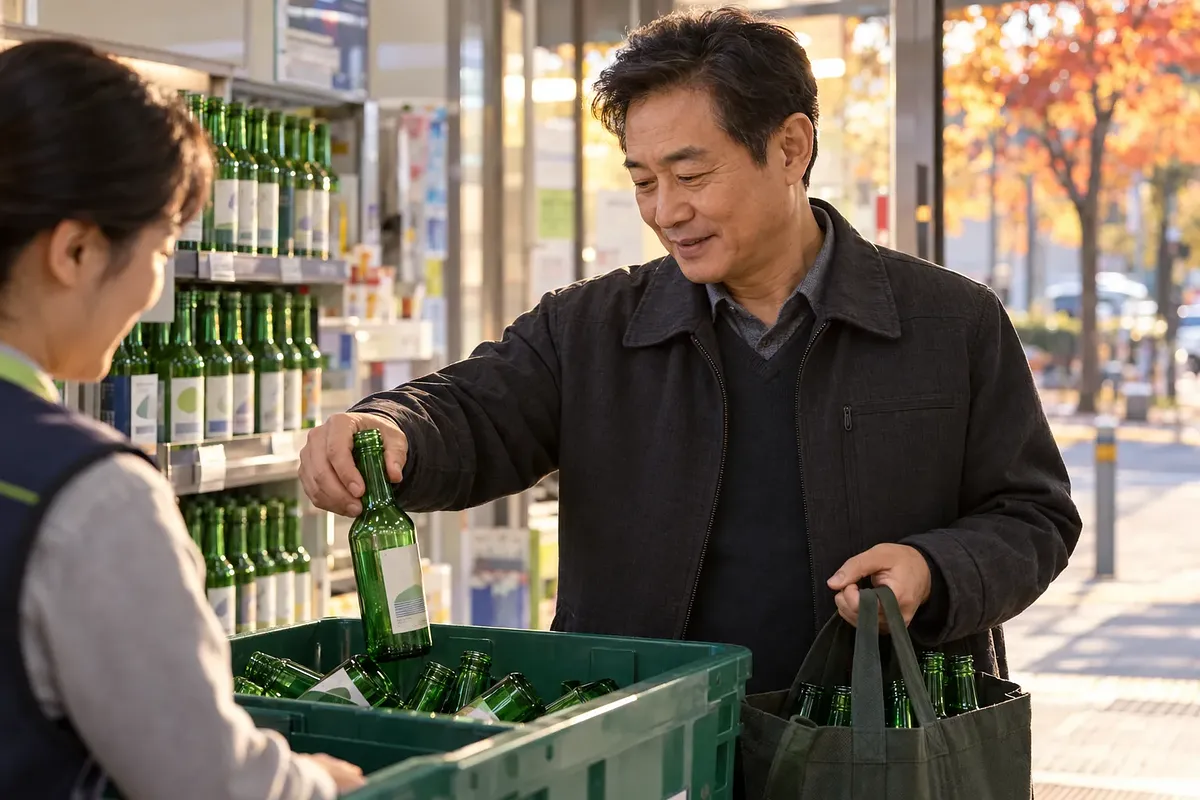
You can get your empty-container deposit back by returning empty bottles bearing the deposit mark to a retailer. Visit a store that sells the same type of deposit-bearing product during business hours. Any bottles beyond 30 per day require proof of purchase from that store.
The amounts are based on products shipped or imported on or after January 1, 2017, as listed in the center's guidebook.
Preparing Empty Bottles and Returning Them
Prepare empty bottles with clearly visible deposit marks, making sure they are completely emptied. A purchase receipt is not required for ordinary small-quantity returns. This is not a support program with a separate application period.
- Check the bottle label for deposit refund wording and a reuse mark.
- Empty the contents and remove foreign matter, and set broken bottles aside.
- Find a store that sells the same type of deposit-bearing product.
- If you are returning more than 30 bottles per day, bring proof that you bought them at that store.
- At the store's return area, check the bottle count and marked amounts, then collect your deposit.
You can find reverse vending machines and return collection points on the center's official map. Select empty-container returns under the return support service on the website. Check the facility's operating information before visiting. Resource Circulation Deposit Management Center Empty-Container Return Guide
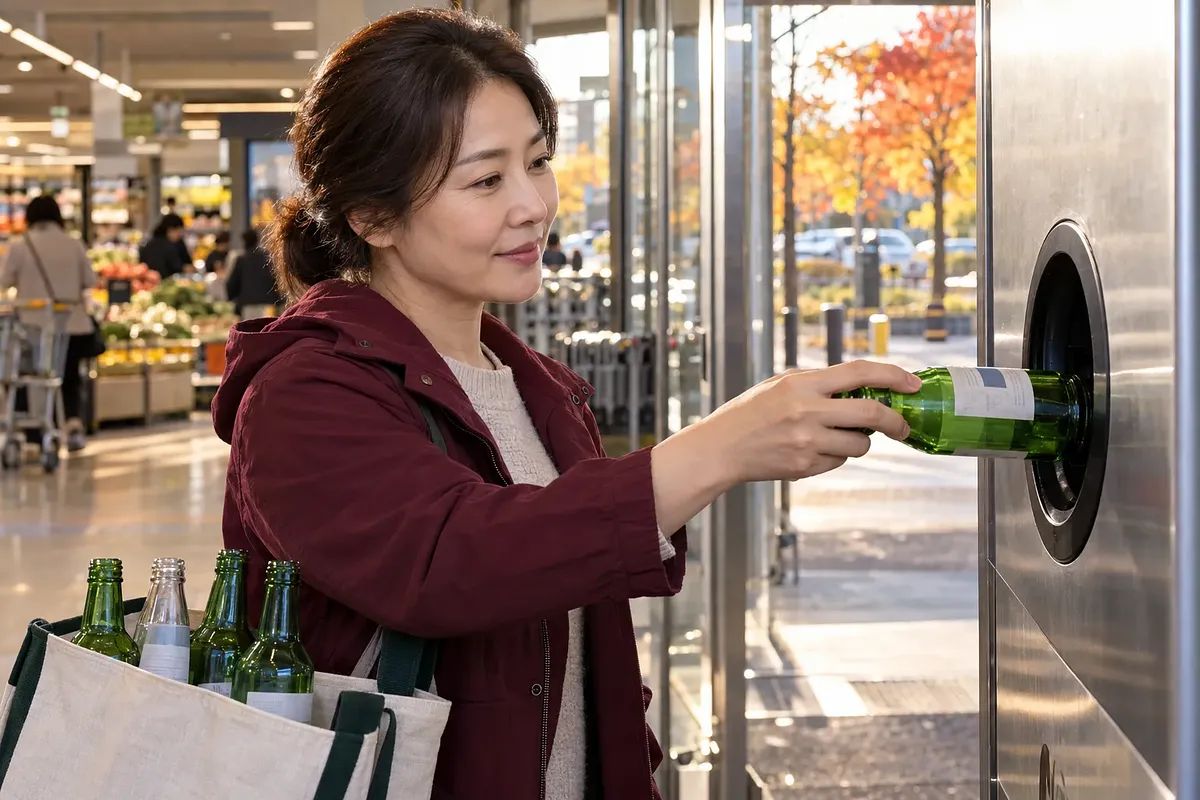
Follow the automated return instructions to return empty bottles and receive your deposit refund.
The Difference Between Deposit-Eligible Bottles and Ordinary Glass Bottles
A bottle does not qualify for a deposit refund simply because it is made of glass. The deposit system refunds money paid when purchasing the product. Collected bottles are inspected, washed, and otherwise processed for reuse.
| Category | Marks and condition to check | How to handle |
|---|---|---|
| Deposit-eligible empty bottles | Refund wording and reuse mark; suitable for reuse | Return to a retailer or other location that meets the conditions |
| Glass bottles not eligible for a deposit | Ordinary glass bottles without a deposit eligibility mark | Dispose of them according to local recycling rules |
| Damaged, broken, or contaminated bottles | Difficult to reuse or impossible to confirm eligibility | Check their condition, as returns may be refused |
| Bottles distributed through commercial channels | Distribution channels for bottles used at restaurants and similar businesses | Check separately whether they can be returned to ordinary retailers |
Wholesalers directly collect empty bottles from products that did not pass through retailers. Do not count bottles from restaurants together with ordinary household bottles. For bottles with worn-off marks, it is best to ask about eligibility first. Appendix 5 of the Enforcement Rule
Deposit per Bottle and a Calculation Example
The deposit amount for eligible bottles varies by capacity. The table below applies to products shipped or imported on or after January 1, 2017. For older bottles, also check the amount actually marked on the bottle.
| Capacity | Deposit per bottle |
|---|---|
| Less than 190mL | 70 won |
| At least 190mL but less than 400mL | 100 won |
| At least 400mL but less than 1,000mL | 130 won |
| At least 1,000mL | 350 won |
Suppose you return 30 eligible bottles marked with a deposit of 100 won. The calculation is 100 won × 30 bottles, giving a refund of 3,000 won. The bottles' condition and the types of products sold by the store must also meet the return requirements.
Handling fees are separate costs paid by producers to wholesalers and retailers. They are not added to the deposit consumers receive. Calculate the consumer refund by adding up the deposits for each bottle. Resource Circulation Deposit Management Center System Guide
Comparing Conditions by Place of Purchase and Quantity
Bottles bought elsewhere are also eligible for return if the store sells the same type of product. Here, “same type” does not mean only the same brand. The center lists the categories as fermented alcoholic beverages, distilled alcoholic beverages, beverages, and drinking water.
| Situation | Return criteria |
|---|---|
| Purchased at another store, at most 30 bottles per day | Eligible for return if the store sells the same type of deposit-bearing product |
| Purchased at another store, more than 30 bottles per day | The portion exceeding 30 bottles may be refused |
| Purchase at that store confirmed, more than 30 bottles per day | Bottles with confirmed purchase cannot be refused solely because they exceed the quantity limit |
| Only the brand differs | If it is the same type of deposit-bearing product, a different brand alone is not grounds for refusal |
| The store does not sell the same type of deposit-bearing product | You cannot assume that the store is required to accept the return |
In every case, both deposit eligibility and bottle condition are checked. Proof of purchase does not remove the conditions concerning damage or contamination. Refer to the center's guidebook for details on determining the same type of product. Empty-Container Deposit Guidebook
Appendix 5 of the Enforcement Rule defines the scope of quantity-based refusal as follows.
When the same person returns more than 30 bottles in 1 day (limited to the portion exceeding that number).
Appendix 5 of the Enforcement Rule of the Act on the Promotion of Saving and Recycling of Resources
This rule does not allow the entire return to be refused simply because it exceeds 30 bottles. If purchase at that store is confirmed, an exception also applies to the excess bottles. You can check the relevant wording in Appendix 5 at the National Law Information Center.