Endurance Rescue 1916: How All 28 Men Survived
All 28 members of the Endurance party survived following a small-boat voyage and rescue by Chile's Yelcho. This account explains the timeline of the ordeal and each person's contribution, distinguishing the deaths in the separate Ross Sea support party.
The Endurance party abandoned ship on October 27, 1915.
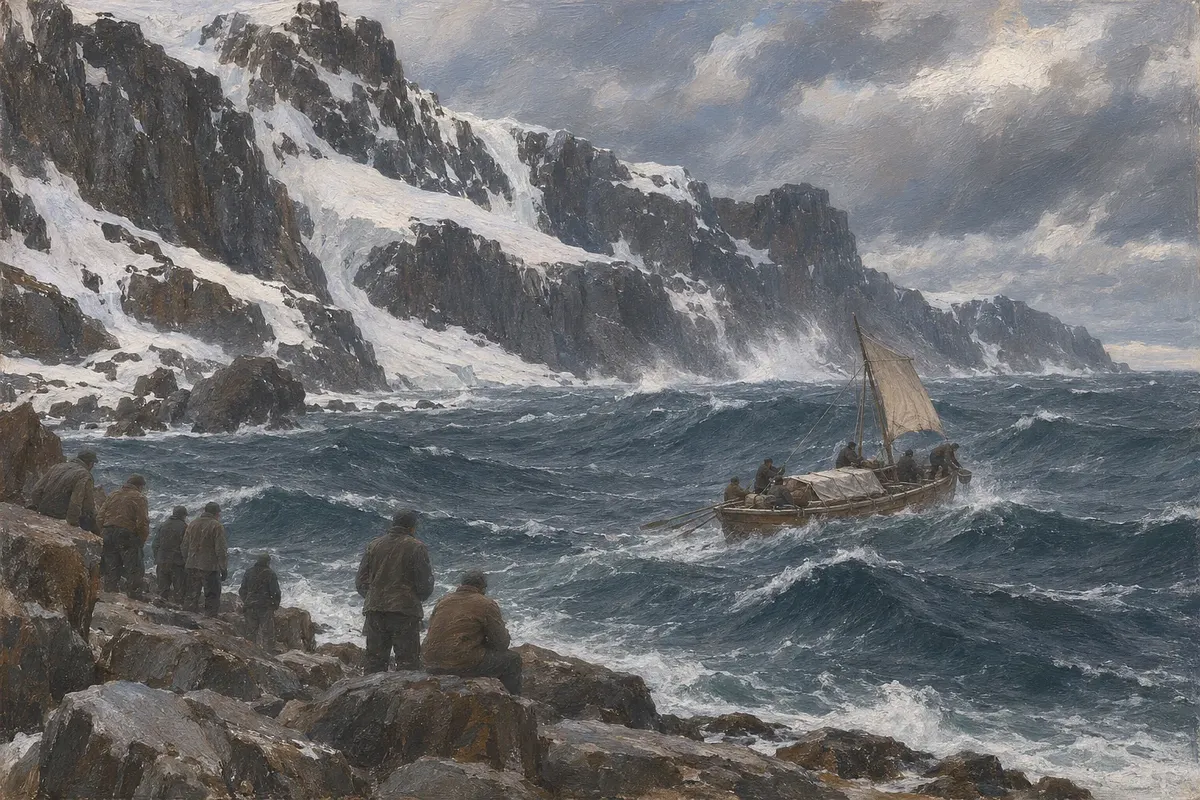
Six men were aboard the James Caird when it departed on April 24, 1916.
Frank Worsley, from New Zealand, handled navigation to South Georgia Island.
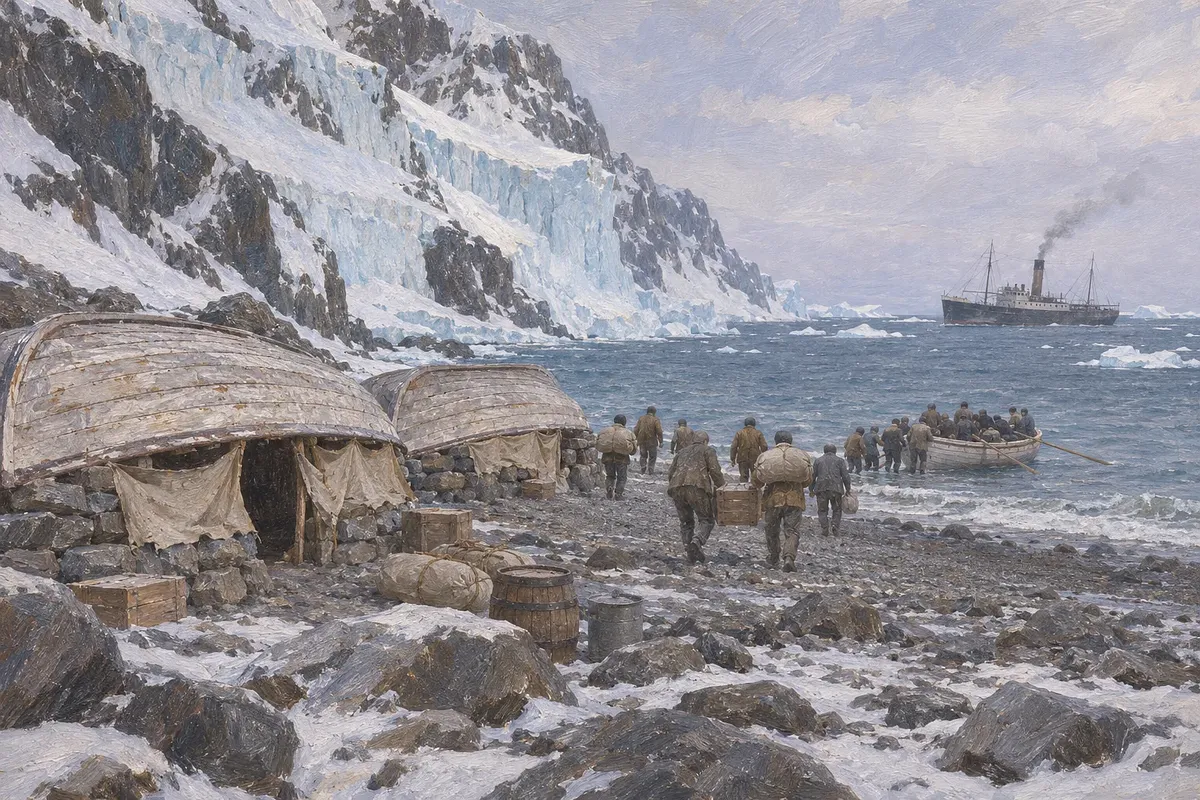
The Yelcho, commanded by Luis Pardo, rescued the 22 men left behind on August 30, 1916.
The survival of all 28 men refers to the Endurance party, excluding the separate Ross Sea support party.
Shackleton's expedition lost the Endurance and became stranded in the Antarctic. In 1916, a small-boat voyage and a rescue by the Chilean vessel Yelcho brought all 28 men back alive. Although the expedition failed to cross Antarctica, it is remembered as a case of survival through navigation skills and a coordinated response.
This account follows South and museum, British, and Chilean records. The information was checked in November 2026.
Why was the Antarctic crossing abandoned?
The plan to cross Antarctica was abandoned when the Endurance became trapped in sea ice. Sea ice forms when seawater freezes. When winds and currents move it, it can exert intense pressure on a ship.
Ernest Shackleton's goal was to cross the continent via the South Pole. The Endurance was to land the crossing party on the Weddell Sea side. On the opposite side, the Ross Sea party was responsible for laying supply depots along the return route.
The Endurance became trapped in ice in January 1915. Hull damage and flooding followed. On October 27, 1915, the men abandoned the ship and moved onto the ice.
The task is to reach land with every member of the expedition.
This is from Ernest Shackleton's diary entry for October 27, 1915, included in Chapter 4 of South.
The entry explicitly identifies survival as the goal after abandoning ship. The men moved the lifeboats and food onto the ice. The ship sank on November 21, not on the day it was abandoned. South, Chapters 4 and 5
Timeline from stranding to rescue
The rescue followed the abandonment of the ship, a period drifting on the ice, and a small-boat voyage. The timeline below distinguishes the date the men left the ship from the date it sank. It also lists the sighting of land separately from the actual landing.
Date | Event | Supporting record
December 5, 1914 | Departed South Georgia for Antarctica | South, Chapter 1
January 19, 1915 | The Endurance became trapped in sea ice | South, Chapter 2
October 27, 1915 | All 28 men left the ship and moved onto the ice | South, Chapter 4
November 21, 1915 | The Endurance sank | South, Chapter 5
April 9, 1916 | Began traveling from the ice in 3 lifeboats | South, Chapter 7
April 15, 1916 | Landed at Cape Valentine on Elephant Island | Canterbury Museum navigation study
April 17, 1916 | Moved to a new camp on the north side of Elephant Island | Canterbury Museum navigation study
April 24, 1916 | 6 men set out in the James Caird to seek rescue | South, Chapter 9
May 8, 1916 | Sighted land on South Georgia | Canterbury Museum navigation study
May 10, 1916 | Landed on South Georgia | Canterbury Museum navigation study
May 20, 1916 | Shackleton, Worsley, and Crean reached Stromness whaling station | Royal Museums Greenwich expedition timeline
August 30, 1916 | The Yelcho rescued the 22 men remaining on Elephant Island | Chilean Navy commemorative record
September 3, 1916 | The rescued men arrived in Punta Arenas, Chile | South, Chapter 11
How did they survive on the ice?
After abandoning ship, the men camped on the ice and waited for a chance to move. Rough ice blocked their attempts to haul the boats toward land. They ultimately spent a long period moving north as the ice drifted.
They could not survive on the food salvaged from the ship alone. The men ate seals and penguins. The animals' fat provided fuel for cooking.
The ice was not as safe as solid ground. When it cracked or broke apart, they had to move camp. In April 1916, they launched the boats and headed for Elephant Island. South, Chapters 5 to 8
Why did the James Caird head for South Georgia?
South Georgia offered a chance to use the winds to reach a whaling station. The Falkland Islands were closer, but reaching them would have meant sailing against the prevailing winds. Waiting for a chance rescue on Elephant Island was also unlikely to work.
6 men boarded the small boat on April 24, 1916. Tom Crean accompanied Shackleton and Worsley. Carpenter Harry McNish, Timothy McCarthy, and John Vincent also went aboard.
The James Caird was a lifeboat taken from the Endurance. McNish prepared it for the open sea by building a cover from wood and canvas. The cover helped keep out waves, but it was not completely watertight.
Requirement for the voyage | Action taken
Reduce the area exposed to waves | Built a cover using wood from boxes, parts of sledges, and canvas
Keep the boat balanced | Added weight to the bottom and managed the load
Maintain course | Took turns steering and handling the sails
Deal with incoming water | Continuously bailed water out of the boat
Determine position | Used celestial observations alongside dead reckoning
Worsley, who was from New Zealand, calculated their position during the voyage. Celestial navigation determines position using the altitude of the sun or other celestial bodies and the time of observation. Dead reckoning estimates position from a previous position using the direction and distance traveled.
Bad weather made it difficult to see the sun or the horizon. Worsley corrected the estimated position whenever he had an opportunity to take observations. Survival required both these calculations and the men's constant care of the boat. South, Chapter 9, Canterbury Museum navigation study
Why did they still have to cross South Georgia after landing?
They needed to travel overland because they had landed on the opposite side of the island from the whaling stations. Even after sighting the island, strong winds prevented them from landing immediately. Sighting land, landing, and making contact with outsiders were therefore separate events.
Date | Stage reached | Remaining task
May 8, 1916 | Sighted South Georgia | Find a landing place amid strong winds
May 10, 1916 | Landed in the King Haakon Bay area | Reach a whaling station on the opposite side
May 20, 1916 | Reached Stromness whaling station | Secure a rescue vessel for Elephant Island
Shackleton, Worsley, and Crean crossed the mountainous terrain. McCarthy stayed behind to care for the weakened McNish and Vincent. After reaching the whaling station, they also brought back the three men left behind by boat.
Reaching the whaling station was the turning point that allowed them to seek outside help. The men on Elephant Island had not yet been rescued. They still needed to secure a ship and a route back to them. South, Chapters 10 and 11, Royal Museums Greenwich expedition timeline
How did the 22 men left on Elephant Island live?
The men who remained endured the winter under Frank Wild's command. They turned the two remaining boats upside down to form the roof of their shelter. They also built walls from stones and canvas to keep out the wind.
The men supplemented their food with seals and penguins. They continually cleared snow to keep their shelter from being buried. Medical staff cared for men whose frostbite and weakness made movement difficult.
Wild's role was to manage food and daily tasks. The coastal camp was also the place the rescue ship needed to find. Chapter 12 of Shackleton's South was written using the men's diaries and conversations during the return journey. South, Chapters 11 and 12
Four rescue attempts and the role of the Yelcho
The rescue from Elephant Island succeeded after three earlier attempts had failed. Securing a rescue vessel was not enough. Sea ice conditions also had to allow the ship to approach.
Period | Vessel used for the rescue attempt | Support and outcome
May 1916 | Southern Sky | Supported by whaling interests on South Georgia, but blocked by sea ice
June 1916 | Instituto de Pesca No. 1 | Supported by the Uruguayan government, but unable to approach because of sea ice
July 1916 | Emma | Arranged by the British community in Punta Arenas, but defeated by ice and bad weather
August 1916 | Yelcho | Provided by the Chilean government; the rescue succeeded under Pardo's command
According to South, the Yelcho sailed on August 25, 1916. The vessel was not suited to breaking through thick sea ice. At the time of the rescue, the ice had shifted, creating an opening for the ship to approach. South, Chapter 11
The Yelcho rescued the 22 remaining men on August 30, 1916. Its commander was Luis Pardo of the Chilean Navy. Chilean Navy records explicitly recognize the contributions of Pardo and his crew. Chilean Navy rescue commemorative record
Many people and organizations shared the roles needed for the rescue. Shackleton secured rescue vessels and kept trying. Pardo and the Chilean crew operated the rescue ship. Wild and the men left behind survived on the island until it arrived.
Who does “all 28 survived” refer to?
The survival of all 28 refers to the Weddell Sea party aboard the Endurance. This includes the 6 men who left in the James Caird. The 22 rescued from Elephant Island were the remaining members.
Group | Numbers and outcome | Scope of the statement
James Caird sailing party | 6 survived | The men who left first to seek outside help
Party remaining on Elephant Island | 22 rescued | The men brought back by the Yelcho
All Endurance expedition members | 28 survived, combining the two groups above | The outcome for the Weddell Sea party
Shore support party left in the Ross Sea | 3 of 10 died; 7 survived | A separate group laying supply depots
The Ross Sea party continued laying supplies without knowing that the crossing plan had been abandoned. They became stranded when the Aurora was carried away. The 7 survivors were rescued in January 1917. New Zealand Ministry for Culture and Heritage, NZ History
It is therefore inaccurate to say that the entire expedition suffered no deaths. The goal of crossing Antarctica was also not achieved. The survival of the Endurance party must be assessed separately from those facts.
What can the navigation log verify?
Worsley's navigation log provides a record against which his position calculations can be checked. The original, held by Canterbury Museum, preserves his observations and calculations. A 2018 study included photographs and transcriptions and reproduced the calculations.
A transcription is a written copy of the letters and numbers read from an original document. The researchers distinguished estimated positions from positions corrected through observations. This distinction shows the basis for each point plotted along the route.
The study also explains errors in a calculation made on May 13, 1916, after the landing. Different errors nearly canceled each other out, producing a result close to the actual latitude. This example shows why an accurate result must be distinguished from an error-free calculation. Canterbury Museum navigation study
How can records and interpretations be distinguished?
Contemporary records and later studies were produced for different purposes. South is an expedition narrative compiled by its leader. The navigation log was a working record for calculating positions and courses. Rescue commemorative speeches convey the event's significance to later generations.
Events confirmed by multiple records
Museum and public history sources distinguish the failed crossing from the men's survival. The loss of the Endurance and the small-boat voyage are established events. The Yelcho's rescue of 22 men also appears in both British and Chilean records.
A British government page reproduces Shackleton's telegram reporting the rescue. It was originally published in the September 5, 1916 edition of the Western Daily Press. The telegram expresses thanks to the Chilean government and Pardo. British government rescue centenary record
Interpretations offered by research
Survival is difficult to explain through the character of a single leader alone. Navigation, boat modifications, and camp management were all necessary. Support from vessels supplied by several countries also made the rescue attempts possible. This interpretation considers the previously established roles together.
The cause of the sinking is also a subject of engineering research. A 2025 paper in Polar Record analyzed weaknesses in the hull's structure. The study identifies the structure's inability to withstand compressive forces from the ice as the central cause. “Why did Endurance sink?”
Remaining uncertainties
The records alone cannot quantify how much each factor contributed to survival. Nor can they establish what would have happened if different decisions had been made. The case should not be generalized into a rule that a particular leadership style guarantees survival.
Some detailed figures in the navigation records also require interpretation. The Canterbury Museum study explains that the reasons for some longitude corrections are unclear. Being able to repeat the calculations does not reveal the reasoning behind every decision. Canterbury Museum navigation study
Why study this event today?
This event shows the different functions of crisis response in concrete terms. The change in goals was tied to skills, equipment, and outside support. It is worth studying because the survival outcome can be examined alongside the conditions that made it possible.
· Changing goals: The goal shifted from crossing the continent to reaching land and rescuing the men.
· The role of technical skills: Position calculations and boat modifications made travel possible.
· Maintaining the camp: Managing shelter and food sustained those left behind until rescue.
· International cooperation: Support came from whaling interests, Uruguay, and Chile.
· Checking records: Diaries, telegrams, and later research can be compared.
Frequently asked questions
When did the Endurance sink?
The sinking date was November 21, 1915. The men left the ship on October 27. The abandonment and sinking occurred at different times.
Did Shackleton succeed in crossing Antarctica?
This expedition did not succeed in crossing Antarctica. The ship became trapped in ice before they landed on the continent. Their subsequent efforts focused on survival and rescue.
Did the James Caird carry all 28 men?
The James Caird carried 6 men. The other 22 stayed on Elephant Island. The ship that rescued them was Chile's Yelcho.
Was the arrival date on South Georgia May 8 or May 10?
The actual landing date was May 10, 1916. May 8 was the day they sighted land. Strong winds prevented them from landing immediately after the sighting.
Who commanded the Yelcho?
The Yelcho's commander was Luis Pardo. He was a member of the Chilean Navy and commanded the rescue voyage. Shackleton's party traveled aboard the vessel back to Elephant Island.
Did the entire expedition return without any deaths?
All 28 members of the Endurance party survived. In the separate Ross Sea shore party, 3 men died. The outcomes of the two groups must not be combined into a claim that everyone survived.
 Injoys