Injoys
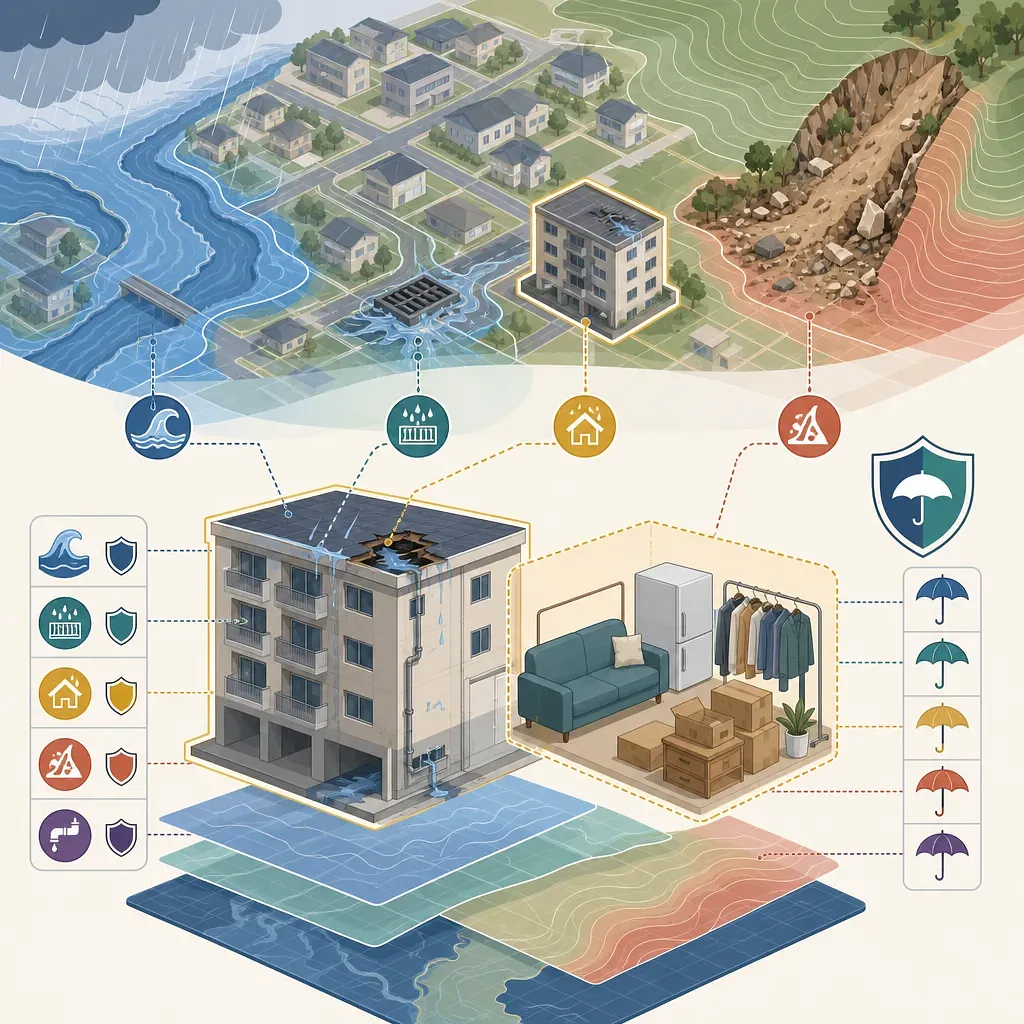
Despite its name, fire insurance in Japan does not provide coverage solely for fire. Depending on the policy, coverage for lightning, rupture or explosion, wind, hail, snow, water damage, and water leakage caused by accidents involving water supply and drainage systems may be selected individually or bundled together. Therefore, if you are concerned about flooding or torrential rain, rather than merely confirming that you “have fire insurance,” you should check whether water damage coverage is included in the policy and what payment conditions and deductibles apply.
In online consultations in Japan, questions repeatedly arise about whether tenants need water damage coverage, the 45 cm above-ground-level threshold, and whether coverage can be excluded in areas shown as low risk on hazard maps. Such questions can inform decisions about obtaining coverage, but individual answers do not replace the policy terms or the insurer’s determination.
How Fire, Wind, and Water Damage Are Distinguished
Even when damage occurs during the same typhoon or torrential rain event, the applicable coverage may differ depending on how the water entered and the direct cause.
| Damage scenario | Coverage generally considered | Points to check |
|---|---|---|
| A home is flooded due to a river overflowing | Water damage | Whether water damage coverage is included, floodwater height, damage ratio, and deductible |
| Road water enters a building because heavy rain exceeds drainage capacity | Water damage | Check whether pluvial flooding is included in the definition of water damage |
| Rainwater enters after a storm damages the roof or windows | Wind damage and resulting loss | The causal relationship between the initial exterior damage and the entry of rain is important |
| Rain seeps through deteriorated gaps in an undamaged roof or exterior wall | Likely to be excluded | Deterioration, defective construction, and inadequate maintenance may generally be excluded from coverage |
| A water supply or drainage pipe is accidentally damaged, soaking the interior | Water leakage caused by an accident involving water supply or drainage systems | The cost of repairing the pipe itself and damage to soaked property may be handled differently |
| A landslide damages the building or household contents | Many products classify this as water damage | Check the policy definitions of earth collapse and landslides |
| Flooding caused by a storm surge or earthquake | May be excluded from standard fire insurance | Check the scope of earthquake insurance and whether a tsunami was the cause |
Insurers look first at the direct cause of an accident rather than its ultimate result. For example, even if rainwater enters the interior, the determination may differ among water damage, wind damage, water leakage, or exclusion depending on whether the cause was a river overflow, drainage backup, roof damage caused by strong winds, or a deteriorated waterproofing layer.
Understanding Floodwater Height and Damage Ratio Criteria
The following conditions are frequently used in water damage provisions under Japanese fire insurance policies:
- Damage to the insured property amounting to at least a specified percentage of its insured value
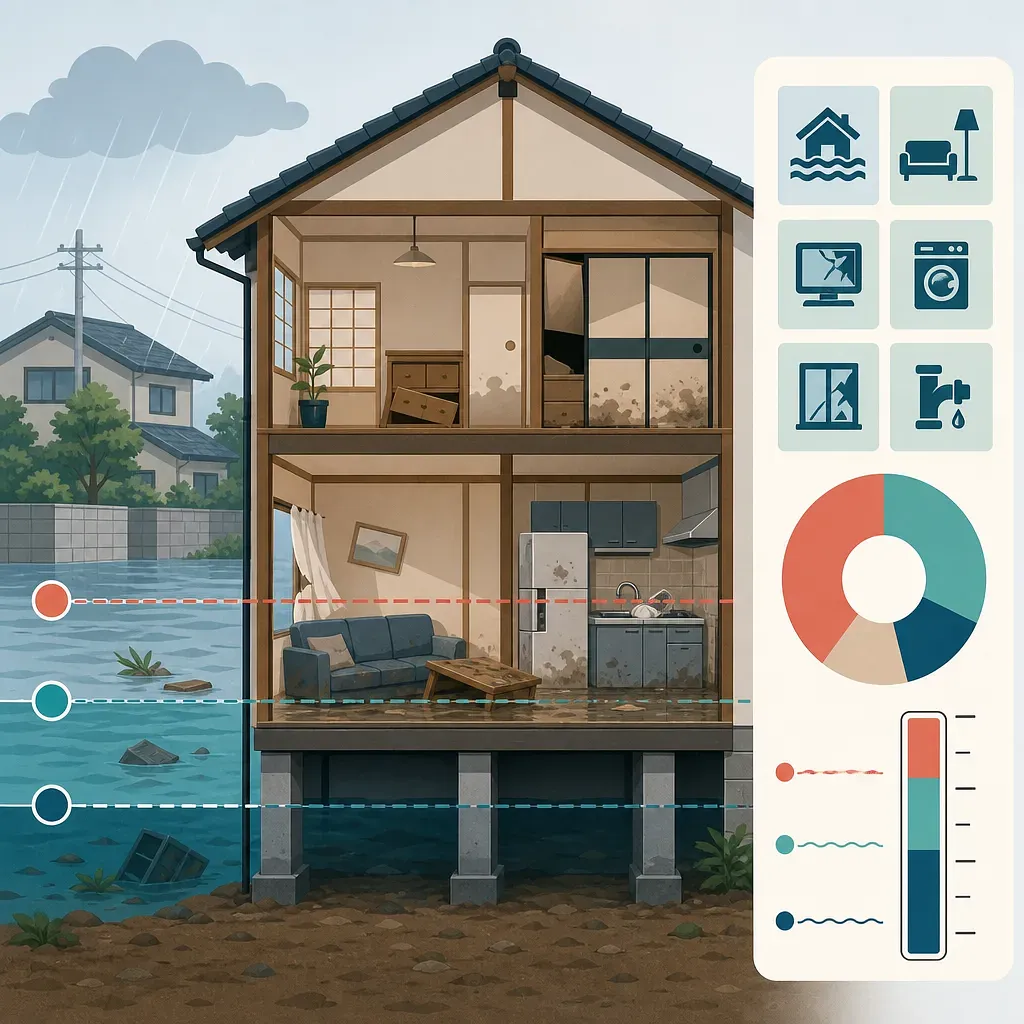
- Flooding above floor level
- Flooding exceeding a specified height above ground level
Common wording includes “damage amounting to at least 30% of the insured value” and “flooding above floor level or more than 45 cm above ground level.” However, not all products use the same conditions or payment methods. Some products compensate based on the actual amount of damage, some policies apply fixed amounts or reduced payment percentages according to specified conditions, and others have separate deductibles. You should therefore not reach a conclusion based solely on these figures.
What Does Ground Level Mean?
Ground level generally refers to the surface of the surrounding ground in contact with the building. It is not the same as the interior floor level. Depending on the height of the building’s foundation, differences in elevation at the entrance, and the structure of semi-basement or basement floors, the flood depth measured from ground level may differ from the depth of flooding inside the building.
Because traces may disappear as the water recedes after an incident, it is useful to gather the following evidence:
- Photograph watermarks on the building’s exterior and interior walls with a ruler in the frame.
- Photograph the entire building, road, entrance, each room, and damaged household contents from multiple angles.
- Make notes about how the water entered and the water level at the time.
- Before disposal, record the manufacturer, model name, purchase date, and photographs of damaged items.
- Check whether the local government can issue a disaster victim certificate or other damage-related documentation.
- Except for urgent safety measures, do not rush into major demolition or repairs before obtaining confirmation from the insurer.
Check the Damage Ratio, Not the Loss Ratio
The term “loss ratio” used by consumers can easily be confused with two different concepts. In the insurance industry, the loss ratio is a management indicator showing insurance claim payments relative to premiums. In contrast, what matters for water damage payment conditions under an individual policy is the damage ratio, or percentage of damage, showing the amount of loss relative to the insured value of the insured property.
Conceptually, it can be understood as follows:
Damage ratio = Amount of damage recognized under the policy terms ÷ Insured value × 100
However, the extent to which the value of salvage, demolition and debris removal costs, temporary repair costs, and replacement-cost or market-value standards are included varies by policy. Even if both the building and household contents are insured, each may be assessed as a separate insured property.
30% and 45 cm Do Not Indicate the Amount of Insurance Payment
“At least 30%” is generally a threshold for determining eligibility for payment; it does not mean that 30% of the insured amount will automatically be paid. Likewise, “more than 45 cm” is not a figure that guarantees automatic payment based solely on the expected flood depth or watermarks. The amount of compensation is calculated by applying the actual amount of damage, insured amount, coverage limits, payment method, deductible, and exclusions.
Differences Between Below-Floor Flooding, Above-Floor Flooding, and Rainwater Leakage
Below-Floor Flooding
A condition in which water has not risen to the wooden flooring or interior floor level is generally called below-floor flooding. However, this does not mean it is always excluded from coverage. Compensation may be available if the policy separately establishes a height threshold measured from ground level or a damage ratio condition and that condition is met.
Conversely, if the conditions are not met, water damage insurance payments may not be made even if the foundation, below-floor equipment, insulation, or other components have actually been damaged. Whether contamination, moisture, or mold below the floor was directly caused by the incident or the work was merely preventive cleaning may also be investigated.
Above-Floor Flooding
This refers to water entering above the residential floor surface. Because tatami, flooring, wallpaper, furniture, and appliances are likely to be damaged together, it is frequently used as one of the payment conditions for water damage. However, whether an earthen entrance floor, garage, storage area, or underground space is recognized as a “floor” or residential area under the policy may vary according to the building structure and definition provisions.
Rainwater Leakage
Determining the cause is crucial in cases of rainwater leakage. If rain enters immediately after strong winds blow off the roof or break a window, the damage may be considered consequential loss resulting from wind damage. Water that seeps through deteriorated sealant, cracks, or defective waterproofing without external damage may be regarded as deterioration or a maintenance issue rather than an accidental incident and may therefore be excluded.
“Water damage” must also be distinguished from “water wetting” or water leakage coverage. In Japanese insurance, water leakage coverage often refers to water damage originating from equipment, such as plumbing on an upper floor or an accident involving water supply or drainage systems. It is not a term that includes all flooding caused by natural disasters.
Using Hazard Maps to Assess the Need for Water Damage Coverage
The Hazard Map Portal operated by Japan’s Ministry of Land, Infrastructure, Transport and Tourism and the Geospatial Information Authority of Japan allows users to overlay information on river flooding, pluvial flooding, storm surges, landslides, and other hazards around an address. When evaluating water damage coverage, do not rely on only one map; review multiple layers representing different causes.
| Map or information | Main risks shown | Points to note when interpreting |
|---|---|---|
| Projected flood inundation zones | Projected inundation area and depth if a river overflows | Check the rivers covered and the assumed rainfall scale |
| Pluvial flood map | Flooding caused by rainfall exceeding sewer and drainage capacity | Not all local governments provide it using the same methods or coverage |
| Projected storm-surge inundation | Risk of sea-level rise caused by storms and other events | Its cause and insurance classification differ from those of earthquake tsunami maps |
| Landslide hazard zones | Risk of steep-slope collapse, debris flows, and other events | Water damage coverage may need to be considered even when no inundation depth is shown |
| Topography and elevation information | Low-lying areas, former river channels, and elevation differences in surrounding areas | Does not directly indicate statutory hazard zones or insurance payment conditions |
No Color on the Map Does Not Mean Zero Risk
Hazard maps are created based on specific rainfall scenarios, calculation models, topographic data, and designated rivers. They may not fully reflect overflows from small waterways, localized drainage failures, differences in elevation at building entrances, or routes through which water may enter underground spaces. You should also check whether the topography or drainage facilities may have changed since the map was published.
The projected inundation depth on a map also does not directly correspond to the actual floodwater height threshold in an insurance policy. A map provides estimates for future scenarios, while insurers make determinations after investigating the actual incident and damage. For example, even if a map shows 0.5 m, that alone does not establish that the policy threshold of more than 45 cm above ground level has been met.
Also Consider the Floor Level and Evacuation Options
Households on upper floors of high-rise apartment buildings may be less likely to experience direct interior flooding. However, if basement electrical equipment, elevators, water supply pumps, mechanical parking systems, or common areas are flooded, daily life may be disrupted for an extended period. Because an individual household contents policy does not cover restoration costs for common areas or all indirect living expenses, distinguish between the homeowners’ association’s insurance and temporary expense coverage under the individual policy.
Water Damage Risk Classes and Hazard Maps Are Not the Same Data
For residential fire insurance in Japan, particularly for policies issued or renewed on or after October 2024, the advisory rate system may reflect a classification that divides the water damage risk of the property’s location into several classes. A classification from Class 1 through Class 5 is commonly used, although adoption and actual premiums may differ by insurer.
These classes are not the same as hazard maps showing the projected inundation depth of individual parcels. Even within the same risk class, actual risk may vary depending on distance from a river, elevation, and building structure. It is therefore safer not to exclude coverage based solely on the premium risk class.