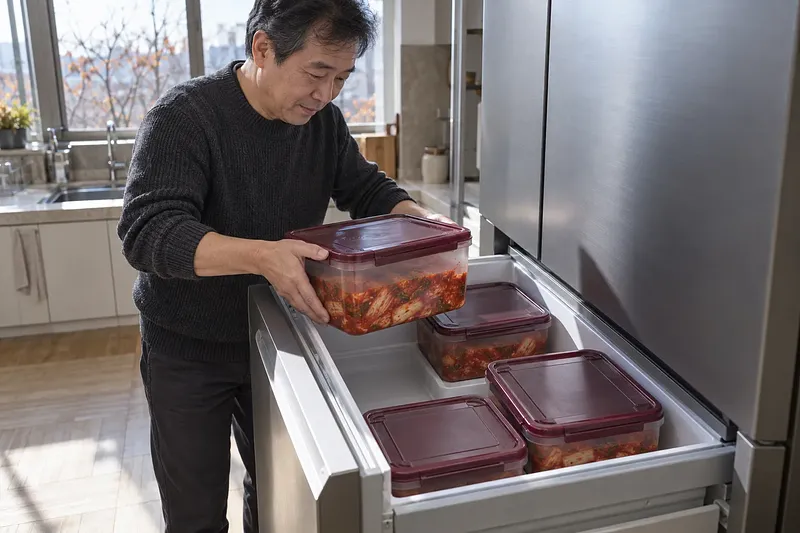
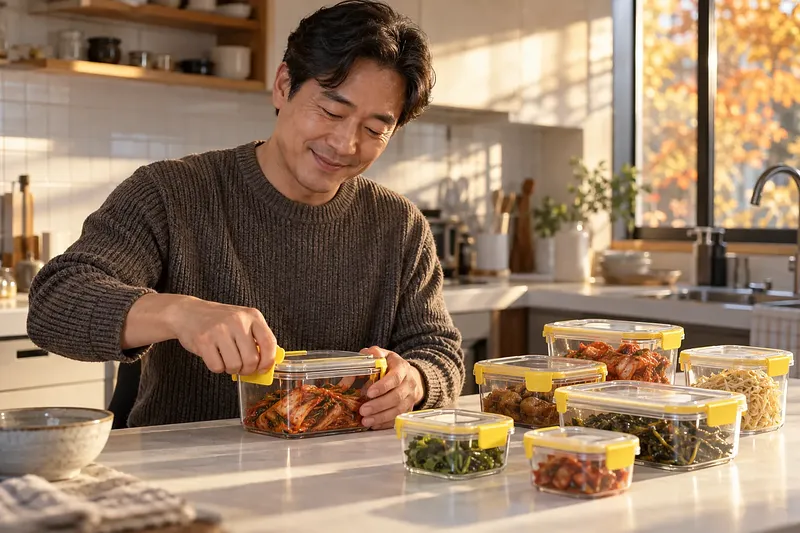
Kimchi Fridge and Container Cleaning Before Making Kimchi
Before making kimchi, distinguish between the cleaning requirements for the refrigerator itself and its kimchi containers. Check the drying instructions for each container type and how to remove frost. After restarting the refrigerator, let it cool sufficiently before putting kimchi in.
Only use detergents approved in the model's manual to clean the refrigerator itself.
Do not apply odor-removal methods for standard containers unchanged to containers with filters.
Frost can form in direct-cooling models and must not be removed with sharp tools.
After cleaning, check for moisture, confirm that parts are installed, and make sure the door seals properly.
Use the cooling instructions for each model, not a universal waiting period, to decide when to put food back in.
Before making kimchi for winter, clean the kimchi refrigerator itself and its containers separately. Follow the instructions for each part when choosing detergents and drying methods. Remove frost without sharp tools. Add fresh kimchi only after restarting the refrigerator and allowing the interior to cool sufficiently.
This article is based on manufacturers’ care guidance and separate product-specific instructions as of October 2026.
Kimchi storage functions and cooling methods
The kimchi storage function adjusts the storage temperature to suit the characteristics of kimchi. The fermentation function is used to ripen kimchi. Vegetable and meat storage functions are available on models that support them.
Do not judge the cooling method by appearance alone. Direct cooling chills the storage compartment walls themselves. Samsung Electronics Service explains that the middle and lower compartments of some upright models also use direct cooling. Some frost can therefore form even in upright models.
Type | Structure and functions to check | Effect on maintenance
Top-opening, direct-cooling models | Interior walls that become cold | Frost on the walls needs to be managed
Some upright models | Cooling method for each compartment | Frost may form in direct-cooling compartments
Models with food-specific modes | Settings for kimchi, vegetables, meat, and other foods | Select the mode that suits the food being stored
Maintenance should be based on the actual structure of the storage compartments rather than the refrigerator’s shape. Details are available in Samsung Electronics Service’s guide to frost in upright models.
Comparing cleaning guidelines for the main unit and removable parts
When cleaning a kimchi refrigerator, first distinguish where water can be used. Spraying water directly onto the main unit is not allowed. Removable parts must also be cleaned only as permitted in the manual.
Part | Basic care method | Additional points to check
Interior walls and floor | Remove dirt with a soft cloth | Whether a neutral detergent is allowed
Shelves and drawers | Remove and clean according to the manual | Removal direction and cleaning restrictions
Rubber door gasket | Use a soft cloth to remove debris from the grooves | Permitted detergents and signs of damage
Standard plastic containers | Use a neutral detergent and a soft sponge | Whether the lid and gasket can be removed
Containers with filters | Follow the separate instructions for that container | Conditions for washing, drying, and replacing the filter
Samsung Electronics Service recommends water and a neutral detergent for the interior of upright models. It instructs users to remove detergent residue and moisture after cleaning. Bleach, alcohol, acetone, and thinner can cause damage or discoloration. These restrictions are stated in its upright model cleaning and care guide.
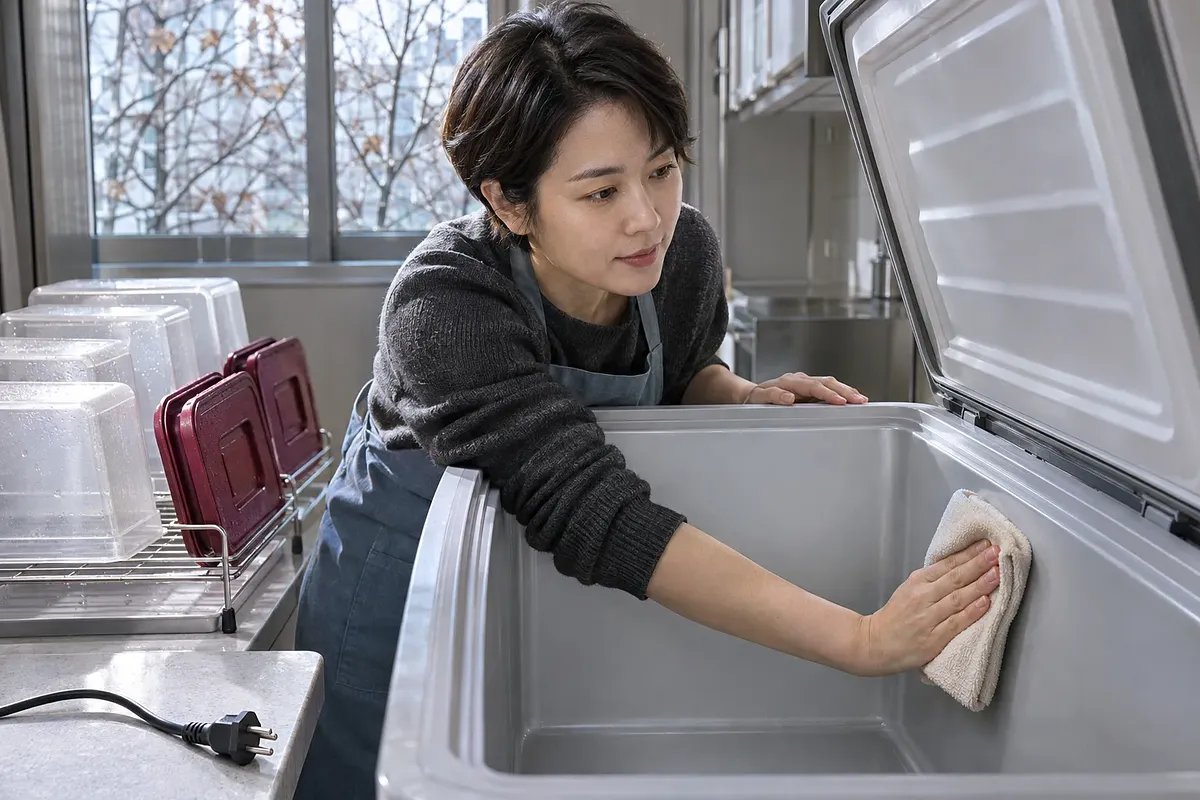
Steps for wiping the interior clean
Clean the interior after moving the food and disconnecting the power.
· Make room in a refrigerated space for the stored food.
· With dry hands, grasp the plug itself and unplug it.
· Remove spilled brine and food residue with a soft cloth.
· Wipe the walls and accessories using a method permitted in the manual.
· Finish by removing all detergent residue and moisture.
Samsung Electronics Service advises against spraying water directly onto the unit. Do not use abrasive scrubbers or brushes on the main unit’s surfaces. Do not force off fixed covers or parts that are difficult to remove.
Cleaning kimchi containers and controlling odors
The basic method for standard plastic containers is to wash them with a neutral detergent and a soft sponge. The inside of the lid and the sealing grooves also need cleaning. Remove gaskets only if the container’s manual permits it.
· Empty the contents and any remaining brine.
· Wash the inside and outside of the container with a soft sponge.
· Remove residue from the lid and sealing grooves.
· Rinse thoroughly so that no detergent remains.
· Dry according to the instructions for the container, then reassemble the parts.
Samsung Electronics Service also describes methods using baking soda or vinegar diluted in water. Its guidance dated October 26, 2026 gives a soaking time of about one day. This method is presented for controlling odors in kimchi containers. It does not instruct users to apply the same diluted solution to the refrigerator’s interior walls.
The guidance does not specify an exact dilution ratio. An arbitrary mixing ratio therefore cannot be set as a universal standard. Check both how to keep food fresh and the container’s manual to determine where the method applies.
Comparing drying methods for standard and Odor Care containers
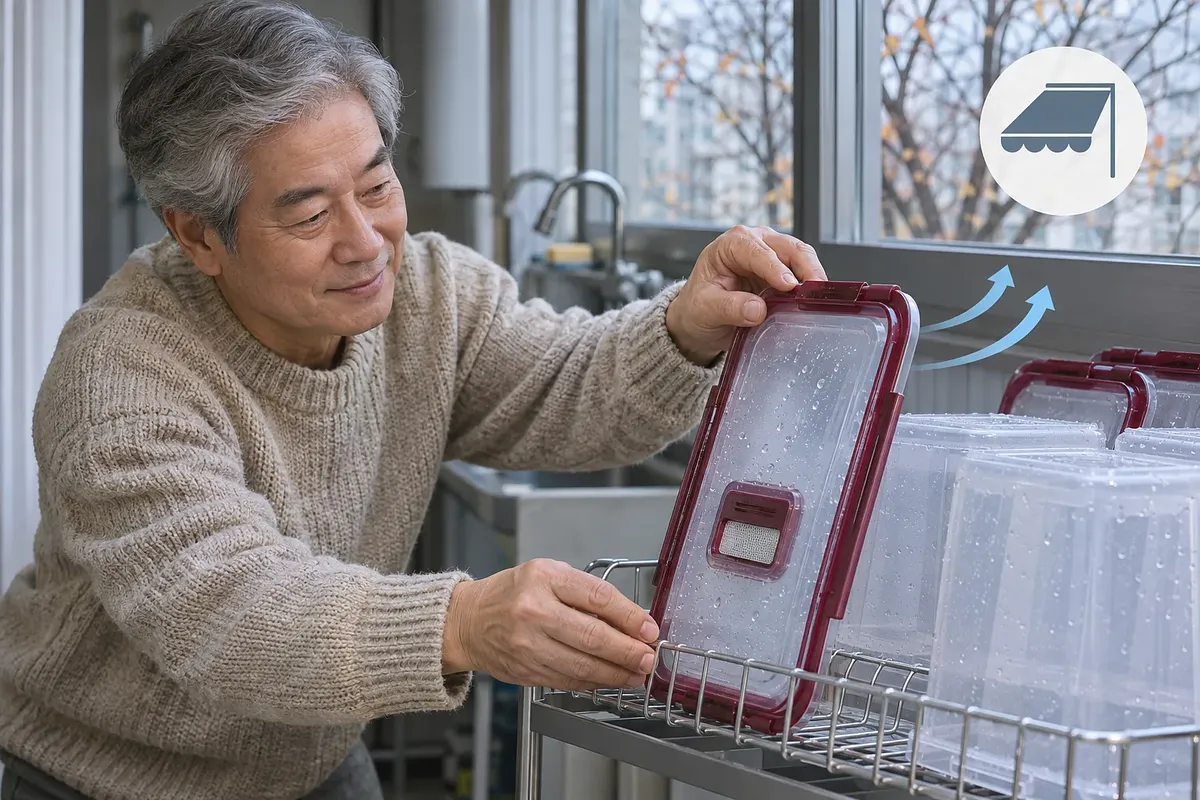
Do not apply the drying method for standard containers to containers with filters without checking their instructions. Samsung Electronics Service’s guidance for standard containers includes drying in sunlight. Its guidance for Odor Care kimchi containers, however, says to avoid direct sunlight.
Item | Standard container care guidance | Instructions specifically for Odor Care kimchi containers
Washing | Soft sponge and neutral detergent | Hand-washing the container and lid is recommended
Sunlight | Prolonged exposure may cause deformation or discoloration | Avoid direct sunlight and store in a cool place
If the filter gets wet | Not applicable to containers without filters | Dry in the shade before use
If the filter is torn or dirty | Not applicable to containers without filters | Replace with a new filter
Samsung Electronics Service’s “Cleaning and Precautions for Odor Care Kimchi Containers” gives the following warning.
When the kimchi container is not in use, do not store it at high temperatures for extended periods.
If this container becomes deformed from high-temperature washing, its odor-reducing function may become less effective. Do not use a dirty filter; replace it. Follow the instructions specifically for Odor Care kimchi containers for detailed conditions.
Choosing how to remove kimchi refrigerator odors based on their source
Odor control depends on where the smell comes from. Lingering odors in a container and brine spilled inside the main unit require different care. Odors at the back of the refrigerator also cannot be resolved by cleaning the interior alone.
Where the odor is noticed | What to check first | Scope of care
When opening a container lid | Sealing grooves, gasket, and container interior | Cleaning and drying according to the container’s instructions
Throughout the storage compartment | Stored food, spilled brine, and door gasket | Removing the source of contamination and wiping the interior
A container with a filter | Dirt or tears in the filter | Replacement according to the specific instructions
Back of the appliance | Dust and debris around the cover | Cleaning accessible exterior areas
LG Electronics advises unplugging the power cord before cleaning the back. Dust on the outside of the cover can be removed with a vacuum cleaner. Do not remove the machinery compartment cover yourself. Doing so risks damaging the internal refrigerant pipes and causing a safety incident.
Cleaning that requires disassembly should be assessed by a professional service technician. This warning is stated in LG Electronics’ guide to odors coming from behind the refrigerator.
Frost removal and inspection guidelines for kimchi refrigerators
Frost can form during normal use in direct-cooling storage compartments. It forms when moisture in the air entering through an open door touches the cold walls. Remove thick frost by following the procedure for the specific model.
LG Electronics’ guidance for top-opening models describes natural defrosting. Samsung Electronics Service’s guidance for upright models also includes natural defrosting. However, the buttons used to turn off the power and the controls for individual compartments vary by product.
· Move food to a suitable refrigerated storage space.
· Turn off the relevant compartment or the appliance according to the manual.
· Open the door and allow the frost to melt naturally.
· Collect the meltwater and wipe the interior completely dry.
· Restart the appliance and add food once it has cooled sufficiently.
Do not chip or scrape frost with a knife or awl. LG Electronics warns that damage to the cooling plate can cause refrigerant gas to leak. Even plastic tools should be used only in ways permitted for the model. The relevant warning is available in the guide to frozen food and frost management.
If thick frost repeatedly forms, check whether the door closes properly. Also check the gasket for debris or damage. If sealing problems or cooling issues persist, an inspection by the manufacturer is needed.
The difference between finishing cleaning and being ready to add food
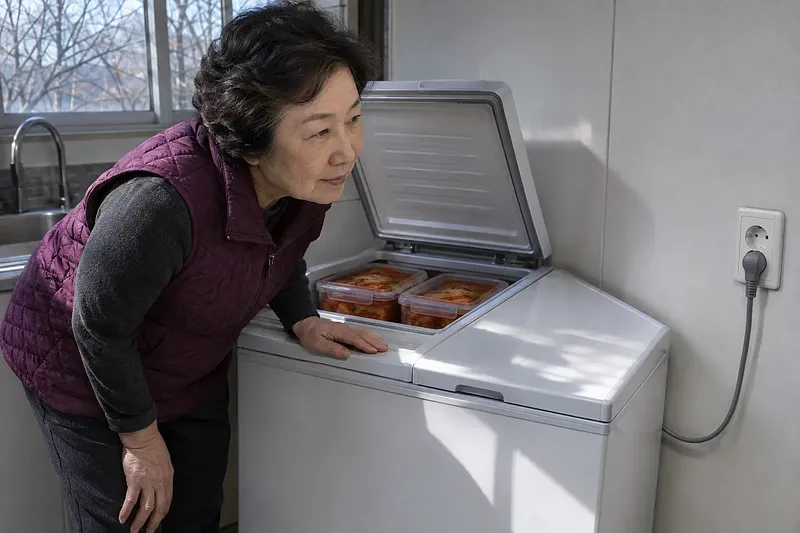
Removing dirt alone does not mean the refrigerator is ready for food. First check that moisture has been removed and the parts are properly installed. After turning on the power, check the actual cooling conditions.
Item to check | Required condition
Interior, drawers, and gasket grooves | No detergent residue or moisture remains
Parts that were removed | Properly installed in their original positions
Door and gasket | Seal tightly without catching on parts or containers
Cord and plug | No damage or abnormal heat
Display | The compartment to be used and its storage mode are set correctly
Interior cooling | The conditions specified in the manual for adding food have been reached
Samsung Electronics Service advises adding food after the interior temperature has dropped sufficiently. There is no basis for converting this into a single waiting time for all products. Check the model’s manual for the time needed and how to confirm readiness.
Common mistakes with storage settings
The coldest setting is not suitable for every type of kimchi. The appropriate setting depends on the kimchi type and salt content. The fermentation function also serves a different purpose from the long-term storage function.
Common assumption | Correct guideline
Set all kimchi intended for long-term storage to high | Low-salt kimchi can freeze, so check the setting for each type
Use fermentation mode for all freshly made kimchi | Choose based on when you plan to eat it and how ripe you want it
A kimchi container can be filled to the top as long as the lid closes | Follow the fill line marked on the container
Modes with the same name have the same temperature on every model | Check the set temperature for each model
LG Electronics gives water kimchi and radish kimchi as examples for the low setting. It recommends medium for napa cabbage kimchi and mustard leaf kimchi, and high for salty, aged kimchi. Actual temperatures may vary by model. These examples should be understood within the scope of the temperature setting guide by kimchi type.
Frequently asked questions
How many days before making winter kimchi should the refrigerator be cleaned?
There is no single timing rule that applies to every household. First secure space to move the food already in storage. Also allow enough time for the containers to dry and the main unit to cool.
Can neutral detergent be used anywhere on the main unit?
It cannot be used in the same way on every part. Samsung Electronics Service recommends it for the interior and accessories of upright models. For other models, follow the permitted uses in their manuals.
Can Odor Care containers also be dried in sunlight?
These containers must be kept out of direct sunlight. Their specific instructions say to store them in a cool place. If the filter gets wet, dry it in the shade before use.
Is frost normal in an upright model?
Some frost can form in direct-cooling storage compartments. Samsung Electronics Service cites the middle and lower compartments of some upright models as examples. If thick frost repeatedly forms, check the door and gasket.
What should I do if black stains remain on the door gasket?
Wipe gently with a detergent permitted in the manual. If stains or unpleasant odors recur even after cleaning, you can contact the manufacturer. If the gasket is torn or does not seal properly, check whether it can be replaced.
Can I add fresh kimchi immediately after turning on the power?
Add it only after confirming that the interior has cooled sufficiently. The display lighting up alone does not determine when food can be added. Follow the model’s manual for instructions on returning it to use.
 Injoys