Skip to content
Injoys
Knowledge Base

There Is No Average Employee: Personalized Leadership That Preserves Strengths

An average is a statistic that summarizes a group, but it does not directly explain an individual's abilities or fit. This article examines the precise meaning of the U.S. Air Force cockpit study and explains how to adapt individual strengths and work environments while maintaining fair standards.

Listen or read this article

15:52

Listen, or read the text only.

There Is No Average Employee: Personalized Leadership That Preserves Strengths

Kokoro 82M AI-generated voice 16 min read

0:00 15:52

Advertisement

Download audio

File name
no-average-employee-customized-leadership-en.mp3
Format
MP3 (audio/mpeg)
Duration
15:52
File size
10.9 MB
Engine
Kokoro 82M

This audio was generated by AI.

You may download and use it freely for personal use.

There Is No Average Employee: Personalized Leadership That Preserves Strengths

12 min read

There Is No Average Employee: Personalized Leadership That Preserves Strengths
An average is a statistic that summarizes a group, but it does not directly explain an individual's abilities or fit. This article examines the precise meaning of the U.S. Air Force cockpit study and explains how to adapt individual strengths and work environments while maintaining fair standards.
Group averages are useful for allocating resources and understanding current conditions, but using them as a standard model representing actual individuals can lead to significant errors.
Gilbert Daniels's research demonstrated the limitations of multidimensional averages, showing that almost no one fell within the average range across multiple body measurements at the same time.
Personalized leadership does not mean applying different performance standards to each person; it means adapting work methods and feedback environments so people can reach the same goals.
Do not generalize one low employee score to their overall capabilities; evaluate the combination of strengths, tasks, working relationships, and environment.
Leaders should not guess individual preferences but should validate adaptations through observable performance data and regular conversations.
Averages summarize a complex group in a single number. However, treating that number as a standard model of a real person can lead to misjudgments about team members’ strengths and job fit. Leaders do not need to eliminate averages, but to use them only as group statistics and draw conclusions about individuals from more multidimensional evidence.
Why the Term “Average Employee” Is Dangerous
Different concepts are mixed together in what we commonly call an average.
· Arithmetic mean: The sum of all values divided by the number of observations. · Median: The middle value when values are placed in order. · Percentile range: The range of values within a particular section of the overall distribution. · Typical person: An imagined individual whose various traits are assumed to be at ordinary levels.
The first three are statistical concepts, but the last is an interpretation or assumption. Just because a group’s average performance score is 70 does not mean that most employees score around 70 in every competency. A person with an analytical ability score of 90 and a presentation skill score of 50 may appear similar in an average-based table to someone with the opposite traits.
Averages are therefore useful for questions such as:
· Has the team’s overall processing time improved since last quarter? · Is there a difference in group performance before and after training? · Is workload or compensation concentrated in a particular group?
By contrast, averages alone are not sufficient for individual judgments such as:
· What work should be assigned to this employee? · Is low performance caused by competency, role, resources, or collaboration? · What type of feedback helps change behavior? · What strengths are not being revealed in the employee’s current role?
What the U.S. Air Force Cockpit Study Actually Showed
In the early 1950s, Gilbert S. Daniels, who conducted anthropometric work for the U.S. Air Force, analyzed 4,063 aircrew members. For each of 10 body measurements, including height, chest circumference, and sleeve length, he defined the central 30% range and then examined how many measurements each person fell within simultaneously.
The results showed that no one fell within the average range for all 10 measurements. Even when only three measurements were applied, less than 3.5% fell within all the ranges simultaneously. This was because a person whose height was close to average might not have average arm or leg lengths.
The average discussed in this study was not a single arithmetic mean, but the central 30% range for each measurement. The key point is that even with a fairly broad range, the number of people who simultaneously met multiple conditions declined sharply.
Verified Facts and Claims Requiring Caution
Claim | Assessment | Explanation Daniels analyzed data from 4,063 people | Evidence-based fact | This is a key figure confirmed in the relevant technical report. No one fell within the average range for all 10 measurements | Evidence-based fact | This shows that human traits are uneven across multiple dimensions. Cockpits should account for body-size ranges and adjustability rather than a single average point | Design principle derived from the study | It influenced the move toward adjustable designs for seats, pedals, safety equipment, and other components. This study alone reduced accidents by a specific amount | Causality requires verification | Because accidents involve many factors, including training, maintenance, aircraft performance, and procedures, the size of any reduction cannot be attributed to the study alone. Modern adjustable car seats were first invented as a result of this study | Claim lacking evidence | Attributing the origin of adjustable seats to this study alone requires separate historical verification.
The lesson of this case is not that “averages are always wrong.” It is that designs that assume one fixed average model and impose the same environment on everyone are dangerous.
Human Competency Is a Combination, Not a Single Score
An individual’s ability to work cannot be arranged along a single axis like height. Analytical ability, speed, accuracy, persuasiveness, customer understanding, creativity, and collaboration skills are different dimensions, and their value also varies by work situation.
For example, suppose an employee handles customer inquiries more slowly than the team average. Based on speed alone, the employee might be classified as a low performer, but the judgment may change when the following data are considered together:
· The percentage of issues resolved in a single interaction · The percentage of customers who contact the company again about the same issue · Cases in which the employee prevented a dissatisfied customer from leaving · The extent to which documenting complex issues saved colleagues’ time · Rates of policy violations or rework
This employee may be better suited to complex problem-solving or customer retention work than to simple inquiries. Conversely, the employee should not be allowed to continually fall short of essential processing standards merely because they are courteous. What matters more than the distance from the average is the results a person produces under particular conditions.
Three Average-Related Traps Leaders Often Fall Into
1. The Error of Explaining Individuals Through Group Labels
Statements such as “new employees lack autonomy” or “young employees prefer public communication” erase differences within groups. Age or position cannot fully explain an individual’s motivation and way of working.
Leaders should treat group-level tendencies only as hypotheses. It is safer to decide actual work assignments after reviewing the individual’s experience, current competencies, preferences, and performance data.
2. The Error of Turning What Worked for You into the Standard
If a leader applies public praise to every team member simply because it helped the leader grow, it may feel like pressure rather than recognition to some people. Detailed instructions may provide stability to some employees, but they may feel like unnecessary control to experienced employees.
The following aspects of feedback can be adjusted:
· Public or private delivery · Verbal conversation or written communication · Detailed procedures or goal-oriented delegation · Short, frequent check-ins or reviews at longer intervals · Immediate feedback or a conversation after time for reflection
3. The Error of Turning One Weakness into an Overall Rating of the Person
Being poor at presentations provides information about presentation skills; it is not evidence that analytical ability or leadership potential is also low. Leaders should guard against the halo effect or horn effect, in which one prominent trait influences the overall evaluation.
Weaknesses should be divided into three categories:
· Weaknesses that must be improved: Problems related to safety, ethics, laws and regulations, or core job requirements · Weaknesses that can be compensated for: Problems that can be managed through tools, colleagues, procedures, or division of roles · Weaknesses of low importance in the current role: Problems for which leveraging strengths offers more value than the cost of improvement
Personalized Leadership Is Not Favoritism
Personalized management does not mean eliminating common standards or unconditionally protecting low-performing employees. To maintain fairness, leaders must separate standards for results from the path to achieving those results.
Elements That Must Remain Fixed | Elements That Can Be Adjusted Safety, ethics, and legal standards | Method of delivering feedback Quality levels essential to the role | Work sequence and time allocation Commitments to customers and colleagues | Public praise or private recognition Evaluation periods and evidence requirements | Degree of autonomy and frequency of check-ins Decision-making principles that prevent discrimination | Work configurations that leverage strengths
The same deadlines and quality standards can be applied while one employee receives frequent interim check-ins and another is given results-oriented delegation. If the difference is based on business needs and mutual agreement, and the evaluation standards are transparent, it can be distinguished from arbitrary favoritism.
Managing Teams by Looking at Distributions and Combinations Instead of Averages
To look beyond averages, leaders need recordable data rather than intuition.
1. Define the Role’s Essential Results First
Instead of using personality-based expressions such as “must be proactive,” specify observable results such as deadlines, quality, customer impact, and collaboration responsibilities. Standards that must be met should also be distinguished from competencies that are merely desirable.
2. Create an Individual Strengths Map
A strength is not simply work someone enjoys, but the ability to repeatedly produce valuable results. Examine the following evidence together:
· Recent successful assignments and specific contributions · Areas in which colleagues frequently ask for help · Work performed reliably with little supervision · Situations in which the employee shows high concentration and rapid learning · Impact on customers, quality, revenue, or time savings
3. Record the Conditions Under Which Performance Changes
Identify common features of situations in which an employee performed well or struggled. Examine how task complexity, distractions, collaborators, decision-making authority, and deadline pressure affected performance. This is a process of finding the relationship between performance and the environment rather than classifying people into fixed types.
4. Experiment With Small Adjustments
Before completely redesigning the work, try changing one element, such as the frequency of check-ins, meeting participation, focused work time, document formats, or division of roles. Setting the trial period and success criteria in advance helps distinguish preferences from actual effectiveness.
5. Examine How Individual Optimization Affects the Team as a Whole
An approach that is convenient for one person may increase someone else’s workload or block important information. Leaders should evaluate not only individual performance but also handoffs, collaboration costs, workload concentration, and team resilience.
Language and Evaluation Forms Can Limit Potential
Expressions such as “below average,” “passive,” or “lacks leadership” may sound like observations, but they are often interpretations. Such labels can also affect future work assignments and training opportunities.
Evaluation language should describe behavior, context, and impact rather than a person’s identity.
Expression to Avoid | More Precise Expression Has poor communication skills | Failed to share key risks in the last three meetings, delaying schedule adjustments Lacks initiative | Works independently on assignments with defined goals but frequently seeks clarification before beginning ambiguous assignments Is a below-average employee | Processing speed is below the team median, but the rework rate and repeat customer inquiry rate must also be reviewed Lacks leadership | Coordinated colleagues well in small technical reviews but lacks experience giving formal presentations
Making evaluation statements more specific in this way makes it possible to identify both the behaviors that need improvement and the strengths that can be leveraged.
Limits to Observe When Applying Personalization
Personalized leadership can also cause problems if applied incorrectly.
· Do not lock people into personality types. People’s preferences and competencies can change with experience and circumstances. · Not every preference can be accommodated. Customer requirements, security, safety, and collaboration standards may take priority over individual preferences. · Do not abandon averages completely. Group statistics are necessary to identify workload concentration, pay gaps, and evaluation bias. · Do not rely solely on informal impressions. Highly visible employees may receive higher evaluations than their actual contributions warrant. · You must be able to explain the reason for personalization. Adjustments should be based on business needs, verifiable effects, and reasonable support requirements.
A good team is not an organization that makes everyone the same. Nor is it an organization that applies separate rules to every person. It is closer to an organization that keeps shared responsibilities clear while adjusting the environment so each person can perform.
Questions for Leaders to Review
If any of the following questions are difficult to answer, you may be treating team members as average people.
· Can you describe the work in which each team member repeatedly produces good results? · Have you distinguished competency problems from environmental problems when examining low performance? · Have you used observable behaviors in evaluations rather than expressions that make assumptions about personality? · Have you distinguished core standards from adjustable ways of working? · Have you directly confirmed individual preferences regarding public praise, autonomy, and the frequency of check-ins? · Have you reviewed whether an adjustment for one person places an unfair burden on colleagues? · Have you examined distributions, exceptional cases, and the quality of work as well as averages?
An average is a map that shows a team from a distance. But assigning actual work and designing growth paths require a closer look at each person’s strengths, tasks, relationships, and environment.
0:00 0:00
1 / 70

Advertisement

Download text

File name
no-average-employee-customized-leadership-en.txt
Format
TXT (text/plain)
Paragraphs
70

Downloads exactly what you see as a text file.

Please cite the source when quoting.

Large text

Makes the text larger and the colors clearer. Turn it on if the text feels too small.

An instructor guides a woman through hands-on flight training in the cockpit.

Key points

  • Group averages are useful for allocating resources and understanding current conditions, but using them as a standard model representing actual individuals can lead to significant errors.
  • Gilbert Daniels's research demonstrated the limitations of multidimensional averages, showing that almost no one fell within the average range across multiple body measurements at the same time.
  • Personalized leadership does not mean applying different performance standards to each person; it means adapting work methods and feedback environments so people can reach the same goals.
  • Do not generalize one low employee score to their overall capabilities; evaluate the combination of strengths, tasks, working relationships, and environment.
  • Leaders should not guess individual preferences but should validate adaptations through observable performance data and regular conversations.

Averages summarize a complex group in a single number. However, treating that number as a standard model of a real person can lead to misjudgments about team members’ strengths and job fit. Leaders do not need to eliminate averages, but to use them only as group statistics and draw conclusions about individuals from more multidimensional evidence.

Why the Term “Average Employee” Is Dangerous

Different concepts are mixed together in what we commonly call an average.

  • Arithmetic mean: The sum of all values divided by the number of observations.
  • Median: The middle value when values are placed in order.
  • Percentile range: The range of values within a particular section of the overall distribution.
  • Typical person: An imagined individual whose various traits are assumed to be at ordinary levels.

The first three are statistical concepts, but the last is an interpretation or assumption. Just because a group’s average performance score is 70 does not mean that most employees score around 70 in every competency. A person with an analytical ability score of 90 and a presentation skill score of 50 may appear similar in an average-based table to someone with the opposite traits.

Averages are therefore useful for questions such as:

  • Has the team’s overall processing time improved since last quarter?
  • Is there a difference in group performance before and after training?
  • Is workload or compensation concentrated in a particular group?

By contrast, averages alone are not sufficient for individual judgments such as:

  • What work should be assigned to this employee?
  • Is low performance caused by competency, role, resources, or collaboration?
  • What type of feedback helps change behavior?
  • What strengths are not being revealed in the employee’s current role?

What the U.S. Air Force Cockpit Study Actually Showed

In the early 1950s, Gilbert S. Daniels, who conducted anthropometric work for the U.S. Air Force, analyzed 4,063 aircrew members. For each of 10 body measurements, including height, chest circumference, and sleeve length, he defined the central 30% range and then examined how many measurements each person fell within simultaneously.

The results showed that no one fell within the average range for all 10 measurements. Even when only three measurements were applied, less than 3.5% fell within all the ranges simultaneously. This was because a person whose height was close to average might not have average arm or leg lengths.

The average discussed in this study was not a single arithmetic mean, but the central 30% range for each measurement. The key point is that even with a fairly broad range, the number of people who simultaneously met multiple conditions declined sharply.

Verified Facts and Claims Requiring Caution

Claim Assessment Explanation
Daniels analyzed data from 4,063 people Evidence-based fact This is a key figure confirmed in the relevant technical report.
No one fell within the average range for all 10 measurements Evidence-based fact This shows that human traits are uneven across multiple dimensions.
Cockpits should account for body-size ranges and adjustability rather than a single average point Design principle derived from the study It influenced the move toward adjustable designs for seats, pedals, safety equipment, and other components.
This study alone reduced accidents by a specific amount Causality requires verification Because accidents involve many factors, including training, maintenance, aircraft performance, and procedures, the size of any reduction cannot be attributed to the study alone.
Modern adjustable car seats were first invented as a result of this study Claim lacking evidence Attributing the origin of adjustable seats to this study alone requires separate historical verification.

The lesson of this case is not that “averages are always wrong.” It is that designs that assume one fixed average model and impose the same environment on everyone are dangerous.

Human Competency Is a Combination, Not a Single Score

An individual’s ability to work cannot be arranged along a single axis like height. Analytical ability, speed, accuracy, persuasiveness, customer understanding, creativity, and collaboration skills are different dimensions, and their value also varies by work situation.

For example, suppose an employee handles customer inquiries more slowly than the team average. Based on speed alone, the employee might be classified as a low performer, but the judgment may change when the following data are considered together:

  • The percentage of issues resolved in a single interaction
  • The percentage of customers who contact the company again about the same issue
  • Cases in which the employee prevented a dissatisfied customer from leaving
  • The extent to which documenting complex issues saved colleagues’ time
  • Rates of policy violations or rework

This employee may be better suited to complex problem-solving or customer retention work than to simple inquiries. Conversely, the employee should not be allowed to continually fall short of essential processing standards merely because they are courteous. What matters more than the distance from the average is the results a person produces under particular conditions.

1. The Error of Explaining Individuals Through Group Labels

Statements such as “new employees lack autonomy” or “young employees prefer public communication” erase differences within groups. Age or position cannot fully explain an individual’s motivation and way of working.

Leaders should treat group-level tendencies only as hypotheses. It is safer to decide actual work assignments after reviewing the individual’s experience, current competencies, preferences, and performance data.

2. The Error of Turning What Worked for You into the Standard

If a leader applies public praise to every team member simply because it helped the leader grow, it may feel like pressure rather than recognition to some people. Detailed instructions may provide stability to some employees, but they may feel like unnecessary control to experienced employees.

The following aspects of feedback can be adjusted:

  • Public or private delivery
  • Verbal conversation or written communication
  • Detailed procedures or goal-oriented delegation
  • Short, frequent check-ins or reviews at longer intervals
  • Immediate feedback or a conversation after time for reflection

3. The Error of Turning One Weakness into an Overall Rating of the Person

Being poor at presentations provides information about presentation skills; it is not evidence that analytical ability or leadership potential is also low. Leaders should guard against the halo effect or horn effect, in which one prominent trait influences the overall evaluation.

Weaknesses should be divided into three categories:

  1. Weaknesses that must be improved: Problems related to safety, ethics, laws and regulations, or core job requirements
  2. Weaknesses that can be compensated for: Problems that can be managed through tools, colleagues, procedures, or division of roles
  3. Weaknesses of low importance in the current role: Problems for which leveraging strengths offers more value than the cost of improvement

Personalized Leadership Is Not Favoritism

Personalized management does not mean eliminating common standards or unconditionally protecting low-performing employees. To maintain fairness, leaders must separate standards for results from the path to achieving those results.

Elements That Must Remain Fixed Elements That Can Be Adjusted
Safety, ethics, and legal standards Method of delivering feedback
Quality levels essential to the role Work sequence and time allocation
Commitments to customers and colleagues Public praise or private recognition
Evaluation periods and evidence requirements Degree of autonomy and frequency of check-ins
Decision-making principles that prevent discrimination Work configurations that leverage strengths

The same deadlines and quality standards can be applied while one employee receives frequent interim check-ins and another is given results-oriented delegation. If the difference is based on business needs and mutual agreement, and the evaluation standards are transparent, it can be distinguished from arbitrary favoritism.

Managing Teams by Looking at Distributions and Combinations Instead of Averages

To look beyond averages, leaders need recordable data rather than intuition.

1. Define the Role’s Essential Results First

Instead of using personality-based expressions such as “must be proactive,” specify observable results such as deadlines, quality, customer impact, and collaboration responsibilities. Standards that must be met should also be distinguished from competencies that are merely desirable.

2. Create an Individual Strengths Map

A strength is not simply work someone enjoys, but the ability to repeatedly produce valuable results. Examine the following evidence together:

  • Recent successful assignments and specific contributions
  • Areas in which colleagues frequently ask for help
  • Work performed reliably with little supervision
  • Situations in which the employee shows high concentration and rapid learning
  • Impact on customers, quality, revenue, or time savings

3. Record the Conditions Under Which Performance Changes

Identify common features of situations in which an employee performed well or struggled. Examine how task complexity, distractions, collaborators, decision-making authority, and deadline pressure affected performance. This is a process of finding the relationship between performance and the environment rather than classifying people into fixed types.

4. Experiment With Small Adjustments

Before completely redesigning the work, try changing one element, such as the frequency of check-ins, meeting participation, focused work time, document formats, or division of roles. Setting the trial period and success criteria in advance helps distinguish preferences from actual effectiveness.

5. Examine How Individual Optimization Affects the Team as a Whole

An approach that is convenient for one person may increase someone else’s workload or block important information. Leaders should evaluate not only individual performance but also handoffs, collaboration costs, workload concentration, and team resilience.

Language and Evaluation Forms Can Limit Potential

Expressions such as “below average,” “passive,” or “lacks leadership” may sound like observations, but they are often interpretations. Such labels can also affect future work assignments and training opportunities.

Evaluation language should describe behavior, context, and impact rather than a person’s identity.

Expression to Avoid More Precise Expression
Has poor communication skills Failed to share key risks in the last three meetings, delaying schedule adjustments
Lacks initiative Works independently on assignments with defined goals but frequently seeks clarification before beginning ambiguous assignments
Is a below-average employee Processing speed is below the team median, but the rework rate and repeat customer inquiry rate must also be reviewed
Lacks leadership Coordinated colleagues well in small technical reviews but lacks experience giving formal presentations

Making evaluation statements more specific in this way makes it possible to identify both the behaviors that need improvement and the strengths that can be leveraged.

Limits to Observe When Applying Personalization

Personalized leadership can also cause problems if applied incorrectly.

  • Do not lock people into personality types. People’s preferences and competencies can change with experience and circumstances.
  • Not every preference can be accommodated. Customer requirements, security, safety, and collaboration standards may take priority over individual preferences.
  • Do not abandon averages completely. Group statistics are necessary to identify workload concentration, pay gaps, and evaluation bias.
  • Do not rely solely on informal impressions. Highly visible employees may receive higher evaluations than their actual contributions warrant.
  • You must be able to explain the reason for personalization. Adjustments should be based on business needs, verifiable effects, and reasonable support requirements.

A good team is not an organization that makes everyone the same. Nor is it an organization that applies separate rules to every person. It is closer to an organization that keeps shared responsibilities clear while adjusting the environment so each person can perform.

Questions for Leaders to Review

If any of the following questions are difficult to answer, you may be treating team members as average people.

  • Can you describe the work in which each team member repeatedly produces good results?
  • Have you distinguished competency problems from environmental problems when examining low performance?
  • Have you used observable behaviors in evaluations rather than expressions that make assumptions about personality?
  • Have you distinguished core standards from adjustable ways of working?
  • Have you directly confirmed individual preferences regarding public praise, autonomy, and the frequency of check-ins?
  • Have you reviewed whether an adjustment for one person places an unfair burden on colleagues?
  • Have you examined distributions, exceptional cases, and the quality of work as well as averages?

An average is a map that shows a team from a distance. But assigning actual work and designing growth paths require a closer look at each person’s strengths, tasks, relationships, and environment.

Sign-in required

Sign in with your Google account to like, comment, and save highlights.

Images

An instructor guides a woman through hands-on flight training in the cockpit.
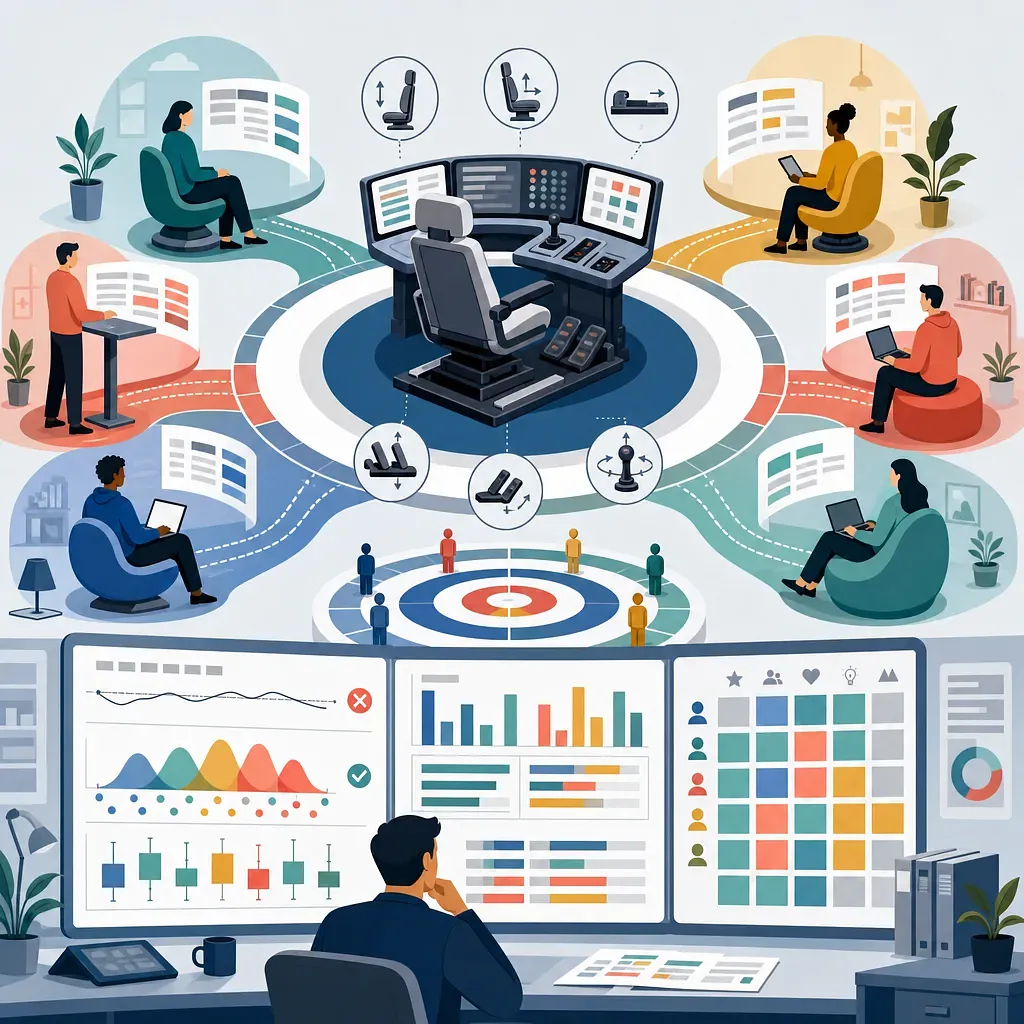
A manager uses individual data and work settings to tailor leadership to each employee’s strengths.

FAQ

Does this mean that averages are not useful?

No. Averages are useful for summarizing a team's overall changes, workload, costs, processing time, and so on. However, if a group average is regarded as a standard model for actual individuals, or if an individual's placement and growth potential are judged by a single average, important differences may be overlooked.

Was there really not a single average pilot in the U.S. Air Force study?

When Gilbert S. Daniels applied the middle 30% range to each of the 10 body measurements he selected, none of the 4,063 people met all the conditions simultaneously. This does not mean that no one was close to average in any measurement, but rather that no one was average across multiple measurements at the same time.

Does personalized leadership mean applying different evaluation criteria to each employee?

No. Core standards such as safety, ethics, quality, and deadlines should remain consistent. Personalized leadership is an approach that reasonably adjusts the method of feedback, frequency of check-ins, autonomy, role design, and so on in the process of reaching goals.

How can employees' strengths be identified objectively?

Rather than asking only about their preferences, data such as tasks in which they have repeatedly succeeded, requests from colleagues, customer impact, error rates, and learning speed should also be reviewed. It is practical to define a strength as the ability to consistently produce valuable results under specific conditions.

Should we not point out below-average performance?

Necessary performance feedback should be provided clearly. However, a low result on one metric should not be generalized to a person's overall value or potential. Instead, the specific behaviors that fall short of the standard, their impact, the causes, and the improvement plan should be explained separately.

Wouldn't management become complicated if every employee worked differently?

Applying personalization without limits can increase complexity. The management burden can be limited by standardizing shared outcome criteria and collaboration rules, while adjusting only a small number of elements that have proven effective.

What should we do if individualized adjustments seem unfair to other employees?

The work-related purpose of the adjustments and the shared evaluation criteria should be explained transparently. Even without disclosing personal information, employees should be informed about what types of support and work adjustments can be made available to anyone through a reasonable process.

Can personality type tests be used for personalized leadership?

They may be used in a limited way as a starting point for discussion, but test results should not be treated as a fixed identity or as the sole basis for work assignments. Actual behavior, performance data, changes depending on the situation, and the individual's own views should also be considered.

Sources

Also available as video and a short read

Videos and a short write-up made from this content. Watch instead of reading, or skim the gist first.

Short version

Loading…

Data formats

This content is available in several machine-friendly formats.

Data-only languages (machine translated, files only)

Indonesian JSON MD Portuguese JSON MD Chinese (Traditional) JSON MD Deutsch JSON MD

Verification

Reviewed by 신익희 · 편집장 · 2026-08-31

Figures in this article were checked against the source material during generation. 1 correction(s) applied. · 2026-08-31

This translation has been cross-checked by AI. · 2026-08-31

Reuse & AI usage

Search indexing and AI citation with attribution are welcome. See the license policy for details.

CC BY · License

Loading…

Loading…

Related content

From Injoys

Request the content you want and take 70% of what it earns

Just leave the subject. We handle production, review, translation and distribution.

See how revenue sharing works

Comments