Injoys
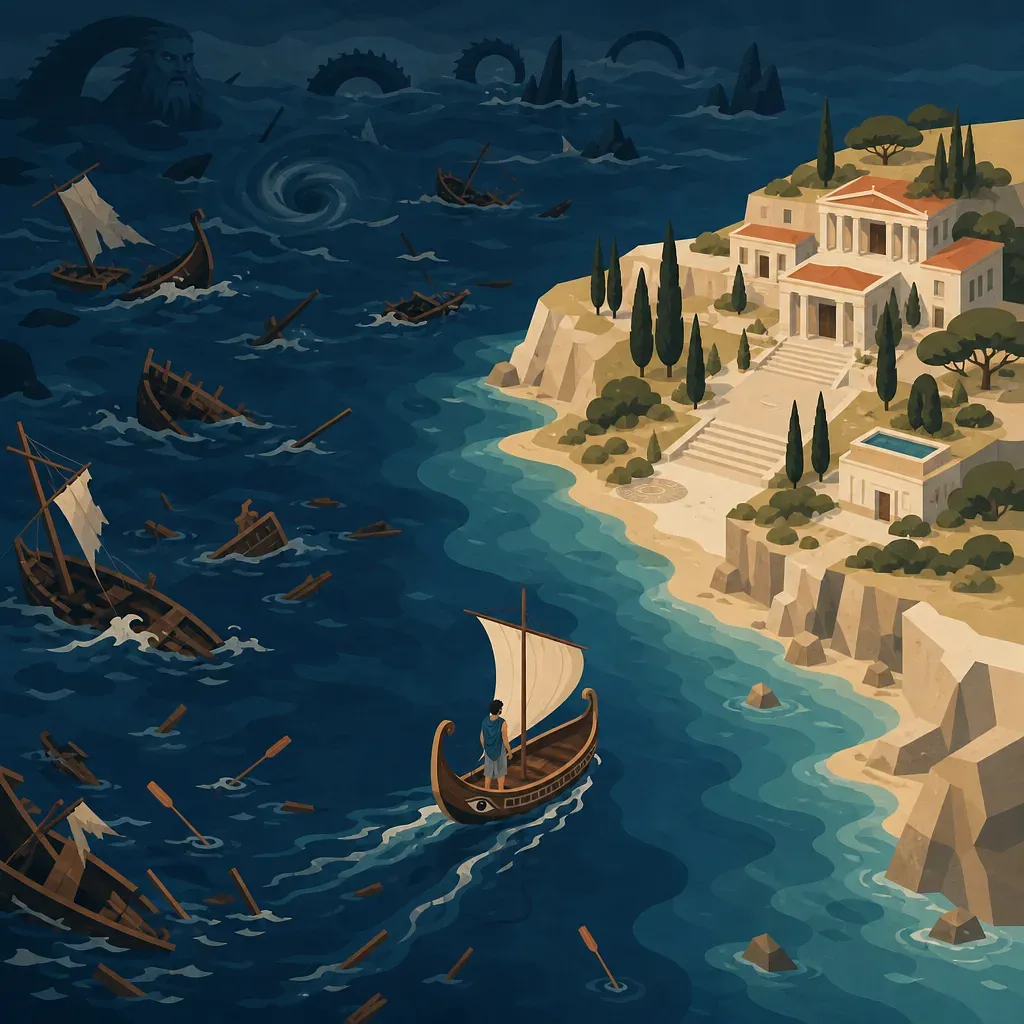
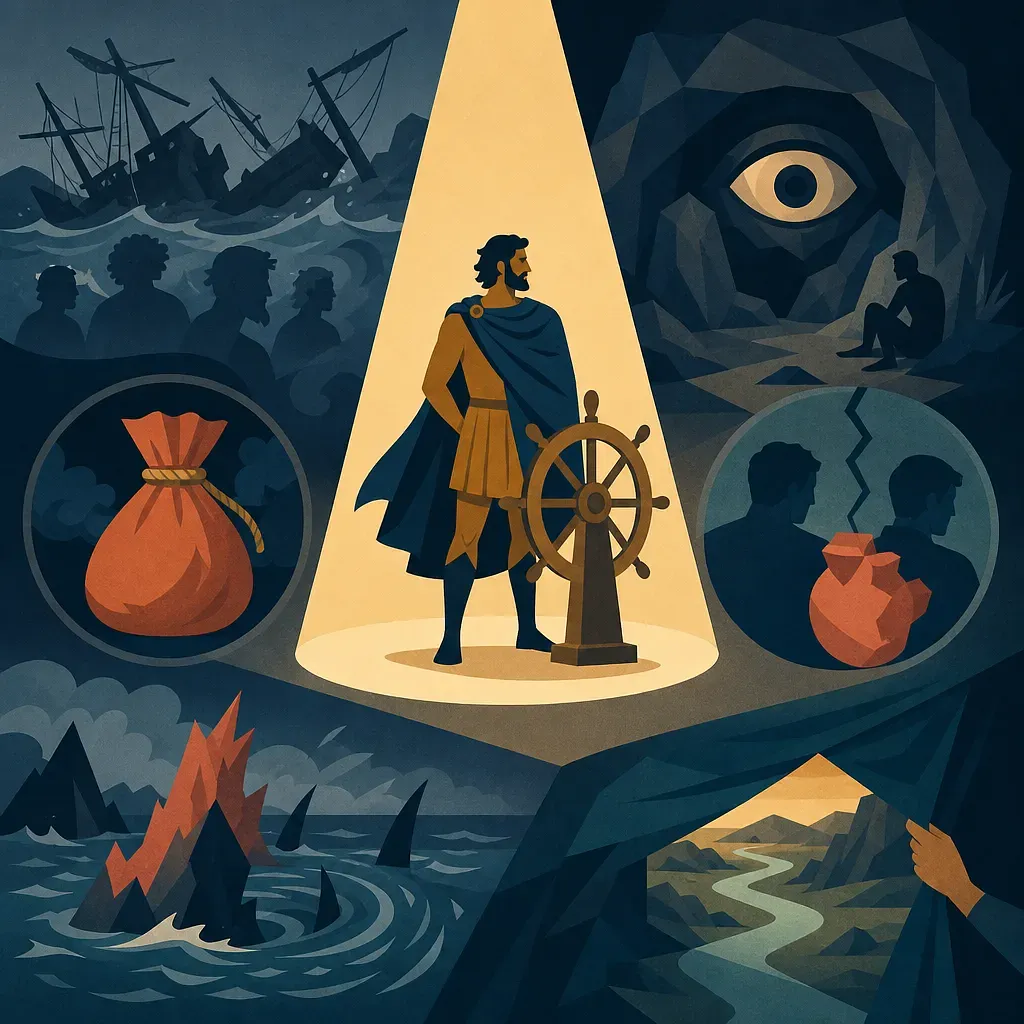
Christopher Nolan’s film has brought Homer’s 『The Odyssey』 back to the center of popular attention. But when the original voyage is converted into an organizational scorecard, the results are difficult to explain as merely a heroic tale. Odysseus departed Troy with 12 ships, lost all his companions, and returned to Ithaca alone with the help of other people’s ships.
This fact does not immediately establish him as the “worst leader.” Conversely, he cannot be called a successful leader merely because he endured uncertainty and ultimately reached his destination. 『The Odyssey』 is useful to today’s leaders not because it provides a model answer, but because it presents a complex case in which performance, responsibility, luck, authority, and trust collide.
The First Fact to Check: Did Every Member Really Die?
In 『The Odyssey』, all the companions who sailed with Odysseus die before returning home. The opening of the work also summarizes that although he tried to save his companions, he ultimately failed to do so. However, not every death resulted from a single decision or the same cause.
| Event | Major Losses and Outcomes | Leadership Issue |
|---|---|---|
| Battle with the Cicones | 6 men from each ship, 72 in total, are said to have died | His companions did not obey the order to withdraw immediately after the plunder |
| The Cyclops’ cave | Polyphemus devours 6 companions | Odysseus rejected his companions’ proposal to take only the spoils and leave |
| After escaping Polyphemus | Odysseus shouts out his name, provoking Poseidon’s wrath | His desire to boast after a successful escape created long-term danger |
| Aeolus’s bag of winds | His companions secretly open the bag, sending them adrift again just off Ithaca | It reveals not only disobedience but also distrust concerning rewards and information |
| Attack by the Laestrygonians | 11 ships are destroyed, with only Odysseus’s ship surviving | Differences in anchoring location and reconnaissance methods determined who survived |
| Circe’s island | Elpenor falls from a roof and dies | Discipline and safety management grew lax during the prolonged stay |
| Scylla and Charybdis | Scylla snatches and kills 6 sailors | It was a choice of the lesser evil to avoid total destruction, but information about the danger was not adequately shared |
| The cattle of Helios, the sun god | His companions slaughter and eat the forbidden cattle, and all die from Zeus’s thunderbolt | Hunger, violation of orders, failure of supplies, and supernatural punishment all played a role |
Therefore, the claim that “Odysseus killed every one of his subordinates” is overly simplistic. A more accurate statement is: “Every companion on the return voyage under his command died, and the outcome resulted from a combination of his companions’ choices, the leader’s decisions, and intervention by nature and the gods.”
Are an Individual’s Return and an Organization’s Success the Same?
To evaluate a leader’s performance, the unit of success must first be defined.
- Personal objective: Odysseus survived, returned to Ithaca, and reclaimed his throne and family.
- Mission objective: He failed to bring the fleet and his companions home.
- Organizational preservation: He lost all 12 ships and every companion.
- Time and resources: After the Trojan War ended, the return journey took another 10 years.
- Ethical outcome: Some companions died from unavoidable threats, but reckless exploration and ostentatious behavior contributed to some of the losses.
This distinction also applies to modern organizations. Even if a founder receives a large personal reward by selling a company, the project cannot be called a success for every stakeholder if employees and customers are left with severe harm. We must ask not only whether the objective was achieved, but whose objective it was and who bore the cost.
Assessments Favorable to Odysseus
Odysseus’s leadership has genuine strengths. Denying them would mean overlooking the complexity of crisis response depicted in the work.
He Made Decisions Even Under Uncertainty
As in the escape from the Cyclops’ cave, he devised a workable plan under conditions of limited time and incomplete information. The process of intoxicating and blinding the monster, then escaping by tying themselves beneath the sheep, is an example of problem-solving that combined observation, deception, and resourcefulness.
He Never Lost Sight of His Destination
Despite repeated temptation and frustration, Odysseus did not abandon his goal of returning to Ithaca. In a long-term project, persistence of purpose can give an organization the strength to endure short-term turmoil.
He Shared the Risks Himself
He was not someone who merely issued orders while remaining in a safe place. He personally participated in reconnaissance and combat and confronted Circe to save his companions. When those in charge share the risks, the legitimacy of their orders and the trust of their members can increase.
Not Every Failure Was Controllable
Storms, monsters, and the hostility of the gods lay beyond human prediction and control. In modern terms, they correspond to external shocks that leaders cannot eliminate, such as sudden market shifts, war, disasters, and regulatory changes. The mere fact that the outcome was bad does not automatically make the decision made at the time a bad one.
Assessments Unfavorable to Odysseus
It is also dangerous to read him only as a responsible hero. The work repeatedly depicts losses that could have been avoided or reduced.
Curiosity and Vanity Turned into Organizational Risk
In the Cyclops’ cave, Odysseus’s companions propose taking the food and livestock and leaving quickly. Odysseus stays because he expects to meet the owner and receive a gift. After escaping, he reveals his name and taunts Polyphemus, provoking Poseidon’s retaliation.
This can be read as a case in which an individual’s desire for honor imposed the cost of risk on the entire organization. A leader’s boldness and vanity can look similar until the results appear, so a process for reviewing opposing views is necessary.
He Monopolized Even Necessary Information
Odysseus is warned that Scylla will kill six men, but he does not tell the sailors about the specific danger. Even if this was intended to prevent them from dropping their oars in terror, the ethical problem remains that he withheld information from people who might be sacrificed.
There are cases in organizations where confidentiality is necessary. But the discomfort of disclosing information must be distinguished from an operational need to restrict it. Decisions that deprive members of the opportunity to understand and prepare for danger carry a greater obligation to explain.
Repeating Orders Could Not Replace Trust
In the episodes involving the bag of winds and the cattle of the sun god, his companions disobey orders. This could simply be viewed as a problem caused by incompetent and greedy subordinates. But it is also important that they were not told what was inside the bag and came to suspect that Odysseus was monopolizing the rewards.
Compliance with orders is not guaranteed by title alone. When information gaps are wide and doubts about fairness accumulate, members trust rumors more than the leader’s explanations. Psychological safety does not mean only a comfortable atmosphere. It also includes an environment in which people can raise questions, report risks, and verify the basis for decisions.